Forms and Conventions used
9 Key Stills – How do they conform to the Crime genre? Stills 1 - 2
The first frame (top left) depicts the font used for the film, which is ‘Birch Black 80’ from Adobe Premier Pro. I chose
to implement this font because the colour black reflects the dark tone of the film. I have conformed to the crime
genre because the style represents the serious mood of the film and I did not want a font with positive
connotations that would not suit the threatening nature of a film in the crime genre.
The second still demonstrates my use of camera technique. Firstly, I created a set up in which the gangster was in
focus and the light switch out of focus. I then changed the focus to reverse the set up. The two different shots, when
combined, are highly effective for directing the audience’s focus points. Upon the change for when the switch
becomes in focus, we know immediately that this is a significant objet which therefore heightens the curiosity as to
what the gangster is concealing, increasing the suspense.
9 Key Stills – How do they conform to the Crime genre? Stills 3 - 5
The third frame best demonstrates my use of set to convey the crime genre. I chose to
utilise a barn because this is a suitable place to hide a hostage since it is mostly unused. I
like the ambient lighting for when the main doors are left open and a stream of light
cascades into the room creating an air of mystery and signalling the hostage's initial
defeat. The derelict nature of the barn conforms to stereotypical crime films because it is
dull and mundane. Moreover, the barn represents the Hostage's bleak situation starkly to
the audience and it makes them aware that this location will not hold positive outcomes.
The gangster’s costume is a stereotypical black suit which audiences now expect,
reflecting upon Quentin Tarantino’s traditional dress code for his crime films.
My fourth still further represents how the ambient lighting effectively highlights the
different characters’ dominance in the scene. For example, the use of relatively low-key
lighting highlights the gangster’s primary rugged features, allowing the audience to
visualise his violent edge. Furthermore the use of the low-angle camera shot represents
how the gangster adopts overall authority and control over the hostage, making the
audience interpret him to be the stereotypical villain of the film.
The fifth frame depicts my further use of effective set-dressing. The dull, grimy and
mundane objects reinstate the isolation of the location and therefore reflects the
gangster’s hostile agenda towards the hostage. It also shows my use of different camera
techniques. I have further conformed to the crime genre by using the ‘super zoom’,
drawing inspiration from Quentin Tarantino’s crime film ‘Django Unchained’ (2012). This
creates a sense of urgency to reflect the shock of the henchman’s appearance to the
audience.
9 Key Stills – How do they conform to the Crime genre? Stills 6 - 8
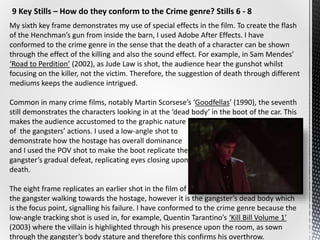
My sixth key frame demonstrates my use of special effects in the film. To create the flash
of the Henchman’s gun from inside the barn, I used Adobe After Effects. I have
conformed to the crime genre in the sense that the death of a character can be shown
through the effect of the killing and also the sound effect. For example, in Sam Mendes’
‘Road to Perdition’ (2002), as Jude Law is shot, the audience hear the gunshot whilst
focusing on the killer, not the victim. Therefore, the suggestion of death through different
mediums keeps the audience intrigued.
Common in many crime films, notably Martin Scorsese’s ‘Goodfellas’ (1990), the seventh
still demonstrates the characters looking in at the ‘dead body’ in the boot of the car. This
makes the audience accustomed to the graphic nature
of the gangsters’ actions. I used a low-angle shot to
demonstrate how the hostage has overall dominance
and I used the POV shot to make the boot replicate the
gangster’s gradual defeat, replicating eyes closing upon
death.
The eight frame replicates an earlier shot in the film of
the gangster walking towards the hostage, however it is the gangster’s dead body which
is the focus point, signalling his failure. I have conformed to the crime genre because the
low-angle tracking shot is used in, for example, Quentin Tarantino’s ‘Kill Bill Volume 1’
(2003) where the villain is highlighted through his presence upon the room, as sown
through the gangster’s body stature and therefore this confirms his overthrow.
9 Key Stills – How do they conform to the Crime genre? Still 9
Finally, my ninth key still (bottom right) demonstrates my title for the film. I decided to
place it at the end of the opening scene because it allows the audience to develop an
interpretation of the film’s content and form a relationship with the characters. I have
essentially challenged the crime genre because the audience have no sympathy for the
gangster at the beginning of the
film. However, upon being abruptly
shot down, they therefore gain
support for him, and not the
hostage. The background layer for
my title is used to demonstrated
the rugged nature of the crime
world and therefore, it hints of the
violent themes throughout because of the dull, dark grey tones. I have conformed to the
crime genre as many films use the method of introducing the title after the opening. For
example, in Quentin Tarantino’s ‘Reservoir Dogs’(1992), the forceful nature of the
gangsters is presented in the opening scene where one of the men refuses to pay a tip. As
a result, this creates an impression upon the audience because they visualise the
turbulent actions of the men, even in normal, everyday circumstances such as visiting a
restaurant.

MFM Evaluation - Question 1

  • 1.
  • 2.
    9 Key Stills– How do they conform to the Crime genre? Stills 1 - 2 The first frame (top left) depicts the font used for the film, which is ‘Birch Black 80’ from Adobe Premier Pro. I chose to implement this font because the colour black reflects the dark tone of the film. I have conformed to the crime genre because the style represents the serious mood of the film and I did not want a font with positive connotations that would not suit the threatening nature of a film in the crime genre. The second still demonstrates my use of camera technique. Firstly, I created a set up in which the gangster was in focus and the light switch out of focus. I then changed the focus to reverse the set up. The two different shots, when combined, are highly effective for directing the audience’s focus points. Upon the change for when the switch becomes in focus, we know immediately that this is a significant objet which therefore heightens the curiosity as to what the gangster is concealing, increasing the suspense.
  • 3.
    9 Key Stills– How do they conform to the Crime genre? Stills 3 - 5 The third frame best demonstrates my use of set to convey the crime genre. I chose to utilise a barn because this is a suitable place to hide a hostage since it is mostly unused. I like the ambient lighting for when the main doors are left open and a stream of light cascades into the room creating an air of mystery and signalling the hostage's initial defeat. The derelict nature of the barn conforms to stereotypical crime films because it is dull and mundane. Moreover, the barn represents the Hostage's bleak situation starkly to the audience and it makes them aware that this location will not hold positive outcomes. The gangster’s costume is a stereotypical black suit which audiences now expect, reflecting upon Quentin Tarantino’s traditional dress code for his crime films. My fourth still further represents how the ambient lighting effectively highlights the different characters’ dominance in the scene. For example, the use of relatively low-key lighting highlights the gangster’s primary rugged features, allowing the audience to visualise his violent edge. Furthermore the use of the low-angle camera shot represents how the gangster adopts overall authority and control over the hostage, making the audience interpret him to be the stereotypical villain of the film. The fifth frame depicts my further use of effective set-dressing. The dull, grimy and mundane objects reinstate the isolation of the location and therefore reflects the gangster’s hostile agenda towards the hostage. It also shows my use of different camera techniques. I have further conformed to the crime genre by using the ‘super zoom’, drawing inspiration from Quentin Tarantino’s crime film ‘Django Unchained’ (2012). This creates a sense of urgency to reflect the shock of the henchman’s appearance to the audience.
  • 4.
    9 Key Stills– How do they conform to the Crime genre? Stills 6 - 8 My sixth key frame demonstrates my use of special effects in the film. To create the flash of the Henchman’s gun from inside the barn, I used Adobe After Effects. I have conformed to the crime genre in the sense that the death of a character can be shown through the effect of the killing and also the sound effect. For example, in Sam Mendes’ ‘Road to Perdition’ (2002), as Jude Law is shot, the audience hear the gunshot whilst focusing on the killer, not the victim. Therefore, the suggestion of death through different mediums keeps the audience intrigued. Common in many crime films, notably Martin Scorsese’s ‘Goodfellas’ (1990), the seventh still demonstrates the characters looking in at the ‘dead body’ in the boot of the car. This makes the audience accustomed to the graphic nature of the gangsters’ actions. I used a low-angle shot to demonstrate how the hostage has overall dominance and I used the POV shot to make the boot replicate the gangster’s gradual defeat, replicating eyes closing upon death. The eight frame replicates an earlier shot in the film of the gangster walking towards the hostage, however it is the gangster’s dead body which is the focus point, signalling his failure. I have conformed to the crime genre because the low-angle tracking shot is used in, for example, Quentin Tarantino’s ‘Kill Bill Volume 1’ (2003) where the villain is highlighted through his presence upon the room, as sown through the gangster’s body stature and therefore this confirms his overthrow.
  • 5.
    9 Key Stills– How do they conform to the Crime genre? Still 9 Finally, my ninth key still (bottom right) demonstrates my title for the film. I decided to place it at the end of the opening scene because it allows the audience to develop an interpretation of the film’s content and form a relationship with the characters. I have essentially challenged the crime genre because the audience have no sympathy for the gangster at the beginning of the film. However, upon being abruptly shot down, they therefore gain support for him, and not the hostage. The background layer for my title is used to demonstrated the rugged nature of the crime world and therefore, it hints of the violent themes throughout because of the dull, dark grey tones. I have conformed to the crime genre as many films use the method of introducing the title after the opening. For example, in Quentin Tarantino’s ‘Reservoir Dogs’(1992), the forceful nature of the gangsters is presented in the opening scene where one of the men refuses to pay a tip. As a result, this creates an impression upon the audience because they visualise the turbulent actions of the men, even in normal, everyday circumstances such as visiting a restaurant.