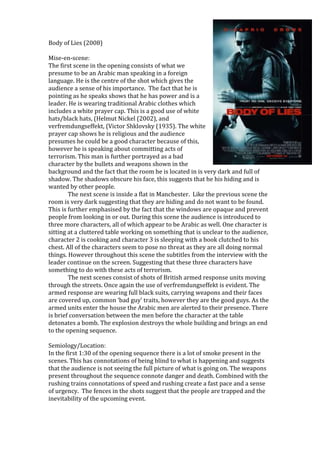
3886200-457200Body of Lies (2008)<br />Mise-en-scene:<br />The first scene in the opening consists of what we presume to be an Arabic man speaking in a foreign language. He is the centre of the shot which gives the audience a sense of his importance.  The fact that he is pointing as he speaks shows that he has power and is a leader. He is wearing traditional Arabic clothes which includes a white prayer cap. This is a good use of white hats/black hats, (Helmut Nickel (2002), and verfremdungseffekt, (Victor Shklovsky (1935). The white prayer cap shows he is religious and the audience presumes he could be a good character because of this, however he is speaking about committing acts of terrorism. This man is further portrayed as a bad character by the bullets and weapons shown in the background and the fact that the room he is located in is very dark and full of shadow. The shadows obscure his face, this suggests that he his hiding and is wanted by other people. <br />The next scene is inside a flat in Manchester.  Like the previous scene the room is very dark suggesting that they are hiding and do not want to be found. This is further emphasised by the fact that the windows are opaque and prevent people from looking in or out. During this scene the audience is introduced to three more characters, all of which appear to be Arabic as well. One character is sitting at a cluttered table working on something that is unclear to the audience, character 2 is cooking and character 3 is sleeping with a book clutched to his chest. All of the characters seem to pose no threat as they are all doing normal things. However throughout this scene the subtitles from the interview with the leader continue on the screen. Suggesting that these three characters have something to do with these acts of terrorism.<br />The next scenes consist of shots of British armed response units moving through the streets. Once again the use of verfremdungseffekt is evident. The armed response are wearing full black suits, carrying weapons and their faces are covered up, common ‘bad guy’ traits, however they are the good guys. As the armed units enter the house the Arabic men are alerted to their presence. There is brief conversation between the men before the character at the table detonates a bomb. The explosion destroys the whole building and brings an end to the opening sequence.<br />Semiology/Location:<br />In the first 1:30 of the opening sequence there is a lot of smoke present in the scenes. This has connotations of being blind to what is happening and suggests that the audience is not seeing the full picture of what is going on. The weapons present throughout the sequence connote danger and death. Combined with the rushing trains connotations of speed and rushing create a fast pace and a sense of urgency.  The fences in the shots suggest that the people are trapped and the inevitability of the upcoming event. <br />Camera shots: <br />I think most of the camera shots in the first minute of the opening sequence are simply to keep the audience involved in the action and to set the scene.  After this the camera starts to follow to armed response unit as they make their way to the house. These shots give a sense of being part of the action and make it seem as though you are either a member of the team assaulting the building or a civilian looking in on the action. For example when the camera is looking through the fence at the unit. There is also a variety of camera shots used to emphasise the power of the explosion.  The shots used are a mixture of low angle and high angle shots. The low angle shots used to emphasis to power, fierceness of the explosion and the high angle shots to emphasise the helplessness, vulnerability of the people caught in the explosion. <br />Sound effects:<br />Diegetic sound – the first diegetic sound in the sequence is the dictators’ voice, which the characters in the building are listening to. His voice his powerful, firm and in control. This suggests he has authority over his listeners and can control what they believe or do.  The sound of the train whistling past creates an eerie feel to the scene. The whistling also sounds similar to wind and creates a sense of isolation in what is effectively an extremely busy city. The sound effect of the mobile beep that turns into the whine creates a very brief sense of panic before the initial explosion. The sense of panic is emphasised by the sound of screams as terrified people run from the explosion. <br />Non-diegetic sound – the Arabic music at the beginning of the sequence further suggests the characters background. The next piece of non-diegetic sound comes out of the noise of the train. The soundtrack starts with a low beating piano key and escalates in intensity and pitch to foreshadow the imminent event. However this music kind of acts as an anti-climax because the music subsides, which suggests the action is over.  <br />
Body of lies

Body of lies

  • 1.
    3886200-457200Body of Lies(2008)<br />Mise-en-scene:<br />The first scene in the opening consists of what we presume to be an Arabic man speaking in a foreign language. He is the centre of the shot which gives the audience a sense of his importance. The fact that he is pointing as he speaks shows that he has power and is a leader. He is wearing traditional Arabic clothes which includes a white prayer cap. This is a good use of white hats/black hats, (Helmut Nickel (2002), and verfremdungseffekt, (Victor Shklovsky (1935). The white prayer cap shows he is religious and the audience presumes he could be a good character because of this, however he is speaking about committing acts of terrorism. This man is further portrayed as a bad character by the bullets and weapons shown in the background and the fact that the room he is located in is very dark and full of shadow. The shadows obscure his face, this suggests that he his hiding and is wanted by other people. <br />The next scene is inside a flat in Manchester. Like the previous scene the room is very dark suggesting that they are hiding and do not want to be found. This is further emphasised by the fact that the windows are opaque and prevent people from looking in or out. During this scene the audience is introduced to three more characters, all of which appear to be Arabic as well. One character is sitting at a cluttered table working on something that is unclear to the audience, character 2 is cooking and character 3 is sleeping with a book clutched to his chest. All of the characters seem to pose no threat as they are all doing normal things. However throughout this scene the subtitles from the interview with the leader continue on the screen. Suggesting that these three characters have something to do with these acts of terrorism.<br />The next scenes consist of shots of British armed response units moving through the streets. Once again the use of verfremdungseffekt is evident. The armed response are wearing full black suits, carrying weapons and their faces are covered up, common ‘bad guy’ traits, however they are the good guys. As the armed units enter the house the Arabic men are alerted to their presence. There is brief conversation between the men before the character at the table detonates a bomb. The explosion destroys the whole building and brings an end to the opening sequence.<br />Semiology/Location:<br />In the first 1:30 of the opening sequence there is a lot of smoke present in the scenes. This has connotations of being blind to what is happening and suggests that the audience is not seeing the full picture of what is going on. The weapons present throughout the sequence connote danger and death. Combined with the rushing trains connotations of speed and rushing create a fast pace and a sense of urgency. The fences in the shots suggest that the people are trapped and the inevitability of the upcoming event. <br />Camera shots: <br />I think most of the camera shots in the first minute of the opening sequence are simply to keep the audience involved in the action and to set the scene. After this the camera starts to follow to armed response unit as they make their way to the house. These shots give a sense of being part of the action and make it seem as though you are either a member of the team assaulting the building or a civilian looking in on the action. For example when the camera is looking through the fence at the unit. There is also a variety of camera shots used to emphasise the power of the explosion. The shots used are a mixture of low angle and high angle shots. The low angle shots used to emphasis to power, fierceness of the explosion and the high angle shots to emphasise the helplessness, vulnerability of the people caught in the explosion. <br />Sound effects:<br />Diegetic sound – the first diegetic sound in the sequence is the dictators’ voice, which the characters in the building are listening to. His voice his powerful, firm and in control. This suggests he has authority over his listeners and can control what they believe or do. The sound of the train whistling past creates an eerie feel to the scene. The whistling also sounds similar to wind and creates a sense of isolation in what is effectively an extremely busy city. The sound effect of the mobile beep that turns into the whine creates a very brief sense of panic before the initial explosion. The sense of panic is emphasised by the sound of screams as terrified people run from the explosion. <br />Non-diegetic sound – the Arabic music at the beginning of the sequence further suggests the characters background. The next piece of non-diegetic sound comes out of the noise of the train. The soundtrack starts with a low beating piano key and escalates in intensity and pitch to foreshadow the imminent event. However this music kind of acts as an anti-climax because the music subsides, which suggests the action is over. <br />