Where Do Good Ideas
Come From?
B RYA N R U SC H E | D IR EC TOR OF MA R K ETIN G
@bryanrusche
AGENDA
• Where do good ideas come from?
• Manufacturing creativity
Think left and think
right and think low
and think high.
Oh, the thinks you
can think up if only
you try!
~Dr. Seuss
Note: there’s an accompanying blog post that gives context to some of the image-only slides. You can
read the post at: https://soapboxhq.com/blog/manufacturing-creativity-good-ideas-on-demand
“Some people create with words, or with
music, or with a brush and paints. I like to
make something beautiful when I run. I like
to make people stop and say, ‘I’ve never
seen anyone run like that before.’ It’s more
than just a race, it’s style. It’s doing
something better than everyone else. It’s
being creative.”
~ Steve Prefontaine
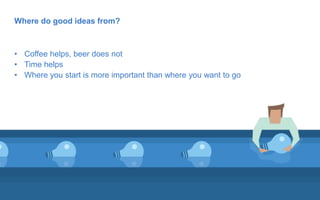
Where do good ideas from?
• Coffee helps, beer does not
• Time helps
• Where you start is more important than where you want to go
Mr. Smith is on his way home from a
successful business trip. He is very happy
and he is thinking about his wonderful family
and how glad he will be to see them again.
He can picture it, about an hour from now,
his plane landing at the airport and Mrs.
Smith and their three children all there
welcoming him home again.
This man is flying back from Reno where he
has won a divorce from his wife. He couldn’t
stand to live with her anymore, he told the
judge, because she wore so much cold
cream on her face at night that her head
would skid across the pillow. He’s now
contemplating a new skid-proof face cream.
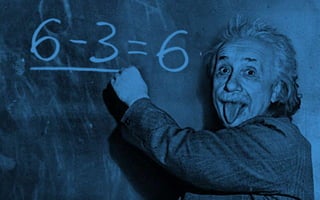
The formulation of a problem is often more
essential than its solution, which may merely
be a matter of mathematical or experimental
skill.
~ Einstein
Manufacturing Creativity
You can’t wait for inspiration, you have to go
after it with a club.
~ Jack London
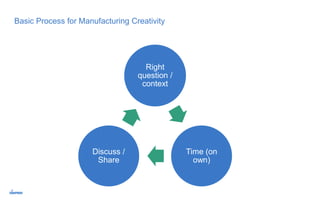
Basic Process for Manufacturing Creativity
Right
question /
context
Time (on
own)
Discuss /
Share
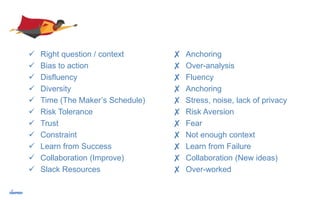
 Right question / context
 Bias to action
 Disfluency
 Diversity
 Time (The Maker’s Schedule)
 Risk Tolerance
 Trust
 Constraint
 Learn from Success
 Collaboration (Improve)
 Slack Resources
✘ Anchoring
✘ Over-analysis
✘ Fluency
✘ Anchoring
✘ Stress, noise, lack of privacy
✘ Risk Aversion
✘ Fear
✘ Not enough context
✘ Learn from Failure
✘ Collaboration (New ideas)
✘ Over-worked
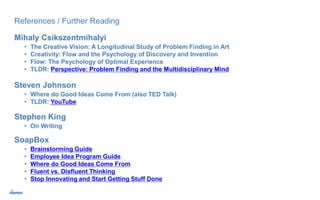
References / Further Reading
Mihaly Csikszentmihalyi
• The Creative Vision: A Longitudinal Study of Problem Finding in Art
• Creativity: Flow and the Psychology of Discovery and Invention
• Flow: The Psychology of Optimal Experience
• TLDR: Perspective: Problem Finding and the Multidisciplinary Mind
Steven Johnson
• Where do Good Ideas Come From (also TED Talk)
• TLDR: YouTube
SoapBox
• Brainstorming Guide
• Employee Idea Program Guide
• Where do Good Ideas Come From
• Fluent vs. Disfluent Thinking
• Stop Innovating and Start Getting Stuff Done
Stephen King
• On Writing

Where do good ideas come from?

  • 1.
    Where Do GoodIdeas Come From? B RYA N R U SC H E | D IR EC TOR OF MA R K ETIN G @bryanrusche
  • 2.
    AGENDA • Where dogood ideas come from? • Manufacturing creativity Think left and think right and think low and think high. Oh, the thinks you can think up if only you try! ~Dr. Seuss Note: there’s an accompanying blog post that gives context to some of the image-only slides. You can read the post at: https://soapboxhq.com/blog/manufacturing-creativity-good-ideas-on-demand
  • 7.
    “Some people createwith words, or with music, or with a brush and paints. I like to make something beautiful when I run. I like to make people stop and say, ‘I’ve never seen anyone run like that before.’ It’s more than just a race, it’s style. It’s doing something better than everyone else. It’s being creative.” ~ Steve Prefontaine
  • 8.
    Where do goodideas from? • Coffee helps, beer does not • Time helps • Where you start is more important than where you want to go
  • 12.
    Mr. Smith ison his way home from a successful business trip. He is very happy and he is thinking about his wonderful family and how glad he will be to see them again. He can picture it, about an hour from now, his plane landing at the airport and Mrs. Smith and their three children all there welcoming him home again.
  • 13.
    This man isflying back from Reno where he has won a divorce from his wife. He couldn’t stand to live with her anymore, he told the judge, because she wore so much cold cream on her face at night that her head would skid across the pillow. He’s now contemplating a new skid-proof face cream.
  • 16.
    The formulation ofa problem is often more essential than its solution, which may merely be a matter of mathematical or experimental skill. ~ Einstein
  • 17.
    Manufacturing Creativity You can’twait for inspiration, you have to go after it with a club. ~ Jack London
  • 19.
    Basic Process forManufacturing Creativity Right question / context Time (on own) Discuss / Share
  • 21.
     Right question/ context  Bias to action  Disfluency  Diversity  Time (The Maker’s Schedule)  Risk Tolerance  Trust  Constraint  Learn from Success  Collaboration (Improve)  Slack Resources ✘ Anchoring ✘ Over-analysis ✘ Fluency ✘ Anchoring ✘ Stress, noise, lack of privacy ✘ Risk Aversion ✘ Fear ✘ Not enough context ✘ Learn from Failure ✘ Collaboration (New ideas) ✘ Over-worked
  • 22.
    References / FurtherReading Mihaly Csikszentmihalyi • The Creative Vision: A Longitudinal Study of Problem Finding in Art • Creativity: Flow and the Psychology of Discovery and Invention • Flow: The Psychology of Optimal Experience • TLDR: Perspective: Problem Finding and the Multidisciplinary Mind Steven Johnson • Where do Good Ideas Come From (also TED Talk) • TLDR: YouTube SoapBox • Brainstorming Guide • Employee Idea Program Guide • Where do Good Ideas Come From • Fluent vs. Disfluent Thinking • Stop Innovating and Start Getting Stuff Done Stephen King • On Writing

Editor's Notes

  • #3 White Version
  • #10 The English coffeehouse was crucial to the development and spread of one of the great intellectual flowerings of the last 500 years, what we now call the Enlightenment. It was a space where people would get together from different backgrounds, different fields of expertise, and share. We take ideas from other people, from people we've learned from, from people we run into in the coffee shop, and we stitch them together into new forms and we create something new. That's really where innovation happens.
  • #11 Although we often associate ideas with a light-bulb or a eureka moment, the reality is that great discoveries are more like slow hunches which take time and cultivation
  • #14 Stimulus free themes Unexpected endings Humor Incongruities Playfullness High IQ vs High Divergent Convergent vs Divergent thinking Point of departure rather than being goal bound Discovered problems
  • #15 3 kinds of problems Where we’re given the problem and how to solve it Where we’re given the problem, but not how to solve it Where we’re not given a problem
  • #16 Art Institute of Chicago – A Sunday Afternoon on the Island of La Grande Jatte by Georges Seurat Problem Finders: Increased willingness to switch direction when new approaches suggested themselves. They were open to reformulating problems as they experimented with different perspectives. They were slow to judge their work as absolutely finished They were able to evaluate critically the probability that improvements were achievable Artists who rated high in these areas were judged to be exceptionally creative, and follow-up studies of their work 18 years later demonstrated that they achieved a higher degree of professional success than did their less creative colleagues Another study, this one of artists and scientists, compared those who were critically acclaimed with others who were professionally merely competent. This study found that the former spent more time and energy on problem finding