Taming Board Paper Templates
Mary Morel
www.writetogovern.com.au
What we’re covering
The value of templates and guidelines
Principles of modern writing
Decision time (e.g. number of templates)
Headers and headings
Guidelines and styles
Reinforcing template use
Definitions
• I refer to reports as the regular board
updates, such as the CEO report, CFO and
COO report
• Papers are one-off documents for decision,
noting (information) and discussion
The value of templates and guidelines
Templates
• Provide a consistent reading experience for
directors
• Encourage writers to structure their writing
well
Guidelines
• Provide prompts for writers so they
anticipate and answer directors’ questions
• Encourage writers to use correct grammar
and consistent styles
Principles of modern writing
Implications for writers
Writers must:
• Get to the point upfront
• Write concisely
• Think about layout, e.g. how
tables will look online
Decision time
One or two templates?
One template for decision, noting
(information) and discussion
Two templates  one for noting
and discussion, and the other for
decision
Where should the guidelines be?
Embed the guidelines within the template
Have a separate guideline document
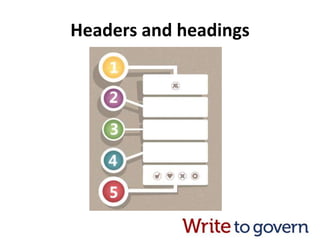
Headers and headings
Header information
• Name of board/committee
• Title of the paper
• For noting/discussion/decision
• Author/manager/approver
• Date (of meeting or date written)
Headings for one-size-fits-all template
• Recommendation
• Summary (Key points, Overview)
• Background
• Discussion (Considerations)
• Appendices (Attachments, Annexures)
Headings for two templates
• The decision template is the same as the
one-size-fits-all template
• Noting paper:
– Summary
– Discussion
– Appendices
Possible template subheadings
• Strategy
• Risks
• Financial
• Other, e.g. members, legal issues,
safety, environment
Should the subheadings be mandatory?
Guidelines and styles
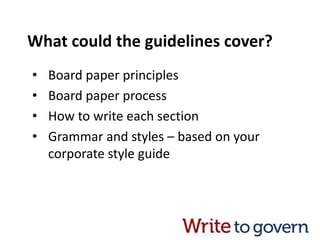
What could the guidelines cover?
• Board paper principles
• Board paper process
• How to write each section
• Grammar and styles – based on your
corporate style guide
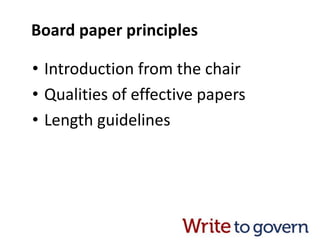
Board paper principles
• Introduction from the chair
• Qualities of effective papers
• Length guidelines
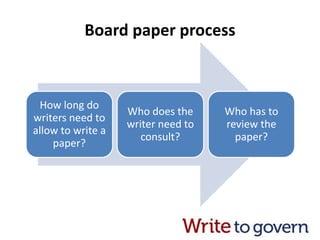
Board paper process
How long do
writers need to
allow to write a
paper?
Who does the
writer need to
consult?
Who has to
review the
paper?
How to write key sections
Provide guidelines on how to write:
• Recommendations
• Summaries
• Background
• Strategic alignment
• Financial commentary
• Risk analysis and commentary
Recommendations
• Recommendations should be at the
beginning of the paper, not the end
• They should be clear, specific and stand-
alone
• They should be easy to turn into a resolution
in the minutes with minimal word changes
• A noting paper template does not need a
recommendation
• Read my blog on recommendations
Styles for recommendations
• Start with a consistent stem statement
That the Board…
• Use bullets or numbers for more than one
recommendation
• Use a narrow range of verbs
approve, endorse, note, authorise
• Use a consistent verb form, e.g. approve or
approves – read my blog about verbs in
recommendations
Summaries: short and to the point
• Summaries work in tandem with
recommendations (what and why)
• They must be brief, i.e. a few
paragraphs or bullet points
• They must sum up the essence of the
paper (what and why, strategy, risks
and dollars)
The background must be concise
• Refer to previous papers, past events
and issues that affect the paper (e.g.
political)
• Link to previous papers if using a board
paper app
Discussion
The discussion provides:
• More information about the topic
• Strategy (if relevant)
• Risks (if relevant)
• Financial (if relevant)
• Other, e.g. compliance, legal issues
Writing about strategy
• If relevant, writers should link to the
strategic or business plan, including KPIs
• Writers should state if their
recommendation is a departure from
strategy
Writing about risks
• Flag high risks in the summary
• Write commentary about risks and
how they will be managed – a table of
data is not commentary!
Writing about financial information
• Add commentary about what the data
means
• Don’t regurgitate all the information in the
table in words – directors must be able to
read financial statements
• Think about the layout of tables – large
tables are hard to read online
Include a two-page
style guide in the
guidelines based on
your corporate style
guide
Common grammar and style issues
• Consistent font and justification
• Consistent use of initial capitals
• Consistent style for bulleted lists
• Consistent money references ($6m or
$6M?)
• Company names are singular
• Apostrophes
Reinforcing template use
How do you reinforce template use?
• Offer template training?
• Stop reformatting writers’ papers for
them?
• Send a paper back if it’s not in the
correct template?
About Mary Morel
Mary is the author of Write to Govern: How to
write effective board papers. She works with
companies to improve the quality of their board
papers.
Read more at www.writetogovern.com.au
For more information
Contact Mary Morel
mary@writetogovern.com.au
Ph: +61 2 9365 7711
Mob: +61 400 686 600

Review your board paper templates

  • 1.
    Taming Board PaperTemplates Mary Morel www.writetogovern.com.au
  • 2.
    What we’re covering Thevalue of templates and guidelines Principles of modern writing Decision time (e.g. number of templates) Headers and headings Guidelines and styles Reinforcing template use
  • 3.
    Definitions • I referto reports as the regular board updates, such as the CEO report, CFO and COO report • Papers are one-off documents for decision, noting (information) and discussion
  • 4.
    The value oftemplates and guidelines
  • 5.
    Templates • Provide aconsistent reading experience for directors • Encourage writers to structure their writing well
  • 6.
    Guidelines • Provide promptsfor writers so they anticipate and answer directors’ questions • Encourage writers to use correct grammar and consistent styles
  • 7.
  • 8.
    Implications for writers Writersmust: • Get to the point upfront • Write concisely • Think about layout, e.g. how tables will look online
  • 9.
  • 10.
    One or twotemplates? One template for decision, noting (information) and discussion Two templates  one for noting and discussion, and the other for decision
  • 11.
    Where should theguidelines be? Embed the guidelines within the template Have a separate guideline document
  • 12.
  • 13.
    Header information • Nameof board/committee • Title of the paper • For noting/discussion/decision • Author/manager/approver • Date (of meeting or date written)
  • 14.
    Headings for one-size-fits-alltemplate • Recommendation • Summary (Key points, Overview) • Background • Discussion (Considerations) • Appendices (Attachments, Annexures)
  • 15.
    Headings for twotemplates • The decision template is the same as the one-size-fits-all template • Noting paper: – Summary – Discussion – Appendices
  • 16.
    Possible template subheadings •Strategy • Risks • Financial • Other, e.g. members, legal issues, safety, environment
  • 17.
  • 18.
  • 19.
    What could theguidelines cover? • Board paper principles • Board paper process • How to write each section • Grammar and styles – based on your corporate style guide
  • 20.
    Board paper principles •Introduction from the chair • Qualities of effective papers • Length guidelines
  • 21.
    Board paper process Howlong do writers need to allow to write a paper? Who does the writer need to consult? Who has to review the paper?
  • 22.
    How to writekey sections Provide guidelines on how to write: • Recommendations • Summaries • Background • Strategic alignment • Financial commentary • Risk analysis and commentary
  • 23.
    Recommendations • Recommendations shouldbe at the beginning of the paper, not the end • They should be clear, specific and stand- alone • They should be easy to turn into a resolution in the minutes with minimal word changes • A noting paper template does not need a recommendation • Read my blog on recommendations
  • 24.
    Styles for recommendations •Start with a consistent stem statement That the Board… • Use bullets or numbers for more than one recommendation • Use a narrow range of verbs approve, endorse, note, authorise • Use a consistent verb form, e.g. approve or approves – read my blog about verbs in recommendations
  • 25.
    Summaries: short andto the point • Summaries work in tandem with recommendations (what and why) • They must be brief, i.e. a few paragraphs or bullet points • They must sum up the essence of the paper (what and why, strategy, risks and dollars)
  • 26.
    The background mustbe concise • Refer to previous papers, past events and issues that affect the paper (e.g. political) • Link to previous papers if using a board paper app
  • 27.
    Discussion The discussion provides: •More information about the topic • Strategy (if relevant) • Risks (if relevant) • Financial (if relevant) • Other, e.g. compliance, legal issues
  • 28.
    Writing about strategy •If relevant, writers should link to the strategic or business plan, including KPIs • Writers should state if their recommendation is a departure from strategy
  • 29.
    Writing about risks •Flag high risks in the summary • Write commentary about risks and how they will be managed – a table of data is not commentary!
  • 30.
    Writing about financialinformation • Add commentary about what the data means • Don’t regurgitate all the information in the table in words – directors must be able to read financial statements • Think about the layout of tables – large tables are hard to read online
  • 31.
    Include a two-page styleguide in the guidelines based on your corporate style guide
  • 32.
    Common grammar andstyle issues • Consistent font and justification • Consistent use of initial capitals • Consistent style for bulleted lists • Consistent money references ($6m or $6M?) • Company names are singular • Apostrophes
  • 33.
  • 34.
    How do youreinforce template use? • Offer template training? • Stop reformatting writers’ papers for them? • Send a paper back if it’s not in the correct template?
  • 35.
    About Mary Morel Maryis the author of Write to Govern: How to write effective board papers. She works with companies to improve the quality of their board papers. Read more at www.writetogovern.com.au
  • 36.
    For more information ContactMary Morel mary@writetogovern.com.au Ph: +61 2 9365 7711 Mob: +61 400 686 600