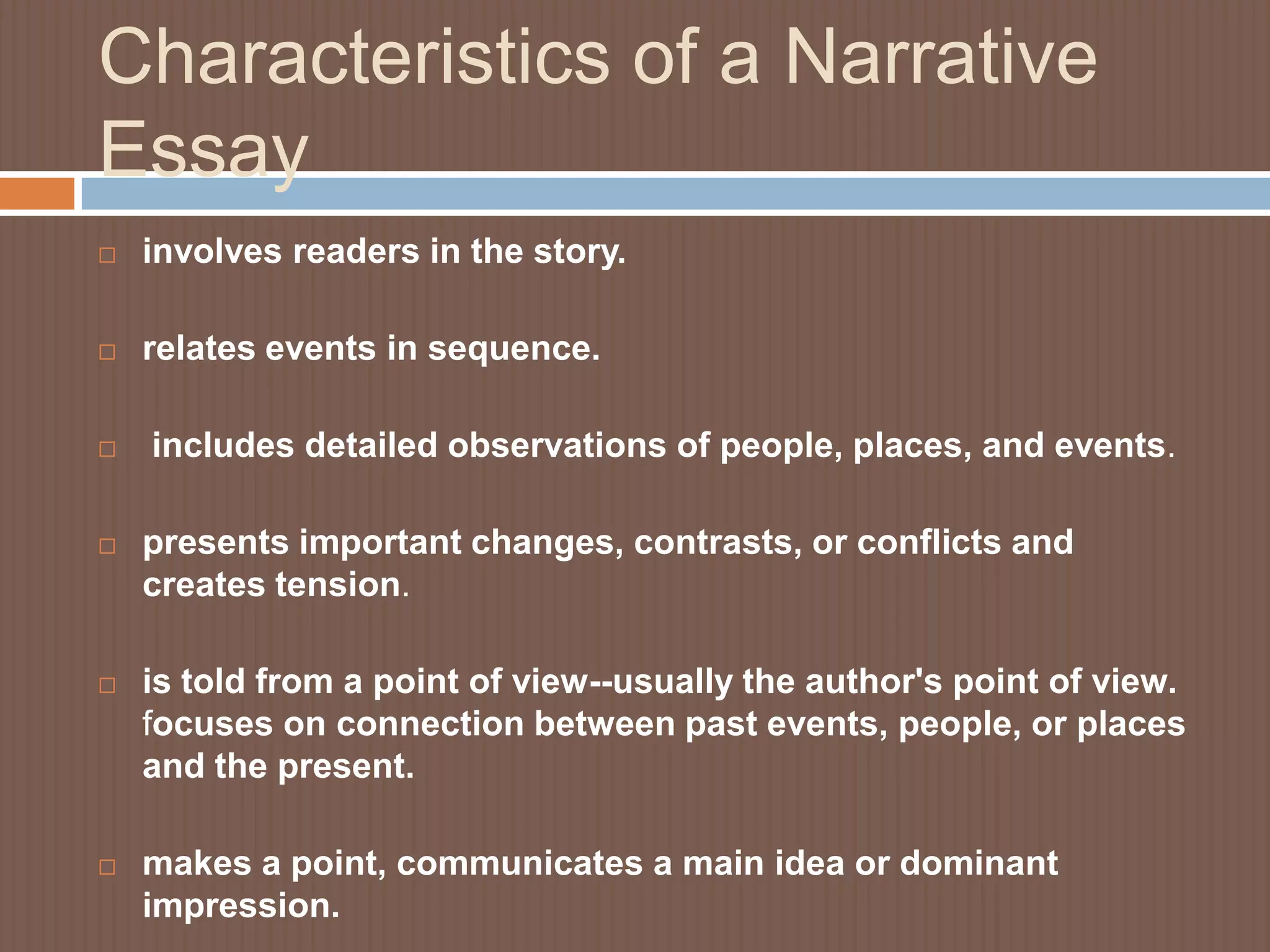
Characteristics of a Narrative
Essay
   involves readers in the story.

   relates events in sequence.

   includes detailed observations of people, places, and events.

   presents important changes, contrasts, or conflicts and
    creates tension.

   is told from a point of view--usually the author's point of view.
    focuses on connection between past events, people, or places
    and the present.

   makes a point, communicates a main idea or dominant
    impression.
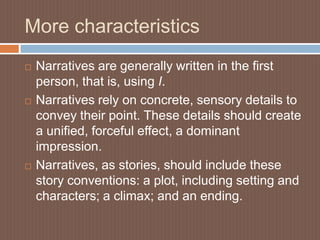
More characteristics
   Narratives are generally written in the first
    person, that is, using I.
   Narratives rely on concrete, sensory details to
    convey their point. These details should create
    a unified, forceful effect, a dominant
    impression.
   Narratives, as stories, should include these
    story conventions: a plot, including setting and
    characters; a climax; and an ending.
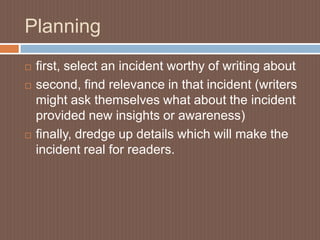
Planning
   first, select an incident worthy of writing about
   second, find relevance in that incident (writers
    might ask themselves what about the incident
    provided new insights or awareness)
   finally, dredge up details which will make the
    incident real for readers.
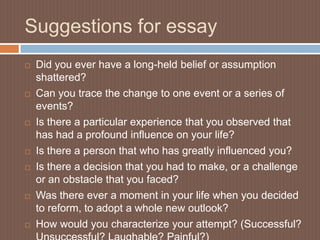
Suggestions for essay
   Did you ever have a long-held belief or assumption
    shattered?
   Can you trace the change to one event or a series of
    events?
   Is there a particular experience that you observed that
    has had a profound influence on your life?
   Is there a person that who has greatly influenced you?
   Is there a decision that you had to make, or a challenge
    or an obstacle that you faced?
   Was there ever a moment in your life when you decided
    to reform, to adopt a whole new outlook?
   How would you characterize your attempt? (Successful?
Resources
   DeSoto, Marla. "Writing a Narrative Essay."
    Eng101 Online. Glendale Community College,
    n.d. Web. 25 Oct 2011.
    <http://web.gccaz.edu/~mdinchak/101online_n
    ew/assignment3writing.htm>.

Narrative essay

  • 1.
    Characteristics of aNarrative Essay  involves readers in the story.  relates events in sequence.  includes detailed observations of people, places, and events.  presents important changes, contrasts, or conflicts and creates tension.  is told from a point of view--usually the author's point of view. focuses on connection between past events, people, or places and the present.  makes a point, communicates a main idea or dominant impression.
  • 2.
    More characteristics  Narratives are generally written in the first person, that is, using I.  Narratives rely on concrete, sensory details to convey their point. These details should create a unified, forceful effect, a dominant impression.  Narratives, as stories, should include these story conventions: a plot, including setting and characters; a climax; and an ending.
  • 3.
    Planning  first, select an incident worthy of writing about  second, find relevance in that incident (writers might ask themselves what about the incident provided new insights or awareness)  finally, dredge up details which will make the incident real for readers.
  • 4.
    Suggestions for essay  Did you ever have a long-held belief or assumption shattered?  Can you trace the change to one event or a series of events?  Is there a particular experience that you observed that has had a profound influence on your life?  Is there a person that who has greatly influenced you?  Is there a decision that you had to make, or a challenge or an obstacle that you faced?  Was there ever a moment in your life when you decided to reform, to adopt a whole new outlook?  How would you characterize your attempt? (Successful?
  • 5.
    Resources  DeSoto, Marla. "Writing a Narrative Essay." Eng101 Online. Glendale Community College, n.d. Web. 25 Oct 2011. <http://web.gccaz.edu/~mdinchak/101online_n ew/assignment3writing.htm>.