Wheezing
A three year old comes in with a complaint of coughing for 2 weeks. Coughing is present every night. He has
also had a mild fever, but his temperature has not been measured at home. His parents have been using a
decongestant/antihistamine syrup and albuterol syrup which were left over from a sibling. Initially the cough
improved but it worsened over the next 2 days. He is noted to have morning sneezing and nasal congestion.
There are colds going around the pre-school. He has had similar episodes in the past, but this episode is
worse. He has no known allergies to foods or medications.
His past history is notable for eczema and dry skin since infancy. He is otherwise healthy and he is fully
immunized. His family history is notable for a brother who has asthma. In his home environment, there are no
smokers or pets.
Case
● Exam: VS T 38.1, P 100, RR 24, BP 85/65, oxygen saturation 99% in room air.
He is alert and cooperative in minimal distress if any. His eyes are clear, nasal
mucosa is boggy with clear discharge, and his pharynx has moderate lymphoid
hypertrophy. He has multiple small lymph nodes palpable in his upper neck.
His chest has an increased AP diameter and it is tympanitic (hyperresonant) to
percussion. Rhonchi and occasional wheezes are heard on auscultation, but
there are no retractions. Heart is in a regular rhythm and no murmurs are
heard. His skin is dry, but not flaky, inflamed or thickened.
IDENTIFYING DATA :
Age : 3 year old
Gender : Male
CHIEF COMPLAINT :
Coughing for 2 weeks
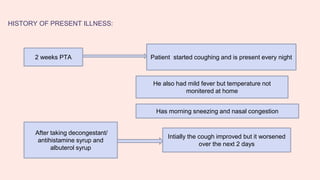
HISTORY OF PRESENT ILLNESS:
2 weeks PTA Patient started coughing and is present every night
He also had mild fever but temperature not
monitered at home
After taking decongestant/
antihistamine syrup and
albuterol syrup
Intially the cough improved but it worsened
over the next 2 days
Has morning sneezing and nasal congestion
● Is there sputum while coughing? Or dry cough ?
● How long does one episode of cough last?
● Is the cough recurrent or persistent?
● If there is sputum, what is its color and amount?
● Is there blood in cough ?
● Does physical activity increase or decrease cough?
● Does it interfere with sleeping?
● Is there difficulty in breathing or shortness of breath due to cough?
● Is there chest pain ?
● Is the breathing noisy?
● How many similar episodes in past?
● Is this symptoms occur seasonal or present through out the year?
● Is there vomiting due to extreme cough?
● Is there choking while taking food ?
● Can the child do daily activities?
Additional questions to ask:
(+) mild fever
General :
(+) Eczema, (+) dry skin,
(-) jaundice
Skin :
(-) Headache, (-) dizziness
Head
(-) itching or tearing, (-) blurred
vision (-) redness ,(-) pain
Eyes
(-) ear infection, (-)
earaches
Ears
(+) Clear discharge, (+)
Nasal Congestion (+)
morning sneezing
Nose/sinuses ;
REVIEW OF SYMPTOMS
(-) Sore throat , (-)
Hoarseness
Throat/ mouth
(+)Cough, (+)Wheezing (-)
shortness of breath
Respiratory:
(-) Chest pain, (-)
Palpitation
Cardiovascular:
(-) Vomiting, (-) abdominal
pain, (-) heart burn,
(-) Diarrhea, (-)
constipation
Gastrointestinal :
(-) dysuria, (-) urgency,
(-) Nocturia
Urinary :
● (-) Muscle pain/
cramps, (-)
broken bone
Musculoskeletal :
(-) Seizure, (-) tremors, (-)
numbness/ tingling, (-)
local weakness
Nervous system :
(-) anemia, (-) bruising
Hematologic :
(-) thyroid problem, (-)
excess sweat, thirst or
hunger, (-) heat/cold
intolerance
Endocrine :
● (-) nervousness, (-)
tension, (-) mood
change, (-) panic
attack
Psychiatric :
(-) hernia, (-) testicular
pain soreness on
genitals
Genital :
● He has had similar episode in past
● After using decongestant/antihistamine and albuterol syrup initially the
cough improved but it got worsened over the next 2 days
● Notable for Eczema and dry skin since infancy
● He has no known allergies to foods or medication
Past medical history:
•Additional questions:
•When did the episode start ?
•How long does it lasted? :
•Dry cough or with sputum?
FAMILY MEDICAL HISTORY:
(+) Asthma – brother
Additional questions :
•Does any other family members have asthma or are exposed to TB?
•Does any of the family members have diabetes mellitus or high blood presure
or any other illness
● Not given
BIRTH AND MATERNAL HISTORY:
Additional questions :
•Age of the mother during pregnancy?
•Is the chile born preterm or term? Age of gestation?
•Method of delivery
•Any complications or respiratory distress in child after birth?
•Parity and gravidity?
•Intake of drugs or alcohol or smokind during pregnancy?
•Infections during pregnancy?
•Any complications or illness during pregnancy
•Birth weight
● Fully immunized
IMMUNIZATION HISTORY
Additional questions :
•What are the vaccines ?
•Is Covid Vaccine included ?
•Is flu shots included?
NUTRITIONAL HISTORY
Not given
Additional questions :
•Type of feeding during infancy ?
•What are the foods taken by child ?
•His likes and dislikes ?
•How about his appetite ?
•Any vitamins taken?
Developmental History :
Not given
Additional questions :
•Did the child Achieved various milestones in appropriate age?
SOCIAL HISTORY:
• There are colds going around the preschool
• No smokers or pets in his environment
Additional questions
•Did the child travel anywhere recently other than preschool
•Is the child happy with everyone? Any suspect of abuse ?
•How is the hygiene maintained at home?
•What is the source of water?
Alert and cooperative in minimal
distress if any
● Temperature: 38.1 C (Febrile)
● Pulse Rate :100 bpm (Normal)
● Respiratory Rate: 24 bpm (Normal)
● Blood Pressure:85/65 mm/Hg (slightly low
BP)
● O2 saturation: 99% in room air
Vitals:
Dry but not flaky, inflamed or thickened
Skin :
Physical Examination:
General:
HEENT
:
•Eyes are clear.
•Nasal mucosa is boggy with clear discharge.
•Pharynx has moderate lymphoid hypertrophy.
•Multiple small lymph nodes palpable in the upper neck.
Chest/Lungs:
• Chest has an increased AP diameter and
it is tympanitic (Hyperresonant) to
percussion.
•Rhonchi and occasional wheezes are
heard on auscultation, but there are no
retractions.
CREDITS:
This presentation template was
created by Slidesgo, including
icons by Flaticon, infographics &
images by Freepik
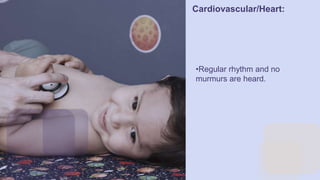
Cardiovascular/Heart:
•Regular rhythm and no
murmurs are heard.
● No edema or clubbing, normal range of motion
ABDOMEN
EXTREMITIES
● Flat abdomen without any visible masses, scars or swellings.
● No abdominal distention
● Non tender with normoactive bowel sounds
Additional Physical Examination:
Anthropometric Measurements
• Height
• Weight
• BMI
● 3 year old
● Coughing for 2 weeks
● Coughing present every night
● Mild fever
● After using decongestant/antihistamine and albuterol syrup initially the cough improved but it got
worsened over the next 2 days
● Noted to have morning sneezing and nasal congestion
● Colds around pre school
● Similar episodes in past but this is worse
● Past history of eczema and dryskin in infancy
● His brother has asthma
● Nasal mucosa is boggy with clear discharge
● Pharynx ha moderate lymphoid hypertrophy
● Multiple small lymphnodes palpable in upper neck
● Chest has increased AP diameter and is hyperresonant
● Rhonchi and occasional wheezes are heard
SALIENT FEATURES
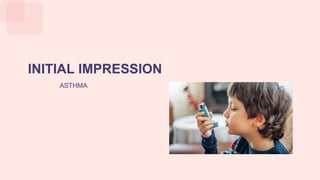
INITIAL IMPRESSION
ASTHMA
Allergic rhinitis
Viral Bronchiolitis
Sinusitis
Tuberculosis
Childhood asthma
DIFFERENTIAL DIAGNOSIS
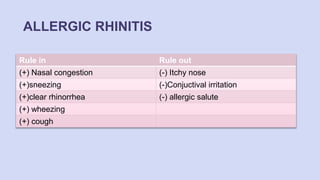
ALLERGIC RHINITIS
Rule in Rule out
(+) Nasal congestion (-) Itchy nose
(+)sneezing (-)Conjuctival irritation
(+)clear rhinorrhea (-) allergic salute
(+) wheezing
(+) cough
VIRAL BRONCHIOLITIS
Rule in Rule out
(+) sneezing (-)loss of appetite
(+) clear rhinnorrhea (-) dyspnea
(+) Wheezing (-) Tachypnea
(+) Nasal congestion
(+) fever
SINUSITIS
Rule in Rule out
(+)Fever (-) purulent nasal discharge
(+)Cough (-) halitosis
(+) Nasal congestion (-) hyposmia
(+) Nasal discharge (-) periorbital edema
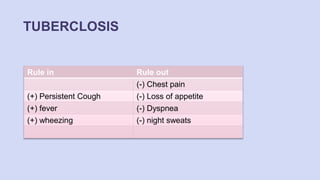
TUBERCLOSIS
Rule in Rule out
(-) Chest pain
(+) Persistent Cough (-) Loss of appetite
(+) fever (-) Dyspnea
(+) wheezing (-) night sweats
CHILDHOOD ASTHMA
Rule in Rule out
(+) Coughing especially at night
(+) Rhonchi and wheezing
(+) Eczema
(+) Mild fever
(+) Sneezing and Nasal congestion
(+) Frequent cold
(+) rhinorrhea
(+) Family History of Asthma
FINAL
DIAGNOSIS
● MODERATE PERSISTENT CHILDHOOD ASTHMA
● Asthma is a chronic inflammatory
condition of the lung airways resulting in
episodic airflow obstruction
● This chronic inflammation heightens the
twitchiness of the airways—airways
hyperresponsiveness (AHR)—to
provocative exposures.
● 2 types of asthma (1) recurrent
wheezing in early childhood (2)
chronic asthma associated with allergy
that persists into later childhood
CHILDHOOD ASTHMA
RISK FACTORS
● Parental asthma
● Allergy:
• Atopic dermatitis (eczema)
• Allergic rhinitis
• Food allergy
• Inhalant allergen sensitization
• Food allergen sensitization
● Severe lower respiratory tract infection:
• Pneumonia
• Bronchiolitis requiring hospitalization
● Wheezing apart from colds
● Male gender
● Low birthweight
● Environmental tobacco smoke exposure
● Reduced lung function at birth
PATHOPHYSIOLOGY
PATHOPHYSIOLOGY
● A combination of environmental and genetic factors in early life shape how the
immune system develops and responds to all environmental exposures.
● This factors may lead to development of innate and adaptive immunity with
increased predisposition to an immune reaction (atopy)
● Respiratory microbes, inhaled allergens, and toxins exposed by the child can injure
the lower airways targeting the disease process to the lungs.
● The child airways and immune system shows abberent immune and repair reponses
so the function gets compromised.
● This leads to persistant inflammation, airway hyperresponsiveness, remodelling,
change in airway growth and differentiation and altered airways at mature ages.
● Leading to asthma
● Once asthma has developed, ongoing inflammatory exposures appear to worsen it,
driving disease persistence and increasing the risk of severe exacerbations.
INVESTIGATIONS
Pulmonary function test : to diagnose and monitor asthma
Spirometry (in clinic): (for child > 6 year old )
• Airflow limitation:
• Low FEV1 (relative to percentage of predicted norms)
• FEV1:FVC ratio <0.80 ( indicates air flow obstruction )
Bronchodilator response (to inhaled β-agonist):
• Improvement in FEV1 ≥12% and ≥200 mL (for asthmatic patient)
Exercise challenge:
• Worsening in FEV1 ≥15% (due to bronchospasm)
Exhaled nitric oxide test : a marker of airway inflammation, can confirm asthma
Daily peak flow or FEV1 monitoring: (to assess airflow at home)
day to day and/or A.M.-to-P.M. Diurnal variation ≥20%
Chest X ray
MANAGEMENT
● Assesing the asthma severity is the initial step of therapy.
● Educate the child and parent about the disease and how to keep it in
control by using daily controller medication.
● Control environmental factors and comorbid conditions:
● Medications
● Exacerbations
Comorbid conditions :
Rhinitis
Sinusitis
GERD
Environmental factors :
Tobacco
Smoke
Dusts
Allergens
Chemical odors
Medications
Medications :
● The patient is 3 year old and has moderate persistent asthma so we
will use the step 3 and 4 to attain well controlled asthma.
● Daily medications are given
● Medium dose inhaled corticosteroids as monotherapy is given
● If asthma is not controlled a combination of medium dose inhaled
corticosteriods with long acting beta agonist is given
● Oral corticosteroids as controller therapy can be used to reduce
inflammation
● As the child has fever paracetamol is also prescribed
● If the child showed well controlled response to asthma treatment for 3
months we can decrease the dose of medications
● But if the child symptoms worsen or acute excerbation of attacks occur
then treatment is stepped up to high dose
Excerbations :
Quick releivers are given to prevent status asthmaticus
Prevention and advise
● Avoid allergen and triggers causing asthma attacks
● Stick to daily controller medication even when feeling well
● Quick relievers are used to prevent asthma attacks
● Carry child’s rescue medications
● Encourage the child to be active
● Take vaccine shots against flu.
● Have a written asthma plan
● Further follow up has to be done
wheezing case presentation.pptx

wheezing case presentation.pptx

  • 1.
  • 2.
    A three yearold comes in with a complaint of coughing for 2 weeks. Coughing is present every night. He has also had a mild fever, but his temperature has not been measured at home. His parents have been using a decongestant/antihistamine syrup and albuterol syrup which were left over from a sibling. Initially the cough improved but it worsened over the next 2 days. He is noted to have morning sneezing and nasal congestion. There are colds going around the pre-school. He has had similar episodes in the past, but this episode is worse. He has no known allergies to foods or medications. His past history is notable for eczema and dry skin since infancy. He is otherwise healthy and he is fully immunized. His family history is notable for a brother who has asthma. In his home environment, there are no smokers or pets. Case
  • 3.
    ● Exam: VST 38.1, P 100, RR 24, BP 85/65, oxygen saturation 99% in room air. He is alert and cooperative in minimal distress if any. His eyes are clear, nasal mucosa is boggy with clear discharge, and his pharynx has moderate lymphoid hypertrophy. He has multiple small lymph nodes palpable in his upper neck. His chest has an increased AP diameter and it is tympanitic (hyperresonant) to percussion. Rhonchi and occasional wheezes are heard on auscultation, but there are no retractions. Heart is in a regular rhythm and no murmurs are heard. His skin is dry, but not flaky, inflamed or thickened.
  • 4.
    IDENTIFYING DATA : Age: 3 year old Gender : Male
  • 5.
  • 6.
    HISTORY OF PRESENTILLNESS: 2 weeks PTA Patient started coughing and is present every night He also had mild fever but temperature not monitered at home After taking decongestant/ antihistamine syrup and albuterol syrup Intially the cough improved but it worsened over the next 2 days Has morning sneezing and nasal congestion
  • 7.
    ● Is theresputum while coughing? Or dry cough ? ● How long does one episode of cough last? ● Is the cough recurrent or persistent? ● If there is sputum, what is its color and amount? ● Is there blood in cough ? ● Does physical activity increase or decrease cough? ● Does it interfere with sleeping? ● Is there difficulty in breathing or shortness of breath due to cough? ● Is there chest pain ? ● Is the breathing noisy? ● How many similar episodes in past? ● Is this symptoms occur seasonal or present through out the year? ● Is there vomiting due to extreme cough? ● Is there choking while taking food ? ● Can the child do daily activities? Additional questions to ask:
  • 8.
    (+) mild fever General: (+) Eczema, (+) dry skin, (-) jaundice Skin : (-) Headache, (-) dizziness Head (-) itching or tearing, (-) blurred vision (-) redness ,(-) pain Eyes (-) ear infection, (-) earaches Ears (+) Clear discharge, (+) Nasal Congestion (+) morning sneezing Nose/sinuses ; REVIEW OF SYMPTOMS
  • 9.
    (-) Sore throat, (-) Hoarseness Throat/ mouth (+)Cough, (+)Wheezing (-) shortness of breath Respiratory: (-) Chest pain, (-) Palpitation Cardiovascular: (-) Vomiting, (-) abdominal pain, (-) heart burn, (-) Diarrhea, (-) constipation Gastrointestinal : (-) dysuria, (-) urgency, (-) Nocturia Urinary : ● (-) Muscle pain/ cramps, (-) broken bone Musculoskeletal :
  • 10.
    (-) Seizure, (-)tremors, (-) numbness/ tingling, (-) local weakness Nervous system : (-) anemia, (-) bruising Hematologic : (-) thyroid problem, (-) excess sweat, thirst or hunger, (-) heat/cold intolerance Endocrine : ● (-) nervousness, (-) tension, (-) mood change, (-) panic attack Psychiatric : (-) hernia, (-) testicular pain soreness on genitals Genital :
  • 11.
    ● He hashad similar episode in past ● After using decongestant/antihistamine and albuterol syrup initially the cough improved but it got worsened over the next 2 days ● Notable for Eczema and dry skin since infancy ● He has no known allergies to foods or medication Past medical history: •Additional questions: •When did the episode start ? •How long does it lasted? : •Dry cough or with sputum?
  • 12.
    FAMILY MEDICAL HISTORY: (+)Asthma – brother Additional questions : •Does any other family members have asthma or are exposed to TB? •Does any of the family members have diabetes mellitus or high blood presure or any other illness
  • 13.
    ● Not given BIRTHAND MATERNAL HISTORY: Additional questions : •Age of the mother during pregnancy? •Is the chile born preterm or term? Age of gestation? •Method of delivery •Any complications or respiratory distress in child after birth? •Parity and gravidity? •Intake of drugs or alcohol or smokind during pregnancy? •Infections during pregnancy? •Any complications or illness during pregnancy •Birth weight
  • 14.
    ● Fully immunized IMMUNIZATIONHISTORY Additional questions : •What are the vaccines ? •Is Covid Vaccine included ? •Is flu shots included?
  • 15.
    NUTRITIONAL HISTORY Not given Additionalquestions : •Type of feeding during infancy ? •What are the foods taken by child ? •His likes and dislikes ? •How about his appetite ? •Any vitamins taken?
  • 16.
    Developmental History : Notgiven Additional questions : •Did the child Achieved various milestones in appropriate age?
  • 17.
    SOCIAL HISTORY: • Thereare colds going around the preschool • No smokers or pets in his environment Additional questions •Did the child travel anywhere recently other than preschool •Is the child happy with everyone? Any suspect of abuse ? •How is the hygiene maintained at home? •What is the source of water?
  • 18.
    Alert and cooperativein minimal distress if any ● Temperature: 38.1 C (Febrile) ● Pulse Rate :100 bpm (Normal) ● Respiratory Rate: 24 bpm (Normal) ● Blood Pressure:85/65 mm/Hg (slightly low BP) ● O2 saturation: 99% in room air Vitals: Dry but not flaky, inflamed or thickened Skin : Physical Examination: General:
  • 19.
    HEENT : •Eyes are clear. •Nasalmucosa is boggy with clear discharge. •Pharynx has moderate lymphoid hypertrophy. •Multiple small lymph nodes palpable in the upper neck.
  • 20.
    Chest/Lungs: • Chest hasan increased AP diameter and it is tympanitic (Hyperresonant) to percussion. •Rhonchi and occasional wheezes are heard on auscultation, but there are no retractions.
  • 21.
    CREDITS: This presentation templatewas created by Slidesgo, including icons by Flaticon, infographics & images by Freepik Cardiovascular/Heart: •Regular rhythm and no murmurs are heard.
  • 22.
    ● No edemaor clubbing, normal range of motion ABDOMEN EXTREMITIES ● Flat abdomen without any visible masses, scars or swellings. ● No abdominal distention ● Non tender with normoactive bowel sounds
  • 23.
    Additional Physical Examination: AnthropometricMeasurements • Height • Weight • BMI
  • 24.
    ● 3 yearold ● Coughing for 2 weeks ● Coughing present every night ● Mild fever ● After using decongestant/antihistamine and albuterol syrup initially the cough improved but it got worsened over the next 2 days ● Noted to have morning sneezing and nasal congestion ● Colds around pre school ● Similar episodes in past but this is worse ● Past history of eczema and dryskin in infancy ● His brother has asthma ● Nasal mucosa is boggy with clear discharge ● Pharynx ha moderate lymphoid hypertrophy ● Multiple small lymphnodes palpable in upper neck ● Chest has increased AP diameter and is hyperresonant ● Rhonchi and occasional wheezes are heard SALIENT FEATURES
  • 25.
  • 26.
  • 27.
    ALLERGIC RHINITIS Rule inRule out (+) Nasal congestion (-) Itchy nose (+)sneezing (-)Conjuctival irritation (+)clear rhinorrhea (-) allergic salute (+) wheezing (+) cough
  • 28.
    VIRAL BRONCHIOLITIS Rule inRule out (+) sneezing (-)loss of appetite (+) clear rhinnorrhea (-) dyspnea (+) Wheezing (-) Tachypnea (+) Nasal congestion (+) fever
  • 29.
    SINUSITIS Rule in Ruleout (+)Fever (-) purulent nasal discharge (+)Cough (-) halitosis (+) Nasal congestion (-) hyposmia (+) Nasal discharge (-) periorbital edema
  • 30.
    TUBERCLOSIS Rule in Ruleout (-) Chest pain (+) Persistent Cough (-) Loss of appetite (+) fever (-) Dyspnea (+) wheezing (-) night sweats
  • 31.
    CHILDHOOD ASTHMA Rule inRule out (+) Coughing especially at night (+) Rhonchi and wheezing (+) Eczema (+) Mild fever (+) Sneezing and Nasal congestion (+) Frequent cold (+) rhinorrhea (+) Family History of Asthma
  • 32.
  • 33.
    ● Asthma isa chronic inflammatory condition of the lung airways resulting in episodic airflow obstruction ● This chronic inflammation heightens the twitchiness of the airways—airways hyperresponsiveness (AHR)—to provocative exposures. ● 2 types of asthma (1) recurrent wheezing in early childhood (2) chronic asthma associated with allergy that persists into later childhood CHILDHOOD ASTHMA
  • 34.
    RISK FACTORS ● Parentalasthma ● Allergy: • Atopic dermatitis (eczema) • Allergic rhinitis • Food allergy • Inhalant allergen sensitization • Food allergen sensitization ● Severe lower respiratory tract infection: • Pneumonia • Bronchiolitis requiring hospitalization ● Wheezing apart from colds ● Male gender ● Low birthweight ● Environmental tobacco smoke exposure ● Reduced lung function at birth
  • 35.
  • 36.
    ● A combinationof environmental and genetic factors in early life shape how the immune system develops and responds to all environmental exposures. ● This factors may lead to development of innate and adaptive immunity with increased predisposition to an immune reaction (atopy) ● Respiratory microbes, inhaled allergens, and toxins exposed by the child can injure the lower airways targeting the disease process to the lungs. ● The child airways and immune system shows abberent immune and repair reponses so the function gets compromised. ● This leads to persistant inflammation, airway hyperresponsiveness, remodelling, change in airway growth and differentiation and altered airways at mature ages. ● Leading to asthma ● Once asthma has developed, ongoing inflammatory exposures appear to worsen it, driving disease persistence and increasing the risk of severe exacerbations.
  • 37.
    INVESTIGATIONS Pulmonary function test: to diagnose and monitor asthma Spirometry (in clinic): (for child > 6 year old ) • Airflow limitation: • Low FEV1 (relative to percentage of predicted norms) • FEV1:FVC ratio <0.80 ( indicates air flow obstruction ) Bronchodilator response (to inhaled β-agonist): • Improvement in FEV1 ≥12% and ≥200 mL (for asthmatic patient) Exercise challenge: • Worsening in FEV1 ≥15% (due to bronchospasm) Exhaled nitric oxide test : a marker of airway inflammation, can confirm asthma Daily peak flow or FEV1 monitoring: (to assess airflow at home) day to day and/or A.M.-to-P.M. Diurnal variation ≥20% Chest X ray
  • 38.
    MANAGEMENT ● Assesing theasthma severity is the initial step of therapy. ● Educate the child and parent about the disease and how to keep it in control by using daily controller medication. ● Control environmental factors and comorbid conditions: ● Medications ● Exacerbations Comorbid conditions : Rhinitis Sinusitis GERD Environmental factors : Tobacco Smoke Dusts Allergens Chemical odors
  • 39.
  • 40.
    Medications : ● Thepatient is 3 year old and has moderate persistent asthma so we will use the step 3 and 4 to attain well controlled asthma. ● Daily medications are given ● Medium dose inhaled corticosteroids as monotherapy is given ● If asthma is not controlled a combination of medium dose inhaled corticosteriods with long acting beta agonist is given ● Oral corticosteroids as controller therapy can be used to reduce inflammation ● As the child has fever paracetamol is also prescribed
  • 41.
    ● If thechild showed well controlled response to asthma treatment for 3 months we can decrease the dose of medications ● But if the child symptoms worsen or acute excerbation of attacks occur then treatment is stepped up to high dose Excerbations : Quick releivers are given to prevent status asthmaticus
  • 43.
    Prevention and advise ●Avoid allergen and triggers causing asthma attacks ● Stick to daily controller medication even when feeling well ● Quick relievers are used to prevent asthma attacks ● Carry child’s rescue medications ● Encourage the child to be active ● Take vaccine shots against flu. ● Have a written asthma plan ● Further follow up has to be done