ASSIGNMENT
ON
WHEAT STARCH
DEPARTMENT OFAGRONOMY,
SAM HIGGINBOTTOM UNIVERSITY OFAGRICULTURE, TECHNOLOGY AND SCIENCES,
ALLAHABAD – 211007 (U.P.)
SUBMITTED BY
KUMBAM MAHESH
19MSAGRO192
M.Sc. Ag. (Agronomy)
SUBMITTED TO:
Dr. THOMAS ABRAHAM
PROFESSOR
DEPARMENT OF AGRONOMY
INTRODUCTION
 Wheat is a Grass widely cultivated for its seed, as cereal
grain which is a world wide staple food.
Botanical Name : Triticum aestivum
Family : Poaceae
 Wheat is an important source of carbohydrates. Globally, it
is a leading source of vegetable protein in human food,
having a protein content of about 13%.
 Which is relatively high compared to other major cereals but
relatively low in protein quality for supplying essential
amino acids.
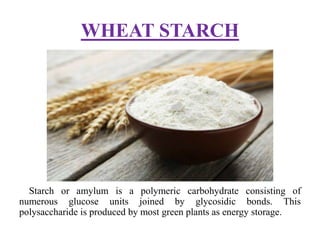
WHEAT STARCH
Starch or amylum is a polymeric carbohydrate consisting of
numerous glucose units joined by glycosidic bonds. This
polysaccharide is produced by most green plants as energy storage.
COMMERCIAL PURPOSE
• Being a pure renewable natural polymer, starch
has a multitude of applications.
• Commercial wheat starch is used in the
manufacture of sweetners, sizing of paper and
textile and as a food thickener and stabilizer.
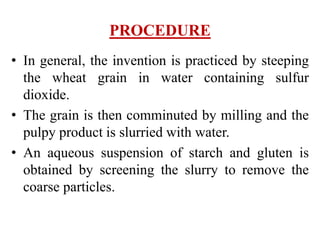
PROCEDURE
• In general, the invention is practiced by steeping
the wheat grain in water containing sulfur
dioxide.
• The grain is then comminuted by milling and the
pulpy product is slurried with water.
• An aqueous suspension of starch and gluten is
obtained by screening the slurry to remove the
coarse particles.
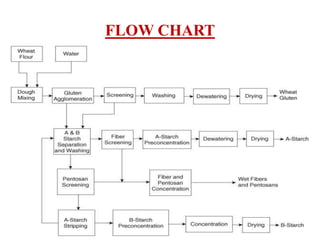
FLOW CHART
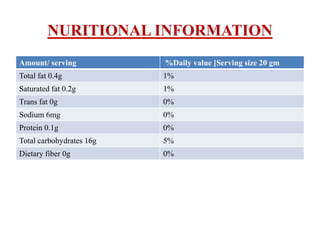
NURITIONAL INFORMATION
Amount/ serving %Daily value [Serving size 20 gm
Total fat 0.4g 1%
Saturated fat 0.2g 1%
Trans fat 0g 0%
Sodium 6mg 0%
Protein 0.1g 0%
Total carbohydrates 16g 5%
Dietary fiber 0g 0%
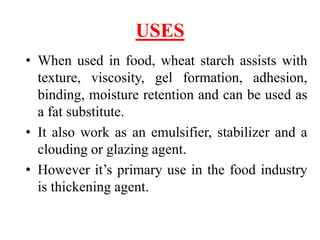
USES
• When used in food, wheat starch assists with
texture, viscosity, gel formation, adhesion,
binding, moisture retention and can be used as
a fat substitute.
• It also work as an emulsifier, stabilizer and a
clouding or glazing agent.
• However it’s primary use in the food industry
is thickening agent.
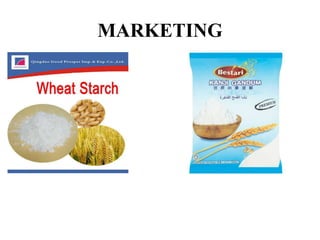
MARKETING
INFERENCE
• When used in food, wheat starch assists With
texture, viscosity, gel formation, adhesion,
binding, moisture retention and can be used as
a fat substitute. It also Works as a emulsifier,
stabilizer and a clouding or glazing agent.
However it’s primary use in food industry is a
thickening agent.
REFERENCES
• Roy L. Whistler, James N. BeMiller; Eugene F.
Paschall, eds. (2012). Starch: Chemistry and
technology. Academic Press. p.220. “Starch
has variable density depending on botanical
origin, prior treatment, and method of
measurement”
• CRC Handbook of chemistry and physics, 49th
edition, 1968-1969, p. D-188.
Wheat starch kumbam mahesh

Wheat starch kumbam mahesh

  • 1.
    ASSIGNMENT ON WHEAT STARCH DEPARTMENT OFAGRONOMY, SAMHIGGINBOTTOM UNIVERSITY OFAGRICULTURE, TECHNOLOGY AND SCIENCES, ALLAHABAD – 211007 (U.P.) SUBMITTED BY KUMBAM MAHESH 19MSAGRO192 M.Sc. Ag. (Agronomy) SUBMITTED TO: Dr. THOMAS ABRAHAM PROFESSOR DEPARMENT OF AGRONOMY
  • 2.
    INTRODUCTION  Wheat isa Grass widely cultivated for its seed, as cereal grain which is a world wide staple food. Botanical Name : Triticum aestivum Family : Poaceae  Wheat is an important source of carbohydrates. Globally, it is a leading source of vegetable protein in human food, having a protein content of about 13%.  Which is relatively high compared to other major cereals but relatively low in protein quality for supplying essential amino acids.
  • 3.
    WHEAT STARCH Starch oramylum is a polymeric carbohydrate consisting of numerous glucose units joined by glycosidic bonds. This polysaccharide is produced by most green plants as energy storage.
  • 4.
    COMMERCIAL PURPOSE • Beinga pure renewable natural polymer, starch has a multitude of applications. • Commercial wheat starch is used in the manufacture of sweetners, sizing of paper and textile and as a food thickener and stabilizer.
  • 5.
    PROCEDURE • In general,the invention is practiced by steeping the wheat grain in water containing sulfur dioxide. • The grain is then comminuted by milling and the pulpy product is slurried with water. • An aqueous suspension of starch and gluten is obtained by screening the slurry to remove the coarse particles.
  • 6.
  • 7.
    NURITIONAL INFORMATION Amount/ serving%Daily value [Serving size 20 gm Total fat 0.4g 1% Saturated fat 0.2g 1% Trans fat 0g 0% Sodium 6mg 0% Protein 0.1g 0% Total carbohydrates 16g 5% Dietary fiber 0g 0%
  • 8.
    USES • When usedin food, wheat starch assists with texture, viscosity, gel formation, adhesion, binding, moisture retention and can be used as a fat substitute. • It also work as an emulsifier, stabilizer and a clouding or glazing agent. • However it’s primary use in the food industry is thickening agent.
  • 9.
  • 10.
    INFERENCE • When usedin food, wheat starch assists With texture, viscosity, gel formation, adhesion, binding, moisture retention and can be used as a fat substitute. It also Works as a emulsifier, stabilizer and a clouding or glazing agent. However it’s primary use in food industry is a thickening agent.
  • 11.
    REFERENCES • Roy L.Whistler, James N. BeMiller; Eugene F. Paschall, eds. (2012). Starch: Chemistry and technology. Academic Press. p.220. “Starch has variable density depending on botanical origin, prior treatment, and method of measurement” • CRC Handbook of chemistry and physics, 49th edition, 1968-1969, p. D-188.