BAKING INGREDIENTS
BAKING INGREDIENTS
AND THEIR PROPERTIES
TLED 118 ADVANCE BAKING
MR. REXIAN NOAH ZARENO
Instructor
Instructor
MEMBERS
Jhasmin Diana Veronica Abegail
GROUP 1
TIKIMAN
TIME
CHAPTER 2 LESSON 1:
WHEAT FLOUR
LEARNING OBJECTIVES:
At the end of the module, the students must be able to:
1. Identify the three parts of kernel.
2. Differentiate hard wheat and soft wheat.
3. Describe the three market forms of wheat flour that are
available in the Philippines.
4. Discuss the functions of flour in baked products.
5. Select flour for quality assurance.
6. Store flour to maintain good condition
Wheat is a grass grown all over the world for its highly
nutritious and functional grain. It is one of the top three
most produced crops in the world, along with corn and
rice. Wheat has been cultivated for over 10.000 years
and probably originates in the Fertile Crescent, along
with other staple crops. A wide range of products are
made from it by humans, including most famously flour,
which is made from the grain itself.
FLOUR
is a finely ground powder made from various grains,
roots, beans, nuts, or seeds. It's a versatile ingredient used
in countless dishes around the world, from breads and
pastries to pasta and thickening agents.
WHEAT FLOUR
The most common type of flour, made from grinding
wheat kernels.
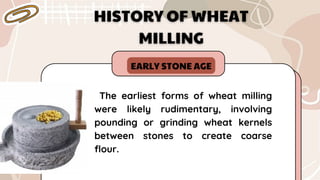
EARLY STONE AGE
The earliest forms of wheat milling
were likely rudimentary, involving
pounding or grinding wheat kernels
between stones to create coarse
flour.
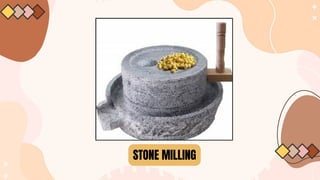
STONE MILLING
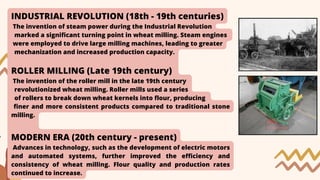
INDUSTRIAL REVOLUTION (18th - 19th centuries)
The invention of steam power during the Industrial Revolution
marked a significant turning point in wheat milling. Steam engines
were employed to drive large milling machines, leading to greater
mechanization and increased production capacity.
ROLLER MILLING (Late 19th century)
The invention of the roller mill in the late 19th century
revolutionized wheat milling. Roller mills used a series
of rollers to break down wheat kernels into flour, producing
finer and more consistent products compared to traditional stone
milling.
MODERN ERA (20th century - present)
Advances in technology, such as the development of electric motors
and automated systems, further improved the efficiency and
consistency of wheat milling. Flour quality and production rates
continued to increase.
STEAM ENGINE ROLLER MILLING
THREE BASIC TYPES OF
FLOUR
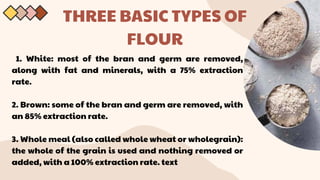
1. White: most of the bran and germ are removed,
along with fat and minerals, with a 75% extraction
rate.
2. Brown: some of the bran and germ are removed, with
an 85% extraction rate.
3. Whole meal (also called whole wheat or wholegrain):
the whole of the grain is used and nothing removed or
added, with a 100% extraction rate. text
SOME COMMON
SOME COMMON
TYPES OF FLOUR
TYPES OF FLOUR
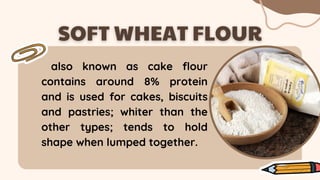
also known as cake flour
contains around 8% protein
and is used for cakes, biscuits
and pastries; whiter than the
other types; tends to hold
shape when lumped together.
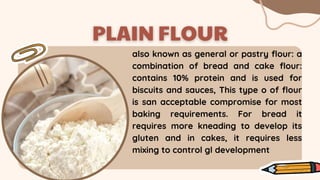
also known as general or pastry flour: a
combination of bread and cake flour:
contains 10% protein and is used for
biscuits and sauces, This type o of flour
is san acceptable compromise for most
baking requirements. For bread it
requires more kneading to develop its
gluten and in cakes, it requires less
mixing to control gl development
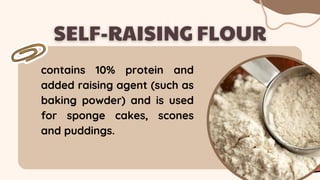
contains 10% protein and
added raising agent (such as
baking powder) and is used
for sponge cakes, scones
and puddings.
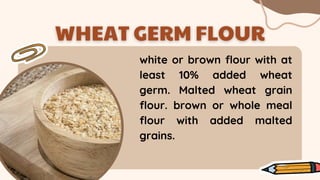
white or brown flour with at
least 10% added wheat
germ. Malted wheat grain
flour. brown or whole meal
flour with added malted
grains.
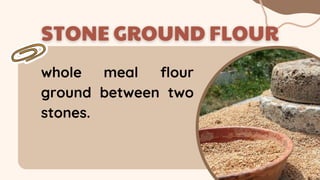
whole meal flour
ground between two
stones.
CLASSIFICATION
OF WHEAT
type
color
hardness
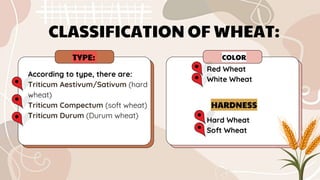
According to type, there are:
Triticum Aestivum/Sativum (hard
wheat)
Triticum Compectum (soft wheat)
Triticum Durum (Durum wheat)
CLASSIFICATION OF WHEAT:
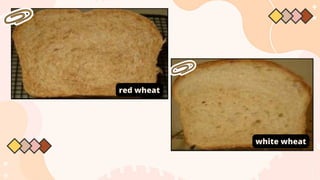
TYPE: COLOR
Red Wheat
White Wheat
Hard Wheat
Soft Wheat
HARDNESS
red wheat
white wheat
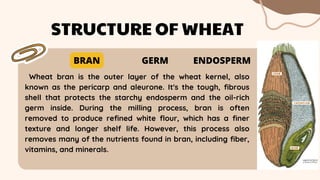
Wheat bran is the outer layer of the wheat kernel, also
known as the pericarp and aleurone. It's the tough, fibrous
shell that protects the starchy endosperm and the oil-rich
germ inside. During the milling process, bran is often
removed to produce refined white flour, which has a finer
texture and longer shelf life. However, this process also
removes many of the nutrients found in bran, including fiber,
vitamins, and minerals.
STRUCTURE OF WHEAT
BRAN GERM ENDOSPERM
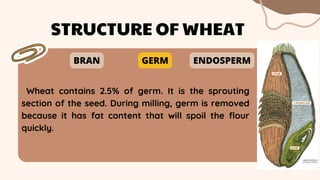
Wheat contains 2.5% of germ. It is the sprouting
section of the seed. During milling, germ is removed
because it has fat content that will spoil the flour
quickly.
STRUCTURE OF WHEAT
BRAN GERM ENDOSPERM
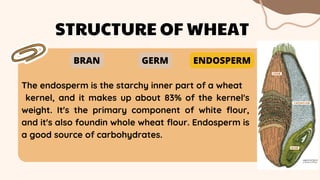
The endosperm is the starchy inner part of a wheat
kernel, and it makes up about 83% of the kernel's
weight. It's the primary component of white flour,
and it's also foundin whole wheat flour. Endosperm is
a good source of carbohydrates.
STRUCTURE OF WHEAT
BRAN GERM ENDOSPERM
TYPES OF
TYPES OF
WHEAT
WHEAT
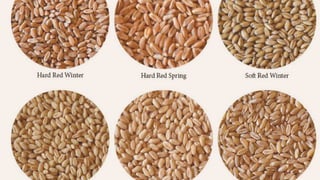
TYPES OF WHEAT
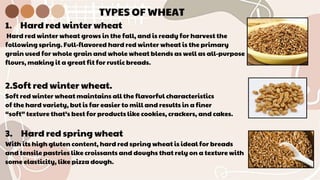
1. Hard red winter wheat
Hard red winter wheat grows in the fall, and is ready for harvest the
following spring. Full-flavored hard red winter wheat is the primary
grain used for whole grain and whole wheat blends as well as all-purpose
flours, making it a great fit for rustic breads.
2.Soft red winter wheat.
Soft red winter wheat maintains all the flavorful characteristics
of the hard variety, but is far easier to mill and results in a finer
“soft” texture that’s best for products like cookies, crackers, and cakes.
3. Hard red spring wheat
With its high gluten content, hard red spring wheat is ideal for breads
and tensile pastries like croissants and doughs that rely on a texture with
some elasticity, like pizza dough.
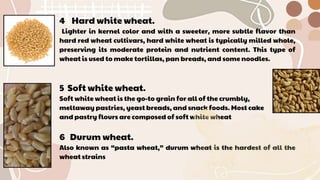
4 Hard white wheat.
Lighter in kernel color and with a sweeter, more subtle flavor than
hard red wheat cultivars, hard white wheat is typically milled whole,
preserving its moderate protein and nutrient content. This type of
wheat is used to make tortillas, pan breads, and some noodles.
5 Soft white wheat.
Soft white wheat is the go-to grain for all of the crumbly,
meltaway pastries, yeast breads, and snack foods. Most cake
and pastry flours are composed of soft white wheat
6 Durum wheat.
Also known as “pasta wheat,” durum wheat is the hardest of all the
wheat strains
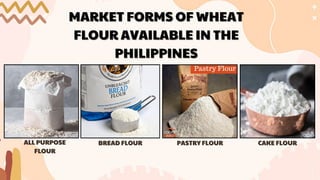
MARKET FORMS OF WHEAT
FLOUR AVAILABLE IN THE
PHILIPPINES
PHILIPPINES
ALL PURPOSE
ALL PURPOSE
FLOUR
FLOUR
BREAD FLOUR
BREAD FLOUR PASTRY FLOUR
PASTRY FLOUR CAKE FLOUR
CAKE FLOUR
ALL PURPOSE
FLOUR Protein Content 10-11% This
flour is the most versatile
and widely used of all flours.
It comes from the finely
ground part of the wheat
kernel called the endosperm,
which gets separated from
the bran and germ during
the milling process.
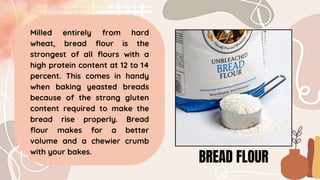
BREAD FLOUR
Milled entirely from hard
wheat, bread flour is the
strongest of all flours with a
high protein content at 12 to 14
percent. This comes in handy
when baking yeasted breads
because of the strong gluten
content required to make the
bread rise properly. Bread
flour makes for a better
volume and a chewier crumb
with your bakes.
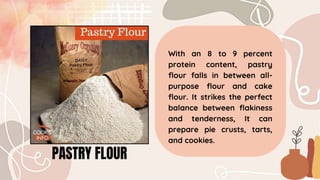
With an 8 to 9 percent
protein content, pastry
flour falls in between all-
purpose flour and cake
flour. It strikes the perfect
balance between flakiness
and tenderness, It can
prepare pie crusts, tarts,
and cookies.
PASTRY FLOUR
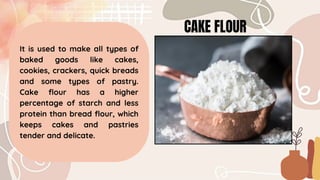
CAKE FLOUR
It is used to make all types of
baked goods like cakes,
cookies, crackers, quick breads
and some types of pastry.
Cake flour has a higher
percentage of starch and less
protein than bread flour, which
keeps cakes and pastries
tender and delicate.
PROPERTIES
PROPERTIES
OF FLOUR
OF FLOUR
1. Colour
Colour of the flour is important as it influences colour of the products. If the
colour of flour is dark or brownish, the colour of the crumb of bread also will
be brownish which is not a desirable. Similarly biscuits and cakes will have
undesirable dark colour particularly at inside portions.
2. Granularity
The granularity or the particle size of the flour is important as it affects the
rate of hydration of flour as well as the amount of water needed to form the
dough. In finer flour, the rate of hydration is faster and the amount of water
needed is also more.
1. MOISTURE
Moisture content in flour is influenced by the conditioning
moisture and the conditions of storage of flour with respect of
temperature, humidity and the packaging materials used. The
deteriorative changes that take place during storage depends
on the moisture. Higher the moisture, faster are the changes,
as most of the reactions are moisture dependent. Higher
moisture level in flour is conducive for the growth of molds and
bacteria.
CHEMICAL
CHARACTERISTICS
ASH ACID ASH
Ash content in maida is important
as it is indicative of contamination
with bran. Higher amount of bran
imparts dull brown colour to maida.
Improper cleaning of wheat prior
to milling, results in higher acid
insoluble ash content in flour.
GLUTEN
Apart from gluten content, the
quality of gluten also influences the
suitability of maida for different
end uses. It is well known that
though gluten content is much
higher in durum wheat, it has very
poor bread making potential due
to inferior quality gluten
GLUTEN QUALITY
Wheat protein is called as gluten.
Wheat is different from other
cereals in that only wheat has the
gluten which is an insoluble protein.
LIPIDS
Enzyme activity in flour is
important mainly in bread making
while in case of biscuits and cake it
is non-significant. However too high
enzyme activity caused by rain
damage will effect the quality of
cake and biscuits.
ENZYMES
Lipids in flour influence nutritional
value, stability on storage, and
processing characteristics
particularly bread making quality.
There are two types oflipids
namely free lipids and bound lipids.
These are again sub classified as
polar lipids and non polar lipids. .
Wheat flour contains 70-75% of starch. Starch by itself acts as
a filler or diluant and imparts rigidity to the dough, and takes
part in the formation on dimensional network of starch +Iipids
- Gluten. This net work is responsible for the gas retention of
tile dough. The starch is responsible for imparting rigidity to
bread. The bread cannot be made without starch, however
the difference in the quality of starch obtained from different
wheats is negligible.
STARCH
CHEMICAL
CHARACTERISTICS
SELECTION
SELECTION
OF FLOUR
OF FLOUR
How do you choose the right flour?
There are two important considerations: quality and protein content.
First, ensure that your flour is the best you can find. Most flour
companies bleach their flour with chemicals like chlorine dioxide and
benzoyl peroxide to give it an artificially white appearance.
Second, know about protein content. Every type of flour is milled to
have a specific protein content — the higher the protein, the “stronger”
the flour. It’s important to use the right flour with the proper protein
content for your recipe and also to choose a brand that adheres
closely to that number. Some flour brands allow wide fluctuations in
their protein content, so every time you use it, you’ll get slightly
different results.
CARE AND
CARE AND
STORAGE OF
STORAGE OF
FLOUR
FLOUR
Here are some ways to ensure the quality
and freshness of the flour even after seven
to eight months.
1. Store the flour in a cool and dry place
2. Ensure the storage is a dark place
3. Use stone jars and containers
4. Make use of air tight containers
5. Make use of Harmless medicines and
special powder in the flour
1. STORE THE FLOUR IN A COOL AND DRY PLACE
The most crucial thing you need to understand
while storing flour is the temperature. You must
choose a place that is away from the heat of the
sun. Usually, the kitchen pantry or shelf is a
better place to store the flour. If the pantry and
shelf are made from stones, it is even better.
Stones remain cool even during high
temperatures. A cool place ensures that the flour
does not retain heat from the surrounding. If the
flour is kept in a high-temperature area, it will
start oozing out the natural oils and turn rancid.
2. ENSURE THE STORAGE IS A DARK PLACE
Apart from the heat, light is the second enemy of
flour. The presence of light will increase the
temperature of the surrounding area. It may also
be a reason to attract critters. Therefore, choose a
storage area that is dark. You already know about
the panty cells and kitchen shelf. Besides, you can
store the flour in cold storage or a freezer. It is
usually dark to prevent the penetration of
sunlight and cold. It can be the best place for flour.
The freshness and quality will not be impacted.
3. USE STONE JARS AND CONTAINERS
Another way to store the flour is to fill them into
stone jars. Stone has cooling properties and
reflects the heat back to the environment. Do not
keep the flour in plastic containers. But make sure
that you keep the stone jars in the pantry, cold
storage, or freezer.
4. MAKE USE OF AIRTIGHT CONTAINERS
Along with heat and light, you need to prevent
moisture from entering the flour storage. If there is
high moisture in the environment, the flour will try
to absorb it. Having moisture content in flour will
destroy the overall quality of the flour. It will lead to
the formation of flour lumps. Moreover, critters
would find it best to feed on such flour. Within no
time, the entire flour will turn rancid and full of
critters. You cannot consume such flour or use it in
the baking process. With an airtight container, air
(oxygen) will not enter the jar. Therefore, it will
protect the flour from moisture, light, and heat.
5. MAKE USE OF HARMLESS MEDICINES AND SPECIAL
POWDER IN THE FLOUR
In the market, you can get a special powder that is
capable of preventing the breeding of critters in
the flour. It does not cause any harm to the flour
and keeps it fresh for a longer duration
CHAPTER 2 LESSON 2:
LIQUID INGREDIENTS
LEARNING OBJECTIVES:
At the end of the module, the students must be able to:
1. Enumerate the uses of liquid in baking.
2. Differentiate the types of water used in baking.
3. Describe each of the commercial processed milks used in
baked products.
4. Discuss the functions of milk in baked products.
5. Explain the functions of fruit juices in baked products.
6. Store liquid ingredients properly.
USES OF LIQUID IN BAKING
1. Dissolves the ingredients and forms a mixture
2. Add moisture
3. Helps to activate the leavening agent (s)
4. Improves the texture
5. Develop gluten.
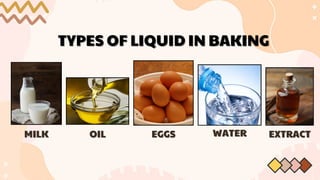
TYPES OF LIQUID IN BAKING
MILK
MILK OIL
OIL EGGS
EGGS WATER
WATER EXTRACT
EXTRACT
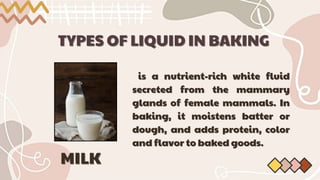
TYPES OF LIQUID IN BAKING
is a nutrient-rich white fluid
secreted from
secreted from the mammary
the mammary
glands of female mammals. In
baking, it moistens batter or
dough, and adds protein, color
and flavor to baked goods.
MILK
MILK
TYPES OF LIQUID IN BAKING
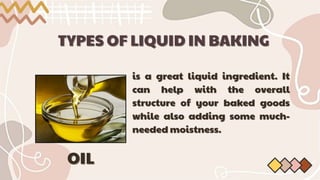
is a great liquid ingredient. It
can help with the overall
structure of your baked goods
while also adding some much-
needed moistness.
needed moistness.
OIL
OIL
TYPES OF LIQUID IN BAKING
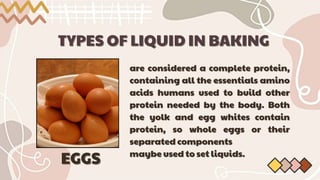
are considered a complete protein,
containing all the essentials amino
acids humans used to build other
protein needed by the body. Both
the yolk and egg whites contain
protein, so whole eggs or their
separated components
maybe used to set liquids.
EGGS
EGGS
TYPES OF LIQUID IN BAKING
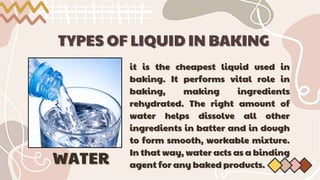
it is the cheapest liquid used in
baking. It performs vital role in
baking, making ingredients
rehydrated. The right amount of
water helps dissolve all other
ingredients in batter and in dough
to form smooth, workable mixture.
In that way, water acts as a binding
agent for any baked products.
WATER
WATER
TYPES OF LIQUID IN BAKING
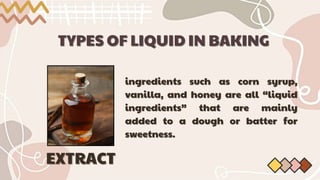
ingredients such as corn syrup,
vanilla, and honey are all “liquid
ingredients” that are mainly
added to a dough or batter for
sweetness.
sweetness.
EXTRACT
EXTRACT
TYPES OF WATER
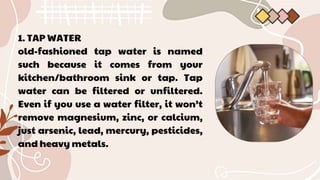
1. TAP WATER
old-fashioned tap water is named
such because it comes from your
kitchen/bathroom sink or tap. Tap
water can be filtered or unfiltered.
Even if you use a water filter, it won’t
remove magnesium, zinc, or calcium,
just arsenic, lead, mercury, pesticides,
and heavy metals.
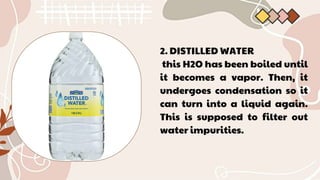
2. DISTILLED WATER
this H2O has been boiled until
it becomes a vapor. Then, it
undergoes condensation so it
can turn into a liquid again.
This is supposed to filter out
water impurities.
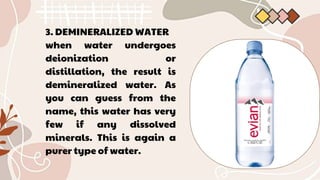
3. DEMINERALIZED WATER
when water undergoes
deionization or
distillation, the result is
demineralized water. As
you can guess from the
name, this water has very
few if any dissolved
minerals. This is again a
purer type of water.
4. SPRING WATER
comes from an aquifer
and then flows to the
earth, where it’s then
bottled at the source. The
natural minerals within
the water are retained.
5. FILTERRED WATER
this is a form of tap water that
undergoes a filtration process.
You can have a filter attached to
your sink, a standalone unit that
purifies water as it exits your
kitchen and bathroom pipes, or
you can buy water filter pitchers.
TYPES OF MILK USED IN BAKING
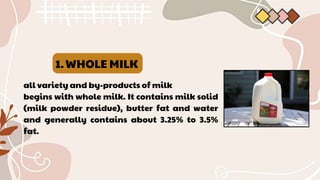
WHOLE MILK
1.
all variety and by-products of milk
begins with whole milk. It contains milk solid
(milk powder residue), butter fat and water
and generally contains about 3.25% to 3.5%
fat.
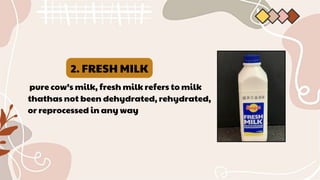
2. FRESH MILK
pure cow’s milk, fresh milk refers to milk
thathas not been dehydrated, rehydrated,
or reprocessed in any way
3. SKIMMED MILK
.non-fat milk or milk that has
zero fat. Because of its lack of fat,
it’s generally thinner
than other milk.
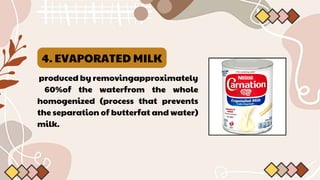
4. EVAPORATED MILK
produced by removingapproximately
60%of the waterfrom the whole
homogenized (process that prevents
the separation of butterfat and water)
milk.
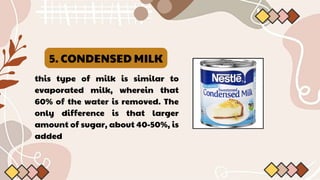
5. CONDENSED MILK
this type of milk is similar to
evaporated milk, wherein that
60% of the water is removed. The
only difference is that larger
amount of sugar, about 40-50%, is
added
6. DRIED MILK
whole milk in powdered milk
FUNCTION OF MILK
FUNCTION OF MILK
AND FRUIT JUICES IN
AND FRUIT JUICES IN
BAKED PRODUCTS
BAKED PRODUCTS
There are several different types of milk that can be used in
baking, including whole milk, reduced-fat milk, and non-dairy milk
alternatives. Each type of milk has its own unique characteristics
and is used to achieve different results in the final product.
Whole milk
- which has a higher fat content, is often used in baking to add
richness and flavor. It is also a good choice for creating a softer
crumb in breads and cakes.
Reduced-fat milk
- which has less fat than whole milk, can be used to reduce the
fat content of baked goods without sacrificing flavor or texture.
Non-dairy milk alternatives such as almond milk or soy milk,
can be used as a substitute for dairy milk in many baked goods
recipes.
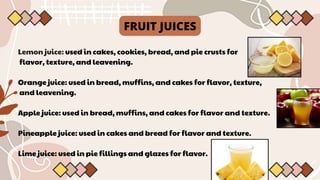
Lemon juice: used in cakes, cookies, bread, and pie crusts for
flavor, texture, and leavening.
Orange juice: used in bread, muffins, and cakes for flavor, texture,
and leavening.
Apple juice: used in bread, muffins, and cakes for flavor and texture.
Pineapple juice: used in cakes and bread for flavor and texture.
Lime juice: used in pie fillings and glazes for flavor.
FRUIT JUICES
Always use fresh, natural juices for the best flavor and texture.
Pay attention to the acidity of the juice you’re using, as it can
impact the leavening and texture of your baked goods.
Use juice as a substitute for some of the liquid in your recipes, but
be mindful of the amount you’re adding to avoid altering the
recipe’s balance.
Adjust the amount of sugar in your recipe based on the
sweetness of the juice you’re using.
STORAGE
Milk - Unopened container: Cool, dark place, or in the fridge.
Milk sweetened condensed - Unopened container: Cool, dark
place, or in the fridge.
Oil, vegetable or canola - Sealed bottle (preferably made of
tinted glass or stainless steel to keep light out) in a dark, cool
place.
Vanilla, pure extract - Sealed bottle in a cool, dark place.
Thank You
Thank You
For Listening!
For Listening!
REFERENCES:
·https://egyankosh.ac.in/bitstream/123456789/11076/5/Unit-1.pdf
·https://www.kingarthurbaking.com/blog/2019/07/12/types-
of%EF%BF%BEflour#:~:text=Every%20type%20of%20flour%20is,adheres%20closely%20to%20that%20number
·https://usflour.com/flour-storage-tips-and-tricks/
·https://bakinghow.com/liquid-ingredients-in-baking/
·https://www.studocu.com/ph/document/richwell-colleges/basic-baking/essential-baking-
ingredients/66164433
·https://www.studocu.com/ph/document/isabela-state-university/bachelor-of-technology-livelihood-
education/bpp-module-1-for-bpp/33995905
·https://slideplayer.com/amp/5687044/to
·https://thebreadguide.com/which-water-should-i-use-when-baking-bread/
·https://www.bakerydestefano.com/blogs/the-blog/the_benefits_of_using_milk_in_baking
·https://www.cakere.com/what-does-juice-do-in-baking/
·https://stressbaking.com/storing-baking-ingredients/

Wheat Flour & Liquid Ingredients use in baking.pdf

  • 1.
    BAKING INGREDIENTS BAKING INGREDIENTS ANDTHEIR PROPERTIES AND THEIR PROPERTIES TLED 118 ADVANCE BAKING TLED 118 ADVANCE BAKING MR. REXIAN NOAH ZARENO MR. REXIAN NOAH ZARENO Instructor Instructor
  • 2.
  • 3.
  • 4.
    CHAPTER 2 LESSON1: WHEAT FLOUR
  • 5.
    LEARNING OBJECTIVES: At theend of the module, the students must be able to: 1. Identify the three parts of kernel. 2. Differentiate hard wheat and soft wheat. 3. Describe the three market forms of wheat flour that are available in the Philippines. 4. Discuss the functions of flour in baked products. 5. Select flour for quality assurance. 6. Store flour to maintain good condition
  • 6.
    Wheat is agrass grown all over the world for its highly nutritious and functional grain. It is one of the top three most produced crops in the world, along with corn and rice. Wheat has been cultivated for over 10.000 years and probably originates in the Fertile Crescent, along with other staple crops. A wide range of products are made from it by humans, including most famously flour, which is made from the grain itself.
  • 7.
    FLOUR is a finelyground powder made from various grains, roots, beans, nuts, or seeds. It's a versatile ingredient used in countless dishes around the world, from breads and pastries to pasta and thickening agents. WHEAT FLOUR The most common type of flour, made from grinding wheat kernels.
  • 8.
    EARLY STONE AGE Theearliest forms of wheat milling were likely rudimentary, involving pounding or grinding wheat kernels between stones to create coarse flour.
  • 9.
  • 10.
    INDUSTRIAL REVOLUTION (18th- 19th centuries) The invention of steam power during the Industrial Revolution marked a significant turning point in wheat milling. Steam engines were employed to drive large milling machines, leading to greater mechanization and increased production capacity. ROLLER MILLING (Late 19th century) The invention of the roller mill in the late 19th century revolutionized wheat milling. Roller mills used a series of rollers to break down wheat kernels into flour, producing finer and more consistent products compared to traditional stone milling. MODERN ERA (20th century - present) Advances in technology, such as the development of electric motors and automated systems, further improved the efficiency and consistency of wheat milling. Flour quality and production rates continued to increase.
  • 11.
  • 12.
    THREE BASIC TYPESOF FLOUR 1. White: most of the bran and germ are removed, along with fat and minerals, with a 75% extraction rate. 2. Brown: some of the bran and germ are removed, with an 85% extraction rate. 3. Whole meal (also called whole wheat or wholegrain): the whole of the grain is used and nothing removed or added, with a 100% extraction rate. text
  • 13.
    SOME COMMON SOME COMMON TYPESOF FLOUR TYPES OF FLOUR
  • 14.
    also known ascake flour contains around 8% protein and is used for cakes, biscuits and pastries; whiter than the other types; tends to hold shape when lumped together.
  • 15.
    also known asgeneral or pastry flour: a combination of bread and cake flour: contains 10% protein and is used for biscuits and sauces, This type o of flour is san acceptable compromise for most baking requirements. For bread it requires more kneading to develop its gluten and in cakes, it requires less mixing to control gl development
  • 16.
    contains 10% proteinand added raising agent (such as baking powder) and is used for sponge cakes, scones and puddings.
  • 17.
    white or brownflour with at least 10% added wheat germ. Malted wheat grain flour. brown or whole meal flour with added malted grains.
  • 18.
    whole meal flour groundbetween two stones.
  • 19.
  • 20.
    According to type,there are: Triticum Aestivum/Sativum (hard wheat) Triticum Compectum (soft wheat) Triticum Durum (Durum wheat) CLASSIFICATION OF WHEAT: TYPE: COLOR Red Wheat White Wheat Hard Wheat Soft Wheat HARDNESS
  • 21.
  • 22.
    Wheat bran isthe outer layer of the wheat kernel, also known as the pericarp and aleurone. It's the tough, fibrous shell that protects the starchy endosperm and the oil-rich germ inside. During the milling process, bran is often removed to produce refined white flour, which has a finer texture and longer shelf life. However, this process also removes many of the nutrients found in bran, including fiber, vitamins, and minerals. STRUCTURE OF WHEAT BRAN GERM ENDOSPERM
  • 23.
    Wheat contains 2.5%of germ. It is the sprouting section of the seed. During milling, germ is removed because it has fat content that will spoil the flour quickly. STRUCTURE OF WHEAT BRAN GERM ENDOSPERM
  • 24.
    The endosperm isthe starchy inner part of a wheat kernel, and it makes up about 83% of the kernel's weight. It's the primary component of white flour, and it's also foundin whole wheat flour. Endosperm is a good source of carbohydrates. STRUCTURE OF WHEAT BRAN GERM ENDOSPERM
  • 25.
  • 27.
    TYPES OF WHEAT 1.Hard red winter wheat Hard red winter wheat grows in the fall, and is ready for harvest the following spring. Full-flavored hard red winter wheat is the primary grain used for whole grain and whole wheat blends as well as all-purpose flours, making it a great fit for rustic breads. 2.Soft red winter wheat. Soft red winter wheat maintains all the flavorful characteristics of the hard variety, but is far easier to mill and results in a finer “soft” texture that’s best for products like cookies, crackers, and cakes. 3. Hard red spring wheat With its high gluten content, hard red spring wheat is ideal for breads and tensile pastries like croissants and doughs that rely on a texture with some elasticity, like pizza dough.
  • 28.
    4 Hard whitewheat. Lighter in kernel color and with a sweeter, more subtle flavor than hard red wheat cultivars, hard white wheat is typically milled whole, preserving its moderate protein and nutrient content. This type of wheat is used to make tortillas, pan breads, and some noodles. 5 Soft white wheat. Soft white wheat is the go-to grain for all of the crumbly, meltaway pastries, yeast breads, and snack foods. Most cake and pastry flours are composed of soft white wheat 6 Durum wheat. Also known as “pasta wheat,” durum wheat is the hardest of all the wheat strains
  • 29.
    MARKET FORMS OFWHEAT MARKET FORMS OF WHEAT FLOUR AVAILABLE IN THE FLOUR AVAILABLE IN THE PHILIPPINES PHILIPPINES ALL PURPOSE ALL PURPOSE FLOUR FLOUR BREAD FLOUR BREAD FLOUR PASTRY FLOUR PASTRY FLOUR CAKE FLOUR CAKE FLOUR
  • 30.
    ALL PURPOSE FLOUR ProteinContent 10-11% This flour is the most versatile and widely used of all flours. It comes from the finely ground part of the wheat kernel called the endosperm, which gets separated from the bran and germ during the milling process.
  • 31.
    BREAD FLOUR Milled entirelyfrom hard wheat, bread flour is the strongest of all flours with a high protein content at 12 to 14 percent. This comes in handy when baking yeasted breads because of the strong gluten content required to make the bread rise properly. Bread flour makes for a better volume and a chewier crumb with your bakes.
  • 32.
    With an 8to 9 percent protein content, pastry flour falls in between all- purpose flour and cake flour. It strikes the perfect balance between flakiness and tenderness, It can prepare pie crusts, tarts, and cookies. PASTRY FLOUR
  • 33.
    CAKE FLOUR It isused to make all types of baked goods like cakes, cookies, crackers, quick breads and some types of pastry. Cake flour has a higher percentage of starch and less protein than bread flour, which keeps cakes and pastries tender and delicate.
  • 34.
  • 35.
    1. Colour Colour ofthe flour is important as it influences colour of the products. If the colour of flour is dark or brownish, the colour of the crumb of bread also will be brownish which is not a desirable. Similarly biscuits and cakes will have undesirable dark colour particularly at inside portions. 2. Granularity The granularity or the particle size of the flour is important as it affects the rate of hydration of flour as well as the amount of water needed to form the dough. In finer flour, the rate of hydration is faster and the amount of water needed is also more.
  • 36.
    1. MOISTURE Moisture contentin flour is influenced by the conditioning moisture and the conditions of storage of flour with respect of temperature, humidity and the packaging materials used. The deteriorative changes that take place during storage depends on the moisture. Higher the moisture, faster are the changes, as most of the reactions are moisture dependent. Higher moisture level in flour is conducive for the growth of molds and bacteria. CHEMICAL CHARACTERISTICS
  • 37.
    ASH ACID ASH Ashcontent in maida is important as it is indicative of contamination with bran. Higher amount of bran imparts dull brown colour to maida. Improper cleaning of wheat prior to milling, results in higher acid insoluble ash content in flour.
  • 38.
    GLUTEN Apart from glutencontent, the quality of gluten also influences the suitability of maida for different end uses. It is well known that though gluten content is much higher in durum wheat, it has very poor bread making potential due to inferior quality gluten GLUTEN QUALITY Wheat protein is called as gluten. Wheat is different from other cereals in that only wheat has the gluten which is an insoluble protein.
  • 39.
    LIPIDS Enzyme activity inflour is important mainly in bread making while in case of biscuits and cake it is non-significant. However too high enzyme activity caused by rain damage will effect the quality of cake and biscuits. ENZYMES Lipids in flour influence nutritional value, stability on storage, and processing characteristics particularly bread making quality. There are two types oflipids namely free lipids and bound lipids. These are again sub classified as polar lipids and non polar lipids. .
  • 40.
    Wheat flour contains70-75% of starch. Starch by itself acts as a filler or diluant and imparts rigidity to the dough, and takes part in the formation on dimensional network of starch +Iipids - Gluten. This net work is responsible for the gas retention of tile dough. The starch is responsible for imparting rigidity to bread. The bread cannot be made without starch, however the difference in the quality of starch obtained from different wheats is negligible. STARCH CHEMICAL CHARACTERISTICS
  • 41.
  • 42.
    How do youchoose the right flour? There are two important considerations: quality and protein content. First, ensure that your flour is the best you can find. Most flour companies bleach their flour with chemicals like chlorine dioxide and benzoyl peroxide to give it an artificially white appearance. Second, know about protein content. Every type of flour is milled to have a specific protein content — the higher the protein, the “stronger” the flour. It’s important to use the right flour with the proper protein content for your recipe and also to choose a brand that adheres closely to that number. Some flour brands allow wide fluctuations in their protein content, so every time you use it, you’ll get slightly different results.
  • 43.
    CARE AND CARE AND STORAGEOF STORAGE OF FLOUR FLOUR
  • 44.
    Here are someways to ensure the quality and freshness of the flour even after seven to eight months. 1. Store the flour in a cool and dry place 2. Ensure the storage is a dark place 3. Use stone jars and containers 4. Make use of air tight containers 5. Make use of Harmless medicines and special powder in the flour
  • 45.
    1. STORE THEFLOUR IN A COOL AND DRY PLACE The most crucial thing you need to understand while storing flour is the temperature. You must choose a place that is away from the heat of the sun. Usually, the kitchen pantry or shelf is a better place to store the flour. If the pantry and shelf are made from stones, it is even better. Stones remain cool even during high temperatures. A cool place ensures that the flour does not retain heat from the surrounding. If the flour is kept in a high-temperature area, it will start oozing out the natural oils and turn rancid.
  • 46.
    2. ENSURE THESTORAGE IS A DARK PLACE Apart from the heat, light is the second enemy of flour. The presence of light will increase the temperature of the surrounding area. It may also be a reason to attract critters. Therefore, choose a storage area that is dark. You already know about the panty cells and kitchen shelf. Besides, you can store the flour in cold storage or a freezer. It is usually dark to prevent the penetration of sunlight and cold. It can be the best place for flour. The freshness and quality will not be impacted.
  • 47.
    3. USE STONEJARS AND CONTAINERS Another way to store the flour is to fill them into stone jars. Stone has cooling properties and reflects the heat back to the environment. Do not keep the flour in plastic containers. But make sure that you keep the stone jars in the pantry, cold storage, or freezer.
  • 48.
    4. MAKE USEOF AIRTIGHT CONTAINERS Along with heat and light, you need to prevent moisture from entering the flour storage. If there is high moisture in the environment, the flour will try to absorb it. Having moisture content in flour will destroy the overall quality of the flour. It will lead to the formation of flour lumps. Moreover, critters would find it best to feed on such flour. Within no time, the entire flour will turn rancid and full of critters. You cannot consume such flour or use it in the baking process. With an airtight container, air (oxygen) will not enter the jar. Therefore, it will protect the flour from moisture, light, and heat.
  • 49.
    5. MAKE USEOF HARMLESS MEDICINES AND SPECIAL POWDER IN THE FLOUR In the market, you can get a special powder that is capable of preventing the breeding of critters in the flour. It does not cause any harm to the flour and keeps it fresh for a longer duration
  • 50.
    CHAPTER 2 LESSON2: LIQUID INGREDIENTS
  • 51.
    LEARNING OBJECTIVES: At theend of the module, the students must be able to: 1. Enumerate the uses of liquid in baking. 2. Differentiate the types of water used in baking. 3. Describe each of the commercial processed milks used in baked products. 4. Discuss the functions of milk in baked products. 5. Explain the functions of fruit juices in baked products. 6. Store liquid ingredients properly.
  • 52.
    USES OF LIQUIDIN BAKING 1. Dissolves the ingredients and forms a mixture 2. Add moisture 3. Helps to activate the leavening agent (s) 4. Improves the texture 5. Develop gluten.
  • 53.
    TYPES OF LIQUIDIN BAKING TYPES OF LIQUID IN BAKING MILK MILK OIL OIL EGGS EGGS WATER WATER EXTRACT EXTRACT
  • 54.
    TYPES OF LIQUIDIN BAKING TYPES OF LIQUID IN BAKING is a nutrient-rich white fluid is a nutrient-rich white fluid secreted from secreted from the mammary the mammary glands of female mammals. In glands of female mammals. In baking, it moistens batter or baking, it moistens batter or dough, and adds protein, color dough, and adds protein, color and flavor to baked goods. and flavor to baked goods. MILK MILK
  • 55.
    TYPES OF LIQUIDIN BAKING TYPES OF LIQUID IN BAKING is a great liquid ingredient. It is a great liquid ingredient. It can help with the overall can help with the overall structure of your baked goods structure of your baked goods while also adding some much- while also adding some much- needed moistness. needed moistness. OIL OIL
  • 56.
    TYPES OF LIQUIDIN BAKING TYPES OF LIQUID IN BAKING are considered a complete protein, are considered a complete protein, containing all the essentials amino containing all the essentials amino acids humans used to build other acids humans used to build other protein needed by the body. Both protein needed by the body. Both the yolk and egg whites contain the yolk and egg whites contain protein, so whole eggs or their protein, so whole eggs or their separated components separated components maybe used to set liquids. maybe used to set liquids. EGGS EGGS
  • 57.
    TYPES OF LIQUIDIN BAKING TYPES OF LIQUID IN BAKING it is the cheapest liquid used in it is the cheapest liquid used in baking. It performs vital role in baking. It performs vital role in baking, making ingredients baking, making ingredients rehydrated. The right amount of rehydrated. The right amount of water helps dissolve all other water helps dissolve all other ingredients in batter and in dough ingredients in batter and in dough to form smooth, workable mixture. to form smooth, workable mixture. In that way, water acts as a binding In that way, water acts as a binding agent for any baked products. agent for any baked products. WATER WATER
  • 58.
    TYPES OF LIQUIDIN BAKING TYPES OF LIQUID IN BAKING ingredients such as corn syrup, ingredients such as corn syrup, vanilla, and honey are all “liquid vanilla, and honey are all “liquid ingredients” that are mainly ingredients” that are mainly added to a dough or batter for added to a dough or batter for sweetness. sweetness. EXTRACT EXTRACT
  • 59.
  • 60.
    1. TAP WATER old-fashionedtap water is named such because it comes from your kitchen/bathroom sink or tap. Tap water can be filtered or unfiltered. Even if you use a water filter, it won’t remove magnesium, zinc, or calcium, just arsenic, lead, mercury, pesticides, and heavy metals.
  • 61.
    2. DISTILLED WATER thisH2O has been boiled until it becomes a vapor. Then, it undergoes condensation so it can turn into a liquid again. This is supposed to filter out water impurities.
  • 62.
    3. DEMINERALIZED WATER whenwater undergoes deionization or distillation, the result is demineralized water. As you can guess from the name, this water has very few if any dissolved minerals. This is again a purer type of water.
  • 63.
    4. SPRING WATER comesfrom an aquifer and then flows to the earth, where it’s then bottled at the source. The natural minerals within the water are retained.
  • 64.
    5. FILTERRED WATER thisis a form of tap water that undergoes a filtration process. You can have a filter attached to your sink, a standalone unit that purifies water as it exits your kitchen and bathroom pipes, or you can buy water filter pitchers.
  • 65.
    TYPES OF MILKUSED IN BAKING
  • 66.
    WHOLE MILK 1. all varietyand by-products of milk begins with whole milk. It contains milk solid (milk powder residue), butter fat and water and generally contains about 3.25% to 3.5% fat.
  • 67.
    2. FRESH MILK purecow’s milk, fresh milk refers to milk thathas not been dehydrated, rehydrated, or reprocessed in any way
  • 68.
    3. SKIMMED MILK .non-fatmilk or milk that has zero fat. Because of its lack of fat, it’s generally thinner than other milk.
  • 69.
    4. EVAPORATED MILK producedby removingapproximately 60%of the waterfrom the whole homogenized (process that prevents the separation of butterfat and water) milk.
  • 70.
    5. CONDENSED MILK thistype of milk is similar to evaporated milk, wherein that 60% of the water is removed. The only difference is that larger amount of sugar, about 40-50%, is added
  • 71.
    6. DRIED MILK wholemilk in powdered milk
  • 72.
    FUNCTION OF MILK FUNCTIONOF MILK AND FRUIT JUICES IN AND FRUIT JUICES IN BAKED PRODUCTS BAKED PRODUCTS
  • 73.
    There are severaldifferent types of milk that can be used in baking, including whole milk, reduced-fat milk, and non-dairy milk alternatives. Each type of milk has its own unique characteristics and is used to achieve different results in the final product. Whole milk - which has a higher fat content, is often used in baking to add richness and flavor. It is also a good choice for creating a softer crumb in breads and cakes. Reduced-fat milk - which has less fat than whole milk, can be used to reduce the fat content of baked goods without sacrificing flavor or texture. Non-dairy milk alternatives such as almond milk or soy milk, can be used as a substitute for dairy milk in many baked goods recipes.
  • 74.
    Lemon juice: usedin cakes, cookies, bread, and pie crusts for flavor, texture, and leavening. Orange juice: used in bread, muffins, and cakes for flavor, texture, and leavening. Apple juice: used in bread, muffins, and cakes for flavor and texture. Pineapple juice: used in cakes and bread for flavor and texture. Lime juice: used in pie fillings and glazes for flavor. FRUIT JUICES
  • 75.
    Always use fresh,natural juices for the best flavor and texture. Pay attention to the acidity of the juice you’re using, as it can impact the leavening and texture of your baked goods. Use juice as a substitute for some of the liquid in your recipes, but be mindful of the amount you’re adding to avoid altering the recipe’s balance. Adjust the amount of sugar in your recipe based on the sweetness of the juice you’re using.
  • 76.
    STORAGE Milk - Unopenedcontainer: Cool, dark place, or in the fridge. Milk sweetened condensed - Unopened container: Cool, dark place, or in the fridge. Oil, vegetable or canola - Sealed bottle (preferably made of tinted glass or stainless steel to keep light out) in a dark, cool place. Vanilla, pure extract - Sealed bottle in a cool, dark place.
  • 77.
    Thank You Thank You ForListening! For Listening!
  • 78.
    REFERENCES: ·https://egyankosh.ac.in/bitstream/123456789/11076/5/Unit-1.pdf ·https://www.kingarthurbaking.com/blog/2019/07/12/types- of%EF%BF%BEflour#:~:text=Every%20type%20of%20flour%20is,adheres%20closely%20to%20that%20number ·https://usflour.com/flour-storage-tips-and-tricks/ ·https://bakinghow.com/liquid-ingredients-in-baking/ ·https://www.studocu.com/ph/document/richwell-colleges/basic-baking/essential-baking- ingredients/66164433 ·https://www.studocu.com/ph/document/isabela-state-university/bachelor-of-technology-livelihood- education/bpp-module-1-for-bpp/33995905 ·https://slideplayer.com/amp/5687044/to ·https://thebreadguide.com/which-water-should-i-use-when-baking-bread/ ·https://www.bakerydestefano.com/blogs/the-blog/the_benefits_of_using_milk_in_baking ·https://www.cakere.com/what-does-juice-do-in-baking/ ·https://stressbaking.com/storing-baking-ingredients/