PREPARE AND PRODUCE
BAKERYPRODUCTS
INFORMATION SHEET 1.1-3
SPECIFIC BAKING INGREDIENTS
AND ITS SUBSTITUTION
2.
OBJECTIVES:
After reading thisinformation sheet
you should be able to:
1. familiarize different baking
ingredients and its properties
2. identify substitutes for different
baking ingredients
3.
UNDERSTANDING INGREDIENTS,WHY THEYFUNCTION THE WAY THEY DO
AND HOW TO ADJUST FOR THEIR DIFFERENCES WILL MAKE THE BAKING
EXPERIENCE MORE SUCCESSFUL AND CONSISTENT.
FLOUR
Provides bulkness and structure to
baked goods.
The higher the protein content, the
greater the flour’s gluten forming
potential.
4.
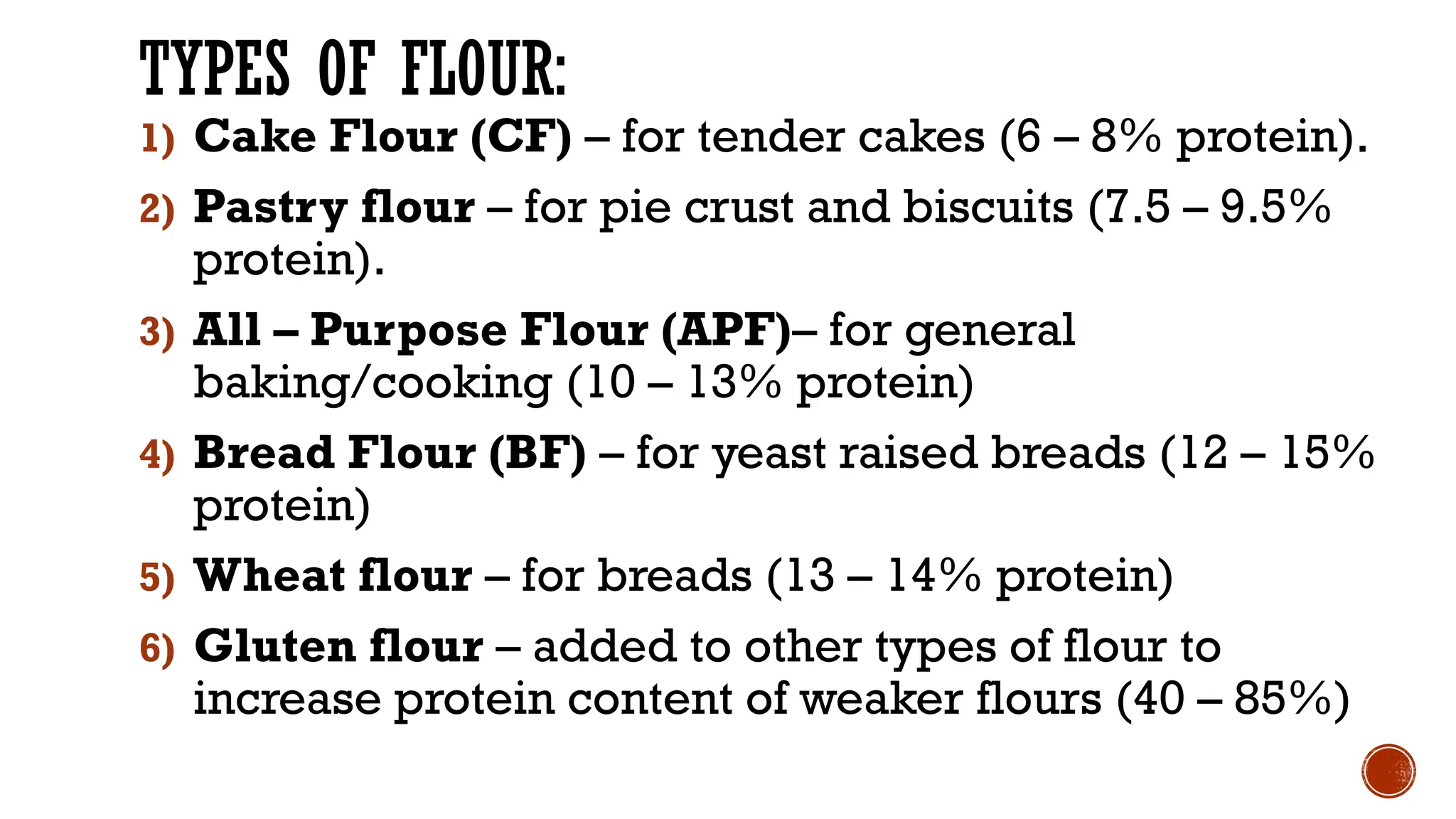
TYPES OF FLOUR:
1)Cake Flour (CF) – for tender cakes (6 – 8% protein).
2) Pastry flour – for pie crust and biscuits (7.5 – 9.5%
protein).
3) All – Purpose Flour (APF)– for general
baking/cooking (10 – 13% protein)
4) Bread Flour (BF) – for yeast raised breads (12 – 15%
protein)
5) Wheat flour – for breads (13 – 14% protein)
6) Gluten flour – added to other types of flour to
increase protein content of weaker flours (40 – 85%)
5.
MEASURING INGREDIENTS
One ofthe keys to successful baking is the correct
measurement of ingredients one should not only
follow the amounts stated in a recipe but also
measure them in the right way.
Dry and liquid ingredients are measured
differently.
6.
MEASURING TECHNIQUES
Dry ingredientslike flour and sugar are
measured in nested measuring cups which come
in a set of 4 (1 cup, ½ cup, 1/3 cup and ¼ cup).
Sugar and all-purpose flour are measured by
dipping the cups into the ingredient until filled
then leveling it off with a spatula.
For cake flour and confectioners’ sugar,
ingredients are spooned onto the cup then
leveled off.
7.
MEASURING TECHNIQUES
Brown sugarmust be compacted in a cup.When
the cup is inverted the measured sugar should
retain the shape of the cup.
Liquid ingredients are poured into spouted glass
measuring cups placed on a flat surface.
Measurement is read at eye level.
Small quantities of dry and liquid ingredients are
measured using spoons measuring 1 tablespoon,
1 teaspoon, ½ teaspoon, or ¼ teaspoon.
8.
MEASURING TECHNIQUES
Dry ingredientsare leveled off with spatula.
Shortening is measured by pressing down
firmly into the measuring cup to make sure
there are no air spaces.
Butter need not be measured in cups. One
bar of butter is already 1 cup just divide the
bar into 2 for 1/3 into 3 and so on.
9.
SELECTING, MEASURING ANDWEIGHING INGREDIENTS
Understanding ingredients why they function
the way they do and how to adjust for their
differences will make the baking experience
more successful and consistent.
1. FLOUR – is a finely ground meal or
powdery product obtained from milling or
grinding cereal grains ,(such as wheat, rice)
root crops, starchy vegetables, and other foods.
10.
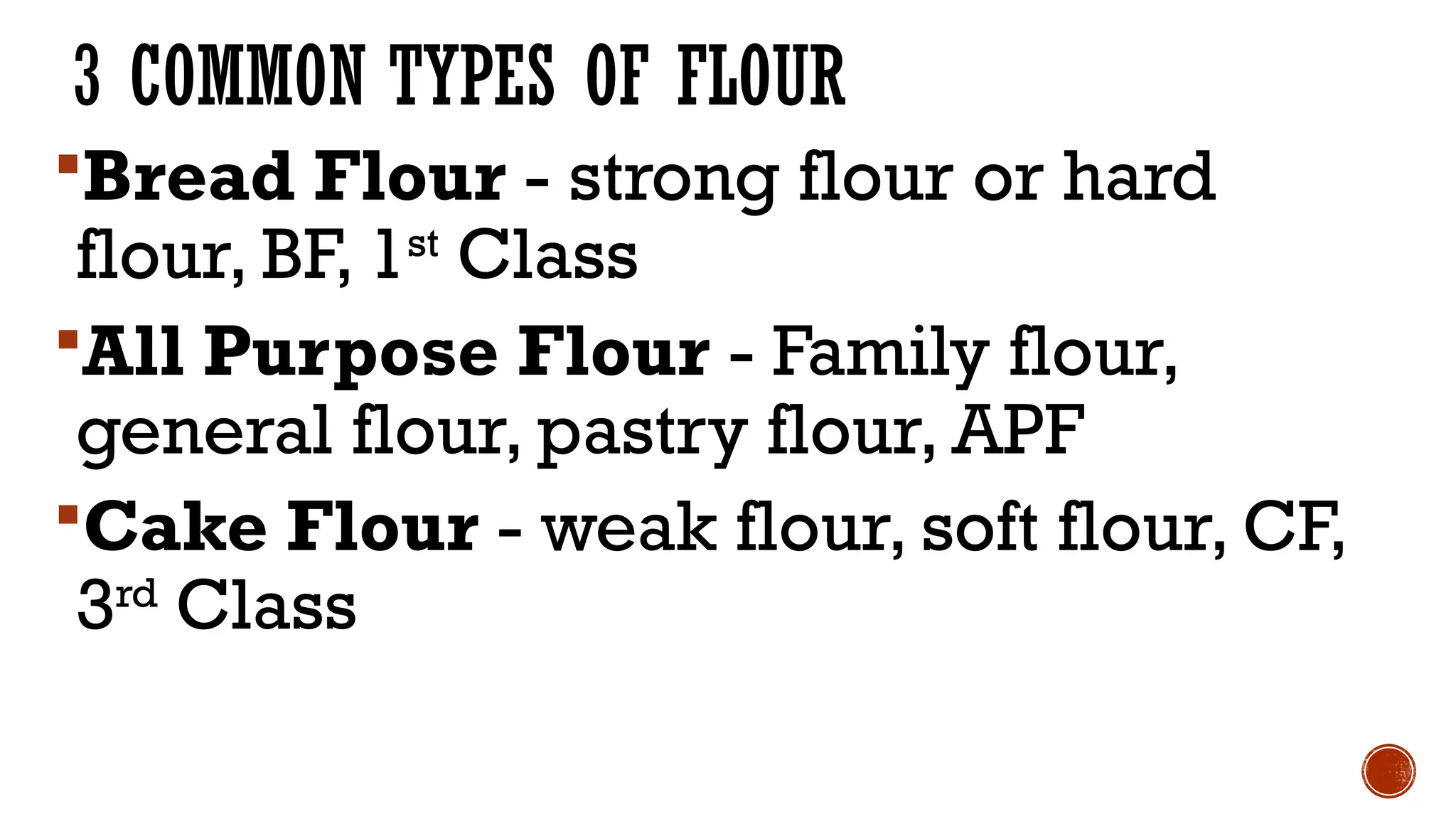
3 COMMON TYPESOF FLOUR
Bread Flour - strong flour or hard
flour, BF, 1st
Class
All Purpose Flour - Family flour,
general flour, pastry flour, APF
Cake Flour - weak flour, soft flour, CF,
3rd
Class
11.
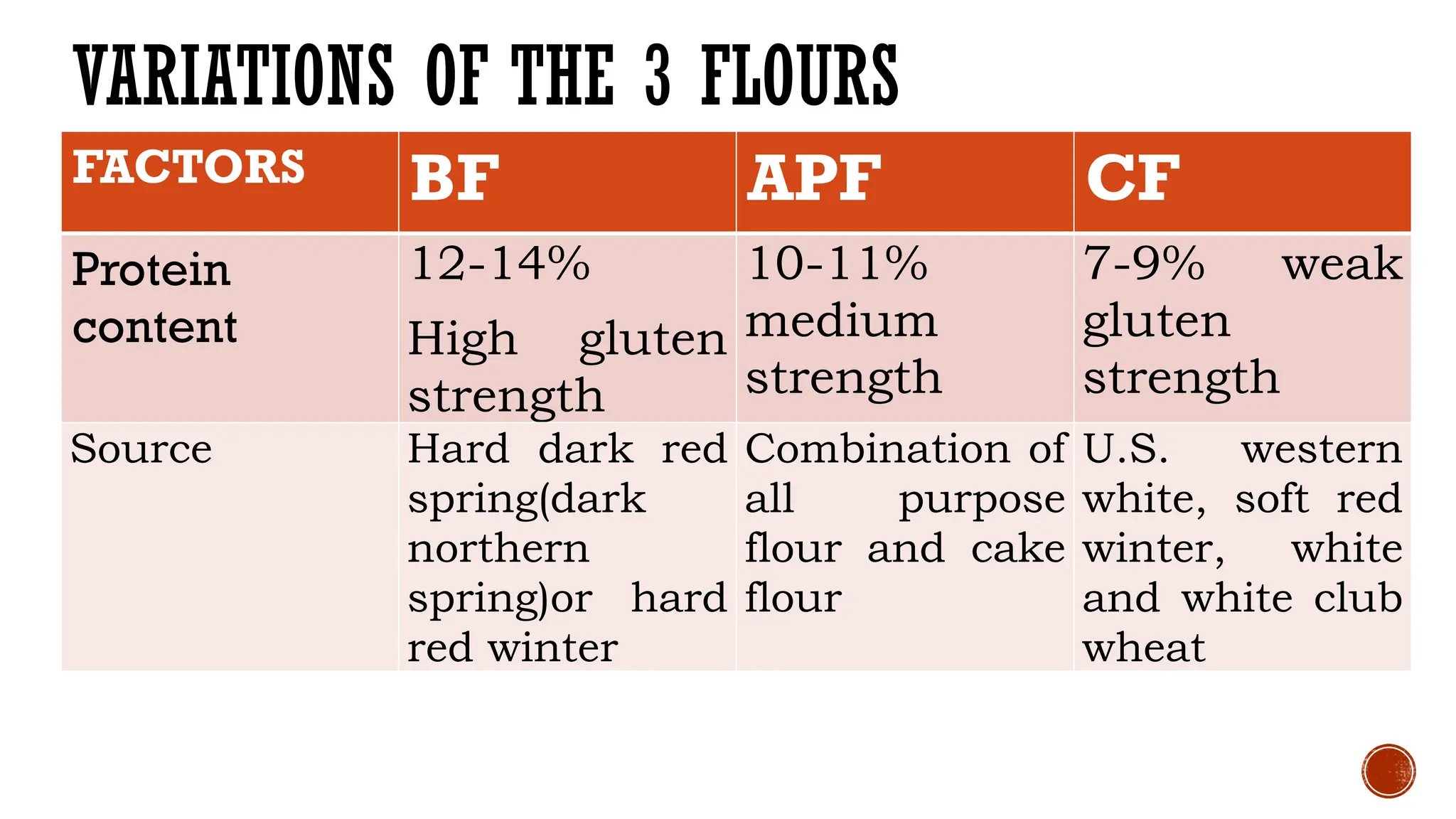
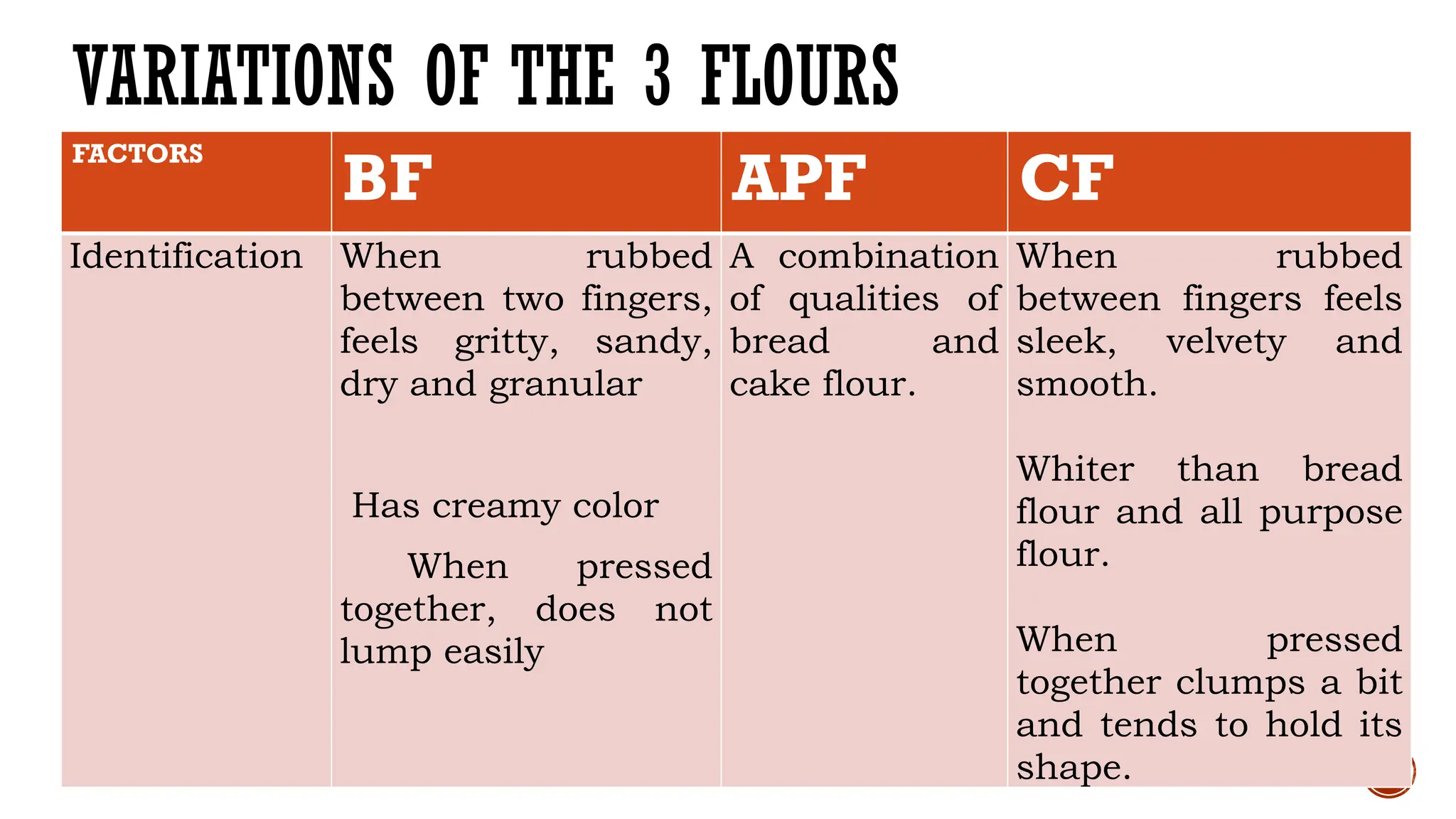
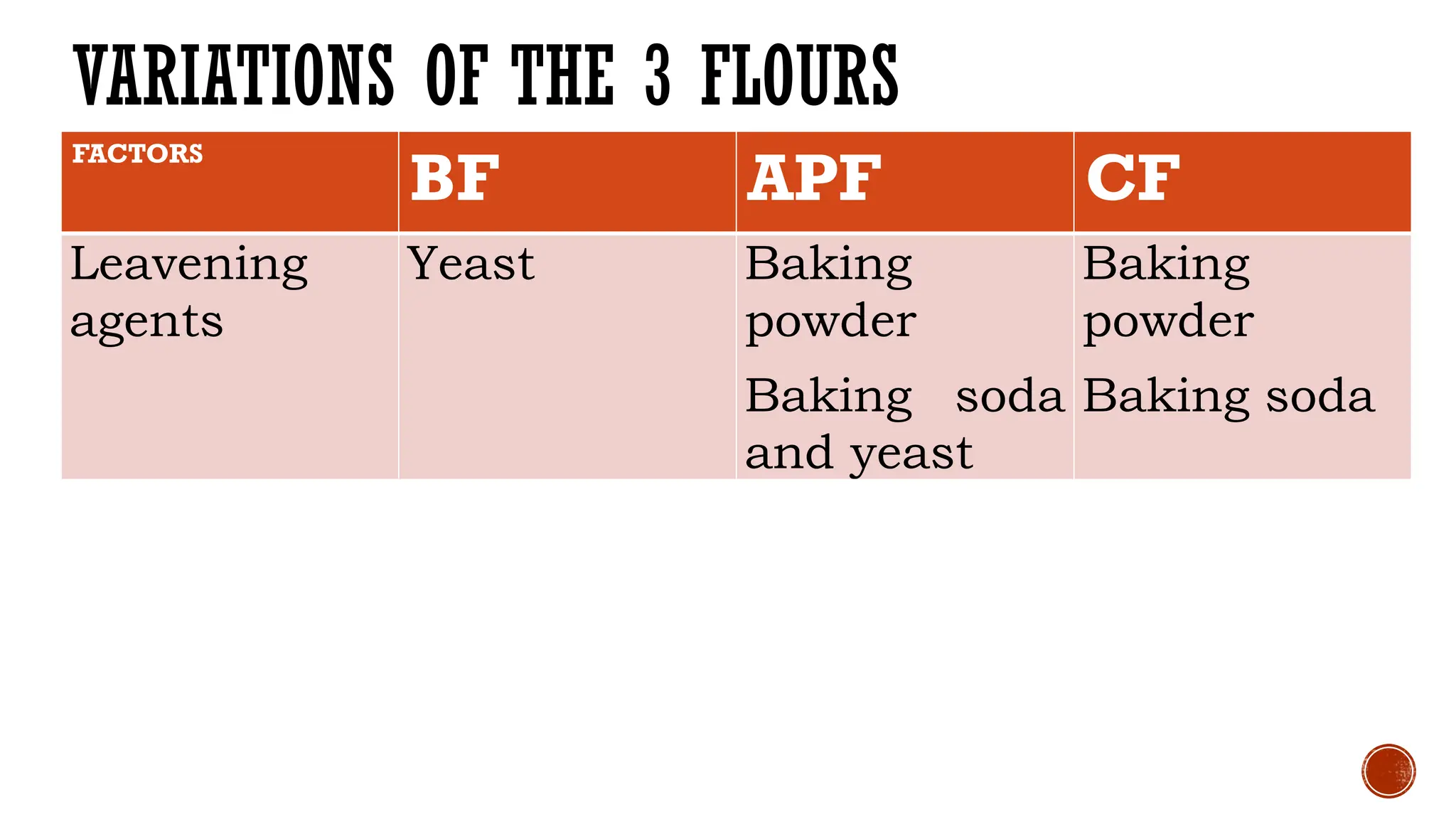
VARIATIONS OF THE3 FLOURS
FACTORS BF APF CF
Protein
content
12-14%
High gluten
strength
10-11%
medium
strength
7-9% weak
gluten
strength
Source Hard dark red
spring(dark
northern
spring)or hard
red winter
Combination of
all purpose
flour and cake
flour
U.S. western
white, soft red
winter, white
and white club
wheat
12.
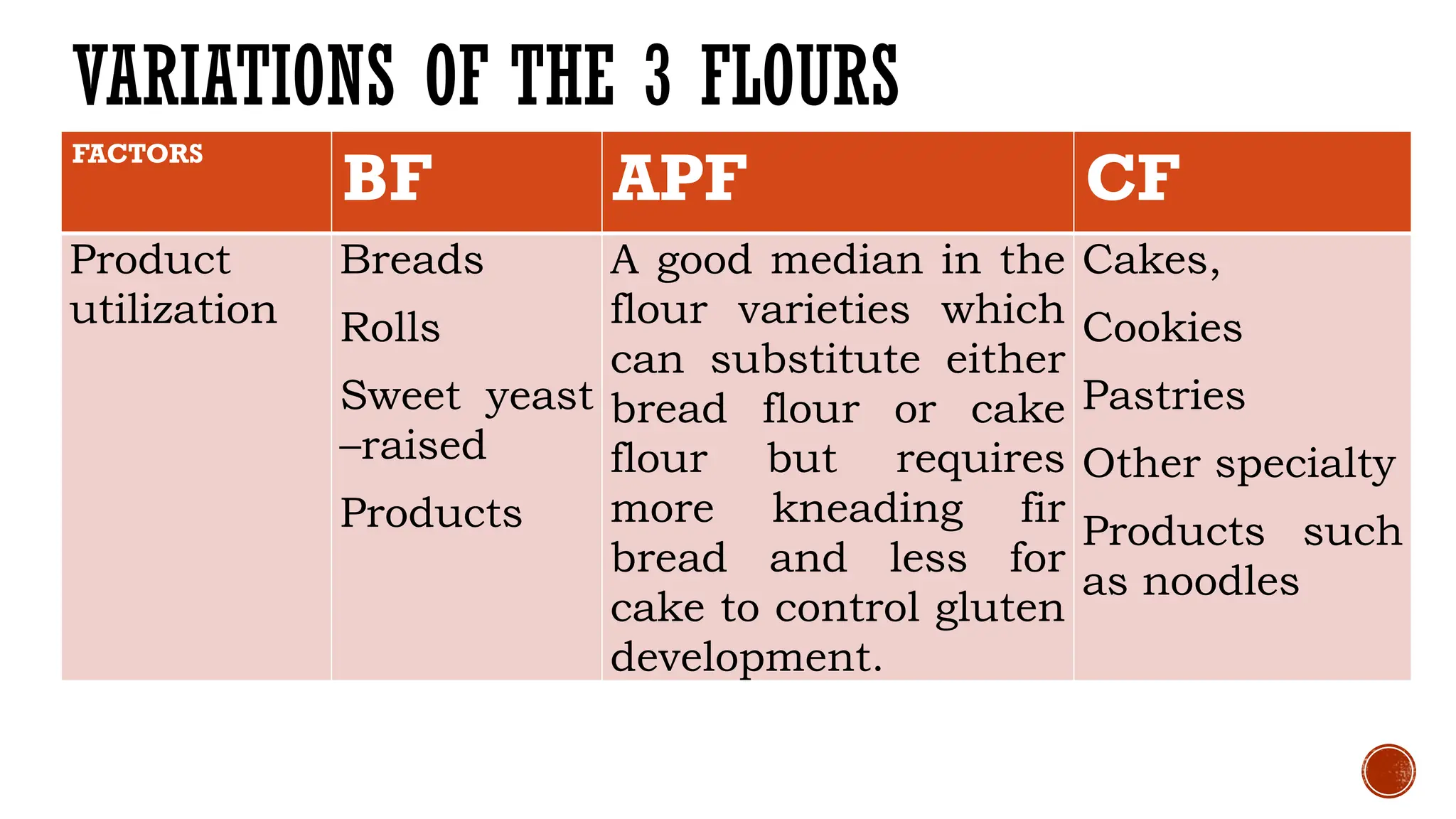
VARIATIONS OF THE3 FLOURS
FACTORS
BF APF CF
Product
utilization
Breads
Rolls
Sweet yeast
–raised
Products
A good median in the
flour varieties which
can substitute either
bread flour or cake
flour but requires
more kneading fir
bread and less for
cake to control gluten
development.
Cakes,
Cookies
Pastries
Other specialty
Products such
as noodles
13.
VARIATIONS OF THE3 FLOURS
FACTORS
BF APF CF
Identification When rubbed
between two fingers,
feels gritty, sandy,
dry and granular
Has creamy color
When pressed
together, does not
lump easily
A combination
of qualities of
bread and
cake flour.
When rubbed
between fingers feels
sleek, velvety and
smooth.
Whiter than bread
flour and all purpose
flour.
When pressed
together clumps a bit
and tends to hold its
shape.
14.
VARIATIONS OF THE3 FLOURS
FACTORS
BF APF CF
Leavening
agents
Yeast Baking
powder
Baking soda
and yeast
Baking
powder
Baking soda
15.
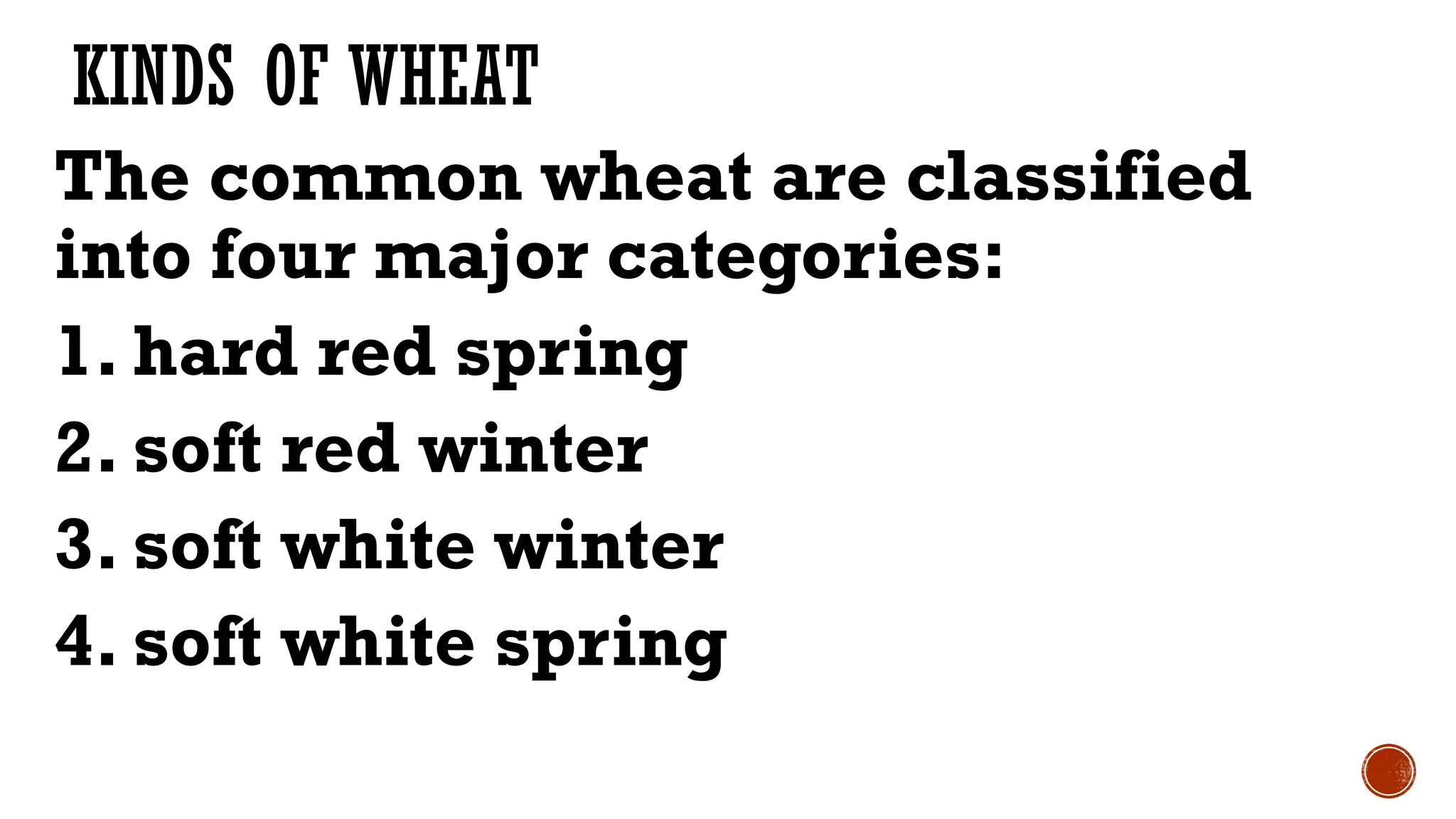
KINDS OF WHEAT
Thecommon wheat are classified
into four major categories:
1. hard red spring
2. soft red winter
3. soft white winter
4. soft white spring
16.
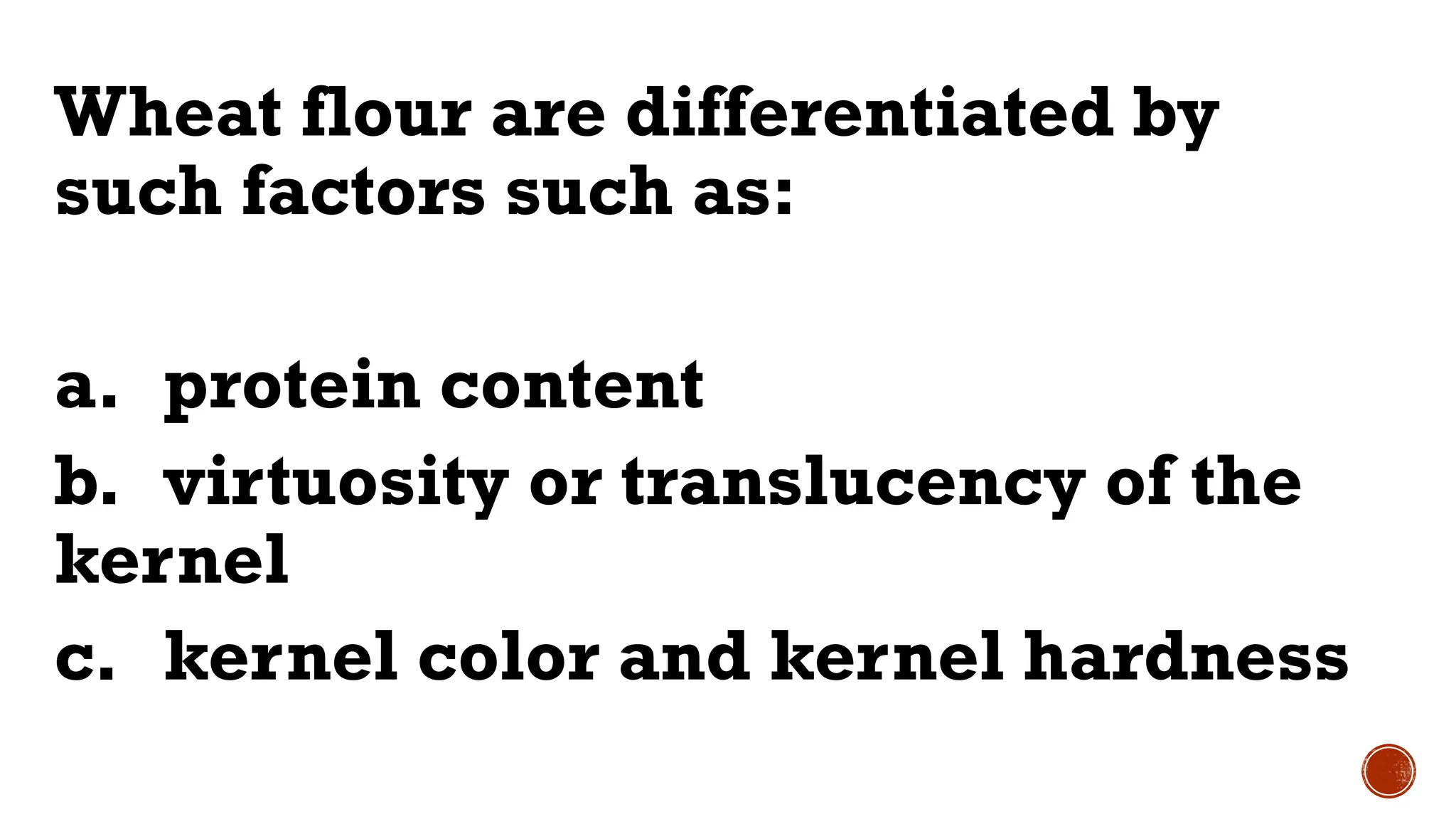
Wheat flour aredifferentiated by
such factors such as:
a. protein content
b. virtuosity or translucency of the
kernel
c. kernel color and kernel hardness
17.
STORAGE OF FLOUR
1.Store flours and other cereal in
tightly covered containers to keep
out dust, moisture and insects.
2. Store in dry place at room
temperature.
3. Flour maybe stored satisfactorily
for 2-3 months.
18.
DIFFERENCE BETWEEN BF,APF & CF
The main difference among flour types is in the
gluten content, which varies depending on
whether the flour is made from hard wheat or
soft wheat.
Gluten is the protein that helps yeast stretch
and rise.
To achieve the best baking results, use the type
of flour a recipe specifically calls for.
19.
OTHER VARIATIONS OFFLOUR
1. All-purpose flour is designed for a number
of uses, including cookies, quick breads,
biscuits, and cakes. A mixture of high-gluten
hard wheat and low-gluten soft wheat, it comes
in both bleached and unbleached forms, which
can be used interchangeably.
20.
OTHER VARIATIONS OFFLOUR
2. Cake flour is made predominantly of soft
wheat. Its fine texture and high starch content
make it ideal for making tender cakes, cookies,
biscuits, and pastries that do not need to stretch
and raise much.
21.
OTHER VARIATIONS OFFLOUR
3. Pastry flour is similar to cake flour but has
slightly higher gluten content.This aids the
elasticity needed to hold together the buttery
layers in flaky dough such as croissants, puff
pastry, and pie crusts.
22.
OTHER VARIATIONS OFFLOUR
4. Self-rising flour is all-purpose flour that has
had baking powder and salt added to it. Use it
in yeast bread recipes in place of all-purpose
flour by omitting salt, and in quick bread
recipes by omitting salt and baking powder.
23.
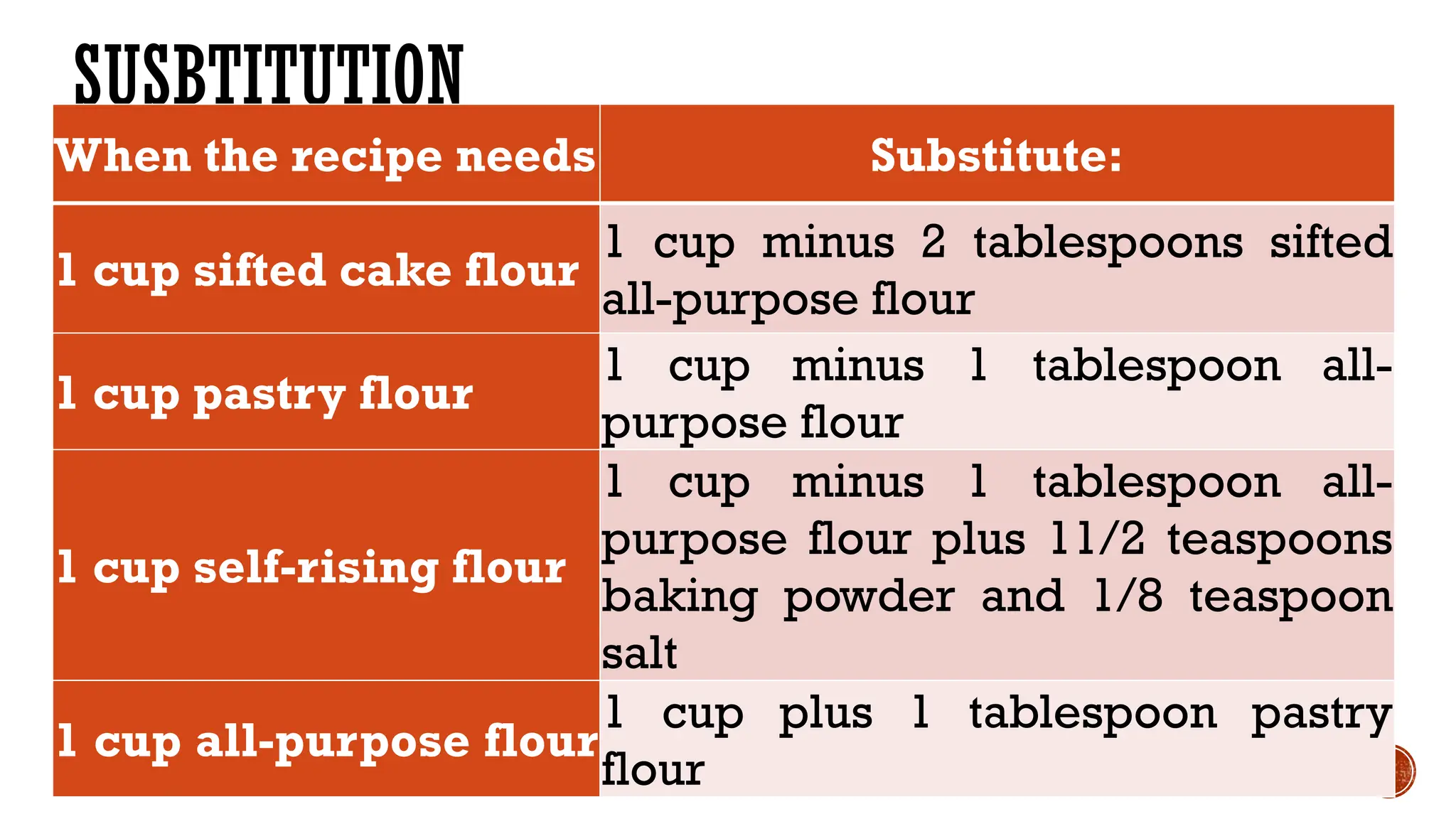
SUSBTITUTION
When the recipeneeds Substitute:
1 cup sifted cake flour
1 cup minus 2 tablespoons sifted
all-purpose flour
1 cup pastry flour
1 cup minus 1 tablespoon all-
purpose flour
1 cup self-rising flour
1 cup minus 1 tablespoon all-
purpose flour plus 11/2 teaspoons
baking powder and 1/8 teaspoon
salt
1 cup all-purpose flour
1 cup plus 1 tablespoon pastry
flour
24.
BLEACHING
Bleaching toughens cakeflour's protein.
This allows cake flour to support large amounts
of sugar and fat without collapsing.
But because of this strengthening effect,
substituting cake flour for pastry flour does
have some physical effects. In cookies, for
example, using cake flour reduces the amount
that cookies spread.
25.
WHITE FLOUR
White flouris the ground inner kernel or
endosperm of two types of wheat: high-gluten
hard wheat and low-gluten soft wheat.
It contains neither the bran nor the germ of
whole-wheat flours.
It does not contain the fiber and nutrients of
whole-wheat flour.
26.
NON-WHEAT FLOURS
1. Ryeflour- this is obtained from sifting rye meal. Of the
non- wheat flour, Rye flour approaches the quality of wheat
flour for bread-making but since it lacks the gluten-forming
wheat flour.
2. Corn Flour – It is obtained by milling and sifting yellow
or white corn.The tortillas of the Mexicans are unleavened
corn cakes using corn flour as the basic ingredient.
3. Buckwheat - it is a finely ground product obtained from
sifting buckwheat meal. It is used in making buckwheat
pancakes.
27.
NON-WHEAT FLOURS
4. Potatoflour - it is made from white potatoes which are
then dried and ground, this makes a good quality
doughnuts and fairly acceptable cookies.
5. Rice flour – it is prepared by milling white rice.
6. Soy Flour - there are two kinds: the full – fat and the low
fat soy flour.The former (full – fat )is made from dehulled
soybeans while the latter (low fat)is prepared from defatted
soybeans or soybean from which most of the oils gas been
previously extracted.
7.Waxy Rice flour – it is also known as sweet rice.
28.
SUGAR AND SWEETENERS
Theyserve special purposes in the bakeshop, provides
flavor and color, tenderize products by weakening
gluten strands, provide food for yeast, serve as a
preservative and act as a creaming or foaming agent to
assist with leavening.
29.
SUGAR AND SWEETENERS
Sugar– are carbohydrates. They come in
different color and texture and are
primarily used to sweeten baked products.
They are classified as simple sugar such as
glucose and fructose which occur naturally
in honey and fruits, or complex sugar,
which may occur naturally such as lactose
in milk or in refined sugars.
TYPES OF SUGAR& SWEETENERS
1. White sugar– refined sugar, granulated sugar,
table sugar, castor or caster sugar.
2. Confectioner’s sugar – contains approximately
3% cornstarch to retard Crystallization. It is primarily
used in icings and also a component of cake mixes.
The finest of this sugar tends itself to easier blending.
3. Brown or yellow sugar – brown sugar contains
caramel, mineral matters and moisture. It still
contains molasses and not been notably purified. This
is used where the flavor and color of the brown sugar
is desired
32.
TYPES OF SUGAR& SWEETENERS
4. Corn syrup – produced by extracting starch from
corn kernels and treating it with acid or an enzyme to
develop a sweet syrup. This syrup is extremely thick
but is less sweet – tasting as honey or refined sugar
5. Glucose – thick syrup extracted from the starch
in corn, potatoes, rice or wheat in a process known as
hydrolysis.
33.
TYPES OF SUGAR& SWEETENERS
6. Invert sugar – dense sugar syrup produced by
refining sucrose with an acid. About 20 to 30%
sweeter than regular sucrose and it is extremely
hygroscopic.
7. Honey – a strong sweetener consisting of fructose
and glucose. It is created by honeybees from nectar
collected from flowers
34.
OTHER SUGAR
A. Cornsugar or dextrose – made from corn starch. It is
approximately 75% as sweet as granulated sugar .it is directly
fermentable by yeast; so using it enhances fermentation.
B. Milk sugar or Lactose – it is present in fresh and skimmed
milk. Although it is not used as a separate ingredient, it is
important that the lactose in milk and milk products imparts
additional flavor and sweetness in the product.
C. Malt sugar or maltose – is present in malt syrup used in
bakery products and add sweetness to the product other sugar
in baking is molasses and honey.
35.
EFFECTS OF SUGARIN BAKED PRODUCTS
1. Increase dough development
2. Gives a richer crust
3. Improves flavor, aroma, and nutrition
4. Increase tenderness
5. Increase volume





![baking ingredients and its functions [Autosaved].pptx](https://cdn.slidesharecdn.com/ss_thumbnails/bakingingredientsanditsfunctionsautosaved-230920210354-aa55c159-thumbnail.jpg?width=640&height=640&fit=bounds)


![baking ingredients and its functions [Autosaved].pptx](https://cdn.slidesharecdn.com/ss_thumbnails/bakingingredientsanditsfunctionsautosaved-240731053745-1a791d6a-thumbnail.jpg?width=640&height=640&fit=bounds)


