Msj 232


                                         What are some of
                                             the special
   What is a          What does a        characteristics that
photojournalist?   photojournalist do?   draw a person into
                                             the field of
                                          photojournalism?
A


Objectives

On completion of the course students should be able to:

1. Produce aesthetically vibrant and technically clean photographs.
2. Demonstrate an ability to identify, research and write a story,
        conduct interviews, and produce appropriate photographs to
        reflect the story
3. Demonstrate the relationship between text and image in journalism
        and produce work that combines the two forms across a range
        of publications
4. Demonstrate and ability to report in a clear, concise and factual      B
        manner using both written and photographic elements
5. Collaborate constructively with fellow students in learning and
        production processes, including online forums
6. Identify and observe key ethical and legal obligations associated
        with photojournalism, and reflect critically on their own and
        others performance in this regard
7. Work independently to produce a photographic portfolio
8. Meet deadlines, and take images under pressure
9. Demonstrate an awareness of news and current issues, and develop
        contacts in the community and regions in which the student
        lives
10.     Demonstrate a critical awareness of the capacities, limitations
        and socio-professional implications of photojournalism
                                                                          C
            Demonstrate a basic knowledge of editing software
                                                      2
Grade Assessment

 Attendances:        10%
 Quizzes:            05%
 Assignments:        10%
 Exhibition 01:      15%
 Exhibition 02:      15%
 Exhibition 03:      15%
 Mid term:           20%
 Team Work:          10%


       Total: 100%


                                                                A


                           D

Outline of Topics

   01. History and the Future of Photojournalism
   02. Camera operation & photo terms Exposure control with M mode Photo download & processing.
   03. Shutter/aperture effect Caption gathering & writing “Put on your thick skin” Who wants to be a
       photojournalist?
   04. Composition Professional practices & guidelines.
   05. Flash photography.
   06. Law in photojournalism.
   07. Photojournalism ethics.
   08. The decisive moment Sound slides & portfolio building.
   09. Caption Writing
   10. Visual Representation.
   11. Photojournalistic Carrier.
   12. Best Practice for Working as Photojournalist


                                                  3
Exhibition 01: Poverty of Bangladesh
                Exhibition 02: Prosperity of Bangladesh
                 Exhibition 03: Stories of Bangladesh
There will be

Reading Assignments:

Writing Assignments:

Photo Assignments:


• Spot news            • Portraiture   • Drama and emotion          • Travel or destination photo
• Landscape            • Wildlife      • Meeting       • Politics         • Product           • Food
                              D                              E                                         F
                                              4
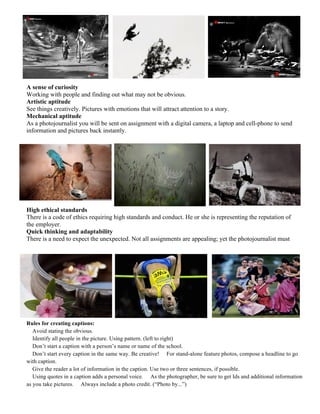
A sense of curiosity
Working with people and finding out what may not be obvious.
Artistic aptitude
See things creatively. Pictures with emotions that will attract attention to a story.
Mechanical aptitude
As a photojournalist you will be sent on assignment with a digital camera, a laptop and cell-phone to send
information and pictures back instantly.


High ethical standards
There is a code of ethics requiring high standards and conduct. He or she is representing the reputation of
the employer.
Quick thinking and adaptability
There is a need to expect the unexpected. Not all assignments are appealing; yet the photojournalist must


Rules for creating captions:
   Avoid stating the obvious.
   Identify all people in the picture. Using pattern. (left to right)
   Don’t start a caption with a person’s name or name of the school.
   Don’t start every caption in the same way. Be creative! For stand-alone feature photos, compose a headline to go
with caption.
   Give the reader a lot of information in the caption. Use two or three sentences, if possible.
   Using quotes in a caption adds a personal voice. As the photographer, be sure to get Ids and additional information
as you take pictures. Always include a photo credit. (“Photo by...”)


                                                          5

Photojournalism msj 232 34.05.2011

  • 1.
    Msj 232 What are some of the special What is a What does a characteristics that photojournalist? photojournalist do? draw a person into the field of photojournalism?
  • 2.
    A Objectives On completion ofthe course students should be able to: 1. Produce aesthetically vibrant and technically clean photographs. 2. Demonstrate an ability to identify, research and write a story, conduct interviews, and produce appropriate photographs to reflect the story 3. Demonstrate the relationship between text and image in journalism and produce work that combines the two forms across a range of publications 4. Demonstrate and ability to report in a clear, concise and factual B manner using both written and photographic elements 5. Collaborate constructively with fellow students in learning and production processes, including online forums 6. Identify and observe key ethical and legal obligations associated with photojournalism, and reflect critically on their own and others performance in this regard 7. Work independently to produce a photographic portfolio 8. Meet deadlines, and take images under pressure 9. Demonstrate an awareness of news and current issues, and develop contacts in the community and regions in which the student lives 10. Demonstrate a critical awareness of the capacities, limitations and socio-professional implications of photojournalism C Demonstrate a basic knowledge of editing software 2
  • 3.
    Grade Assessment Attendances: 10% Quizzes: 05% Assignments: 10% Exhibition 01: 15% Exhibition 02: 15% Exhibition 03: 15% Mid term: 20% Team Work: 10% Total: 100% A D Outline of Topics 01. History and the Future of Photojournalism 02. Camera operation & photo terms Exposure control with M mode Photo download & processing. 03. Shutter/aperture effect Caption gathering & writing “Put on your thick skin” Who wants to be a photojournalist? 04. Composition Professional practices & guidelines. 05. Flash photography. 06. Law in photojournalism. 07. Photojournalism ethics. 08. The decisive moment Sound slides & portfolio building. 09. Caption Writing 10. Visual Representation. 11. Photojournalistic Carrier. 12. Best Practice for Working as Photojournalist 3
  • 4.
    Exhibition 01: Povertyof Bangladesh Exhibition 02: Prosperity of Bangladesh Exhibition 03: Stories of Bangladesh There will be Reading Assignments: Writing Assignments: Photo Assignments: • Spot news • Portraiture • Drama and emotion • Travel or destination photo • Landscape • Wildlife • Meeting • Politics • Product • Food D E F 4
  • 5.
    A sense ofcuriosity Working with people and finding out what may not be obvious. Artistic aptitude See things creatively. Pictures with emotions that will attract attention to a story. Mechanical aptitude As a photojournalist you will be sent on assignment with a digital camera, a laptop and cell-phone to send information and pictures back instantly. High ethical standards There is a code of ethics requiring high standards and conduct. He or she is representing the reputation of the employer. Quick thinking and adaptability There is a need to expect the unexpected. Not all assignments are appealing; yet the photojournalist must Rules for creating captions: Avoid stating the obvious. Identify all people in the picture. Using pattern. (left to right) Don’t start a caption with a person’s name or name of the school. Don’t start every caption in the same way. Be creative! For stand-alone feature photos, compose a headline to go with caption. Give the reader a lot of information in the caption. Use two or three sentences, if possible. Using quotes in a caption adds a personal voice. As the photographer, be sure to get Ids and additional information as you take pictures. Always include a photo credit. (“Photo by...”) 5