ANATOMY &
PHYSIOLOGY
  WEEKLY
                         Anatomy and
                         Physiology Weekly
                         Volume 1, Issue 1 (Informational Section)                                       10.17.2012
Inside this issue:
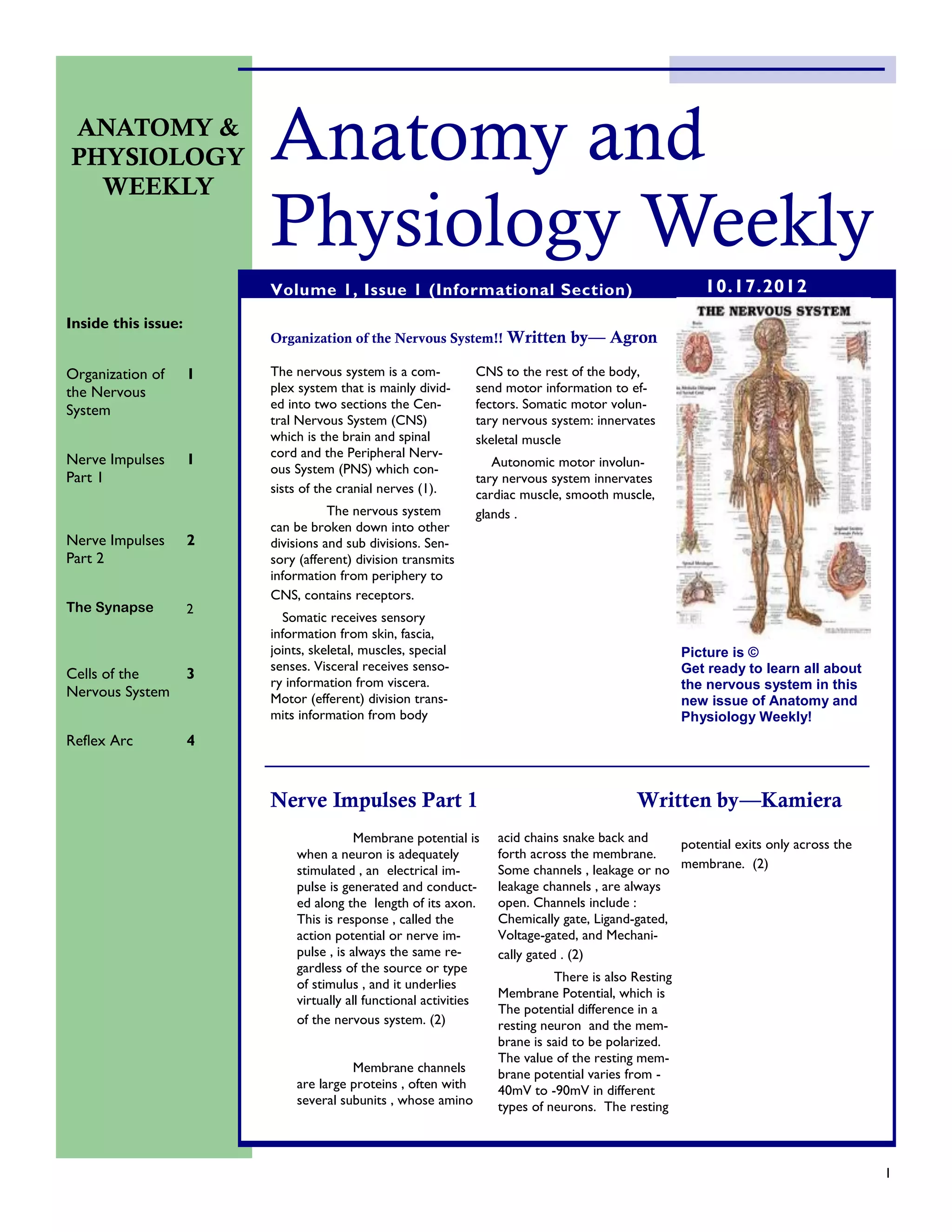
                         Organization of the Nervous System!! Written           by— Agron

Organization of      1   The nervous system is a com-           CNS to the rest of the body,
the Nervous              plex system that is mainly divid-      send motor information to ef-
System                   ed into two sections the Cen-          fectors. Somatic motor volun-
                         tral Nervous System (CNS)              tary nervous system: innervates
                         which is the brain and spinal          skeletal muscle
                         cord and the Peripheral Nerv-
Nerve Impulses       1                                             Autonomic motor involun-
                         ous System (PNS) which con-
Part 1                                                          tary nervous system innervates
                         sists of the cranial nerves (1).       cardiac muscle, smooth muscle,
                                    The nervous system          glands .
                         can be broken down into other
Nerve Impulses       2   divisions and sub divisions. Sen-
Part 2                   sory (afferent) division transmits
                         information from periphery to
                         CNS, contains receptors.
The Synapse          2
                           Somatic receives sensory
                         information from skin, fascia,
                         joints, skeletal, muscles, special                                           Picture is ©
                         senses. Visceral receives senso-                                             Get ready to learn all about
Cells of the         3
                         ry information from viscera.                                                 the nervous system in this
Nervous System           Motor (efferent) division trans-                                             new issue of Anatomy and
                         mits information from body                                                   Physiology Weekly!
Reflex Arc           4


                         Nerve Impulses Part 1                                              Written by—Kamiera
                                          Membrane potential is     acid chains snake back and     potential exits only across the
                              when a neuron is adequately           forth across the membrane.
                              stimulated , an electrical im-        Some channels , leakage or no membrane. (2)
                              pulse is generated and conduct-       leakage channels , are always
                              ed along the length of its axon.      open. Channels include :
                              This is response , called the         Chemically gate, Ligand-gated,
                              action potential or nerve im-         Voltage-gated, and Mechani-
                              pulse , is always the same re-        cally gated . (2)
                              gardless of the source or type
                                                                              There is also Resting
                              of stimulus , and it underlies
                                                                    Membrane Potential, which is
                              virtually all functional activities
                                                                    The potential difference in a
                              of the nervous system. (2)            resting neuron and the mem-
                                                                    brane is said to be polarized.
                                                                    The value of the resting mem-
                                        Membrane channels           brane potential varies from -
                              are large proteins , often with       40mV to -90mV in different
                              several subunits , whose amino        types of neurons. The resting


                                                                                                                                     1
Page 2                                                                     Anatomy and Physiology Weekly


                         Nerve Impulses Part 2                             Written by —Colton


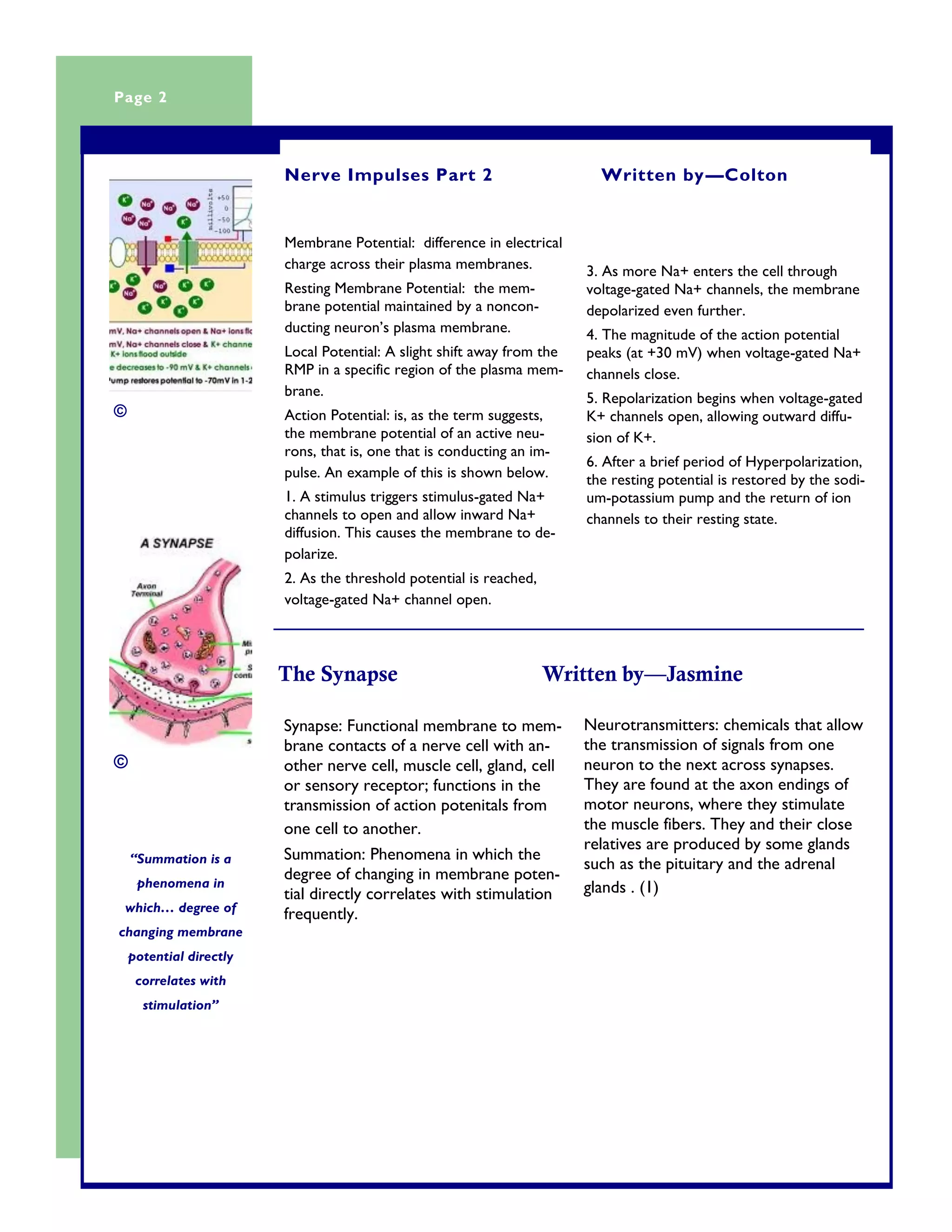
                         Membrane Potential: difference in electrical
                         charge across their plasma membranes.           3. As more Na+ enters the cell through
                         Resting Membrane Potential: the mem-            voltage-gated Na+ channels, the membrane
                         brane potential maintained by a noncon-         depolarized even further.
                         ducting neuron’s plasma membrane.               4. The magnitude of the action potential
                         Local Potential: A slight shift away from the   peaks (at +30 mV) when voltage-gated Na+
                         RMP in a specific region of the plasma mem-     channels close.
                         brane.                                          5. Repolarization begins when voltage-gated
©                        Action Potential: is, as the term suggests,     K+ channels open, allowing outward diffu-
                         the membrane potential of an active neu-        sion of K+.
                         rons, that is, one that is conducting an im-
                                                                         6. After a brief period of Hyperpolarization,
                         pulse. An example of this is shown below.       the resting potential is restored by the sodi-
                         1. A stimulus triggers stimulus-gated Na+       um-potassium pump and the return of ion
                         channels to open and allow inward Na+           channels to their resting state.
                         diffusion. This causes the membrane to de-
                         polarize.
                         2. As the threshold potential is reached,
                         voltage-gated Na+ channel open.


                         The Synapse                                 Written by—Jasmine

                         Synapse: Functional membrane to mem-            Neurotransmitters: chemicals that allow
                         brane contacts of a nerve cell with an-         the transmission of signals from one
©                        other nerve cell, muscle cell, gland, cell      neuron to the next across synapses.
                         or sensory receptor; functions in the           They are found at the axon endings of
                         transmission of action potenitals from          motor neurons, where they stimulate
                         one cell to another.                            the muscle fibers. They and their close
                                                                         relatives are produced by some glands
    “Summation is a      Summation: Phenomena in which the
                                                                         such as the pituitary and the adrenal
     phenomena in
                         degree of changing in membrane poten-
                         tial directly correlates with stimulation       glands . (1)
 which… degree of
                         frequently.
changing membrane
    potential directly
     correlates with
      stimulation”


                                                                                                                          2
Volume 1, Issue 1 (Informational Section)                                                              Page 3


            Cells of the Nervous System                   Written by—Ashley B.
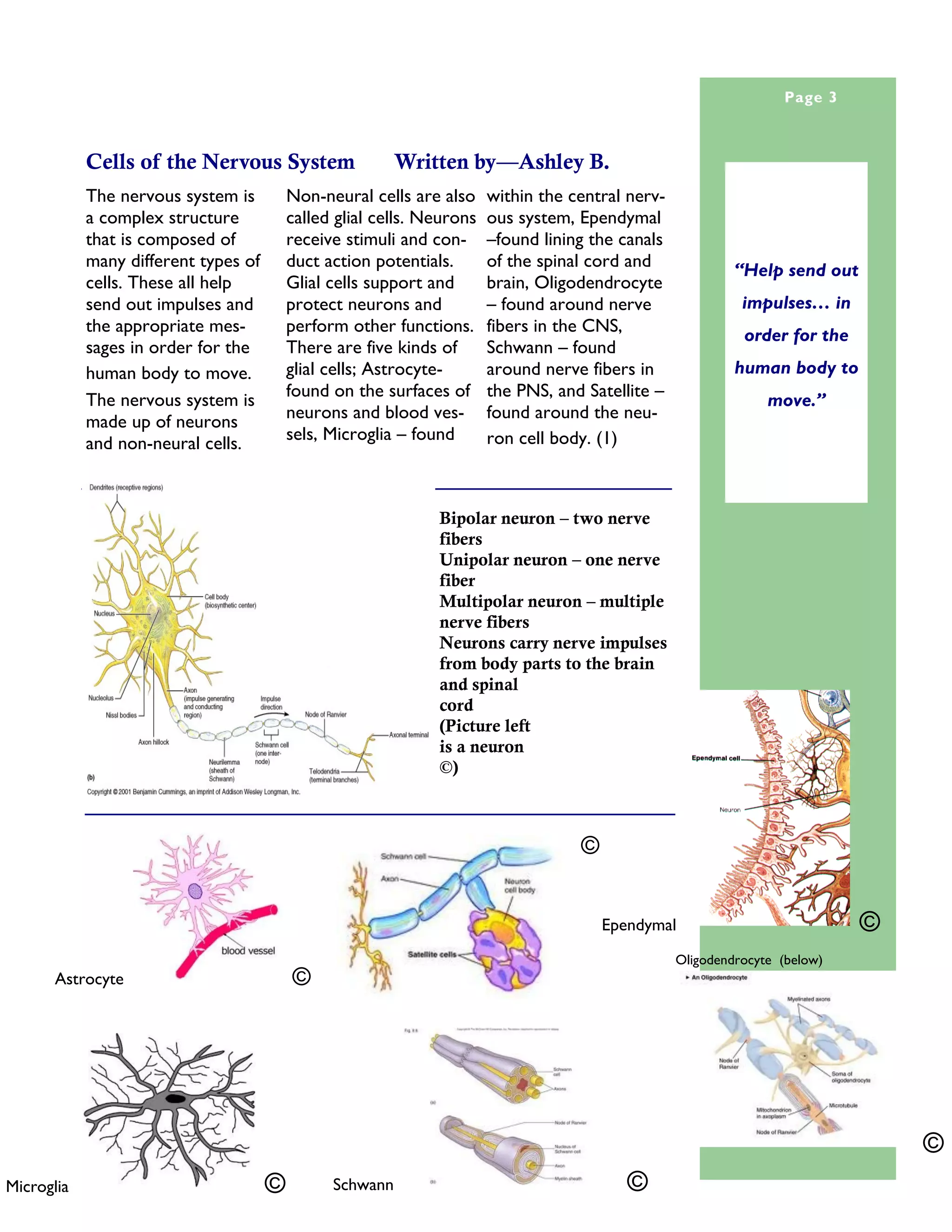
            The nervous system is         Non-neural cells are also     within the central nerv-
            a complex structure           called glial cells. Neurons   ous system, Ependymal
            that is composed of           receive stimuli and con-      –found lining the canals
            many different types of       duct action potentials.       of the spinal cord and              “Help send out
            cells. These all help         Glial cells support and       brain, Oligodendrocyte
            send out impulses and         protect neurons and           – found around nerve                 impulses… in
            the appropriate mes-          perform other functions.      fibers in the CNS,                   order for the
            sages in order for the        There are five kinds of       Schwann – found
            human body to move.           glial cells; Astrocyte-       around nerve fibers in              human body to
                                          found on the surfaces of      the PNS, and Satellite –
            The nervous system is                                                                                move.”
                                          neurons and blood ves-        found around the neu-
            made up of neurons
                                          sels, Microglia – found       ron cell body. (1)
            and non-neural cells.


                                                               Bipolar neuron – two nerve
                                                               fibers
                                                               Unipolar neuron – one nerve
                                                               fiber
                                                               Multipolar neuron – multiple
                                                               nerve fibers
                                                               Neurons carry nerve impulses
                                                               from body parts to the brain
                                                               and spinal
                                                               cord
                                                               (Picture left
                                                               is a neuron
                                                               ©)


                                                                           Satelite   ©


                                                                                          Ependymal                          ©
                                                                                                   Oligodendrocyte (below)
       Astrocyte                          ©


                                                                                                                                     ©
Microglia                             ©         Schwann                                      ©                                   3
Reflex Arc Lab
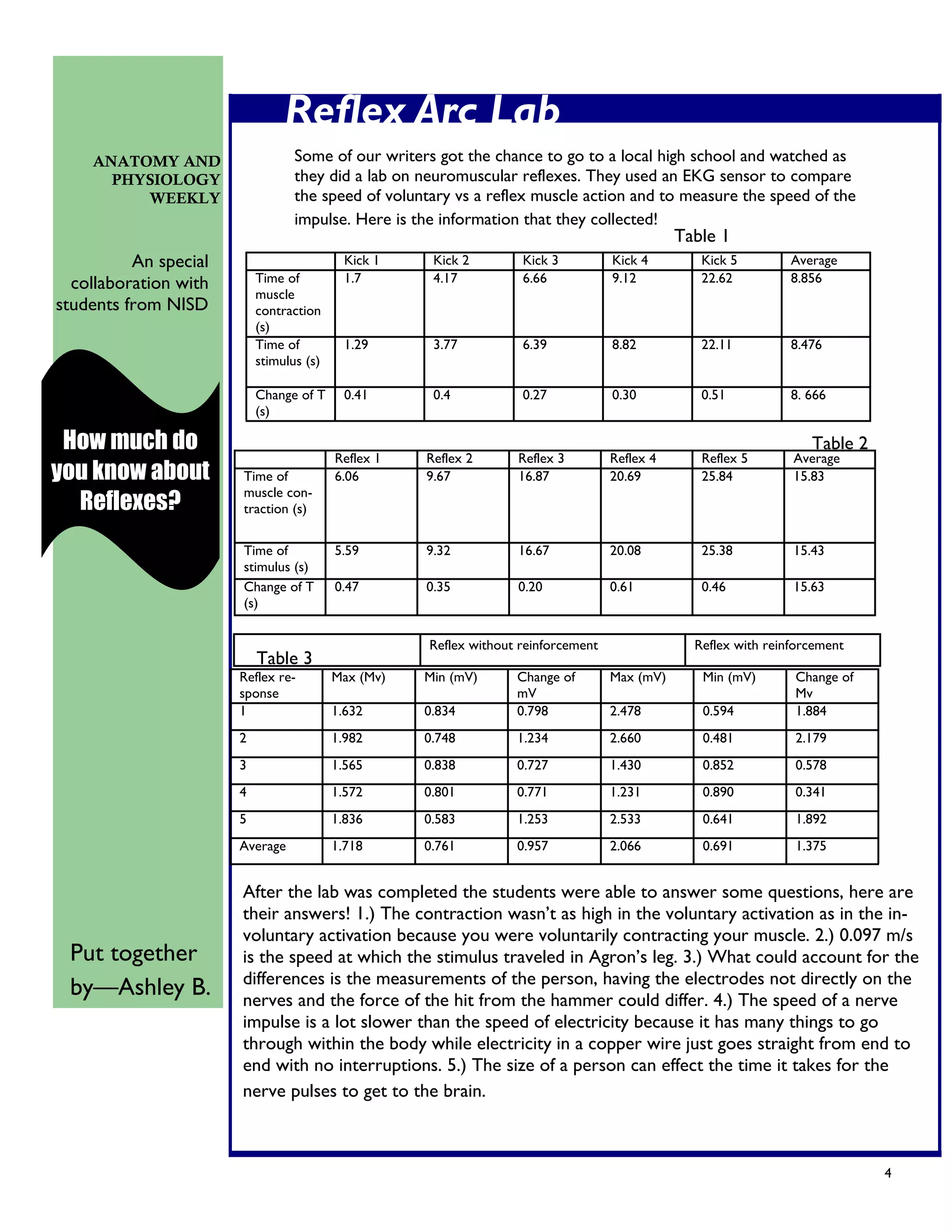
    ANATOMY AND                   Some of our writers got the chance to go to a local high school and watched as
      PHYSIOLOGY                  they did a lab on neuromuscular reflexes. They used an EKG sensor to compare
         WEEKLY                   the speed of voluntary vs a reflex muscle action and to measure the speed of the
                                  impulse. Here is the information that they collected!
                                                                                               Table 1
          An special                        Kick 1    Kick 2        Kick 3          Kick 4        Kick 5         Average
  collaboration with       Time of          1.7       4.17          6.66            9.12          22.62          8.856
                           muscle
students from NISD         contraction
                           (s)
                           Time of          1.29      3.77          6.39            8.82          22.11          8.476
                           stimulus (s)

                           Change of T      0.41      0.4           0.27            0.30          0.51           8. 666
                           (s)

 How much do                                                                                                        Table 2
                                          Reflex 1   Reflex 2      Reflex 3         Reflex 4      Reflex 5       Average
you know about         Time of            6.06       9.67          16.87            20.69         25.84          15.83
                       muscle con-
  Reflexes?            traction (s)

                       Time of            5.59       9.32          16.67            20.08         25.38          15.43
                       stimulus (s)
                       Change of T        0.47       0.35          0.20             0.61          0.46           15.63
                       (s)


                                                     Reflex without reinforcement                Reflex with reinforcement
                           Table 3
                       Reflex re-         Max (Mv)   Min (mV)      Change of        Max (mV)      Min (mV)       Change of
                       sponse                                      mV                                            Mv
                       1                  1.632      0.834         0.798            2.478         0.594          1.884
                       2                  1.982      0.748         1.234            2.660         0.481          2.179
                       3                  1.565      0.838         0.727            1.430         0.852          0.578
                       4                  1.572      0.801         0.771            1.231         0.890          0.341
                       5                  1.836      0.583         1.253            2.533         0.641          1.892
                       Average            1.718      0.761         0.957            2.066         0.691          1.375


                       After the lab was completed the students were able to answer some questions, here are
                       their answers! 1.) The contraction wasn’t as high in the voluntary activation as in the in-
                       voluntary activation because you were voluntarily contracting your muscle. 2.) 0.097 m/s
 Put together          is the speed at which the stimulus traveled in Agron’s leg. 3.) What could account for the
                       differences is the measurements of the person, having the electrodes not directly on the
 by—Ashley B.          nerves and the force of the hit from the hammer could differ. 4.) The speed of a nerve
                       impulse is a lot slower than the speed of electricity because it has many things to go
                       through within the body while electricity in a copper wire just goes straight from end to
                       end with no interruptions. 5.) The size of a person can effect the time it takes for the
                       nerve pulses to get to the brain.


                                                                                                                              4

What makes me nervous artifact

  • 1.
    ANATOMY & PHYSIOLOGY WEEKLY Anatomy and Physiology Weekly Volume 1, Issue 1 (Informational Section) 10.17.2012 Inside this issue: Organization of the Nervous System!! Written by— Agron Organization of 1 The nervous system is a com- CNS to the rest of the body, the Nervous plex system that is mainly divid- send motor information to ef- System ed into two sections the Cen- fectors. Somatic motor volun- tral Nervous System (CNS) tary nervous system: innervates which is the brain and spinal skeletal muscle cord and the Peripheral Nerv- Nerve Impulses 1 Autonomic motor involun- ous System (PNS) which con- Part 1 tary nervous system innervates sists of the cranial nerves (1). cardiac muscle, smooth muscle, The nervous system glands . can be broken down into other Nerve Impulses 2 divisions and sub divisions. Sen- Part 2 sory (afferent) division transmits information from periphery to CNS, contains receptors. The Synapse 2 Somatic receives sensory information from skin, fascia, joints, skeletal, muscles, special Picture is © senses. Visceral receives senso- Get ready to learn all about Cells of the 3 ry information from viscera. the nervous system in this Nervous System Motor (efferent) division trans- new issue of Anatomy and mits information from body Physiology Weekly! Reflex Arc 4 Nerve Impulses Part 1 Written by—Kamiera Membrane potential is acid chains snake back and potential exits only across the when a neuron is adequately forth across the membrane. stimulated , an electrical im- Some channels , leakage or no membrane. (2) pulse is generated and conduct- leakage channels , are always ed along the length of its axon. open. Channels include : This is response , called the Chemically gate, Ligand-gated, action potential or nerve im- Voltage-gated, and Mechani- pulse , is always the same re- cally gated . (2) gardless of the source or type There is also Resting of stimulus , and it underlies Membrane Potential, which is virtually all functional activities The potential difference in a of the nervous system. (2) resting neuron and the mem- brane is said to be polarized. The value of the resting mem- Membrane channels brane potential varies from - are large proteins , often with 40mV to -90mV in different several subunits , whose amino types of neurons. The resting 1
  • 2.
    Page 2 Anatomy and Physiology Weekly Nerve Impulses Part 2 Written by —Colton Membrane Potential: difference in electrical charge across their plasma membranes. 3. As more Na+ enters the cell through Resting Membrane Potential: the mem- voltage-gated Na+ channels, the membrane brane potential maintained by a noncon- depolarized even further. ducting neuron’s plasma membrane. 4. The magnitude of the action potential Local Potential: A slight shift away from the peaks (at +30 mV) when voltage-gated Na+ RMP in a specific region of the plasma mem- channels close. brane. 5. Repolarization begins when voltage-gated © Action Potential: is, as the term suggests, K+ channels open, allowing outward diffu- the membrane potential of an active neu- sion of K+. rons, that is, one that is conducting an im- 6. After a brief period of Hyperpolarization, pulse. An example of this is shown below. the resting potential is restored by the sodi- 1. A stimulus triggers stimulus-gated Na+ um-potassium pump and the return of ion channels to open and allow inward Na+ channels to their resting state. diffusion. This causes the membrane to de- polarize. 2. As the threshold potential is reached, voltage-gated Na+ channel open. The Synapse Written by—Jasmine Synapse: Functional membrane to mem- Neurotransmitters: chemicals that allow brane contacts of a nerve cell with an- the transmission of signals from one © other nerve cell, muscle cell, gland, cell neuron to the next across synapses. or sensory receptor; functions in the They are found at the axon endings of transmission of action potenitals from motor neurons, where they stimulate one cell to another. the muscle fibers. They and their close relatives are produced by some glands “Summation is a Summation: Phenomena in which the such as the pituitary and the adrenal phenomena in degree of changing in membrane poten- tial directly correlates with stimulation glands . (1) which… degree of frequently. changing membrane potential directly correlates with stimulation” 2
  • 3.
    Volume 1, Issue1 (Informational Section) Page 3 Cells of the Nervous System Written by—Ashley B. The nervous system is Non-neural cells are also within the central nerv- a complex structure called glial cells. Neurons ous system, Ependymal that is composed of receive stimuli and con- –found lining the canals many different types of duct action potentials. of the spinal cord and “Help send out cells. These all help Glial cells support and brain, Oligodendrocyte send out impulses and protect neurons and – found around nerve impulses… in the appropriate mes- perform other functions. fibers in the CNS, order for the sages in order for the There are five kinds of Schwann – found human body to move. glial cells; Astrocyte- around nerve fibers in human body to found on the surfaces of the PNS, and Satellite – The nervous system is move.” neurons and blood ves- found around the neu- made up of neurons sels, Microglia – found ron cell body. (1) and non-neural cells. Bipolar neuron – two nerve fibers Unipolar neuron – one nerve fiber Multipolar neuron – multiple nerve fibers Neurons carry nerve impulses from body parts to the brain and spinal cord (Picture left is a neuron ©) Satelite © Ependymal © Oligodendrocyte (below) Astrocyte © © Microglia © Schwann © 3
  • 4.
    Reflex Arc Lab ANATOMY AND Some of our writers got the chance to go to a local high school and watched as PHYSIOLOGY they did a lab on neuromuscular reflexes. They used an EKG sensor to compare WEEKLY the speed of voluntary vs a reflex muscle action and to measure the speed of the impulse. Here is the information that they collected! Table 1 An special Kick 1 Kick 2 Kick 3 Kick 4 Kick 5 Average collaboration with Time of 1.7 4.17 6.66 9.12 22.62 8.856 muscle students from NISD contraction (s) Time of 1.29 3.77 6.39 8.82 22.11 8.476 stimulus (s) Change of T 0.41 0.4 0.27 0.30 0.51 8. 666 (s) How much do Table 2 Reflex 1 Reflex 2 Reflex 3 Reflex 4 Reflex 5 Average you know about Time of 6.06 9.67 16.87 20.69 25.84 15.83 muscle con- Reflexes? traction (s) Time of 5.59 9.32 16.67 20.08 25.38 15.43 stimulus (s) Change of T 0.47 0.35 0.20 0.61 0.46 15.63 (s) Reflex without reinforcement Reflex with reinforcement Table 3 Reflex re- Max (Mv) Min (mV) Change of Max (mV) Min (mV) Change of sponse mV Mv 1 1.632 0.834 0.798 2.478 0.594 1.884 2 1.982 0.748 1.234 2.660 0.481 2.179 3 1.565 0.838 0.727 1.430 0.852 0.578 4 1.572 0.801 0.771 1.231 0.890 0.341 5 1.836 0.583 1.253 2.533 0.641 1.892 Average 1.718 0.761 0.957 2.066 0.691 1.375 After the lab was completed the students were able to answer some questions, here are their answers! 1.) The contraction wasn’t as high in the voluntary activation as in the in- voluntary activation because you were voluntarily contracting your muscle. 2.) 0.097 m/s Put together is the speed at which the stimulus traveled in Agron’s leg. 3.) What could account for the differences is the measurements of the person, having the electrodes not directly on the by—Ashley B. nerves and the force of the hit from the hammer could differ. 4.) The speed of a nerve impulse is a lot slower than the speed of electricity because it has many things to go through within the body while electricity in a copper wire just goes straight from end to end with no interruptions. 5.) The size of a person can effect the time it takes for the nerve pulses to get to the brain. 4