An Introduction to the
Kodály Method
Zoltan Kodály: the Man Behind the Method
● Kodaly (1882-1967) was a Hungarian composer and music
educator
● His extensive travels exposed him to folk music of different
backgrounds
● Disillusioned with music education in Hungary, he set out to
overhaul the whole system
● He created a new curriculum and new teaching methods for
young students
● It was on the principles of these methods that his colleagues,
students, and friends created the Kodály Method
Learn more: http://musl.ink/a33
Principles of the Kodály Method
1. Music should be taught from a young age. Kodály
believed that music was among, if not the most important
subject to teach in schools.
2. Music should be taught in a logical and sequential
manner.
3. There should be a pleasure in learning music; learning
should not be torturous.
4. The voice is the most accessible, universal instrument.
5. The musical material is taught in the context of the
mother-tongue folk song.
Learn more: http://musl.ink/a33
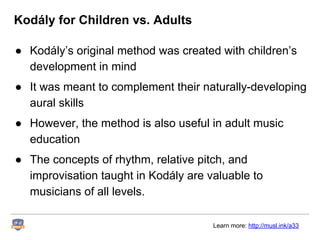
Kodály for Children vs. Adults
● Kodály’s original method was created with children’s
development in mind
● It was meant to complement their naturally-developing
aural skills
● However, the method is also useful in adult music
education
● The concepts of rhythm, relative pitch, and
improvisation taught in Kodály are valuable to
musicians of all levels.
Learn more: http://musl.ink/a33
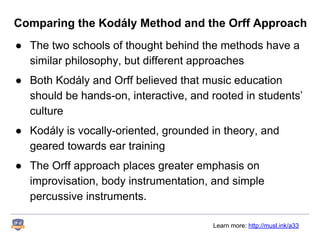
Comparing the Kodály Method and the Orff Approach
● The two schools of thought behind the methods have a
similar philosophy, but different approaches
● Both Kodály and Orff believed that music education
should be hands-on, interactive, and rooted in students’
culture
● Kodály is vocally-oriented, grounded in theory, and
geared towards ear training
● The Orff approach places greater emphasis on
improvisation, body instrumentation, and simple
percussive instruments.
Learn more: http://musl.ink/a33
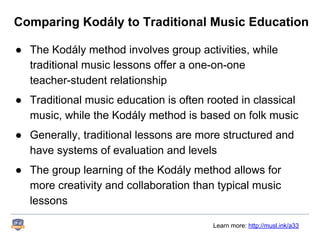
Comparing Kodály to Traditional Music Education
● The Kodály method involves group activities, while
traditional music lessons offer a one-on-one
teacher-student relationship
● Traditional music education is often rooted in classical
music, while the Kodály method is based on folk music
● Generally, traditional lessons are more structured and
have systems of evaluation and levels
● The group learning of the Kodály method allows for
more creativity and collaboration than typical music
lessons
Learn more: http://musl.ink/a33
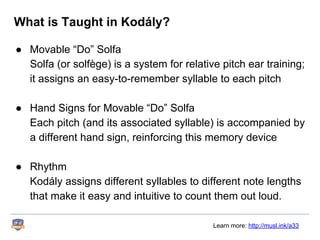
What is Taught in Kodály?
● Movable “Do” Solfa
Solfa (or solfège) is a system for relative pitch ear training;
it assigns an easy-to-remember syllable to each pitch
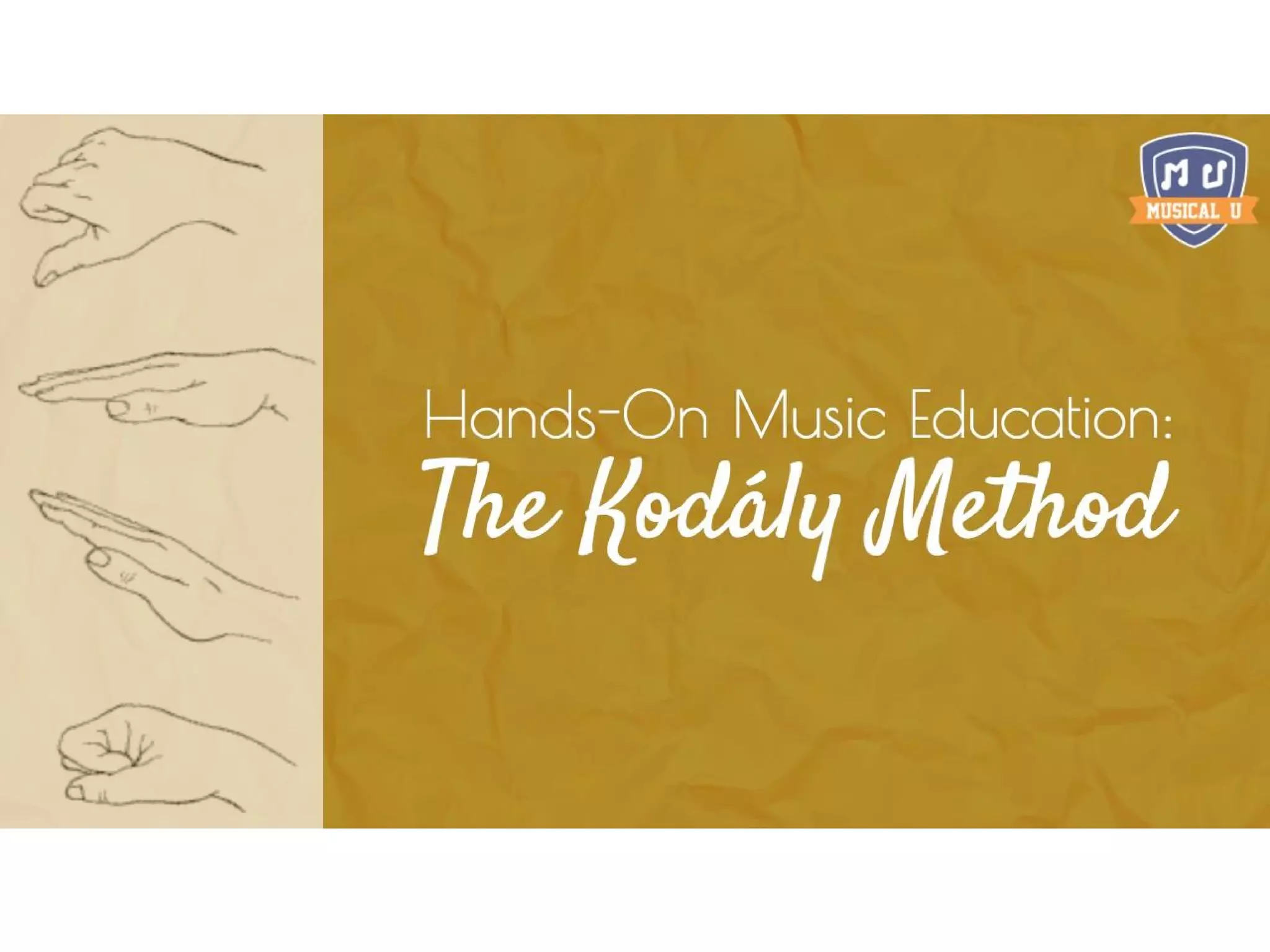
● Hand Signs for Movable “Do” Solfa
Each pitch (and its associated syllable) is accompanied by
a different hand sign, reinforcing this memory device
● Rhythm
Kodály assigns different syllables to different note lengths
that make it easy and intuitive to count them out loud.
Learn more: http://musl.ink/a33
What is Taught in Kodály?
● Creativity
The easy-to-follow associations that Kodály develops
empower musicians to be creative and confident in their
musical practice.
● Collaboration
The Kodály method is meant to be communal and
group-oriented, giving ample opportunities for the
exchange of ideas between students.
Learn more: http://musl.ink/a33
Summary
● This interactive way of learning music is for children and adults
alike, and can benefit musicians of any level
● It relies on associations between musical concepts and body
movements/words to make the learning process intuitive and
hands-on
● Many organizations including The Organization of American
Kodály Educators, The British Kodály Academy, and The
International Kodály Society can be consulted to find a class
near you
● Integrate some principles from the Kodály method into your
practice; for example, try the solfa method of learning relative
pitch!
Learn more: http://musl.ink/a33
Learn More

What is the Kodály method?

  • 1.
    An Introduction tothe Kodály Method
  • 2.
    Zoltan Kodály: theMan Behind the Method ● Kodaly (1882-1967) was a Hungarian composer and music educator ● His extensive travels exposed him to folk music of different backgrounds ● Disillusioned with music education in Hungary, he set out to overhaul the whole system ● He created a new curriculum and new teaching methods for young students ● It was on the principles of these methods that his colleagues, students, and friends created the Kodály Method Learn more: http://musl.ink/a33
  • 3.
    Principles of theKodály Method 1. Music should be taught from a young age. Kodály believed that music was among, if not the most important subject to teach in schools. 2. Music should be taught in a logical and sequential manner. 3. There should be a pleasure in learning music; learning should not be torturous. 4. The voice is the most accessible, universal instrument. 5. The musical material is taught in the context of the mother-tongue folk song. Learn more: http://musl.ink/a33
  • 4.
    Kodály for Childrenvs. Adults ● Kodály’s original method was created with children’s development in mind ● It was meant to complement their naturally-developing aural skills ● However, the method is also useful in adult music education ● The concepts of rhythm, relative pitch, and improvisation taught in Kodály are valuable to musicians of all levels. Learn more: http://musl.ink/a33
  • 5.
    Comparing the KodályMethod and the Orff Approach ● The two schools of thought behind the methods have a similar philosophy, but different approaches ● Both Kodály and Orff believed that music education should be hands-on, interactive, and rooted in students’ culture ● Kodály is vocally-oriented, grounded in theory, and geared towards ear training ● The Orff approach places greater emphasis on improvisation, body instrumentation, and simple percussive instruments. Learn more: http://musl.ink/a33
  • 6.
    Comparing Kodály toTraditional Music Education ● The Kodály method involves group activities, while traditional music lessons offer a one-on-one teacher-student relationship ● Traditional music education is often rooted in classical music, while the Kodály method is based on folk music ● Generally, traditional lessons are more structured and have systems of evaluation and levels ● The group learning of the Kodály method allows for more creativity and collaboration than typical music lessons Learn more: http://musl.ink/a33
  • 7.
    What is Taughtin Kodály? ● Movable “Do” Solfa Solfa (or solfège) is a system for relative pitch ear training; it assigns an easy-to-remember syllable to each pitch ● Hand Signs for Movable “Do” Solfa Each pitch (and its associated syllable) is accompanied by a different hand sign, reinforcing this memory device ● Rhythm Kodály assigns different syllables to different note lengths that make it easy and intuitive to count them out loud. Learn more: http://musl.ink/a33
  • 8.
    What is Taughtin Kodály? ● Creativity The easy-to-follow associations that Kodály develops empower musicians to be creative and confident in their musical practice. ● Collaboration The Kodály method is meant to be communal and group-oriented, giving ample opportunities for the exchange of ideas between students. Learn more: http://musl.ink/a33
  • 9.
    Summary ● This interactiveway of learning music is for children and adults alike, and can benefit musicians of any level ● It relies on associations between musical concepts and body movements/words to make the learning process intuitive and hands-on ● Many organizations including The Organization of American Kodály Educators, The British Kodály Academy, and The International Kodály Society can be consulted to find a class near you ● Integrate some principles from the Kodály method into your practice; for example, try the solfa method of learning relative pitch! Learn more: http://musl.ink/a33
  • 10.