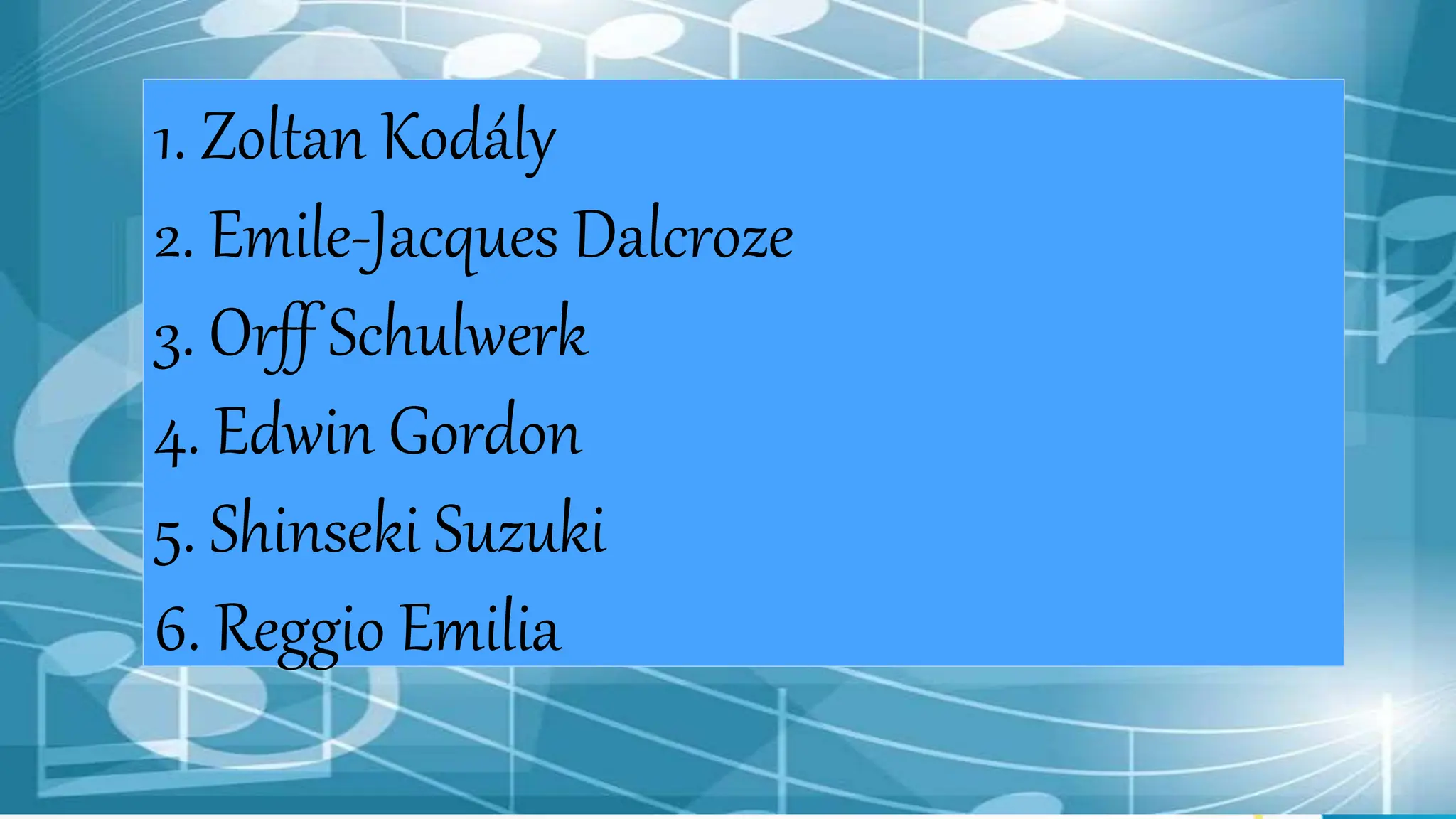
1. Zoltan Kodály
2. Emile-Jacques Dalcroze
3. Orff Schulwerk
4. Edwin Gordon
5. Shinseki Suzuki
6. Reggio Emilia
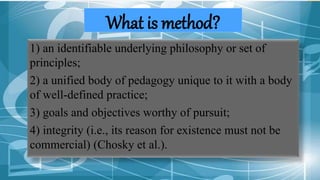
What is method?
1) an identifiable underlying philosophy or set of
principles;
2) a unified body of pedagogy unique to it with a body
of well-defined practice;
3) goals and objectives worthy of pursuit;
4) integrity (i.e., its reason for existence must not be
commercial) (Chosky et al.).
Method Similarities
•Jaques-Emile Dalcroze,
•Zoltan Kodály,
•Carl Orff,
•S. Suzuki
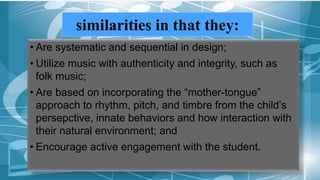
similarities in that they:
• Are systematic and sequential in design;
• Utilize music with authenticity and integrity, such as
folk music;
• Are based on incorporating the “mother-tongue”
approach to rhythm, pitch, and timbre from the child’s
persepctive, innate behaviors and how interaction with
their natural environment; and
• Encourage active engagement with the student.
Orff Schulwerk
Philosophy
Since the beginning of time, children have not
liked to study. They would much rather play, and if
you have their interests at heart, you will let them
learn while they play; they will find that what they
have mastered is child’s play.
The Orff Schulwerk method is the only approach that
is not a systematic “method”, although it does entail
fostering creative thinking through improvisational
experiences. Rather than a system, Schulwerk
combines instruments, singing, movement, and speech to
develop children’s innate musical abilities.
•The Orff Schulwerk method is the only approach that is
not a systematic “method” although it does entail
fostering creative thinking through improvisational
experiences.
•Schulwerk combines instruments, singing, movement, and
speech to develop children’s innate musical abilities.
Carl Orff
•elemental music is based on small-scale musical patterns
(e.g., ostinato, drone) familiar to the students.
•Elemental music is never music alone but forms a unity
with movement, dance and speech. It is music that one
makes oneself, in which one takes part not as a listener,
but as a participant. It is unsophisticated, employs no big
forms and no big architectural structures, and it uses small
sequence forms, ostinato and rondo. Elemental music is
near the earth, natural, physical, within the range of
everyone to learn it and experience it and suitable for the
child… (1963)
Orff Schulwerk utilizes children’s natural behaviors of
play—experimenting, improvising—to access children’s
innate musicality. Schulwerk uses the native language,
sounds, timbres, rhythms, melodies, and tonal material
surrounding the child, particularly in its folk music
repertoire. Similar to many of the other methods, the Orff
Schulwerk emphasizes that children should experience first
and then analyze or intellectualize about music afterwards,
and encourages hands-on music-making regardless of skill
level.
The Orff Instrumentarium
In early 20th century Germany, there were few instruments
accessible to children. Orff began by buying recorders,
which were rare at the time. Since no one knew how to play
them, Dorothée Gunther created instructional books to
teach recorder to children. No one knew how to play them,
so Dorothée Gunther created instructional books to teach
them.
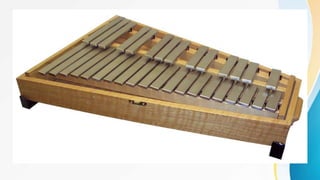
Carl Orff came across an African xylophone, and
developed a way to transform the xylophone into an
instrument for the children at the school to play. He then
developed the metal-barred metallophones from the idea of
the Indonesian gamelan orchestra and the
German glockenspiels, which were small metal-plated
instruments found in Germany.
Thus the instrumentarium was born—the complete set of
which includes bass bars, bass, alto/tenor, and soprano
metallophones, xylophones and alto and soprano
glockenspiels. While each instrument is limited in range to
fewer than two octaves, all together, from bass bars to
soprano glockenspiel, the ensemble covers six octaves,
creating an entire orchestra:
Patterned accompaniments
Orff believed that one of the easiest ways to encourage
student participation in music while also contributing to
beautiful music-making is to have them play a simple
accompaniment on a xylophone. By second grade, most
students will be able to keep a steady beat, with a fair
number able to do so by first grade. Below are some basic
accompaniment patterns on the xylophone or metallophone
that students should be able to perform easily.
Bordun/Chord Bordun:
An open 5th, containing the 1st and 5th degrees of the chord.
The 3rd is not played.
For example, a bordun in C will include the two pitches C and
G; in F, the F and C; in G the G and D; in d minor the d and a,
etc. A chord bordun means that the 1st
and 5th degrees are played simultaneously.
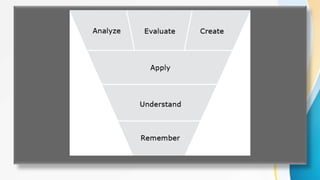
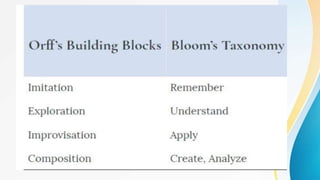
The Orff process
The four stages establish the fundamental building blocks
for children to develop musical literacy. They are similar to
Bloom’s taxonomy, in that they begin by introducing a very
basic skill set and then gradually move on to more complex
activities such as composition, which is represented in the
upper phases of the taxonomy.
Orff as arts integration
One of Orff Schulwerk’s major contributions is its
emphasis on arts integration. Orff includes language
(stories, poetry, rhythmic speech), movement (dance,
improvisation), and drama as well as music.
Parallels between Orff’s
building blocks and Bloom’s
taxonomy
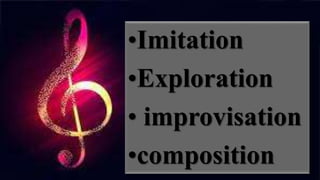
The four stages of
teaching
•Imitation
•Exploration
• improvisation
•composition
Imitation: Echoing,
responding
• Imitation builds the student’s repertoire of
pitches, rhythms, meter, tempo, and
dynamics. Students absorb the fundamental
music materials for their “tool box” to be
used in more complex activities in the
future.
Exploration
• Students begin to understand and even apply the
knowledge learned through imitation. They hear the
movement of pitches, the content of rhythms, the
movement of meter, and explore the timbre of whatever
instrument or voice with which they have access. The
Orff Instrumentarium provides almost limitless
possibilities for exploration.
Improvisation
After exploration and imitation, students not
only understand, but also can apply some of
the possible combinations of rhythms and
pitches, form and dynamics, etc., within a
musical framework.
Composition
Composing is a pinnacle of music-making in
that the composer must also analyze the
musical material s/he is working with in order
to create a new piece.
Applying the Orff approach
developmentally
Schulwerk understands that to be an excellent
musician, the art form must be highly familiar
and internalized to the point of being second
nature. Through the practice of imitation,
exploration, improvisation, and composition,
students learn what music is by performing.
Powerpoint Presentation in Music, Famous

Powerpoint Presentation in Music, Famous

  • 1.
    1. Zoltan Kodály 2.Emile-Jacques Dalcroze 3. Orff Schulwerk 4. Edwin Gordon 5. Shinseki Suzuki 6. Reggio Emilia
  • 2.
    What is method? 1)an identifiable underlying philosophy or set of principles; 2) a unified body of pedagogy unique to it with a body of well-defined practice; 3) goals and objectives worthy of pursuit; 4) integrity (i.e., its reason for existence must not be commercial) (Chosky et al.).
  • 3.
  • 4.
    similarities in thatthey: • Are systematic and sequential in design; • Utilize music with authenticity and integrity, such as folk music; • Are based on incorporating the “mother-tongue” approach to rhythm, pitch, and timbre from the child’s persepctive, innate behaviors and how interaction with their natural environment; and • Encourage active engagement with the student.
  • 5.
    Orff Schulwerk Philosophy Since thebeginning of time, children have not liked to study. They would much rather play, and if you have their interests at heart, you will let them learn while they play; they will find that what they have mastered is child’s play.
  • 6.
    The Orff Schulwerkmethod is the only approach that is not a systematic “method”, although it does entail fostering creative thinking through improvisational experiences. Rather than a system, Schulwerk combines instruments, singing, movement, and speech to develop children’s innate musical abilities.
  • 7.
    •The Orff Schulwerkmethod is the only approach that is not a systematic “method” although it does entail fostering creative thinking through improvisational experiences. •Schulwerk combines instruments, singing, movement, and speech to develop children’s innate musical abilities.
  • 8.
    Carl Orff •elemental musicis based on small-scale musical patterns (e.g., ostinato, drone) familiar to the students.
  • 9.
    •Elemental music isnever music alone but forms a unity with movement, dance and speech. It is music that one makes oneself, in which one takes part not as a listener, but as a participant. It is unsophisticated, employs no big forms and no big architectural structures, and it uses small sequence forms, ostinato and rondo. Elemental music is near the earth, natural, physical, within the range of everyone to learn it and experience it and suitable for the child… (1963)
  • 10.
    Orff Schulwerk utilizeschildren’s natural behaviors of play—experimenting, improvising—to access children’s innate musicality. Schulwerk uses the native language, sounds, timbres, rhythms, melodies, and tonal material surrounding the child, particularly in its folk music repertoire. Similar to many of the other methods, the Orff Schulwerk emphasizes that children should experience first and then analyze or intellectualize about music afterwards, and encourages hands-on music-making regardless of skill level.
  • 11.
    The Orff Instrumentarium Inearly 20th century Germany, there were few instruments accessible to children. Orff began by buying recorders, which were rare at the time. Since no one knew how to play them, Dorothée Gunther created instructional books to teach recorder to children. No one knew how to play them, so Dorothée Gunther created instructional books to teach them.
  • 12.
    Carl Orff cameacross an African xylophone, and developed a way to transform the xylophone into an instrument for the children at the school to play. He then developed the metal-barred metallophones from the idea of the Indonesian gamelan orchestra and the German glockenspiels, which were small metal-plated instruments found in Germany.
  • 14.
    Thus the instrumentariumwas born—the complete set of which includes bass bars, bass, alto/tenor, and soprano metallophones, xylophones and alto and soprano glockenspiels. While each instrument is limited in range to fewer than two octaves, all together, from bass bars to soprano glockenspiel, the ensemble covers six octaves, creating an entire orchestra:
  • 15.
    Patterned accompaniments Orff believedthat one of the easiest ways to encourage student participation in music while also contributing to beautiful music-making is to have them play a simple accompaniment on a xylophone. By second grade, most students will be able to keep a steady beat, with a fair number able to do so by first grade. Below are some basic accompaniment patterns on the xylophone or metallophone that students should be able to perform easily.
  • 16.
    Bordun/Chord Bordun: An open5th, containing the 1st and 5th degrees of the chord. The 3rd is not played. For example, a bordun in C will include the two pitches C and G; in F, the F and C; in G the G and D; in d minor the d and a, etc. A chord bordun means that the 1st and 5th degrees are played simultaneously.
  • 17.
    The Orff process Thefour stages establish the fundamental building blocks for children to develop musical literacy. They are similar to Bloom’s taxonomy, in that they begin by introducing a very basic skill set and then gradually move on to more complex activities such as composition, which is represented in the upper phases of the taxonomy.
  • 18.
    Orff as artsintegration One of Orff Schulwerk’s major contributions is its emphasis on arts integration. Orff includes language (stories, poetry, rhythmic speech), movement (dance, improvisation), and drama as well as music.
  • 19.
    Parallels between Orff’s buildingblocks and Bloom’s taxonomy
  • 22.
    The four stagesof teaching
  • 23.
  • 24.
    Imitation: Echoing, responding • Imitationbuilds the student’s repertoire of pitches, rhythms, meter, tempo, and dynamics. Students absorb the fundamental music materials for their “tool box” to be used in more complex activities in the future.
  • 25.
    Exploration • Students beginto understand and even apply the knowledge learned through imitation. They hear the movement of pitches, the content of rhythms, the movement of meter, and explore the timbre of whatever instrument or voice with which they have access. The Orff Instrumentarium provides almost limitless possibilities for exploration.
  • 26.
    Improvisation After exploration andimitation, students not only understand, but also can apply some of the possible combinations of rhythms and pitches, form and dynamics, etc., within a musical framework.
  • 27.
    Composition Composing is apinnacle of music-making in that the composer must also analyze the musical material s/he is working with in order to create a new piece.
  • 28.
    Applying the Orffapproach developmentally Schulwerk understands that to be an excellent musician, the art form must be highly familiar and internalized to the point of being second nature. Through the practice of imitation, exploration, improvisation, and composition, students learn what music is by performing.