Who is KODALY?
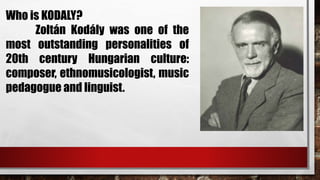
Zoltán Kodály was one of the
most outstanding personalities of
20th century Hungarian culture:
composer, ethnomusicologist, music
pedagogue and linguist.
His internationally acknowledged concept of music
education is the basis for general music teaching in
Hungary and also plays an important role in the
training of professional musicians. Zoltán Kodály
played a prominent role in Hungarian public life,
holding several public posts and being a member or
head of numerous boards and committees. He was
also acquainted with many influential public figures
(musicians, artists, scholars and politicians).
What is Kodaly Method?
According to the Grove Concise Dictionary of Music, the
‘Kodály Method’ is: 'A way of training children in music,
devised by Zoltán Kodály, which is based on giving them a
thorough grounding in solfeggio (using a ‘movable doh’
system), aimed at developing aural ability with emphasis on
sight-singing, dictation and the reading and writing of
music; a progressive repertory of songs and exercises,
based on Hungarian folk music, is used.'
Let’s Practice!
Activity: Video Presentation
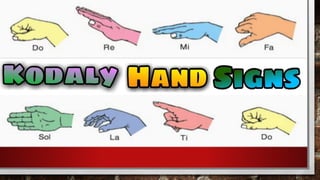
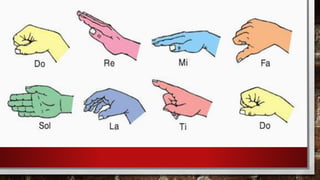
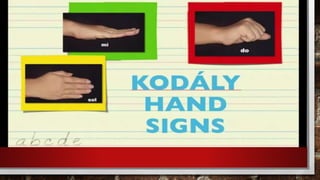
Perform the Kodaly Hand Sign

Kodaly Method by Teacher Kaye

  • 2.
    Who is KODALY? ZoltánKodály was one of the most outstanding personalities of 20th century Hungarian culture: composer, ethnomusicologist, music pedagogue and linguist.
  • 3.
    His internationally acknowledgedconcept of music education is the basis for general music teaching in Hungary and also plays an important role in the training of professional musicians. Zoltán Kodály played a prominent role in Hungarian public life, holding several public posts and being a member or head of numerous boards and committees. He was also acquainted with many influential public figures (musicians, artists, scholars and politicians).
  • 4.
    What is KodalyMethod? According to the Grove Concise Dictionary of Music, the ‘Kodály Method’ is: 'A way of training children in music, devised by Zoltán Kodály, which is based on giving them a thorough grounding in solfeggio (using a ‘movable doh’ system), aimed at developing aural ability with emphasis on sight-singing, dictation and the reading and writing of music; a progressive repertory of songs and exercises, based on Hungarian folk music, is used.'
  • 7.
  • 9.