What is
REALISM?
REALISM, in philosophy,
refers to the view that the
“reality” of any material
objects exists in the external
world independently of the
human mind.
Put differently,
realism holds that
what one perceives is real
and is out there existing
in concrete reality.
For example, the
“maple tree” that I see
with my naked eyes is
existing in concrete
reality and is not just
an abstract concept
produced by the mind
as the idealists would
have us believe.
Hence, the fact that the maple
tree exists in the external world
and has properties of its own
such as hardness and thickness,
that maple tree is independent
of anyone’s perception—
it is therefore “real”.
Full transcript of this presentation is
available at:
https://philonotes.com/index.php/2019/11/14/what
-is-realism/
A video version of this presentation is
available at:
https://www.youtube.com/watch?v=Epop9vwK6qk&
t=41s
Contrary to nominalism,
which holds that universals
do not exist independently
from particulars, realism holds
that both universals and
particulars exist independently
from each other.
In metaphysics, the term
“particulars” refers to concrete,
spatiotemporal entities or objects,
such as a tree or a book.
Often times, the term “individuals”
is used interchangeably with
“particulars”.
One of the most
distinctive
characteristics of
“particulars” is
that they cannot
be in more than
one place at the
same time.
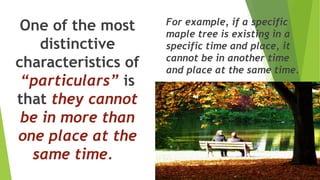
For example, if a specific
maple tree is existing in a
specific time and place, it
cannot be in another time
and place at the same time.
The term
“universals” refers
to the properties or
characteristics
possessed by a
particular, concrete
spatiotemporal
object, such as
color or hardness.
For example, the
“whiteness” of a book
can also be instantiated
in the “whiteness” of a
dress or a paper.
Scholars in philosophy believed
that it was Aristotle who first
popularized realism when he
opposed Plato’s idealism and
argued that the “real” exists in
the sensible world which can be
known through experience.
As we can see, it was
Aristotle who provided
the fundamental
structure of the
development of realism
and its penetration in
other disciplines, such
as in arts and politics.

What is Realism?

  • 1.
  • 2.
    REALISM, in philosophy, refersto the view that the “reality” of any material objects exists in the external world independently of the human mind.
  • 3.
    Put differently, realism holdsthat what one perceives is real and is out there existing in concrete reality.
  • 4.
    For example, the “mapletree” that I see with my naked eyes is existing in concrete reality and is not just an abstract concept produced by the mind as the idealists would have us believe.
  • 5.
    Hence, the factthat the maple tree exists in the external world and has properties of its own such as hardness and thickness, that maple tree is independent of anyone’s perception— it is therefore “real”.
  • 6.
    Full transcript ofthis presentation is available at: https://philonotes.com/index.php/2019/11/14/what -is-realism/ A video version of this presentation is available at: https://www.youtube.com/watch?v=Epop9vwK6qk& t=41s
  • 7.
    Contrary to nominalism, whichholds that universals do not exist independently from particulars, realism holds that both universals and particulars exist independently from each other.
  • 8.
    In metaphysics, theterm “particulars” refers to concrete, spatiotemporal entities or objects, such as a tree or a book. Often times, the term “individuals” is used interchangeably with “particulars”.
  • 9.
    One of themost distinctive characteristics of “particulars” is that they cannot be in more than one place at the same time. For example, if a specific maple tree is existing in a specific time and place, it cannot be in another time and place at the same time.
  • 10.
    The term “universals” refers tothe properties or characteristics possessed by a particular, concrete spatiotemporal object, such as color or hardness. For example, the “whiteness” of a book can also be instantiated in the “whiteness” of a dress or a paper.
  • 11.
    Scholars in philosophybelieved that it was Aristotle who first popularized realism when he opposed Plato’s idealism and argued that the “real” exists in the sensible world which can be known through experience.
  • 12.
    As we cansee, it was Aristotle who provided the fundamental structure of the development of realism and its penetration in other disciplines, such as in arts and politics.