.
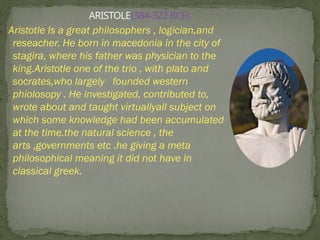
Aristotle Is a great philosophers , logician,and
reseacher. He born in macedonia in the city of
stagira, where his father was physician to the
king.Aristotle one of the trio , with plato and
socrates,who largely founded western
phiolosopy . He investigated, contributed to,
wrote about and taught virtuallyall subject on
which some knowledge had been accumulated
at the time.the natural science , the
arts ,governments etc .he giving a meta
philosophical meaning it did not have in
classical greek.
ARISTOLE(384-322 BCE)
 plato was an ancient Greek philosopher of the Classical period
Plato, whose actual name was Aristocles, was born in Athens or
Aegina, between 428 and 423 BC. He was a member of an
aristocratic and influential family.]
His father was Ariston,]
who
may have been a descendant of two kings—Codrus and
Melanthus.[g][21]
His mother was Perictione, descendant of Solon,
[22][23]
a statesman credited with laying the foundations of
Athenian democracy..
Plato had two brothers, Glaucon and
Adeimantus, a sister, Potone,and a half brother, Antiphon. who is
considered a foundational thinker in Western philosophy and an
innovator of the written dialogue and dialectic forms. He raised
problems for what became all the major areas of both
theoretical philosophy and practical philosophy, and was the
founder of the Platonic Academy, a philosophical school in
Athens where Plato taught the doctrines that would later become
known as Platonism.
Plato (ca. 427-347 B.C.E.)
WHAT IS METAPHYSICS?
 Thebranchofphilosophythatthestudyaboutnature,existence,,truthisknown methaphysics
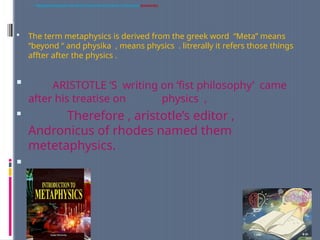
 The term metaphysics is derived from the greek word “Meta” means
“beyond “ and physika , means physics . litrerally it refers those things
affter after the physics .
 ARISTOTLE ‘S writing on ‘fist philosophy’ came
after his treatise on physics ,
 Therefore , aristotle’s editor ,
Andronicus of rhodes named them
metetaphysics.

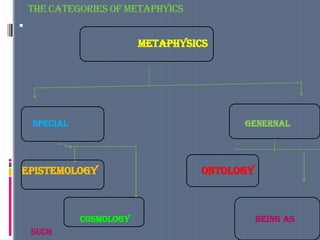
THE CATEGORIES OF METAPHYICS

METAPHYSICS
SPECIAL GENERNAL
EPISTEMOLOGY ONTOLOGY
COSMOLOGY BEING AS
SUCH
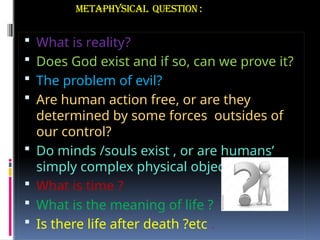
Metaphysical question :
 What is reality?
 Does God exist and if so, can we prove it?
 The problem of evil?
 Are human action free, or are they
determined by some forces outsides of
our control?
 Do minds /souls exist , or are humans’
simply complex physical object ?
 What is time ?
 What is the meaning of life ?
 Is there life after death ?etc .
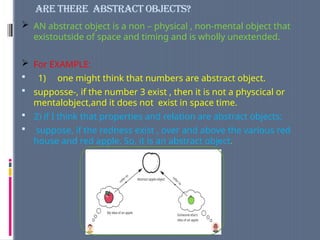
ARE THERE ABSTRACT OBJECTS?
 AN abstract object is a non – physical , non-mental object that
existoutside of space and timing and is wholly unextended.
 For EXAMPLE:
 1) one might think that numbers are abstract object.
 supposse-, if the number 3 exist , then it is not a physcical or
mentalobject,and it does not exist in space time.
 2) if I think that properties and relation are abstract objects;
 suppose, if the redness exist , over and above the various red
house and red apple. So, it is an abstract object.
• Some views are come in world about abstract object theory.
1) Nominalists- those who think there are no abstract objects are typically called
Nominalist.
It played a significant role in the metaphysical debate since at the
middle age.
2) Platonists- Those who think there are no abstract objects are Platonists.
According to the plantonist view of properties , the property of redness
exists independently of any red thing .according to plantonists , this redness
of apple , house property is an abstract object.
3) Fictionalism – One popular version of nominalism of this kind is called frictionalism. It propose that a
certain discourse such as talk about possible world or mathematical talk is usefull perhaps even
indispensable for theoritical pupose.
for example: they may say that “3 is prime” is false because there is no such thing as the number 3.
WHAT ARE PROPERTY?
property are also known as ‘attributes’ , ‘characteristics’ , ‘features’ , ‘types’
and quality . The question of whether properties are a fundamental
category of the entities or whether qualitative similarity and difference
is determined by the existence of something else .
Contemporary philosopy , there are four main
accounts of the ontological basis of suc entities : universal , trops ,
natural classes and resemblance classes.
In modern analytic philosopy there are several debates
about the fundamental nature of the properties . These center around
question such as : Are properties universal or paticulars? Are properties
real? Are they categorical or dispositonal? Are properties physical or
mental?
Examples of properties include redness, the property of being two ,
the property of being non- existence, the property of being identical to
socrates .

An influential division is between universal and trope
.
UNIVERSAL- ACCORDING TO VIEW THE PROPERTY
ARE ABSTRACT OBJECT CALLED UNIVERSAL.
• Universal do not exist in space or time but object in
space or time get to have the property. The very same
thing blackness can exist at different location when it
is instantiated by different obeject.
 TROPE - A trope is a particular instance of property.
According to view universal are unnecessary. Trope
are individual, that is one off things that exist at just
one place and time .
WHAT SORTS OF PROPERTIES AND REALATIONS ARE THERE ?
 There are many important issues in metaphysics about the
nature of particular properties or relations.
 TEMPORAL RELATION= The relation that hold between different times.
Some metaphysicians think that temporal relations are characterised
entirely by certain static relations.
 EXAMPLE: IF the event of my birthdayis later- than the event of
Tim the dinosaur stepping on a flower, and true at all times.
 THOSE who accept this kind of picture of temporal
relation are called B – THEORISTS
 EXAMPLE: The relation of earlier than , later – than and
simultaneous with are said to order events into B - series.
0ppoent of THE B- theory are knowns A- theorist.
 According to the A- THEORY OUR WORLD IS ESSTIALLY DYNAMICAL. Every
event has the property of being either past, present, future .
 A-theorist of time is the view that properties of pastness , presentness, and
futurity do not depend on an event location in the B- series.
 THE idea that one event or thing influences another, causing a change or
the production of something is known as causation.
 Some think that happens when one object or event biffs that is runs into or
imparts a marks on some other even this theories are known as process
theories.
 The idea is that what makes it the case that one event is the cause
of another is that had one event not occurred, the other would not
have occurred either theories of this kind are known as
counterfactual theories.
WHOLES AND PARTS
 Merology is the study of parts and wholes. Wholes and part is major part of
modern metapysics.
 Merological nihilist is the vew that no objects have any proper parts.
 According to merological nihilism , there are only fundamental physical simples
arranged in various spatial pattern.
 FOR EXAMPLES = The mereological nihilist claims that , despite
 appearances to the contrary , there really are no tables. There are only
fundamental physical simples spatially arranged causely interrelated in
such a way as to jointly cause preceptual faculities like ours to have – like
perceptual experiences.
 Mereological universalists are at the other end of the spectrum from
nihilists. They hold that composition occurs under any and every
circumstance.
 Mereological restrictivists think that composition sometime occurs whether
there exist a composite objectbdepends on how some bunch of object is
arranged.
The worry that nihilistand universalists have regarding restrictivism is that it seems very
difficult to come up with perfectly general, non- arbitrary, condition under which composition
occurs from which it will follow that there exist dogs and cats and toasters but not doatnoons.
 The nihilist is faced with the opposite problems to the universalist.
 Nihilist choose nihism because they think that universalists
unncessarily posit object that are not needed to explain the world
around us.
 Universalists choose universalism because they think that nihilist are
unable straightfrowardly to make sense od ordinary claims .
WHAT COULD HAVE BEEN ?
LAW OF NATURE:-
 We want to know of not just what our world is like , but also how it
could have been different . Part of this requires thinking about law of
nature that govern our world.
 Law of nature are of two basic forms 1)a law of universal 2) a law of
probabilistic.
 MODALITY - The study of the metaphysical basis modal statements ,
which are statements about what is possible or necessary.
 NOMICALLY POSSIBLE -When it is consistent with the law if nature in a
given situation . THIS means that there is nothing in the actual world
that prevents it from happening.
 LOGICAL POSSIBLE- It referes to somethings that is conceivable ,
imaginable or hought , even if it not physically possible .
.
PRESENTED BY- PURUSOTTAM BIHARI
COURSE – INTRODUCTION TO PHILOSOPHY
ROLL – 24/992
THANK YOU THANK YOU
THANK YOU
THANK YOU THANK YOU

metaphysics philosophy power point presentation

  • 1.
  • 2.
    Aristotle Is agreat philosophers , logician,and reseacher. He born in macedonia in the city of stagira, where his father was physician to the king.Aristotle one of the trio , with plato and socrates,who largely founded western phiolosopy . He investigated, contributed to, wrote about and taught virtuallyall subject on which some knowledge had been accumulated at the time.the natural science , the arts ,governments etc .he giving a meta philosophical meaning it did not have in classical greek. ARISTOLE(384-322 BCE)
  • 3.
     plato wasan ancient Greek philosopher of the Classical period Plato, whose actual name was Aristocles, was born in Athens or Aegina, between 428 and 423 BC. He was a member of an aristocratic and influential family.] His father was Ariston,] who may have been a descendant of two kings—Codrus and Melanthus.[g][21] His mother was Perictione, descendant of Solon, [22][23] a statesman credited with laying the foundations of Athenian democracy.. Plato had two brothers, Glaucon and Adeimantus, a sister, Potone,and a half brother, Antiphon. who is considered a foundational thinker in Western philosophy and an innovator of the written dialogue and dialectic forms. He raised problems for what became all the major areas of both theoretical philosophy and practical philosophy, and was the founder of the Platonic Academy, a philosophical school in Athens where Plato taught the doctrines that would later become known as Platonism. Plato (ca. 427-347 B.C.E.)
  • 4.
  • 5.
     Thebranchofphilosophythatthestudyaboutnature,existence,,truthisknown methaphysics The term metaphysics is derived from the greek word “Meta” means “beyond “ and physika , means physics . litrerally it refers those things affter after the physics .  ARISTOTLE ‘S writing on ‘fist philosophy’ came after his treatise on physics ,  Therefore , aristotle’s editor , Andronicus of rhodes named them metetaphysics. 
  • 6.
    THE CATEGORIES OFMETAPHYICS  METAPHYSICS SPECIAL GENERNAL EPISTEMOLOGY ONTOLOGY COSMOLOGY BEING AS SUCH
  • 7.
    Metaphysical question : What is reality?  Does God exist and if so, can we prove it?  The problem of evil?  Are human action free, or are they determined by some forces outsides of our control?  Do minds /souls exist , or are humans’ simply complex physical object ?  What is time ?  What is the meaning of life ?  Is there life after death ?etc .
  • 8.
    ARE THERE ABSTRACTOBJECTS?  AN abstract object is a non – physical , non-mental object that existoutside of space and timing and is wholly unextended.  For EXAMPLE:  1) one might think that numbers are abstract object.  supposse-, if the number 3 exist , then it is not a physcical or mentalobject,and it does not exist in space time.  2) if I think that properties and relation are abstract objects;  suppose, if the redness exist , over and above the various red house and red apple. So, it is an abstract object.
  • 9.
    • Some viewsare come in world about abstract object theory. 1) Nominalists- those who think there are no abstract objects are typically called Nominalist. It played a significant role in the metaphysical debate since at the middle age. 2) Platonists- Those who think there are no abstract objects are Platonists. According to the plantonist view of properties , the property of redness exists independently of any red thing .according to plantonists , this redness of apple , house property is an abstract object. 3) Fictionalism – One popular version of nominalism of this kind is called frictionalism. It propose that a certain discourse such as talk about possible world or mathematical talk is usefull perhaps even indispensable for theoritical pupose. for example: they may say that “3 is prime” is false because there is no such thing as the number 3.
  • 10.
    WHAT ARE PROPERTY? propertyare also known as ‘attributes’ , ‘characteristics’ , ‘features’ , ‘types’ and quality . The question of whether properties are a fundamental category of the entities or whether qualitative similarity and difference is determined by the existence of something else . Contemporary philosopy , there are four main accounts of the ontological basis of suc entities : universal , trops , natural classes and resemblance classes. In modern analytic philosopy there are several debates about the fundamental nature of the properties . These center around question such as : Are properties universal or paticulars? Are properties real? Are they categorical or dispositonal? Are properties physical or mental? Examples of properties include redness, the property of being two , the property of being non- existence, the property of being identical to socrates .
  • 11.
     An influential divisionis between universal and trope . UNIVERSAL- ACCORDING TO VIEW THE PROPERTY ARE ABSTRACT OBJECT CALLED UNIVERSAL. • Universal do not exist in space or time but object in space or time get to have the property. The very same thing blackness can exist at different location when it is instantiated by different obeject.  TROPE - A trope is a particular instance of property. According to view universal are unnecessary. Trope are individual, that is one off things that exist at just one place and time .
  • 12.
    WHAT SORTS OFPROPERTIES AND REALATIONS ARE THERE ?  There are many important issues in metaphysics about the nature of particular properties or relations.  TEMPORAL RELATION= The relation that hold between different times. Some metaphysicians think that temporal relations are characterised entirely by certain static relations.  EXAMPLE: IF the event of my birthdayis later- than the event of Tim the dinosaur stepping on a flower, and true at all times.  THOSE who accept this kind of picture of temporal relation are called B – THEORISTS  EXAMPLE: The relation of earlier than , later – than and simultaneous with are said to order events into B - series.
  • 13.
    0ppoent of THEB- theory are knowns A- theorist.  According to the A- THEORY OUR WORLD IS ESSTIALLY DYNAMICAL. Every event has the property of being either past, present, future .  A-theorist of time is the view that properties of pastness , presentness, and futurity do not depend on an event location in the B- series.  THE idea that one event or thing influences another, causing a change or the production of something is known as causation.  Some think that happens when one object or event biffs that is runs into or imparts a marks on some other even this theories are known as process theories.  The idea is that what makes it the case that one event is the cause of another is that had one event not occurred, the other would not have occurred either theories of this kind are known as counterfactual theories.
  • 14.
    WHOLES AND PARTS Merology is the study of parts and wholes. Wholes and part is major part of modern metapysics.  Merological nihilist is the vew that no objects have any proper parts.  According to merological nihilism , there are only fundamental physical simples arranged in various spatial pattern.  FOR EXAMPLES = The mereological nihilist claims that , despite  appearances to the contrary , there really are no tables. There are only fundamental physical simples spatially arranged causely interrelated in such a way as to jointly cause preceptual faculities like ours to have – like perceptual experiences.  Mereological universalists are at the other end of the spectrum from nihilists. They hold that composition occurs under any and every circumstance.  Mereological restrictivists think that composition sometime occurs whether there exist a composite objectbdepends on how some bunch of object is arranged.
  • 15.
    The worry thatnihilistand universalists have regarding restrictivism is that it seems very difficult to come up with perfectly general, non- arbitrary, condition under which composition occurs from which it will follow that there exist dogs and cats and toasters but not doatnoons.  The nihilist is faced with the opposite problems to the universalist.  Nihilist choose nihism because they think that universalists unncessarily posit object that are not needed to explain the world around us.  Universalists choose universalism because they think that nihilist are unable straightfrowardly to make sense od ordinary claims .
  • 16.
    WHAT COULD HAVEBEEN ? LAW OF NATURE:-  We want to know of not just what our world is like , but also how it could have been different . Part of this requires thinking about law of nature that govern our world.  Law of nature are of two basic forms 1)a law of universal 2) a law of probabilistic.  MODALITY - The study of the metaphysical basis modal statements , which are statements about what is possible or necessary.  NOMICALLY POSSIBLE -When it is consistent with the law if nature in a given situation . THIS means that there is nothing in the actual world that prevents it from happening.  LOGICAL POSSIBLE- It referes to somethings that is conceivable , imaginable or hought , even if it not physically possible .
  • 17.
    . PRESENTED BY- PURUSOTTAMBIHARI COURSE – INTRODUCTION TO PHILOSOPHY ROLL – 24/992
  • 18.
    THANK YOU THANKYOU THANK YOU THANK YOU THANK YOU