Realism
Presented by:
Overview
 Definition of Realism
 Key Philosophers
 Effects on Education
 Group Activity
Realism
 Things exist whether or not the human
mind perceives them.
 Objects are characterized by their
properties, such as:
 Size
 Shape
 Weight
 Color
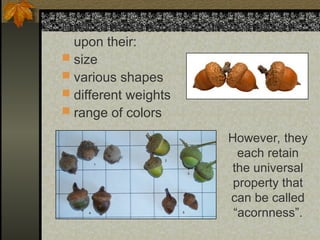
Each of these acorns is different based
upon their:
 size
 various shapes
 different weights
 range of colors
However, they
each retain
the universal
property that
can be called
“acornness”.
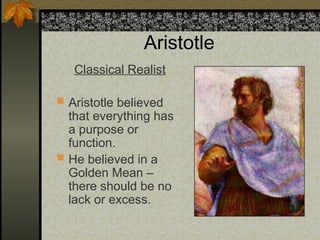
Aristotle
Classical Realist
 Aristotle believed
that everything has
a purpose or
function.
 He believed in a
Golden Mean –
there should be no
lack or excess.
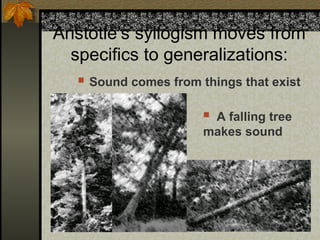
Aristotle’s syllogism moves from
specifics to generalizations:
 Sound comes from things that exist
 A falling tree
makes sound
Therefore, the tree exists.
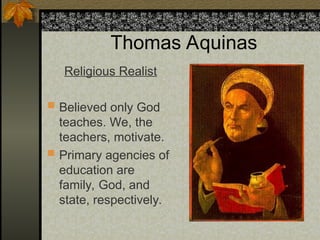
Thomas Aquinas
Religious Realist
 Believed only God
teaches. We, the
teachers, motivate.
 Primary agencies of
education are
family, God, and
state, respectively.
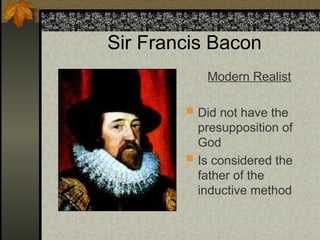
Sir Francis Bacon
Modern Realist
 Did not have the
presupposition of
God
 Is considered the
father of the
inductive method
The inductive method moves to
generalizations from specifics:
 A tree creates sound waves as it falls.
 Sound waves are moving patterns of air
compression.
 These compressions are heard as sound
when they strike the eardrum.
 All falling trees create air compression
patterns.
 Therefore, all trees create sound as they
fall.
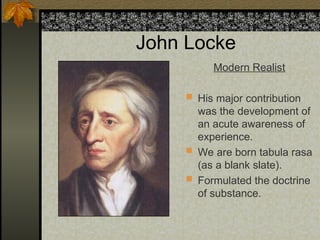
John Locke
Modern Realist
 His major contribution
was the development of
an acute awareness of
experience.
 We are born tabula rasa
(as a blank slate).
 Formulated the doctrine
of substance.
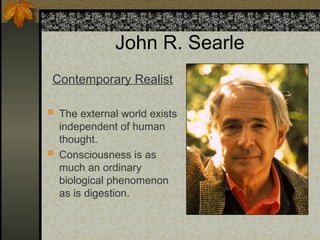
John R. Searle
Contemporary Realist
 The external world exists
independent of human
thought.
 Consciousness is as
much an ordinary
biological phenomenon
as is digestion.
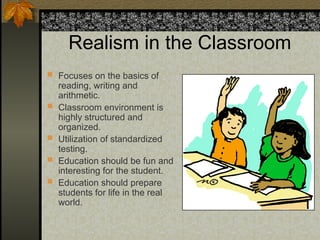
Realism in the Classroom
 Focuses on the basics of
reading, writing and
arithmetic.
 Classroom environment is
highly structured and
organized.
 Utilization of standardized
testing.
 Education should be fun and
interesting for the student.
 Education should prepare
students for life in the real
world.
Advantages of Realism
Teachers:
 It gives testing results that can help prove
that the students are learning the material
Parents:
 gives a parent something tangible to look at
School Corporation:
 State and Federal funding dollars come from
how well students perform on mandated
testing
Disadvantages of Realism:
Teachers:
 Teachers are held accountable for how their
students perform on standardized testing.
Parents:
 When a child’s score isn’t what the parents
expect it to be the parent looks for someone to
blame.
School Corporation:
 Schools can lose valuable funds because of test
scores.
Activity
 Arrange yourselves into your presentation
groups.
 As a group, work to use the parts provided to
create a functioning machine.
 When finished, your machine should
successfully crack the shell of the provided
nuts.
 The groups that accomplish this task in the
time allowed will receive a snack!
Realism-Powerpoint-Presentation.pptxxxx.

  • 1.
  • 2.
    Overview  Definition ofRealism  Key Philosophers  Effects on Education  Group Activity
  • 3.
    Realism  Things existwhether or not the human mind perceives them.  Objects are characterized by their properties, such as:  Size  Shape  Weight  Color
  • 4.
    Each of theseacorns is different based upon their:  size  various shapes  different weights  range of colors However, they each retain the universal property that can be called “acornness”.
  • 5.
    Aristotle Classical Realist  Aristotlebelieved that everything has a purpose or function.  He believed in a Golden Mean – there should be no lack or excess.
  • 6.
    Aristotle’s syllogism movesfrom specifics to generalizations:  Sound comes from things that exist  A falling tree makes sound
  • 7.
  • 8.
    Thomas Aquinas Religious Realist Believed only God teaches. We, the teachers, motivate.  Primary agencies of education are family, God, and state, respectively.
  • 9.
    Sir Francis Bacon ModernRealist  Did not have the presupposition of God  Is considered the father of the inductive method
  • 10.
    The inductive methodmoves to generalizations from specifics:  A tree creates sound waves as it falls.  Sound waves are moving patterns of air compression.  These compressions are heard as sound when they strike the eardrum.  All falling trees create air compression patterns.  Therefore, all trees create sound as they fall.
  • 11.
    John Locke Modern Realist His major contribution was the development of an acute awareness of experience.  We are born tabula rasa (as a blank slate).  Formulated the doctrine of substance.
  • 12.
    John R. Searle ContemporaryRealist  The external world exists independent of human thought.  Consciousness is as much an ordinary biological phenomenon as is digestion.
  • 13.
    Realism in theClassroom  Focuses on the basics of reading, writing and arithmetic.  Classroom environment is highly structured and organized.  Utilization of standardized testing.  Education should be fun and interesting for the student.  Education should prepare students for life in the real world.
  • 14.
    Advantages of Realism Teachers: It gives testing results that can help prove that the students are learning the material Parents:  gives a parent something tangible to look at School Corporation:  State and Federal funding dollars come from how well students perform on mandated testing
  • 15.
    Disadvantages of Realism: Teachers: Teachers are held accountable for how their students perform on standardized testing. Parents:  When a child’s score isn’t what the parents expect it to be the parent looks for someone to blame. School Corporation:  Schools can lose valuable funds because of test scores.
  • 16.
    Activity  Arrange yourselvesinto your presentation groups.  As a group, work to use the parts provided to create a functioning machine.  When finished, your machine should successfully crack the shell of the provided nuts.  The groups that accomplish this task in the time allowed will receive a snack!
Editor's Notes

  • #2 Bullet points will pull up automatically.
  • #6 Page will advance on it’s own through points, sound, animation, and to next page.
  • #14 Bullet points will come up on their own
  • #15 Bullet points will come up on their own.