WHAT IS
hedonism?
HEDONISM is a philosophical
doctrine which originated
from ancient Greece. It
comes from the Attic-Greek
word hēdonē, which means
“pleasure”.
The basic argument
in hedonism is that
the maximization
of pleasure and the
minimization of pain
motivate human
behavior.
In other words, for the hedonists,
all actions of humans are driven by
the forces of pleasure and pain.
Thus, a hedonist will always
strive to attain pleasure;
as a matter of fact, he will
always devote his life for
the attainment of pleasure
and avoidance of pain
by all means.
Full transcript of this presentation is
available at:
https://philonotes.com/index.php/2019/11/27/what-is-
hedonism/
A video version of this presentation is
available at:
https://www.youtube.com/watch?v=7ELLBLwv_Hc
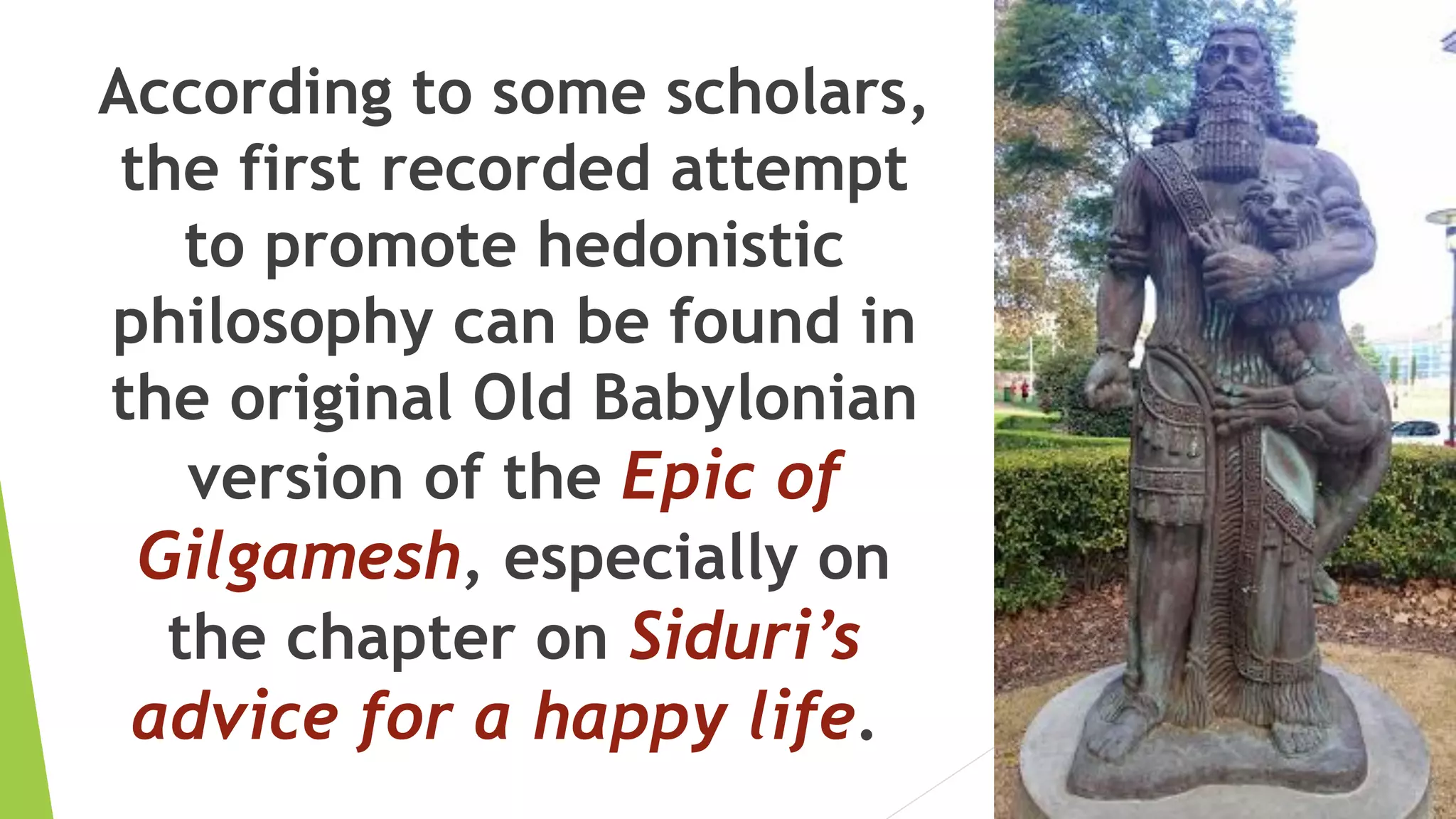
According to some scholars,
the first recorded attempt
to promote hedonistic
philosophy can be found in
the original Old Babylonian
version of the Epic of
Gilgamesh, especially on
the chapter on Siduri’s
advice for a happy life.
As is well known, Siduri was a
Goddess of wine, merry-making,
and wisdom. In the
Epic of Gilgamesh,
Siduri was referred to
as “the Refresher” or
“the girl whose drinks
refresh the soul”.
Some of Siduri’s teachings read:
“Fill your belly. Day
and night make merry.
Let days be full of joy.
Dance and make music
day and night […]
These things alone are
the concern of men.”
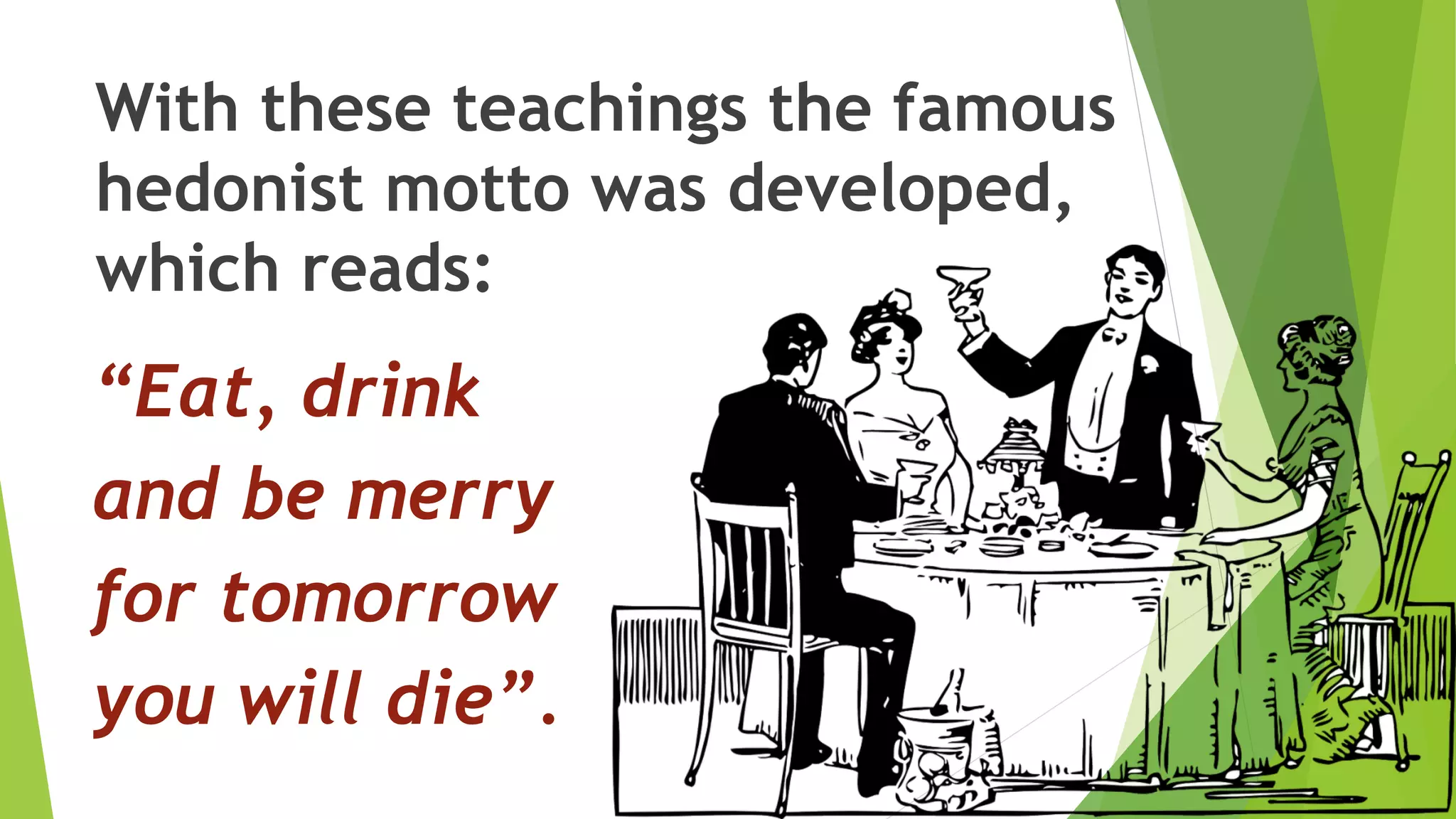
With these teachings the famous
hedonist motto was developed,
which reads:
“Eat, drink
and be merry
for tomorrow
you will die”.
When hedonism is applied to ethics,
the result is “ethical hedonism” the
famous example of which is Bentham’s
model of utilitarian ethics.
Jeremy Bentham, the leading figure
in utilitarianism, appropriated the
principle of hedonism in this
philosophy.
For Bentham, an action is
morally right if it produces
more pleasure than pain.
As we can see, ethical
hedonism argues that:
only pleasure has a positive
importance, while only pain
has a negative importance.

What is Hedonism?

  • 1.
  • 2.
    HEDONISM is aphilosophical doctrine which originated from ancient Greece. It comes from the Attic-Greek word hēdonē, which means “pleasure”.
  • 3.
    The basic argument inhedonism is that the maximization of pleasure and the minimization of pain motivate human behavior.
  • 4.
    In other words,for the hedonists, all actions of humans are driven by the forces of pleasure and pain.
  • 5.
    Thus, a hedonistwill always strive to attain pleasure; as a matter of fact, he will always devote his life for the attainment of pleasure and avoidance of pain by all means.
  • 6.
    Full transcript ofthis presentation is available at: https://philonotes.com/index.php/2019/11/27/what-is- hedonism/ A video version of this presentation is available at: https://www.youtube.com/watch?v=7ELLBLwv_Hc
  • 7.
    According to somescholars, the first recorded attempt to promote hedonistic philosophy can be found in the original Old Babylonian version of the Epic of Gilgamesh, especially on the chapter on Siduri’s advice for a happy life.
  • 8.
    As is wellknown, Siduri was a Goddess of wine, merry-making, and wisdom. In the Epic of Gilgamesh, Siduri was referred to as “the Refresher” or “the girl whose drinks refresh the soul”.
  • 9.
    Some of Siduri’steachings read: “Fill your belly. Day and night make merry. Let days be full of joy. Dance and make music day and night […] These things alone are the concern of men.”
  • 10.
    With these teachingsthe famous hedonist motto was developed, which reads: “Eat, drink and be merry for tomorrow you will die”.
  • 11.
    When hedonism isapplied to ethics, the result is “ethical hedonism” the famous example of which is Bentham’s model of utilitarian ethics. Jeremy Bentham, the leading figure in utilitarianism, appropriated the principle of hedonism in this philosophy.
  • 12.
    For Bentham, anaction is morally right if it produces more pleasure than pain. As we can see, ethical hedonism argues that: only pleasure has a positive importance, while only pain has a negative importance.