Introduction
The term ‘realism’,derived from the word ‘real’, find its origin in the
Greek word: ‘Res’, which means object.
This is the doctrine, which retreats from the reality of the world of
ideas, and which promulgates that what we see and experience around
us is the truth.
3.
Introduction
• Aristotle (383-322 BC), Greek philosopher and student of Plato who
broke with his mentor’s idealist philosophy, is called the father of
realism and the scientific method. He believed that to understand an
object, its ultimate form had to be understood, which doesn’t change.
• John Locke (1690-1781 AD), an English philosopher, gave new impetus
to realism.
• The rapid spread of scientific knowledge in the twentieth century led to
its increased growth and its acceptance as a distinct philosophy.
4.
Aims of Education
•Through education man leads a happy and comfortable life.
• It enables the man to capable of earning by vocational form.
• To develop the memory of the child.
• To strengthen wisdom and power of decision making.
• To create the capacity against struggles with adverse situations arising
while earning a living.
5.
Aims of Education
•To meet the felt needs of individual/related to materialistic.
• To make the man as ‘utilitarian’ with the usage of mother tongue,
experiments, demonstration and tours etc.
• Education will be provided according to the reality of life.
• To develop the child capacity for success in the struggles of future life.
6.
• Laws ofnature and realism: The realist believes that the physical
universe is operated by natural laws. Realists propagated the world as
natural rather than supernatural.
• Realism and science: The realist tries to discover truth with the help
of scientific methods. Such a discovery of truth helps to control the
environment.
7.
• Realism andreligion: There is no absolute antagonism between
realism and religion, though many realists hold the view that religion
is merely man-made and there is no God.
• Realism and value: Most of the realists share the belief that a thing
has an aesthetic value to the extent it harmonizes with the beauty of
nature. Many realists think that behavior is what is socially and
rationally acceptable.
8.
Objective of Education
Thereare two objectives of education according to realism:
• Equipping students with knowledge and skill needed to understand
and master their physical environment.
• Enabling students to adjust themselves to the realities of the physical
world and to adjust with adult approved behavior.
9.
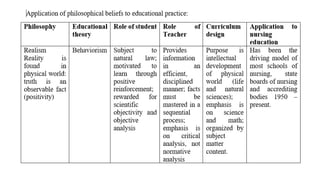
• Realism ineducational practice: Scientific evaluation is the most
important contribution made by realism in the field of education.
Realism lays stress on the use of standardized tests.
• Realism and the role of the teacher: Realism does not attach much
importance to the personality of the teacher. The realist also does not
give importance to the opinion of the teacher. The teacher organizes
and presents content systematically within a discipline, demonstrating
use of criteria in making decisions.
10.
• Teaching methodsfocus on mastery of facts and basic skills through
demonstration and recitation. Students must also demonstrate the
ability to think critically and scientifically, using observation and
experimentation.
• Realism and curriculum: A realistic education meant a curriculum to
be in accurate touch with life; ultimately this led to the boundary of
curriculum to the bounds of life itself. Curriculum should be
scientifically approached, standardized and distinct-discipline based.
11.
Basic concept ofRealism
• Realism is a philosophy away from the world of ideas and is
concerned with the study of the world we live in.
• Realism believes that all knowledge is derived from experience.
• The result believes that the real world is the world of nature.
• The realist believes that everything that exists in the universe is matter
or energy or matter in motion – the ultimate reality is the world of
physical objects.
12.
Implications in Education
•Realism proposes that the world is composed of natural laws that
regulate all of nature.
• The origin of a liberal arts education is in the writings and culture of
realism.
• Realists believe that the student should be rewarded for learning and
responding to new experiences with scientific objectivity and analysis.
14.
References
• Basavanthapa BT.Nursing education. 2nd
ed. New Delhi: Jaypee
Brothers; 2009.
• Singh I. Essentials of education. 9th
ed. Kathmandu: Singh JB; 2011.
• Neeraja KP. Textbook of nursing education. 1st
ed. New Delhi: Jaypee
Brothers Medical Publishers; 2007.




![Realism-in-philosophy-of-education [Autosaved].pptx](https://cdn.slidesharecdn.com/ss_thumbnails/realism-in-philosophy-of-educationautosaved-250124085054-c050c5e5-thumbnail.jpg?width=640&height=640&fit=bounds)


