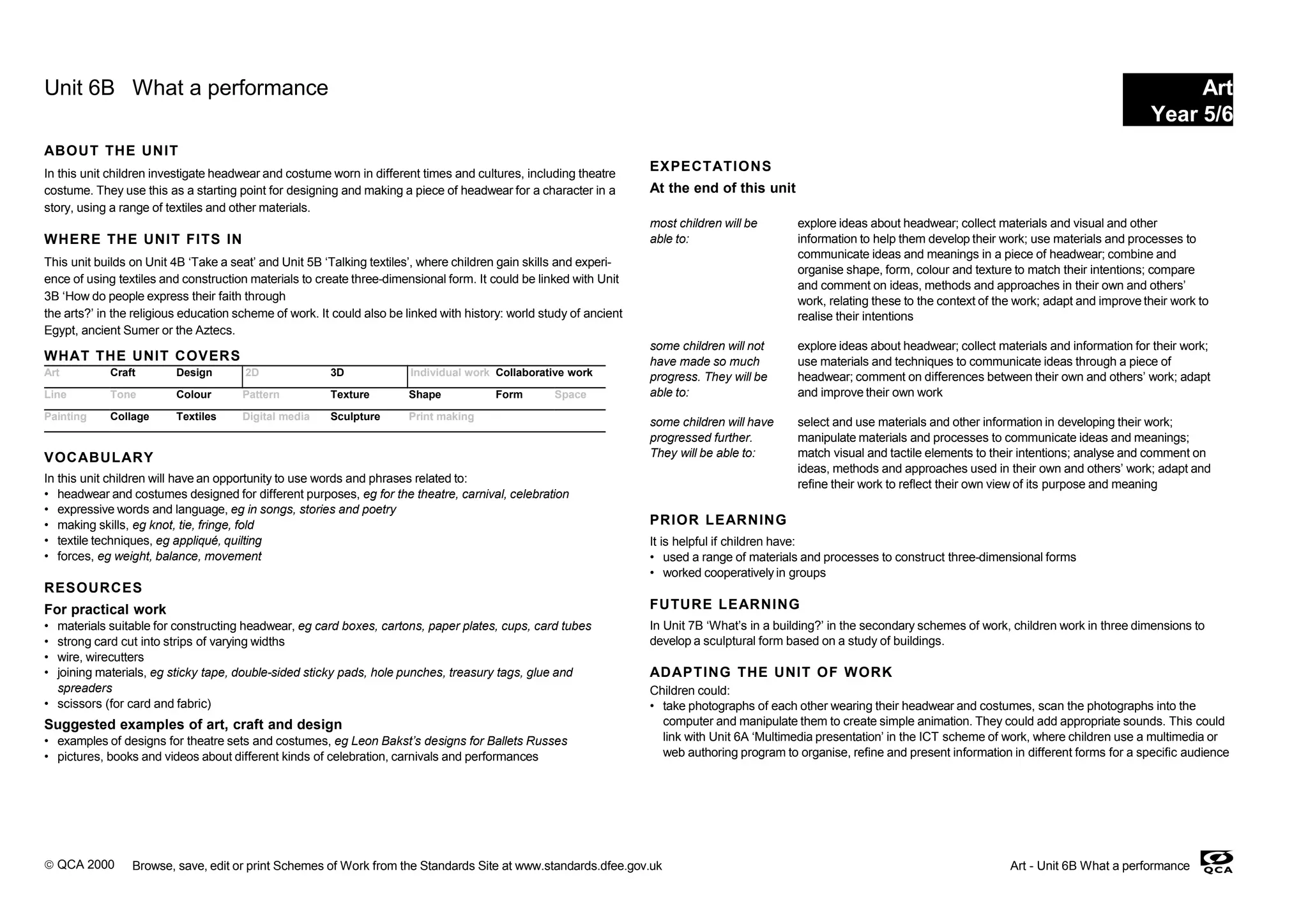
Unit 6B What a performance Art
Year 5/6
ABOUT THE UNIT
In this unit children investigate headwear and costume worn in different times and cultures, including theatre
costume. They use this as a starting point for designing and making a piece of headwear for a character in a
story, using a range of textiles and other materials.
WHERE THE UNIT FITS IN
This unit builds on Unit 4B ‘Take a seat’ and Unit 5B ‘Talking textiles’, where children gain skills and experi-
ence of using textiles and construction materials to create three-dimensional form. It could be linked with Unit
3B ‘How do people express their faith through
the arts?’ in the religious education scheme of work. It could also be linked with history: world study of ancient
Egypt, ancient Sumer or the Aztecs.
WHAT THE UNIT COVERS
Art Craft Design 2D 3D Individual work Collaborative work
Line Tone Colour Pattern Texture Shape Form Space
Painting Collage Textiles Digital media Sculpture Print making
VOCABULARY
In this unit children will have an opportunity to use words and phrases related to:
• headwear and costumes designed for different purposes, eg for the theatre, carnival, celebration
• expressive words and language, eg in songs, stories and poetry
• making skills, eg knot, tie, fringe, fold
• textile techniques, eg appliqué, quilting
• forces, eg weight, balance, movement
RESOURCES
For practical work
• materials suitable for constructing headwear, eg card boxes, cartons, paper plates, cups, card tubes
• strong card cut into strips of varying widths
• wire, wirecutters
• joining materials, eg sticky tape, double-sided sticky pads, hole punches, treasury tags, glue and
spreaders
• scissors (for card and fabric)
Suggested examples of art, craft and design
• examples of designs for theatre sets and costumes, eg Leon Bakst’s designs for Ballets Russes
• pictures, books and videos about different kinds of celebration, carnivals and performances
EXPECTATIONS
At the end of this unit
most children will be
able to:
explore ideas about headwear; collect materials and visual and other
information to help them develop their work; use materials and processes to
communicate ideas and meanings in a piece of headwear; combine and
organise shape, form, colour and texture to match their intentions; compare
and comment on ideas, methods and approaches in their own and others’
work, relating these to the context of the work; adapt and improve their work to
realise their intentions
some children will not
have made so much
progress. They will be
able to:
explore ideas about headwear; collect materials and information for their work;
use materials and techniques to communicate ideas through a piece of
headwear; comment on differences between their own and others’ work; adapt
and improve their own work
some children will have
progressed further.
They will be able to:
select and use materials and other information in developing their work;
manipulate materials and processes to communicate ideas and meanings;
match visual and tactile elements to their intentions; analyse and comment on
ideas, methods and approaches used in their own and others’ work; adapt and
refine their work to reflect their own view of its purpose and meaning
PRIOR LEARNING
It is helpful if children have:
• used a range of materials and processes to construct three-dimensional forms
• worked cooperatively in groups
FUTURE LEARNING
In Unit 7B ‘What’s in a building?’ in the secondary schemes of work, children work in three dimensions to
develop a sculptural form based on a study of buildings.
ADAPTING THE UNIT OF WORK
Children could:
• take photographs of each other wearing their headwear and costumes, scan the photographs into the
computer and manipulate them to create simple animation. They could add appropriate sounds. This could
link with Unit 6A ‘Multimedia presentation’ in the ICT scheme of work, where children use a multimedia or
web authoring program to organise, refine and present information in different forms for a specific audience
© QCA 2000 Browse, save, edit or print Schemes of Work from the Standards Site at www.standards.dfee.gov.uk Art - Unit 6B What a performance
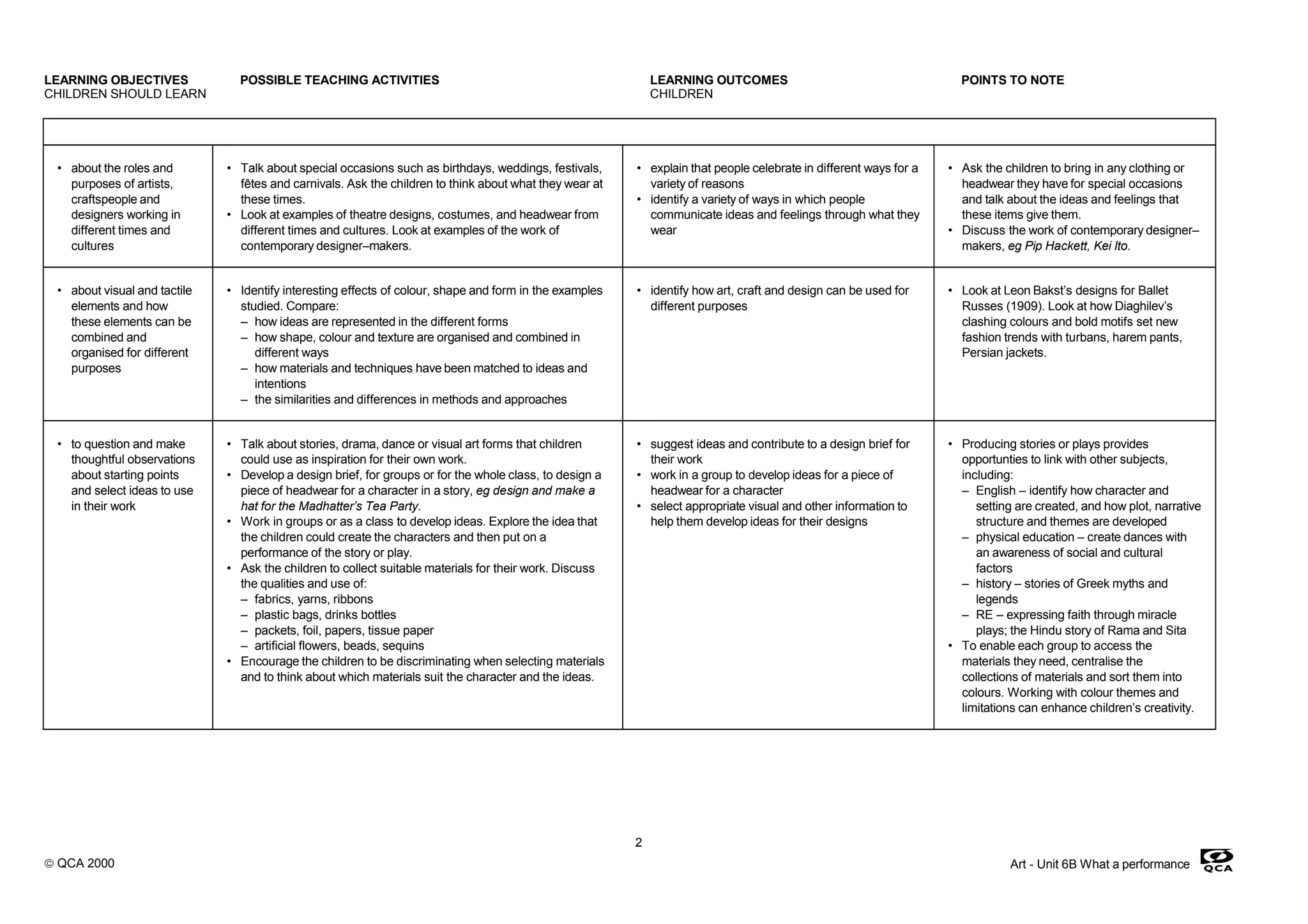
LEARNING OBJECTIVES POSSIBLE TEACHING ACTIVITIES LEARNING OUTCOMES POINTS TO NOTE
CHILDREN SHOULD LEARN CHILDREN
EXPLORING AND DEVELOPING IDEAS
• about the roles and
purposes of artists,
craftspeople and
designers working in
different times and
cultures
• Talk about special occasions such as birthdays, weddings, festivals,
fêtes and carnivals. Ask the children to think about what they wear at
these times.
• Look at examples of theatre designs, costumes, and headwear from
different times and cultures. Look at examples of the work of
contemporary designer–makers.
• explain that people celebrate in different ways for a
variety of reasons
• identify a variety of ways in which people
communicate ideas and feelings through what they
wear
• Ask the children to bring in any clothing or
headwear they have for special occasions
and talk about the ideas and feelings that
these items give them.
• Discuss the work of contemporary designer–
makers, eg Pip Hackett, Kei Ito.
• about visual and tactile
elements and how
these elements can be
combined and
organised for different
purposes
• Identify interesting effects of colour, shape and form in the examples
studied. Compare:
– how ideas are represented in the different forms
– how shape, colour and texture are organised and combined in
different ways
– how materials and techniques have been matched to ideas and
intentions
– the similarities and differences in methods and approaches
• identify how art, craft and design can be used for
different purposes
• Look at Leon Bakst’s designs for Ballet
Russes (1909). Look at how Diaghilev’s
clashing colours and bold motifs set new
fashion trends with turbans, harem pants,
Persian jackets.
• to question and make
thoughtful observations
about starting points
and select ideas to use
in their work
• Talk about stories, drama, dance or visual art forms that children
could use as inspiration for their own work.
• Develop a design brief, for groups or for the whole class, to design a
piece of headwear for a character in a story, eg design and make a
hat for the Madhatter’s Tea Party.
• Work in groups or as a class to develop ideas. Explore the idea that
the children could create the characters and then put on a
performance of the story or play.
• Ask the children to collect suitable materials for their work. Discuss
the qualities and use of:
– fabrics, yarns, ribbons
– plastic bags, drinks bottles
– packets, foil, papers, tissue paper
– artificial flowers, beads, sequins
• Encourage the children to be discriminating when selecting materials
and to think about which materials suit the character and the ideas.
• suggest ideas and contribute to a design brief for
their work
• work in a group to develop ideas for a piece of
headwear for a character
• select appropriate visual and other information to
help them develop ideas for their designs
• Producing stories or plays provides
opportunties to link with other subjects,
including:
– English – identify how character and
setting are created, and how plot, narrative
structure and themes are developed
– physical education – create dances with
an awareness of social and cultural
factors
– history – stories of Greek myths and
legends
– RE – expressing faith through miracle
plays; the Hindu story of Rama and Sita
• To enable each group to access the
materials they need, centralise the
collections of materials and sort them into
colours. Working with colour themes and
limitations can enhance children’s creativity.
© QCA 2000 Art - Unit 6B What a performance
2
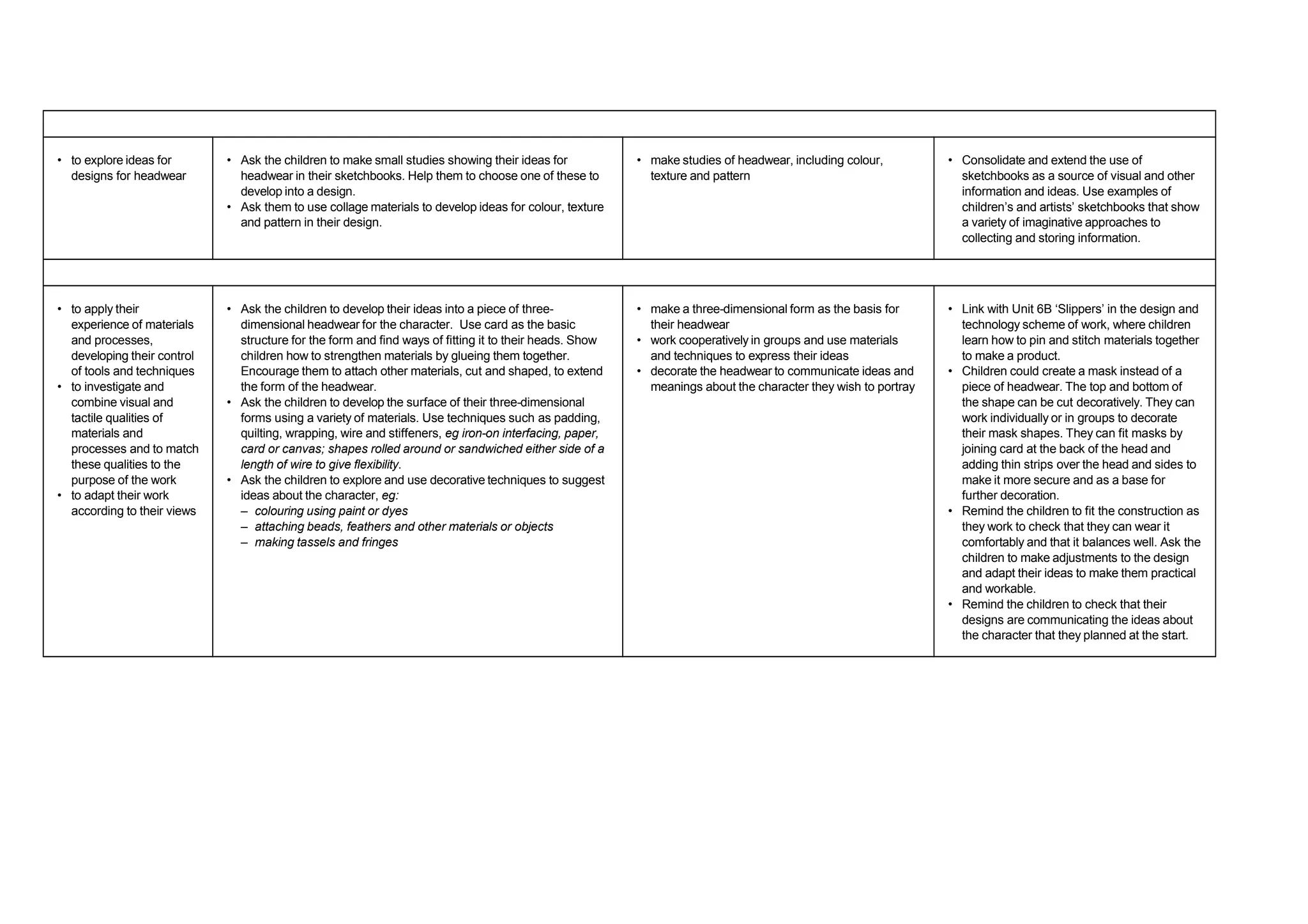
EXPLORING AND DEVELOPING IDEAS (Cont.)
• to explore ideas for
designs for headwear
• Ask the children to make small studies showing their ideas for
headwear in their sketchbooks. Help them to choose one of these to
develop into a design.
• Ask them to use collage materials to develop ideas for colour, texture
and pattern in their design.
• make studies of headwear, including colour,
texture and pattern
• Consolidate and extend the use of
sketchbooks as a source of visual and other
information and ideas. Use examples of
children’s and artists’ sketchbooks that show
a variety of imaginative approaches to
collecting and storing information.
INVESTIGATING AND MAKING
• to apply their
experience of materials
and processes,
developing their control
of tools and techniques
• to investigate and
combine visual and
tactile qualities of
materials and
processes and to match
these qualities to the
purpose of the work
• to adapt their work
according to their views
• Ask the children to develop their ideas into a piece of three-
dimensional headwear for the character. Use card as the basic
structure for the form and find ways of fitting it to their heads. Show
children how to strengthen materials by glueing them together.
Encourage them to attach other materials, cut and shaped, to extend
the form of the headwear.
• Ask the children to develop the surface of their three-dimensional
forms using a variety of materials. Use techniques such as padding,
quilting, wrapping, wire and stiffeners, eg iron-on interfacing, paper,
card or canvas; shapes rolled around or sandwiched either side of a
length of wire to give flexibility.
• Ask the children to explore and use decorative techniques to suggest
ideas about the character, eg:
– colouring using paint or dyes
– attaching beads, feathers and other materials or objects
– making tassels and fringes
• make a three-dimensional form as the basis for
their headwear
• work cooperatively in groups and use materials
and techniques to express their ideas
• decorate the headwear to communicate ideas and
meanings about the character they wish to portray
• Link with Unit 6B ‘Slippers’ in the design and
technology scheme of work, where children
learn how to pin and stitch materials together
to make a product.
• Children could create a mask instead of a
piece of headwear. The top and bottom of
the shape can be cut decoratively. They can
work individually or in groups to decorate
their mask shapes. They can fit masks by
joining card at the back of the head and
adding thin strips over the head and sides to
make it more secure and as a base for
further decoration.
• Remind the children to fit the construction as
they work to check that they can wear it
comfortably and that it balances well. Ask the
children to make adjustments to the design
and adapt their ideas to make them practical
and workable.
• Remind the children to check that their
designs are communicating the ideas about
the character that they planned at the start.
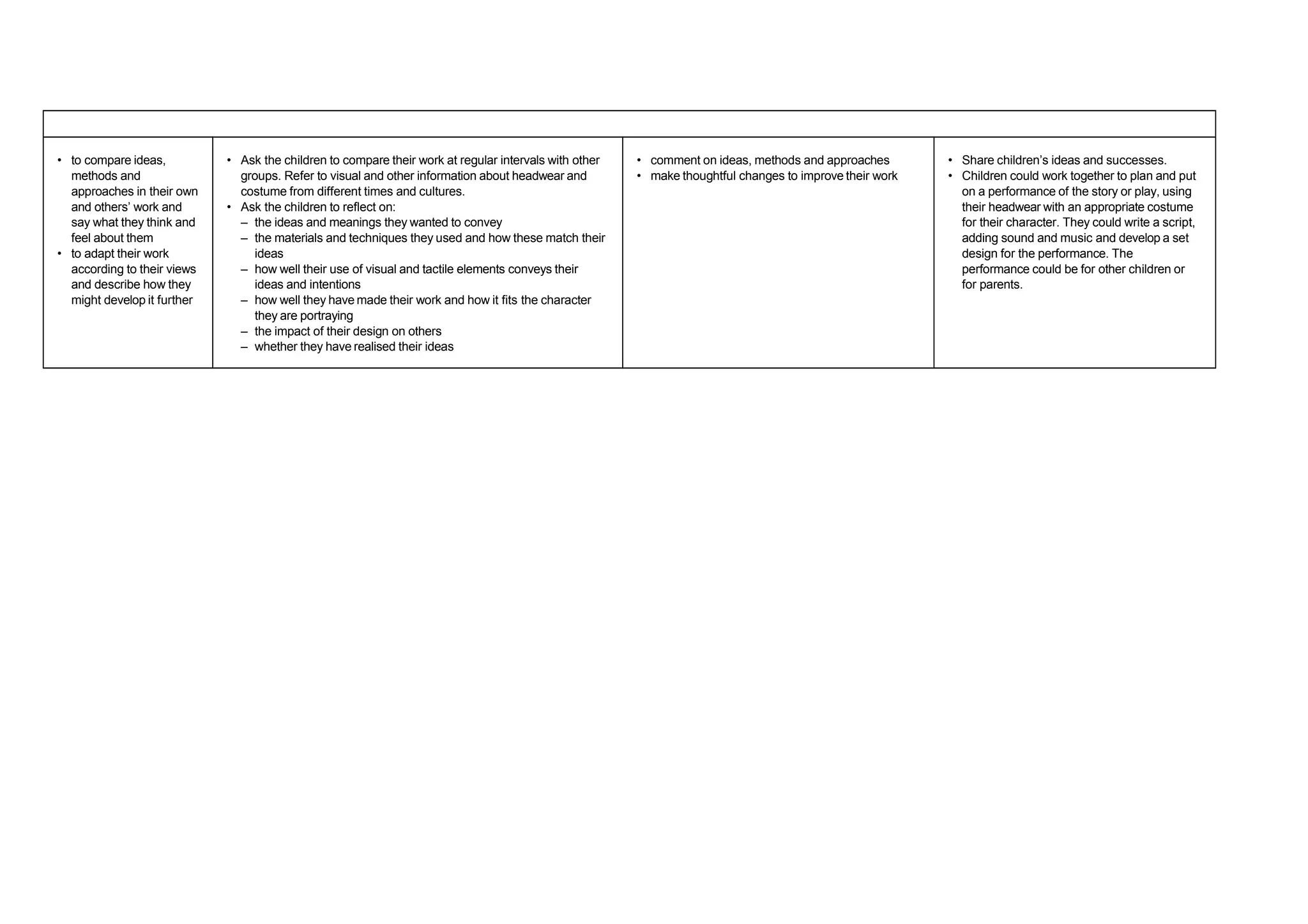
EVALUATING AND DEVELOPING WORK
• to compare ideas,
methods and
approaches in their own
and others’ work and
say what they think and
feel about them
• to adapt their work
according to their views
and describe how they
might develop it further
• Ask the children to compare their work at regular intervals with other
groups. Refer to visual and other information about headwear and
costume from different times and cultures.
• Ask the children to reflect on:
– the ideas and meanings they wanted to convey
– the materials and techniques they used and how these match their
ideas
– how well their use of visual and tactile elements conveys their
ideas and intentions
– how well they have made their work and how it fits the character
they are portraying
– the impact of their design on others
– whether they have realised their ideas
• comment on ideas, methods and approaches
• make thoughtful changes to improve their work
• Share children’s ideas and successes.
• Children could work together to plan and put
on a performance of the story or play, using
their headwear with an appropriate costume
for their character. They could write a script,
adding sound and music and develop a set
design for the performance. The
performance could be for other children or
for parents.

What Is Performance Scheme Of Work-Year 5/Year 6

  • 1.
    Unit 6B Whata performance Art Year 5/6 ABOUT THE UNIT In this unit children investigate headwear and costume worn in different times and cultures, including theatre costume. They use this as a starting point for designing and making a piece of headwear for a character in a story, using a range of textiles and other materials. WHERE THE UNIT FITS IN This unit builds on Unit 4B ‘Take a seat’ and Unit 5B ‘Talking textiles’, where children gain skills and experi- ence of using textiles and construction materials to create three-dimensional form. It could be linked with Unit 3B ‘How do people express their faith through the arts?’ in the religious education scheme of work. It could also be linked with history: world study of ancient Egypt, ancient Sumer or the Aztecs. WHAT THE UNIT COVERS Art Craft Design 2D 3D Individual work Collaborative work Line Tone Colour Pattern Texture Shape Form Space Painting Collage Textiles Digital media Sculpture Print making VOCABULARY In this unit children will have an opportunity to use words and phrases related to: • headwear and costumes designed for different purposes, eg for the theatre, carnival, celebration • expressive words and language, eg in songs, stories and poetry • making skills, eg knot, tie, fringe, fold • textile techniques, eg appliqué, quilting • forces, eg weight, balance, movement RESOURCES For practical work • materials suitable for constructing headwear, eg card boxes, cartons, paper plates, cups, card tubes • strong card cut into strips of varying widths • wire, wirecutters • joining materials, eg sticky tape, double-sided sticky pads, hole punches, treasury tags, glue and spreaders • scissors (for card and fabric) Suggested examples of art, craft and design • examples of designs for theatre sets and costumes, eg Leon Bakst’s designs for Ballets Russes • pictures, books and videos about different kinds of celebration, carnivals and performances EXPECTATIONS At the end of this unit most children will be able to: explore ideas about headwear; collect materials and visual and other information to help them develop their work; use materials and processes to communicate ideas and meanings in a piece of headwear; combine and organise shape, form, colour and texture to match their intentions; compare and comment on ideas, methods and approaches in their own and others’ work, relating these to the context of the work; adapt and improve their work to realise their intentions some children will not have made so much progress. They will be able to: explore ideas about headwear; collect materials and information for their work; use materials and techniques to communicate ideas through a piece of headwear; comment on differences between their own and others’ work; adapt and improve their own work some children will have progressed further. They will be able to: select and use materials and other information in developing their work; manipulate materials and processes to communicate ideas and meanings; match visual and tactile elements to their intentions; analyse and comment on ideas, methods and approaches used in their own and others’ work; adapt and refine their work to reflect their own view of its purpose and meaning PRIOR LEARNING It is helpful if children have: • used a range of materials and processes to construct three-dimensional forms • worked cooperatively in groups FUTURE LEARNING In Unit 7B ‘What’s in a building?’ in the secondary schemes of work, children work in three dimensions to develop a sculptural form based on a study of buildings. ADAPTING THE UNIT OF WORK Children could: • take photographs of each other wearing their headwear and costumes, scan the photographs into the computer and manipulate them to create simple animation. They could add appropriate sounds. This could link with Unit 6A ‘Multimedia presentation’ in the ICT scheme of work, where children use a multimedia or web authoring program to organise, refine and present information in different forms for a specific audience © QCA 2000 Browse, save, edit or print Schemes of Work from the Standards Site at www.standards.dfee.gov.uk Art - Unit 6B What a performance
  • 2.
    LEARNING OBJECTIVES POSSIBLETEACHING ACTIVITIES LEARNING OUTCOMES POINTS TO NOTE CHILDREN SHOULD LEARN CHILDREN EXPLORING AND DEVELOPING IDEAS • about the roles and purposes of artists, craftspeople and designers working in different times and cultures • Talk about special occasions such as birthdays, weddings, festivals, fêtes and carnivals. Ask the children to think about what they wear at these times. • Look at examples of theatre designs, costumes, and headwear from different times and cultures. Look at examples of the work of contemporary designer–makers. • explain that people celebrate in different ways for a variety of reasons • identify a variety of ways in which people communicate ideas and feelings through what they wear • Ask the children to bring in any clothing or headwear they have for special occasions and talk about the ideas and feelings that these items give them. • Discuss the work of contemporary designer– makers, eg Pip Hackett, Kei Ito. • about visual and tactile elements and how these elements can be combined and organised for different purposes • Identify interesting effects of colour, shape and form in the examples studied. Compare: – how ideas are represented in the different forms – how shape, colour and texture are organised and combined in different ways – how materials and techniques have been matched to ideas and intentions – the similarities and differences in methods and approaches • identify how art, craft and design can be used for different purposes • Look at Leon Bakst’s designs for Ballet Russes (1909). Look at how Diaghilev’s clashing colours and bold motifs set new fashion trends with turbans, harem pants, Persian jackets. • to question and make thoughtful observations about starting points and select ideas to use in their work • Talk about stories, drama, dance or visual art forms that children could use as inspiration for their own work. • Develop a design brief, for groups or for the whole class, to design a piece of headwear for a character in a story, eg design and make a hat for the Madhatter’s Tea Party. • Work in groups or as a class to develop ideas. Explore the idea that the children could create the characters and then put on a performance of the story or play. • Ask the children to collect suitable materials for their work. Discuss the qualities and use of: – fabrics, yarns, ribbons – plastic bags, drinks bottles – packets, foil, papers, tissue paper – artificial flowers, beads, sequins • Encourage the children to be discriminating when selecting materials and to think about which materials suit the character and the ideas. • suggest ideas and contribute to a design brief for their work • work in a group to develop ideas for a piece of headwear for a character • select appropriate visual and other information to help them develop ideas for their designs • Producing stories or plays provides opportunties to link with other subjects, including: – English – identify how character and setting are created, and how plot, narrative structure and themes are developed – physical education – create dances with an awareness of social and cultural factors – history – stories of Greek myths and legends – RE – expressing faith through miracle plays; the Hindu story of Rama and Sita • To enable each group to access the materials they need, centralise the collections of materials and sort them into colours. Working with colour themes and limitations can enhance children’s creativity. © QCA 2000 Art - Unit 6B What a performance 2
  • 3.
    EXPLORING AND DEVELOPINGIDEAS (Cont.) • to explore ideas for designs for headwear • Ask the children to make small studies showing their ideas for headwear in their sketchbooks. Help them to choose one of these to develop into a design. • Ask them to use collage materials to develop ideas for colour, texture and pattern in their design. • make studies of headwear, including colour, texture and pattern • Consolidate and extend the use of sketchbooks as a source of visual and other information and ideas. Use examples of children’s and artists’ sketchbooks that show a variety of imaginative approaches to collecting and storing information. INVESTIGATING AND MAKING • to apply their experience of materials and processes, developing their control of tools and techniques • to investigate and combine visual and tactile qualities of materials and processes and to match these qualities to the purpose of the work • to adapt their work according to their views • Ask the children to develop their ideas into a piece of three- dimensional headwear for the character. Use card as the basic structure for the form and find ways of fitting it to their heads. Show children how to strengthen materials by glueing them together. Encourage them to attach other materials, cut and shaped, to extend the form of the headwear. • Ask the children to develop the surface of their three-dimensional forms using a variety of materials. Use techniques such as padding, quilting, wrapping, wire and stiffeners, eg iron-on interfacing, paper, card or canvas; shapes rolled around or sandwiched either side of a length of wire to give flexibility. • Ask the children to explore and use decorative techniques to suggest ideas about the character, eg: – colouring using paint or dyes – attaching beads, feathers and other materials or objects – making tassels and fringes • make a three-dimensional form as the basis for their headwear • work cooperatively in groups and use materials and techniques to express their ideas • decorate the headwear to communicate ideas and meanings about the character they wish to portray • Link with Unit 6B ‘Slippers’ in the design and technology scheme of work, where children learn how to pin and stitch materials together to make a product. • Children could create a mask instead of a piece of headwear. The top and bottom of the shape can be cut decoratively. They can work individually or in groups to decorate their mask shapes. They can fit masks by joining card at the back of the head and adding thin strips over the head and sides to make it more secure and as a base for further decoration. • Remind the children to fit the construction as they work to check that they can wear it comfortably and that it balances well. Ask the children to make adjustments to the design and adapt their ideas to make them practical and workable. • Remind the children to check that their designs are communicating the ideas about the character that they planned at the start.
  • 4.
    EVALUATING AND DEVELOPINGWORK • to compare ideas, methods and approaches in their own and others’ work and say what they think and feel about them • to adapt their work according to their views and describe how they might develop it further • Ask the children to compare their work at regular intervals with other groups. Refer to visual and other information about headwear and costume from different times and cultures. • Ask the children to reflect on: – the ideas and meanings they wanted to convey – the materials and techniques they used and how these match their ideas – how well their use of visual and tactile elements conveys their ideas and intentions – how well they have made their work and how it fits the character they are portraying – the impact of their design on others – whether they have realised their ideas • comment on ideas, methods and approaches • make thoughtful changes to improve their work • Share children’s ideas and successes. • Children could work together to plan and put on a performance of the story or play, using their headwear with an appropriate costume for their character. They could write a script, adding sound and music and develop a set design for the performance. The performance could be for other children or for parents.