ERI SUMMER TRAINING
COMPUTERS & SYSTEMS DEPT.
Dr. Randa ElanwarLecture 1
Content
What is a "pattern"?
What is Pattern Recognition?
What is a "feature"?
What is a "classification problem"?
2
ERI Summer training (C&S) Dr. Randa Elanwar
What is a "classification problem"?
What is a Pattern?
3
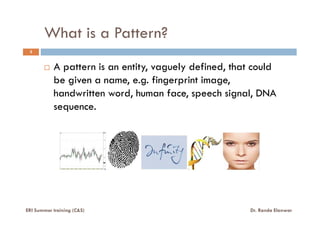
A pattern is an entity, vaguely defined, that could
be given a name, e.g. fingerprint image,
handwritten word, human face, speech signal, DNA
sequence.
ERI Summer training (C&S) Dr. Randa Elanwar
What is meant by recognition?
4
Discover to which class of entities the "pattern" belongs
and the name of the "pattern".
This means when you have an image of an orange, if
you can tell that this image belong to the "class" ofyou can tell that this image belong to the "class" of
"fruits" then you "classified" the "pattern" which is the
orange "image". If you can tell that it is an "orange"
then you "recognized" the "pattern" because you did
the following:
1. You discovered its membership to some class
2. You labeled the pattern and gave it a name
ERI Summer training (C&S) Dr. Randa Elanwar
What is meant by recognition?
5
if you claimed that the pattern belongs to
"vegetables", then you "misclassified" the pattern. If
you couldn't tell its name, then the pattern is
"unrecognized".
When you have only one class of labeled patterns
Fruits = {Banana, orange, apple, peach, etc.}, and
you can tell that it is an "orange" then you
"identified" the "pattern".
ERI Summer training (C&S) Dr. Randa Elanwar
What is meant by recognition?
6
Caution
Sometimes, "identification" and "recognition" are used
interchangeably but this is not always true.
Other times, "classification" and "recognition" are used
interchangeably but this is only true when the label of
the pattern is the class name in the same time.
Let's have more examples:
ERI Summer training (C&S) Dr. Randa Elanwar
Examples
7
1. Face identification and Face recognition:
If you have a security system on some door and only
allowed employees can enter, you take a photo of the
person trying to enter to match it with the data base of
permitted employees.permitted employees.
If your system searches the database of multiple photos
for each employee and found one similar photo to his
and gave permission "Oh yes, this photo has permission
open the door" then he made "Face identification". or
"verification"
ERI Summer training (C&S) Dr. Randa Elanwar
Examples
8
1. Face identification and Face recognition:
If your system searches the database of multiple
photos for each employee and found one similar
photo to his and gave permission "Oh yes, this isphoto to his and gave permission "Oh yes, this is
John Smith, he has permission, open the door" then
he made "Face recognition".
In both cases the pattern "Face" photo has been
"classified" as "Permitted"
ERI Summer training (C&S) Dr. Randa Elanwar
Examples
9
2. Signature Verification:
Assume you have a bank account and you want to
withdraw some money via an application or bank
check.check.
The employee will ask you to sign a paper. Then he
scans your signature to check if it's really yours. The
system should match if the signature you wrote is
exactly similar to the one they have.
ERI Summer training (C&S) Dr. Randa Elanwar
Examples
10
2. Signature Verification:
If the signature is a perfect match to the one they
have, then it's ok to give you the money. They have
"verified" that it's your signature."verified" that it's your signature.
This is not "recognition" they already know you but
they are checking or making sure that the signature
"pattern" is "significantly similar to" the samples
they have "1 class".
ERI Summer training (C&S) Dr. Randa Elanwar
Examples
11
3. Speech Recognition:
Assume you want to call someone on phone while
driving, you speak to your phone via the blue tooth
you are wearing and say "Call Jane Arthur", andyou are wearing and say "Call Jane Arthur", and
what happens?. The phone actually calls Jane.
Well, there is no magic.
ERI Summer training (C&S) Dr. Randa Elanwar
Examples
12
3. Speech Recognition:
The blue tooth sent your speech signal to the
application on your mobile, then the application began
to segment this signal to sequential patterns (represent
characters).characters).
Each pattern is "classified" and "recognized" to be one
of 26 classes A --> Z. Thus, now your speech signal has
been recognized to be a sequence of characters. The
application searches your contact list, finds the name
and dials the corresponding number.
ERI Summer training (C&S) Dr. Randa Elanwar
Examples
13
4. Pdf to word converter
Assume you have a document on paper or a book page
that you want to edit, actually you don't have to re-
write it on any word processing software like MS word
for example. You can simply use a scanner supported
with OCR facility like ABBYY or IRIS.with OCR facility like ABBYY or IRIS.
You scan the paper and the scanner gives you a (.pdf)
file. When you open this file on your computer and use
the OCR program, you get another (.doc) file containing
the same content where you can edit and save the new
version. This is not magic either.
ERI Summer training (C&S) Dr. Randa Elanwar
Examples
14
4. Pdf to word converter
The (.pdf) file is an image. The OCR software takes this image and
segment it to sequential series of smaller images, each correspond
to one word or even one character.
Then each pattern (character image) is "classified" and "recognized"Then each pattern (character image) is "classified" and "recognized"
to be one of 26 classes A --> Z. Thus, now your page content has
been recognized to a sequence of characters. The characters are
grouped into words and their corresponding ASCII characters are
re-written automatically in a (.doc) file it creates.
From here comes the name OCR, or Optical Character Recognition.
"Optical" because it is scanned and "Character Recognition"
because it recognize the characters images to the real ASCII codes
of characters.
ERI Summer training (C&S) Dr. Randa Elanwar
Applications
15
ERI Summer training (C&S) Dr. Randa Elanwar
Applications
16
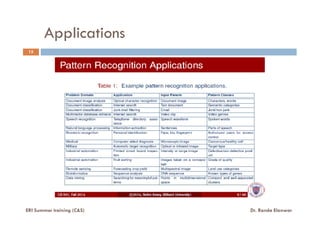
Count millions of applications depending on recognizing
patterns. Actually the scientific definition of pattern
recognition: "The act of taking in raw data and making
an action based on the “category” of the pattern.“
If the pattern was image or sound or video, your targetIf the pattern was image or sound or video, your target
can be categorization, verification, identification,
recognition, clustering, etc.
A person can be categorized as African or Japanese,
verified for his/her eye color, identified to be Jim/Jane,
recognized as being happy or sad, clustered to be
tall/short – thin/fat
ERI Summer training (C&S) Dr. Randa Elanwar
What is a feature?
17
The questions here :
how exactly "recognition" happens?
How patterns are matched to classes?
How do we know the class?
How do we know the name?How do we know the name?
How do we know if the pattern is misclassified or
unrecognized?
If we take the first example of the orange. How do you
know it's an orange?. Simply because oranges are
round and color is orange.
ERI Summer training (C&S) Dr. Randa Elanwar
What is a feature?
18
How do you know your friend in a photo?
Simply you know how his eyes looks, his hair, the color
of his skin. You know he is tall. He is thin.
How do you read a word "Cat"?
You know that a "C" looks like a left curve, and "a"
looks like a circle or a loop with a tail, and "t" is a stick
with curved end and a horizontal dash near the top.
ERI Summer training (C&S) Dr. Randa Elanwar
What is a feature?
19
Then what do you call these characteristics?
They are called features.
Feature is a mark or a symbol that says something
about the entity it describes.
ERI Summer training (C&S) Dr. Randa Elanwar
What is a feature?
20
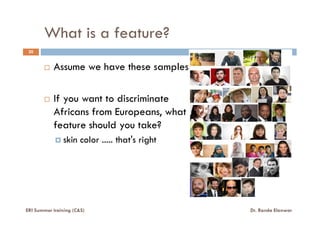
Assume we have these samples
If you want to discriminate
Africans from Europeans, whatAfricans from Europeans, what
feature should you take?
skin color ..... that's right
ERI Summer training (C&S) Dr. Randa Elanwar
What is a feature?
21
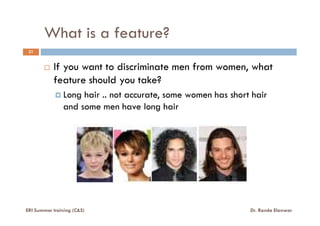
If you want to discriminate men from women, what
feature should you take?
Long hair .. not accurate, some women has short hair
and some men have long hair
ERI Summer training (C&S) Dr. Randa Elanwar
What is a feature?
22
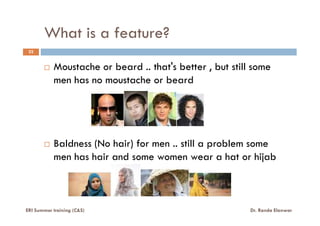
Moustache or beard .. that's better , but still some
men has no moustache or beard
Baldness (No hair) for men .. still a problem some
men has hair and some women wear a hat or hijab
ERI Summer training (C&S) Dr. Randa Elanwar
What is a feature?
23
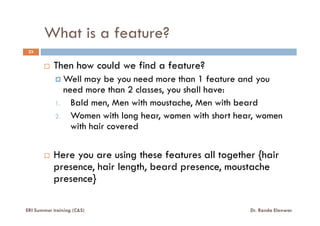
Then how could we find a feature?
Well may be you need more than 1 feature and you
need more than 2 classes, you shall have:
1. Bald men, Men with moustache, Men with beard
2. Women with long hear, women with short hear, women2. Women with long hear, women with short hear, women
with hair covered
Here you are using these features all together {hair
presence, hair length, beard presence, moustache
presence}
ERI Summer training (C&S) Dr. Randa Elanwar
What is a feature?
24
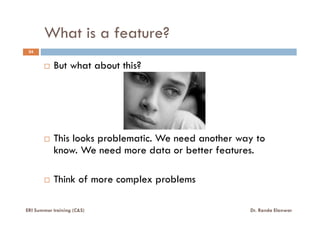
But what about this?
This looks problematic. We need another way to
know. We need more data or better features.
Think of more complex problems
ERI Summer training (C&S) Dr. Randa Elanwar
What is a feature?
25
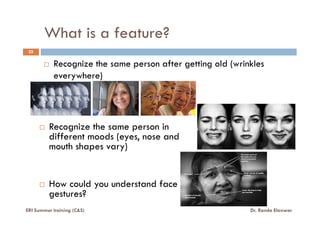
Recognize the same person after getting old (wrinkles
everywhere)
Recognize the same person in
different moods (eyes, nose and
mouth shapes vary)
How could you understand face
gestures?
ERI Summer training (C&S) Dr. Randa Elanwar
What is a feature?
26
Therefore, features can be representative such that
each group of entities can have unique range of
values and might be misleading if they cannot
discriminate between distinct groups of entities
We need something more powerful. We need some
rules or numbers such that we can have an accurate
decision whether or not a pattern belongs to certain
class.
ERI Summer training (C&S) Dr. Randa Elanwar
What is a "classification problem"?
27
Let's do this on an example
This is a very famous example you'll find in Richard
Duda and Peter Hart book "Pattern Classification",
John Wiley & Sons Inc.
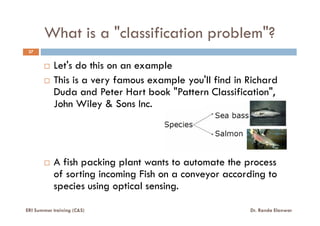
A fish packing plant wants to automate the process
of sorting incoming Fish on a conveyor according to
species using optical sensing.
ERI Summer training (C&S) Dr. Randa Elanwar
What is a "classification problem"?
28
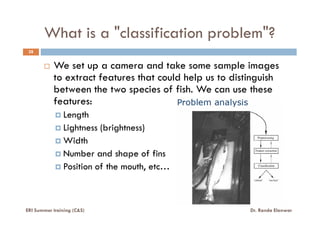
We set up a camera and take some sample images
to extract features that could help us to distinguish
between the two species of fish. We can use these
features:
LengthLength
Lightness (brightness)
Width
Number and shape of fins
Position of the mouth, etc…
ERI Summer training (C&S) Dr. Randa Elanwar
What is a "classification problem"?
29
How can we classify fish?
A sea bass is generally longer than a salmon: Sea
bass has some typical length and this is greater
than the salmon one.than the salmon one.
If we select the length of the fish as a possible
feature for discrimination, we can classify the fish
seeing whether or not the length "l" of the fish
exceeds some critical value "l*".
ERI Summer training (C&S) Dr. Randa Elanwar
What is a "classification problem"?
30
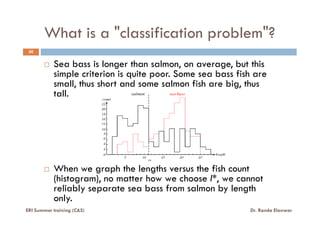
Sea bass is longer than salmon, on average, but this
simple criterion is quite poor. Some sea bass fish are
small, thus short and some salmon fish are big, thus
tall.
When we graph the lengths versus the fish count
(histogram), no matter how we choose l*, we cannot
reliably separate sea bass from salmon by length
only.
ERI Summer training (C&S) Dr. Randa Elanwar
What is a "classification problem"?
31
The same applies if we used lightness for example. we
cannot find a single threshold or number above which
we can decide the fish is sea bass and salmon
otherwise.
To improve the recognition task, we can work with moreTo improve the recognition task, we can work with more
than one feature.
1. Adopt the lightness and add the width of the fish.
2. Sea bass is typically wider than salmon.
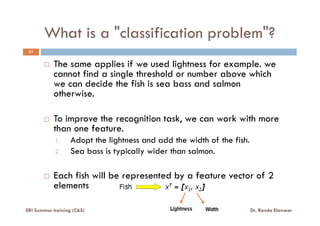
Each fish will be represented by a feature vector of 2
elements
ERI Summer training (C&S) Dr. Randa Elanwar
What is a "classification problem"?
32
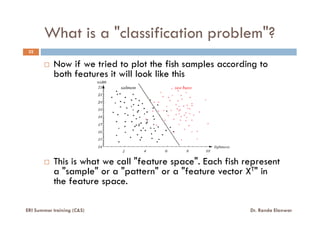
Now if we tried to plot the fish samples according to
both features it will look like this
This is what we call "feature space". Each fish represent
a "sample" or a "pattern" or a "feature vector XT" in
the feature space.
ERI Summer training (C&S) Dr. Randa Elanwar
What is a "classification problem"?
33
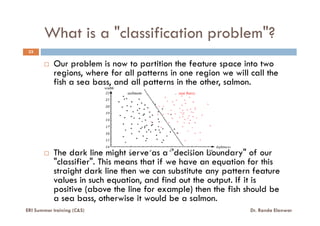
Our problem is now to partition the feature space into two
regions, where for all patterns in one region we will call the
fish a sea bass, and all patterns in the other, salmon.
The dark line might serve as a "decision boundary" of our
"classifier". This means that if we have an equation for this
straight dark line then we can substitute any pattern feature
values in such equation, and find out the output. If it is
positive (above the line for example) then the fish should be
a sea bass, otherwise it would be a salmon.
ERI Summer training (C&S) Dr. Randa Elanwar
What is a "classification problem"?
34
We can assume if the value is zero (i.e. the sample lies on the line) to
be any of the two classes.
Don't bother about the few samples lying in the wrong partition now.
We will talk about this later when we discuss features in more
details.details.
For now, Did you notice what have we done?
1. We had a classification problem of images and we converted it to a
mathematical problem
2. We represented images by feature vectors and got a mathematical
solution (straight line)
3. The solution is a mathematical model of the problem that we can use
by substituting with the feature vector (image representation) of any
new pattern/sample.
ERI Summer training (C&S) Dr. Randa Elanwar
What is a "classification problem"?
35
This means that, if you have any problem or
application that can be interpreted as a
classification problem, all what you need is to think
of:
1. What classes do you have?
2. Are they distinct?
3. Are there specific features for each class?
4. let's find a decision boundary between the classes.
Let's have some more questions:
ERI Summer training (C&S) Dr. Randa Elanwar
What is a "classification problem"?
36
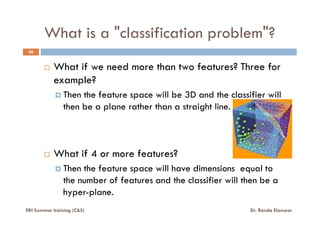
What if we need more than two features? Three for
example?
Then the feature space will be 3D and the classifier will
then be a plane rather than a straight line.
What if 4 or more features?
Then the feature space will have dimensions equal to
the number of features and the classifier will then be a
hyper-plane.
ERI Summer training (C&S) Dr. Randa Elanwar
What is a "classification problem"?
37
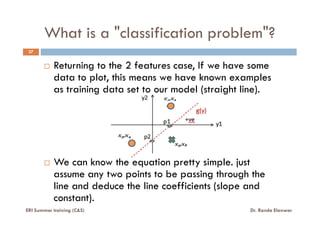
Returning to the 2 features case, If we have some
data to plot, this means we have known examples
as training data set to our model (straight line).
We can know the equation pretty simple. just
assume any two points to be passing through the
line and deduce the line coefficients (slope and
constant).
ERI Summer training (C&S) Dr. Randa Elanwar
What is a "classification problem"?
38
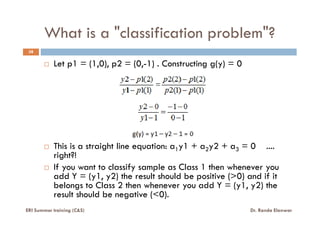
Let p1 = (1,0), p2 = (0,-1) . Constructing g(y) = 0
This is a straight line equation: a1y1 + a2y2 + a3 = 0 ....
right?!
If you want to classify sample as Class 1 then whenever you
add Y = (y1, y2) the result should be positive (>0) and if it
belongs to Class 2 then whenever you add Y = (y1, y2) the
result should be negative (<0).
ERI Summer training (C&S) Dr. Randa Elanwar
What is a "classification problem"?
39
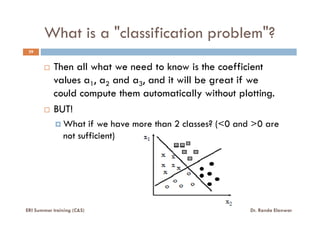
Then all what we need to know is the coefficient
values a1, a2 and a3, and it will be great if we
could compute them automatically without plotting.
BUT!BUT!
What if we have more than 2 classes? (<0 and >0 are
not sufficient)
ERI Summer training (C&S) Dr. Randa Elanwar
What is a "classification problem"?
40
How can we do this for three or more dimensions (y3, y4,
etc.)?
In these cases data samples cannot be visualized. This is
one of the main reasons we need "Machine learning".one of the main reasons we need "Machine learning".
We need an intelligent model "classifier" which we can
feed it with samples and tell it to which class it belongs
and it learns automatically the equation of the decision
boundary so that every time we have a new sample the
model can correctly discover to which class it belongs.
ERI Summer training (C&S) Dr. Randa Elanwar
What is a "classification problem"?
41
Important notes
This type of classification (straight line or plane
decision boundary) is just one of many classification
approaches but it is the simplest. The classifier that
works using this approach is "Neural networks“works using this approach is "Neural networks“
The other classification approaches are: (Template
Matching, Statistical methods, Stochastic Processes
(Marhov Chains), Structural/Graph Matching (Trees,
Chains, etc.)., Rule-based methods). We can discuss
them later. Our focus now is on Neural networks.
ERI Summer training (C&S) Dr. Randa Elanwar
What is a "classification problem"?
42
Important notes
The features are not always as simple as length,
weight, age, etc., because simplicity means they
might not be discriminative enough.
Some problems cannot use such features, like face
recognition for example how can you describe eyes
or nose shape?
How can you describe a fingerprint?
How could you describe a speech signal?
ERI Summer training (C&S) Dr. Randa Elanwar
What is a "classification problem"?
43
Therefore, in such cases the image is decomposed to
number of lines that draw the image. Each line is
represented by an equation or polynomial that
describe the line shape.
The coefficients of these polynomials are the featuresThe coefficients of these polynomials are the features
you can use and make as a feature vector.
Therefore we have different types of features:
Structural Decomposition like number of loops, curves, cross
points, area, length, width, angle, etc.
Series Expansion (Transforms) like Moments, Fourier
transform, Gabor transform, Hough transform, and wavelets.
ERI Summer training (C&S) Dr. Randa Elanwar

What is pattern_recognition (lecture 1 of 6)

  • 1.
    ERI SUMMER TRAINING COMPUTERS& SYSTEMS DEPT. Dr. Randa ElanwarLecture 1
  • 2.
    Content What is a"pattern"? What is Pattern Recognition? What is a "feature"? What is a "classification problem"? 2 ERI Summer training (C&S) Dr. Randa Elanwar What is a "classification problem"?
  • 3.
    What is aPattern? 3 A pattern is an entity, vaguely defined, that could be given a name, e.g. fingerprint image, handwritten word, human face, speech signal, DNA sequence. ERI Summer training (C&S) Dr. Randa Elanwar
  • 4.
    What is meantby recognition? 4 Discover to which class of entities the "pattern" belongs and the name of the "pattern". This means when you have an image of an orange, if you can tell that this image belong to the "class" ofyou can tell that this image belong to the "class" of "fruits" then you "classified" the "pattern" which is the orange "image". If you can tell that it is an "orange" then you "recognized" the "pattern" because you did the following: 1. You discovered its membership to some class 2. You labeled the pattern and gave it a name ERI Summer training (C&S) Dr. Randa Elanwar
  • 5.
    What is meantby recognition? 5 if you claimed that the pattern belongs to "vegetables", then you "misclassified" the pattern. If you couldn't tell its name, then the pattern is "unrecognized". When you have only one class of labeled patterns Fruits = {Banana, orange, apple, peach, etc.}, and you can tell that it is an "orange" then you "identified" the "pattern". ERI Summer training (C&S) Dr. Randa Elanwar
  • 6.
    What is meantby recognition? 6 Caution Sometimes, "identification" and "recognition" are used interchangeably but this is not always true. Other times, "classification" and "recognition" are used interchangeably but this is only true when the label of the pattern is the class name in the same time. Let's have more examples: ERI Summer training (C&S) Dr. Randa Elanwar
  • 7.
    Examples 7 1. Face identificationand Face recognition: If you have a security system on some door and only allowed employees can enter, you take a photo of the person trying to enter to match it with the data base of permitted employees.permitted employees. If your system searches the database of multiple photos for each employee and found one similar photo to his and gave permission "Oh yes, this photo has permission open the door" then he made "Face identification". or "verification" ERI Summer training (C&S) Dr. Randa Elanwar
  • 8.
    Examples 8 1. Face identificationand Face recognition: If your system searches the database of multiple photos for each employee and found one similar photo to his and gave permission "Oh yes, this isphoto to his and gave permission "Oh yes, this is John Smith, he has permission, open the door" then he made "Face recognition". In both cases the pattern "Face" photo has been "classified" as "Permitted" ERI Summer training (C&S) Dr. Randa Elanwar
  • 9.
    Examples 9 2. Signature Verification: Assumeyou have a bank account and you want to withdraw some money via an application or bank check.check. The employee will ask you to sign a paper. Then he scans your signature to check if it's really yours. The system should match if the signature you wrote is exactly similar to the one they have. ERI Summer training (C&S) Dr. Randa Elanwar
  • 10.
    Examples 10 2. Signature Verification: Ifthe signature is a perfect match to the one they have, then it's ok to give you the money. They have "verified" that it's your signature."verified" that it's your signature. This is not "recognition" they already know you but they are checking or making sure that the signature "pattern" is "significantly similar to" the samples they have "1 class". ERI Summer training (C&S) Dr. Randa Elanwar
  • 11.
    Examples 11 3. Speech Recognition: Assumeyou want to call someone on phone while driving, you speak to your phone via the blue tooth you are wearing and say "Call Jane Arthur", andyou are wearing and say "Call Jane Arthur", and what happens?. The phone actually calls Jane. Well, there is no magic. ERI Summer training (C&S) Dr. Randa Elanwar
  • 12.
    Examples 12 3. Speech Recognition: Theblue tooth sent your speech signal to the application on your mobile, then the application began to segment this signal to sequential patterns (represent characters).characters). Each pattern is "classified" and "recognized" to be one of 26 classes A --> Z. Thus, now your speech signal has been recognized to be a sequence of characters. The application searches your contact list, finds the name and dials the corresponding number. ERI Summer training (C&S) Dr. Randa Elanwar
  • 13.
    Examples 13 4. Pdf toword converter Assume you have a document on paper or a book page that you want to edit, actually you don't have to re- write it on any word processing software like MS word for example. You can simply use a scanner supported with OCR facility like ABBYY or IRIS.with OCR facility like ABBYY or IRIS. You scan the paper and the scanner gives you a (.pdf) file. When you open this file on your computer and use the OCR program, you get another (.doc) file containing the same content where you can edit and save the new version. This is not magic either. ERI Summer training (C&S) Dr. Randa Elanwar
  • 14.
    Examples 14 4. Pdf toword converter The (.pdf) file is an image. The OCR software takes this image and segment it to sequential series of smaller images, each correspond to one word or even one character. Then each pattern (character image) is "classified" and "recognized"Then each pattern (character image) is "classified" and "recognized" to be one of 26 classes A --> Z. Thus, now your page content has been recognized to a sequence of characters. The characters are grouped into words and their corresponding ASCII characters are re-written automatically in a (.doc) file it creates. From here comes the name OCR, or Optical Character Recognition. "Optical" because it is scanned and "Character Recognition" because it recognize the characters images to the real ASCII codes of characters. ERI Summer training (C&S) Dr. Randa Elanwar
  • 15.
    Applications 15 ERI Summer training(C&S) Dr. Randa Elanwar
  • 16.
    Applications 16 Count millions ofapplications depending on recognizing patterns. Actually the scientific definition of pattern recognition: "The act of taking in raw data and making an action based on the “category” of the pattern.“ If the pattern was image or sound or video, your targetIf the pattern was image or sound or video, your target can be categorization, verification, identification, recognition, clustering, etc. A person can be categorized as African or Japanese, verified for his/her eye color, identified to be Jim/Jane, recognized as being happy or sad, clustered to be tall/short – thin/fat ERI Summer training (C&S) Dr. Randa Elanwar
  • 17.
    What is afeature? 17 The questions here : how exactly "recognition" happens? How patterns are matched to classes? How do we know the class? How do we know the name?How do we know the name? How do we know if the pattern is misclassified or unrecognized? If we take the first example of the orange. How do you know it's an orange?. Simply because oranges are round and color is orange. ERI Summer training (C&S) Dr. Randa Elanwar
  • 18.
    What is afeature? 18 How do you know your friend in a photo? Simply you know how his eyes looks, his hair, the color of his skin. You know he is tall. He is thin. How do you read a word "Cat"? You know that a "C" looks like a left curve, and "a" looks like a circle or a loop with a tail, and "t" is a stick with curved end and a horizontal dash near the top. ERI Summer training (C&S) Dr. Randa Elanwar
  • 19.
    What is afeature? 19 Then what do you call these characteristics? They are called features. Feature is a mark or a symbol that says something about the entity it describes. ERI Summer training (C&S) Dr. Randa Elanwar
  • 20.
    What is afeature? 20 Assume we have these samples If you want to discriminate Africans from Europeans, whatAfricans from Europeans, what feature should you take? skin color ..... that's right ERI Summer training (C&S) Dr. Randa Elanwar
  • 21.
    What is afeature? 21 If you want to discriminate men from women, what feature should you take? Long hair .. not accurate, some women has short hair and some men have long hair ERI Summer training (C&S) Dr. Randa Elanwar
  • 22.
    What is afeature? 22 Moustache or beard .. that's better , but still some men has no moustache or beard Baldness (No hair) for men .. still a problem some men has hair and some women wear a hat or hijab ERI Summer training (C&S) Dr. Randa Elanwar
  • 23.
    What is afeature? 23 Then how could we find a feature? Well may be you need more than 1 feature and you need more than 2 classes, you shall have: 1. Bald men, Men with moustache, Men with beard 2. Women with long hear, women with short hear, women2. Women with long hear, women with short hear, women with hair covered Here you are using these features all together {hair presence, hair length, beard presence, moustache presence} ERI Summer training (C&S) Dr. Randa Elanwar
  • 24.
    What is afeature? 24 But what about this? This looks problematic. We need another way to know. We need more data or better features. Think of more complex problems ERI Summer training (C&S) Dr. Randa Elanwar
  • 25.
    What is afeature? 25 Recognize the same person after getting old (wrinkles everywhere) Recognize the same person in different moods (eyes, nose and mouth shapes vary) How could you understand face gestures? ERI Summer training (C&S) Dr. Randa Elanwar
  • 26.
    What is afeature? 26 Therefore, features can be representative such that each group of entities can have unique range of values and might be misleading if they cannot discriminate between distinct groups of entities We need something more powerful. We need some rules or numbers such that we can have an accurate decision whether or not a pattern belongs to certain class. ERI Summer training (C&S) Dr. Randa Elanwar
  • 27.
    What is a"classification problem"? 27 Let's do this on an example This is a very famous example you'll find in Richard Duda and Peter Hart book "Pattern Classification", John Wiley & Sons Inc. A fish packing plant wants to automate the process of sorting incoming Fish on a conveyor according to species using optical sensing. ERI Summer training (C&S) Dr. Randa Elanwar
  • 28.
    What is a"classification problem"? 28 We set up a camera and take some sample images to extract features that could help us to distinguish between the two species of fish. We can use these features: LengthLength Lightness (brightness) Width Number and shape of fins Position of the mouth, etc… ERI Summer training (C&S) Dr. Randa Elanwar
  • 29.
    What is a"classification problem"? 29 How can we classify fish? A sea bass is generally longer than a salmon: Sea bass has some typical length and this is greater than the salmon one.than the salmon one. If we select the length of the fish as a possible feature for discrimination, we can classify the fish seeing whether or not the length "l" of the fish exceeds some critical value "l*". ERI Summer training (C&S) Dr. Randa Elanwar
  • 30.
    What is a"classification problem"? 30 Sea bass is longer than salmon, on average, but this simple criterion is quite poor. Some sea bass fish are small, thus short and some salmon fish are big, thus tall. When we graph the lengths versus the fish count (histogram), no matter how we choose l*, we cannot reliably separate sea bass from salmon by length only. ERI Summer training (C&S) Dr. Randa Elanwar
  • 31.
    What is a"classification problem"? 31 The same applies if we used lightness for example. we cannot find a single threshold or number above which we can decide the fish is sea bass and salmon otherwise. To improve the recognition task, we can work with moreTo improve the recognition task, we can work with more than one feature. 1. Adopt the lightness and add the width of the fish. 2. Sea bass is typically wider than salmon. Each fish will be represented by a feature vector of 2 elements ERI Summer training (C&S) Dr. Randa Elanwar
  • 32.
    What is a"classification problem"? 32 Now if we tried to plot the fish samples according to both features it will look like this This is what we call "feature space". Each fish represent a "sample" or a "pattern" or a "feature vector XT" in the feature space. ERI Summer training (C&S) Dr. Randa Elanwar
  • 33.
    What is a"classification problem"? 33 Our problem is now to partition the feature space into two regions, where for all patterns in one region we will call the fish a sea bass, and all patterns in the other, salmon. The dark line might serve as a "decision boundary" of our "classifier". This means that if we have an equation for this straight dark line then we can substitute any pattern feature values in such equation, and find out the output. If it is positive (above the line for example) then the fish should be a sea bass, otherwise it would be a salmon. ERI Summer training (C&S) Dr. Randa Elanwar
  • 34.
    What is a"classification problem"? 34 We can assume if the value is zero (i.e. the sample lies on the line) to be any of the two classes. Don't bother about the few samples lying in the wrong partition now. We will talk about this later when we discuss features in more details.details. For now, Did you notice what have we done? 1. We had a classification problem of images and we converted it to a mathematical problem 2. We represented images by feature vectors and got a mathematical solution (straight line) 3. The solution is a mathematical model of the problem that we can use by substituting with the feature vector (image representation) of any new pattern/sample. ERI Summer training (C&S) Dr. Randa Elanwar
  • 35.
    What is a"classification problem"? 35 This means that, if you have any problem or application that can be interpreted as a classification problem, all what you need is to think of: 1. What classes do you have? 2. Are they distinct? 3. Are there specific features for each class? 4. let's find a decision boundary between the classes. Let's have some more questions: ERI Summer training (C&S) Dr. Randa Elanwar
  • 36.
    What is a"classification problem"? 36 What if we need more than two features? Three for example? Then the feature space will be 3D and the classifier will then be a plane rather than a straight line. What if 4 or more features? Then the feature space will have dimensions equal to the number of features and the classifier will then be a hyper-plane. ERI Summer training (C&S) Dr. Randa Elanwar
  • 37.
    What is a"classification problem"? 37 Returning to the 2 features case, If we have some data to plot, this means we have known examples as training data set to our model (straight line). We can know the equation pretty simple. just assume any two points to be passing through the line and deduce the line coefficients (slope and constant). ERI Summer training (C&S) Dr. Randa Elanwar
  • 38.
    What is a"classification problem"? 38 Let p1 = (1,0), p2 = (0,-1) . Constructing g(y) = 0 This is a straight line equation: a1y1 + a2y2 + a3 = 0 .... right?! If you want to classify sample as Class 1 then whenever you add Y = (y1, y2) the result should be positive (>0) and if it belongs to Class 2 then whenever you add Y = (y1, y2) the result should be negative (<0). ERI Summer training (C&S) Dr. Randa Elanwar
  • 39.
    What is a"classification problem"? 39 Then all what we need to know is the coefficient values a1, a2 and a3, and it will be great if we could compute them automatically without plotting. BUT!BUT! What if we have more than 2 classes? (<0 and >0 are not sufficient) ERI Summer training (C&S) Dr. Randa Elanwar
  • 40.
    What is a"classification problem"? 40 How can we do this for three or more dimensions (y3, y4, etc.)? In these cases data samples cannot be visualized. This is one of the main reasons we need "Machine learning".one of the main reasons we need "Machine learning". We need an intelligent model "classifier" which we can feed it with samples and tell it to which class it belongs and it learns automatically the equation of the decision boundary so that every time we have a new sample the model can correctly discover to which class it belongs. ERI Summer training (C&S) Dr. Randa Elanwar
  • 41.
    What is a"classification problem"? 41 Important notes This type of classification (straight line or plane decision boundary) is just one of many classification approaches but it is the simplest. The classifier that works using this approach is "Neural networks“works using this approach is "Neural networks“ The other classification approaches are: (Template Matching, Statistical methods, Stochastic Processes (Marhov Chains), Structural/Graph Matching (Trees, Chains, etc.)., Rule-based methods). We can discuss them later. Our focus now is on Neural networks. ERI Summer training (C&S) Dr. Randa Elanwar
  • 42.
    What is a"classification problem"? 42 Important notes The features are not always as simple as length, weight, age, etc., because simplicity means they might not be discriminative enough. Some problems cannot use such features, like face recognition for example how can you describe eyes or nose shape? How can you describe a fingerprint? How could you describe a speech signal? ERI Summer training (C&S) Dr. Randa Elanwar
  • 43.
    What is a"classification problem"? 43 Therefore, in such cases the image is decomposed to number of lines that draw the image. Each line is represented by an equation or polynomial that describe the line shape. The coefficients of these polynomials are the featuresThe coefficients of these polynomials are the features you can use and make as a feature vector. Therefore we have different types of features: Structural Decomposition like number of loops, curves, cross points, area, length, width, angle, etc. Series Expansion (Transforms) like Moments, Fourier transform, Gabor transform, Hough transform, and wavelets. ERI Summer training (C&S) Dr. Randa Elanwar