PATTERN RECOGNITION
FOR TECHNICAL COMMUNICATORS

      Kai Weber (@techwriterkai)
   & Chris Atherton (@finiteattention)
           22 September 2011
                TCUK 11
WHO ARE WE AND WHAT DO WE KNOW?

            Kai Weber                         Chris Atherton
            @techwriterkai                    @finiteattention


   Technical writer since 1988      User experience consultant


   Senior Technical Writer at       Mendeley, Skype, academia
    SimCorp, CPH, since 2008
                                     Incurable cross-disciplinarian
   Coach, trainer, mentor
                                     Ph.D. in Cognitive
   M.A. in American Studies          Neuroscience
OUR MISSION

   Helping you understand what you do …

   … so you can do what you do, better.
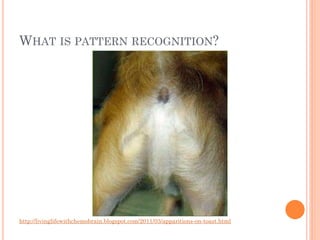
WHAT IS PATTERN RECOGNITION?


http://livinglifewithchemobrain.blogspot.com/2011/03/apparitions-on-toast.html
WHAT IS PATTERN RECOGNITION?

   Don’t believe that your brain is optimised to
    create patterns from apparent chaos? Watch this:
    http://www.youtube.com/watch?v=yVkdfJ9PkRQ
WHAT IS PATTERN RECOGNITION?


           Examples  rules
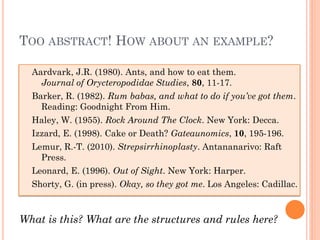
TOO ABSTRACT! HOW ABOUT AN EXAMPLE?

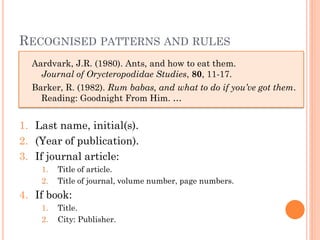
  Aardvark, J.R. (1980). Ants, and how to eat them.
    Journal of Orycteropodidae Studies, 80, 11-17.
  Barker, R. (1982). Rum babas, and what to do if you’ve got them.
    Reading: Goodnight From Him.
  Haley, W. (1955). Rock Around The Clock. New York: Decca.
  Izzard, E. (1998). Cake or Death? Gateaunomics, 10, 195-196.
  Lemur, R.-T. (2010). Strepsirrhinoplasty. Antananarivo: Raft
    Press.
  Leonard, E. (1996). Out of Sight. New York: Harper.
  Shorty, G. (in press). Okay, so they got me. Los Angeles: Cadillac.


What is this? What are the structures and rules here?
RECOGNISED PATTERNS AND RULES
  Aardvark, J.R. (1980). Ants, and how to eat them.
    Journal of Orycteropodidae Studies, 80, 11-17.
  Barker, R. (1982). Rum babas, and what to do if you’ve got them.
    Reading: Goodnight From Him. …


1. Last name, initial(s).
2. (Year of publication).
3. If journal article:
    1.   Title of article.
    2.   Title of journal, volume number, page numbers.
4. If book:
    1.   Title.
    2.   City: Publisher.
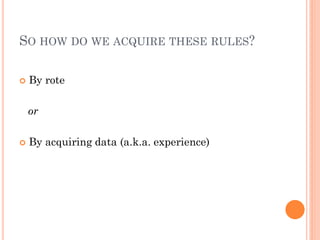
SO HOW DO WE ACQUIRE THESE RULES?

   By rote

    or

   By acquiring data (a.k.a. experience)
IMPLICIT VS. EXPLICIT KNOWLEDGE

   Gladwell, M. (2005). Blink. London: Penguin.
    http://www.gladwell.com/blink/index.html
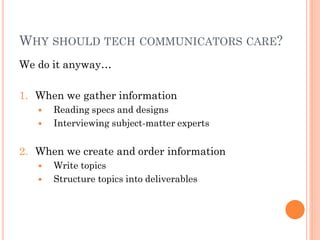
WHY SHOULD TECH COMMUNICATORS CARE?
We do it anyway…

1. When we gather information
      Reading specs and designs
      Interviewing subject-matter experts


2. When we create and order information
      Write topics
      Structure topics into deliverables
WHY SHOULD TECH COMMUNICATORS CARE?
We do it anyway, so we might as well do it smartly!

   If we make sense of our subjects more efficiently…

   If we structure better what we need to convey…

   … we can provide better documentation!
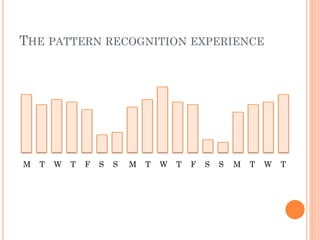
THE PATTERN RECOGNITION EXPERIENCE


M   T   W   T   F   S   S   M   T   W   T   F   S   S   M   T   W   T
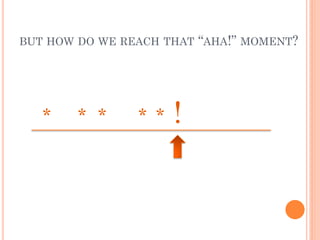
BUT HOW DO WE REACH THAT “AHA!” MOMENT?


   *    * *     * *   !
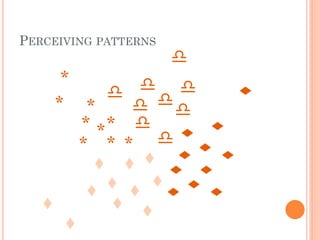
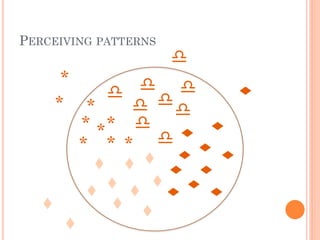
PERCEIVING PATTERNS
                        d
        *      d d
             d


                                   t
       * *     d dd
          * ** d


                        t
                         t t t
          * * * d

                          t t
                           t
           t    t t          t t
             t      t
           t     t
   t          t
                   t           t
       t
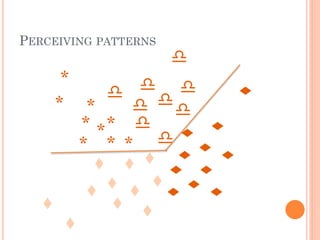
PERCEIVING PATTERNS
                        d
        *      d d
             d


                                   t
       * *     d dd
          * ** d


                        t
                         t t t
          * * * d

                          t t
                           t
           t    t t          t t
             t      t
           t     t
   t          t
                   t           t
       t
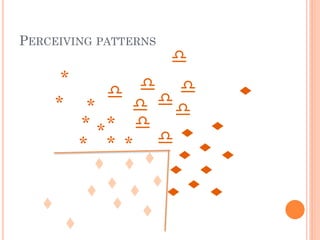
PERCEIVING PATTERNS
                        d
        *      d d
             d


                                   t
       * *     d dd
          * ** d


                        t
                         t t t
          * * * d

                          t t
                           t
           t    t t          t t
             t      t
           t     t
   t          t
                   t           t
       t
PERCEIVING PATTERNS
                        d
        *      d d
             d


                                   t
       * *     d dd
          * ** d


                        t
                         t t t
          * * * d

                          t t
                           t
           t    t t          t t
             t      t
           t     t
   t          t
                   t           t
       t
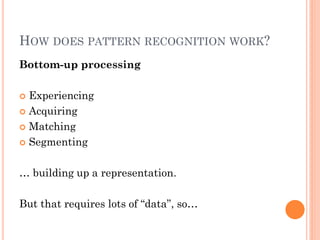
HOW DOES PATTERN RECOGNITION WORK?
Bottom-up processing

 Experiencing
 Acquiring

 Matching

 Segmenting


… building up a representation.

But that requires lots of “data”, so…
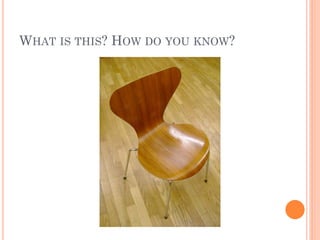
WHAT IS THIS? HOW DO YOU KNOW?
HOW DOES PATTERN RECOGNITION WORK?
Top-down processing

 Knowing
 Generalising

 Contextualising

 Applying


… searching for confirmation.
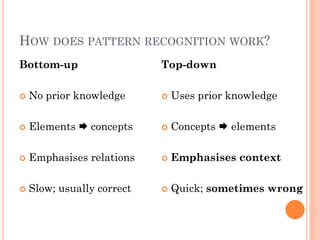
HOW DOES PATTERN RECOGNITION WORK?
Bottom-up                   Top-down

   No prior knowledge         Uses prior knowledge

   Elements  concepts        Concepts  elements

   Emphasises relations       Emphasises context

   Slow; usually correct      Quick; sometimes wrong
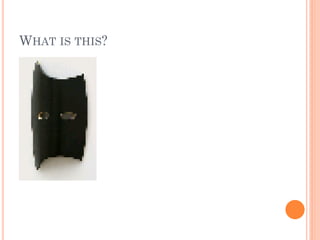
WHAT IS THIS?
WHAT IS THIS? IT’S ART...


Martin Boyce:
Untitled, 2002.
WHAT IS THIS? IT’S PART OF THE SAME CHAIR!


Martin Boyce:                          Arne Jacobsen:
Untitled, 2002.                        Chair 3107, c.1952.
It is the back side of the chair where the back rest
turns into the seat, with two holes cut in and turned by 90°.
HOW DOES PATTERN RECOGNITION WORK?
Bottom-up                   Top-down

   No prior knowledge         Uses prior knowledge

   Elements  concepts        Concepts  elements

   Emphasises relations       Emphasises context

   Slow; usually correct      Quick; sometimes wrong
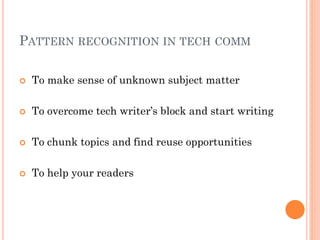
PATTERN RECOGNITION IN TECH COMM

   To make sense of unknown subject matter

   To overcome tech writer’s block and start writing

   To chunk topics and find reuse opportunities

   To help your readers
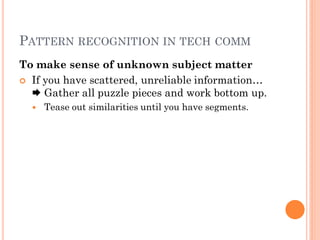
PATTERN RECOGNITION IN TECH COMM
To make sense of unknown subject matter
 If you have scattered, unreliable information…
   Gather all puzzle pieces and work bottom up.
     Tease out similarities until you have segments.
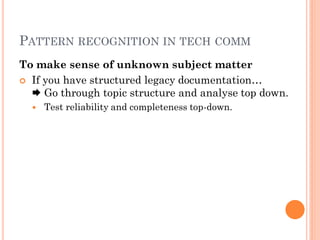
PATTERN RECOGNITION IN TECH COMM
To make sense of unknown subject matter
 If you have structured legacy documentation…
   Go through topic structure and analyse top down.
     Test reliability and completeness top-down.
PATTERN RECOGNITION IN TECH COMM
To overcome writer’s block and start writing
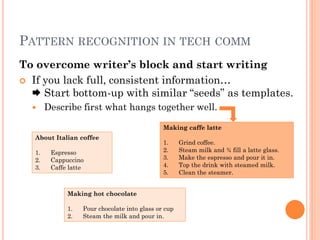
 If you lack full, consistent information…
   Start bottom-up with similar “seeds” as templates.
       Describe first what hangs together well.

                                               Making caffe latte
   About Italian coffee
                                               1.     Grind coffee.
   1.    Espresso                              2.     Steam milk and ¾ fill a latte glass.
   2.    Cappuccino                            3.     Make the espresso and pour it in.
   3.    Caffe latte                           4.     Top the drink with steamed milk.
                                               5.     Clean the steamer.


              Making hot chocolate

              1.   Pour chocolate into glass or cup
              2.   Steam the milk and pour in.
PATTERN RECOGNITION IN TECH COMM
To chunk topics and find reuse opportunities
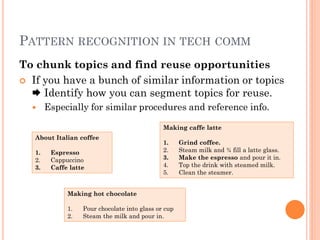
 If you have a bunch of similar information or topics
   Identify how you can segment topics for reuse.
       Especially for similar procedures and reference info.

                                               Making caffe latte
   About Italian coffee
                                               1.     Grind coffee.
   1.    Espresso                              2.     Steam milk and ¾ fill a latte glass.
   2.    Cappuccino                            3.     Make the espresso and pour it in.
   3.    Caffe latte                           4.     Top the drink with steamed milk.
                                               5.     Clean the steamer.


              Making hot chocolate

              1.   Pour chocolate into glass or cup
              2.   Steam the milk and pour in.
PATTERN RECOGNITION IN TECH COMM
To help your readers
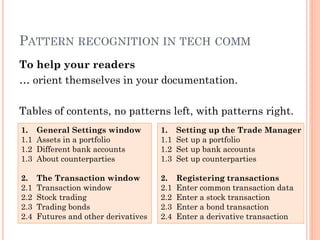
… orient themselves in your documentation.
Tables of contents, no patterns left, with patterns right.
1.    General Settings window         1.    Setting up the Trade Manager
1.1   Assets in a portfolio           1.1   Set up a portfolio
1.2   Different bank accounts         1.2   Set up bank accounts
1.3   About counterparties            1.3   Set up counterparties

2.    The Transaction window          2.    Registering transactions
2.1   Transaction window              2.1   Enter common transaction data
2.2   Stock trading                   2.2   Enter a stock transaction
2.3   Trading bonds                   2.3   Enter a bond transaction
2.4   Futures and other derivatives   2.4   Enter a derivative transaction
PATTERN RECOGNITION IN TECH COMM
To help your readers
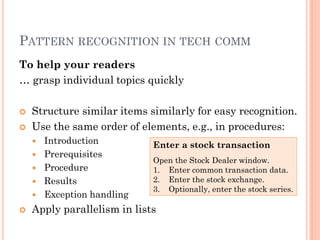
… grasp individual topics quickly

   Structure similar items similarly for easy recognition.
   Use the same order of elements, e.g., in procedures:
       Introduction         Enter a stock transaction
       Prerequisites
                             Open the Stock Dealer window.
       Procedure            1. Enter common transaction data.
       Results              2. Enter the stock exchange.
                             3. Optionally, enter the stock series.
       Exception handling
   Apply parallelism in lists
PATTERN RECOGNITION IN TECH COMM
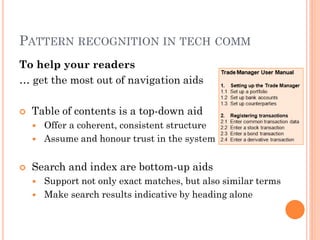
To help your readers
… get the most out of navigation aids

   Table of contents is a top-down aid
       Offer a coherent, consistent structure
       Assume and honour trust in the system


   Search and index are bottom-up aids
       Support not only exact matches, but also similar terms
       Make search results indicative by heading alone
PATTERN RECOGNITION IN TECH COMM
To help your readers
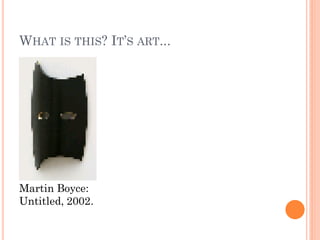
… in ways only you know how!

   <audience brainstorm>
FINAL WORDS OF ADVICE AND WARNING

   Keep your customers – and your job – safe!

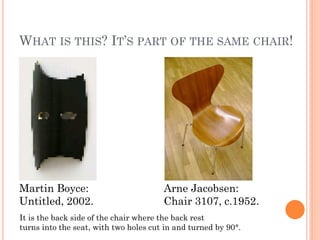
   Apophenia: Humans are addicted to meaning.

   Some patterns refuse to be recognized

   Pattern recognition occurs in contexts

   Creating tech comm is often a top-down process…
    ... but using it is often bottom-up!
THANK YOU! KEEP IN TOUCH!


            Kai Weber                     Chris Atherton


   @techwriterkai               @finiteattention

   kaiweber.wordpress.com/      about.me/cjatherton

Kai Weber & Chris Atherton - Pattern recognition for technical communicators - tcuk11

  • 1.
    PATTERN RECOGNITION FOR TECHNICALCOMMUNICATORS Kai Weber (@techwriterkai) & Chris Atherton (@finiteattention) 22 September 2011 TCUK 11
  • 2.
    WHO ARE WEAND WHAT DO WE KNOW? Kai Weber Chris Atherton @techwriterkai @finiteattention  Technical writer since 1988  User experience consultant  Senior Technical Writer at  Mendeley, Skype, academia SimCorp, CPH, since 2008  Incurable cross-disciplinarian  Coach, trainer, mentor  Ph.D. in Cognitive  M.A. in American Studies Neuroscience
  • 3.
    OUR MISSION Helping you understand what you do … … so you can do what you do, better.
  • 4.
    WHAT IS PATTERNRECOGNITION? http://livinglifewithchemobrain.blogspot.com/2011/03/apparitions-on-toast.html
  • 5.
    WHAT IS PATTERNRECOGNITION?  Don’t believe that your brain is optimised to create patterns from apparent chaos? Watch this: http://www.youtube.com/watch?v=yVkdfJ9PkRQ
  • 6.
    WHAT IS PATTERNRECOGNITION? Examples  rules
  • 7.
    TOO ABSTRACT! HOWABOUT AN EXAMPLE? Aardvark, J.R. (1980). Ants, and how to eat them. Journal of Orycteropodidae Studies, 80, 11-17. Barker, R. (1982). Rum babas, and what to do if you’ve got them. Reading: Goodnight From Him. Haley, W. (1955). Rock Around The Clock. New York: Decca. Izzard, E. (1998). Cake or Death? Gateaunomics, 10, 195-196. Lemur, R.-T. (2010). Strepsirrhinoplasty. Antananarivo: Raft Press. Leonard, E. (1996). Out of Sight. New York: Harper. Shorty, G. (in press). Okay, so they got me. Los Angeles: Cadillac. What is this? What are the structures and rules here?
  • 8.
    RECOGNISED PATTERNS ANDRULES Aardvark, J.R. (1980). Ants, and how to eat them. Journal of Orycteropodidae Studies, 80, 11-17. Barker, R. (1982). Rum babas, and what to do if you’ve got them. Reading: Goodnight From Him. … 1. Last name, initial(s). 2. (Year of publication). 3. If journal article: 1. Title of article. 2. Title of journal, volume number, page numbers. 4. If book: 1. Title. 2. City: Publisher.
  • 9.
    SO HOW DOWE ACQUIRE THESE RULES?  By rote or  By acquiring data (a.k.a. experience)
  • 10.
    IMPLICIT VS. EXPLICITKNOWLEDGE  Gladwell, M. (2005). Blink. London: Penguin. http://www.gladwell.com/blink/index.html
  • 11.
    WHY SHOULD TECHCOMMUNICATORS CARE? We do it anyway… 1. When we gather information  Reading specs and designs  Interviewing subject-matter experts 2. When we create and order information  Write topics  Structure topics into deliverables
  • 12.
    WHY SHOULD TECHCOMMUNICATORS CARE? We do it anyway, so we might as well do it smartly!  If we make sense of our subjects more efficiently…  If we structure better what we need to convey…  … we can provide better documentation!
  • 13.
    THE PATTERN RECOGNITIONEXPERIENCE M T W T F S S M T W T F S S M T W T
  • 14.
    BUT HOW DOWE REACH THAT “AHA!” MOMENT? * * * * * !
  • 15.
    PERCEIVING PATTERNS d * d d d t * * d dd * ** d t t t t * * * d t t t t t t t t t t t t t t t t t
  • 16.
    PERCEIVING PATTERNS d * d d d t * * d dd * ** d t t t t * * * d t t t t t t t t t t t t t t t t t
  • 17.
    PERCEIVING PATTERNS d * d d d t * * d dd * ** d t t t t * * * d t t t t t t t t t t t t t t t t t
  • 18.
    PERCEIVING PATTERNS d * d d d t * * d dd * ** d t t t t * * * d t t t t t t t t t t t t t t t t t
  • 19.
    HOW DOES PATTERNRECOGNITION WORK? Bottom-up processing  Experiencing  Acquiring  Matching  Segmenting … building up a representation. But that requires lots of “data”, so…
  • 20.
    WHAT IS THIS?HOW DO YOU KNOW?
  • 21.
    HOW DOES PATTERNRECOGNITION WORK? Top-down processing  Knowing  Generalising  Contextualising  Applying … searching for confirmation.
  • 22.
    HOW DOES PATTERNRECOGNITION WORK? Bottom-up Top-down  No prior knowledge  Uses prior knowledge  Elements  concepts  Concepts  elements  Emphasises relations  Emphasises context  Slow; usually correct  Quick; sometimes wrong
  • 23.
  • 24.
    WHAT IS THIS?IT’S ART... Martin Boyce: Untitled, 2002.
  • 25.
    WHAT IS THIS?IT’S PART OF THE SAME CHAIR! Martin Boyce: Arne Jacobsen: Untitled, 2002. Chair 3107, c.1952. It is the back side of the chair where the back rest turns into the seat, with two holes cut in and turned by 90°.
  • 26.
    HOW DOES PATTERNRECOGNITION WORK? Bottom-up Top-down  No prior knowledge  Uses prior knowledge  Elements  concepts  Concepts  elements  Emphasises relations  Emphasises context  Slow; usually correct  Quick; sometimes wrong
  • 27.
    PATTERN RECOGNITION INTECH COMM  To make sense of unknown subject matter  To overcome tech writer’s block and start writing  To chunk topics and find reuse opportunities  To help your readers
  • 28.
    PATTERN RECOGNITION INTECH COMM To make sense of unknown subject matter  If you have scattered, unreliable information…  Gather all puzzle pieces and work bottom up.  Tease out similarities until you have segments.
  • 29.
    PATTERN RECOGNITION INTECH COMM To make sense of unknown subject matter  If you have structured legacy documentation…  Go through topic structure and analyse top down.  Test reliability and completeness top-down.
  • 30.
    PATTERN RECOGNITION INTECH COMM To overcome writer’s block and start writing  If you lack full, consistent information…  Start bottom-up with similar “seeds” as templates.  Describe first what hangs together well. Making caffe latte About Italian coffee 1. Grind coffee. 1. Espresso 2. Steam milk and ¾ fill a latte glass. 2. Cappuccino 3. Make the espresso and pour it in. 3. Caffe latte 4. Top the drink with steamed milk. 5. Clean the steamer. Making hot chocolate 1. Pour chocolate into glass or cup 2. Steam the milk and pour in.
  • 31.
    PATTERN RECOGNITION INTECH COMM To chunk topics and find reuse opportunities  If you have a bunch of similar information or topics  Identify how you can segment topics for reuse.  Especially for similar procedures and reference info. Making caffe latte About Italian coffee 1. Grind coffee. 1. Espresso 2. Steam milk and ¾ fill a latte glass. 2. Cappuccino 3. Make the espresso and pour it in. 3. Caffe latte 4. Top the drink with steamed milk. 5. Clean the steamer. Making hot chocolate 1. Pour chocolate into glass or cup 2. Steam the milk and pour in.
  • 32.
    PATTERN RECOGNITION INTECH COMM To help your readers … orient themselves in your documentation. Tables of contents, no patterns left, with patterns right. 1. General Settings window 1. Setting up the Trade Manager 1.1 Assets in a portfolio 1.1 Set up a portfolio 1.2 Different bank accounts 1.2 Set up bank accounts 1.3 About counterparties 1.3 Set up counterparties 2. The Transaction window 2. Registering transactions 2.1 Transaction window 2.1 Enter common transaction data 2.2 Stock trading 2.2 Enter a stock transaction 2.3 Trading bonds 2.3 Enter a bond transaction 2.4 Futures and other derivatives 2.4 Enter a derivative transaction
  • 33.
    PATTERN RECOGNITION INTECH COMM To help your readers … grasp individual topics quickly  Structure similar items similarly for easy recognition.  Use the same order of elements, e.g., in procedures:  Introduction Enter a stock transaction  Prerequisites Open the Stock Dealer window.  Procedure 1. Enter common transaction data.  Results 2. Enter the stock exchange. 3. Optionally, enter the stock series.  Exception handling  Apply parallelism in lists
  • 34.
    PATTERN RECOGNITION INTECH COMM To help your readers … get the most out of navigation aids  Table of contents is a top-down aid  Offer a coherent, consistent structure  Assume and honour trust in the system  Search and index are bottom-up aids  Support not only exact matches, but also similar terms  Make search results indicative by heading alone
  • 35.
    PATTERN RECOGNITION INTECH COMM To help your readers … in ways only you know how!  <audience brainstorm>
  • 36.
    FINAL WORDS OFADVICE AND WARNING  Keep your customers – and your job – safe!  Apophenia: Humans are addicted to meaning.  Some patterns refuse to be recognized  Pattern recognition occurs in contexts  Creating tech comm is often a top-down process… ... but using it is often bottom-up!
  • 37.
    THANK YOU! KEEPIN TOUCH! Kai Weber Chris Atherton  @techwriterkai  @finiteattention  kaiweber.wordpress.com/  about.me/cjatherton