


What is
Partner Sales
Enablement?
2 | © ZINFI Technologies Inc. All Rights Reserved
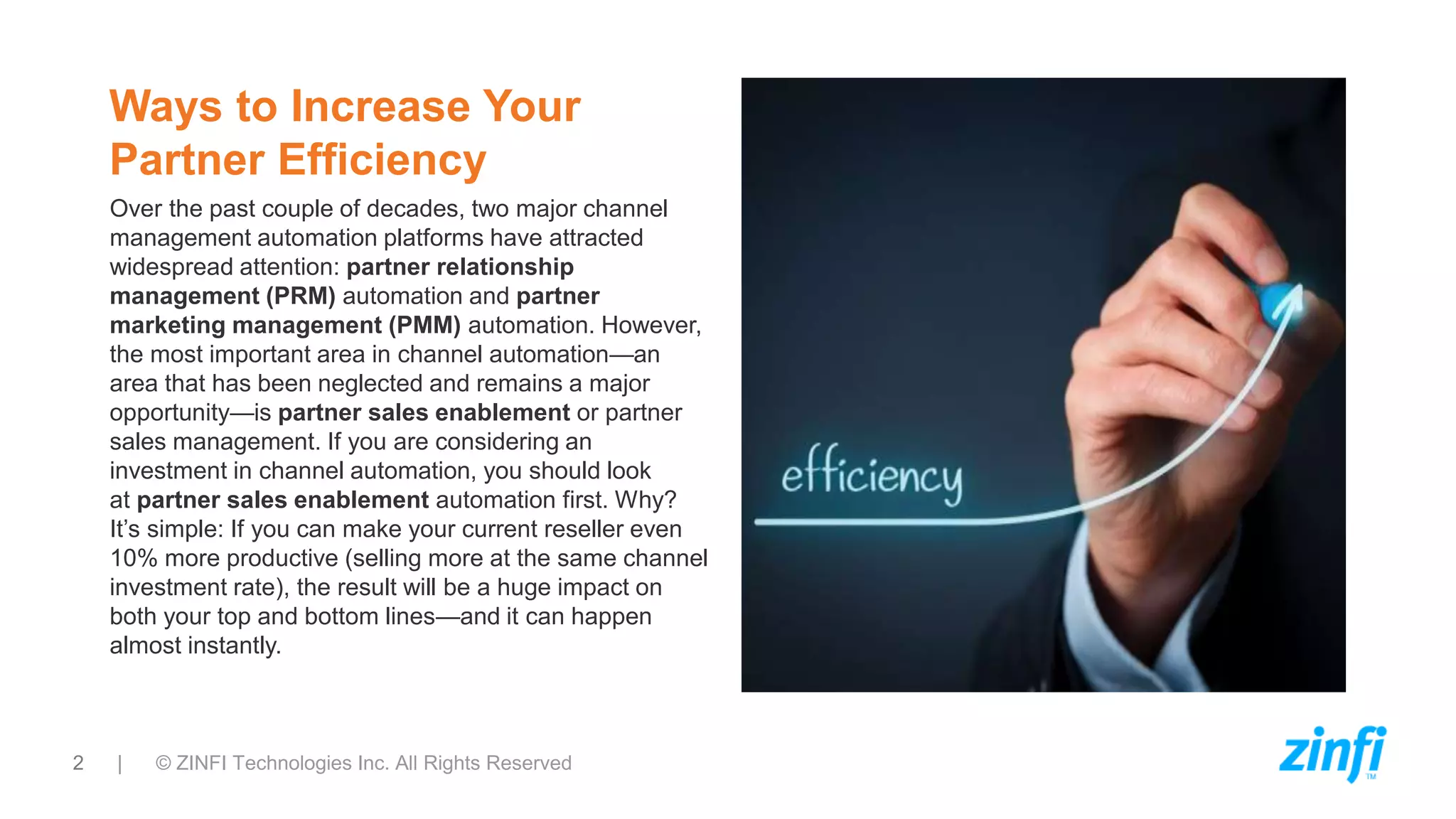
Ways to Increase Your
Partner Efficiency
Over the past couple of decades, two major channel
management automation platforms have attracted
widespread attention: partner relationship
management (PRM) automation and partner
marketing management (PMM) automation. However,
the most important area in channel automation—an
area that has been neglected and remains a major
opportunity—is partner sales enablement or partner
sales management. If you are considering an
investment in channel automation, you should look
at partner sales enablement automation first. Why?
It’s simple: If you can make your current reseller even
10% more productive (selling more at the same channel
investment rate), the result will be a huge impact on
both your top and bottom lines—and it can happen
almost instantly.
3 | © ZINFI Technologies Inc. All Rights Reserved
Partner Sales Enablement -
Explained
Before we delve into the details, let’s very briefly
discuss partner sales enablement and how you can
make this happen, either through the infrastructure you
have today or by investing in a partner sales
enablement automation platform. Partner sales
enablement has two core points of focus:
1) contextual sales training and enablement (i.e., during
the selling process), which leverages the relative wealth
of sales resources vs. technical or marketing resources;
and 2) buyer engagement tracking and measurement to
assess how the end buyer is engaged in the sales
process.
4 | © ZINFI Technologies Inc. All Rights Reserved
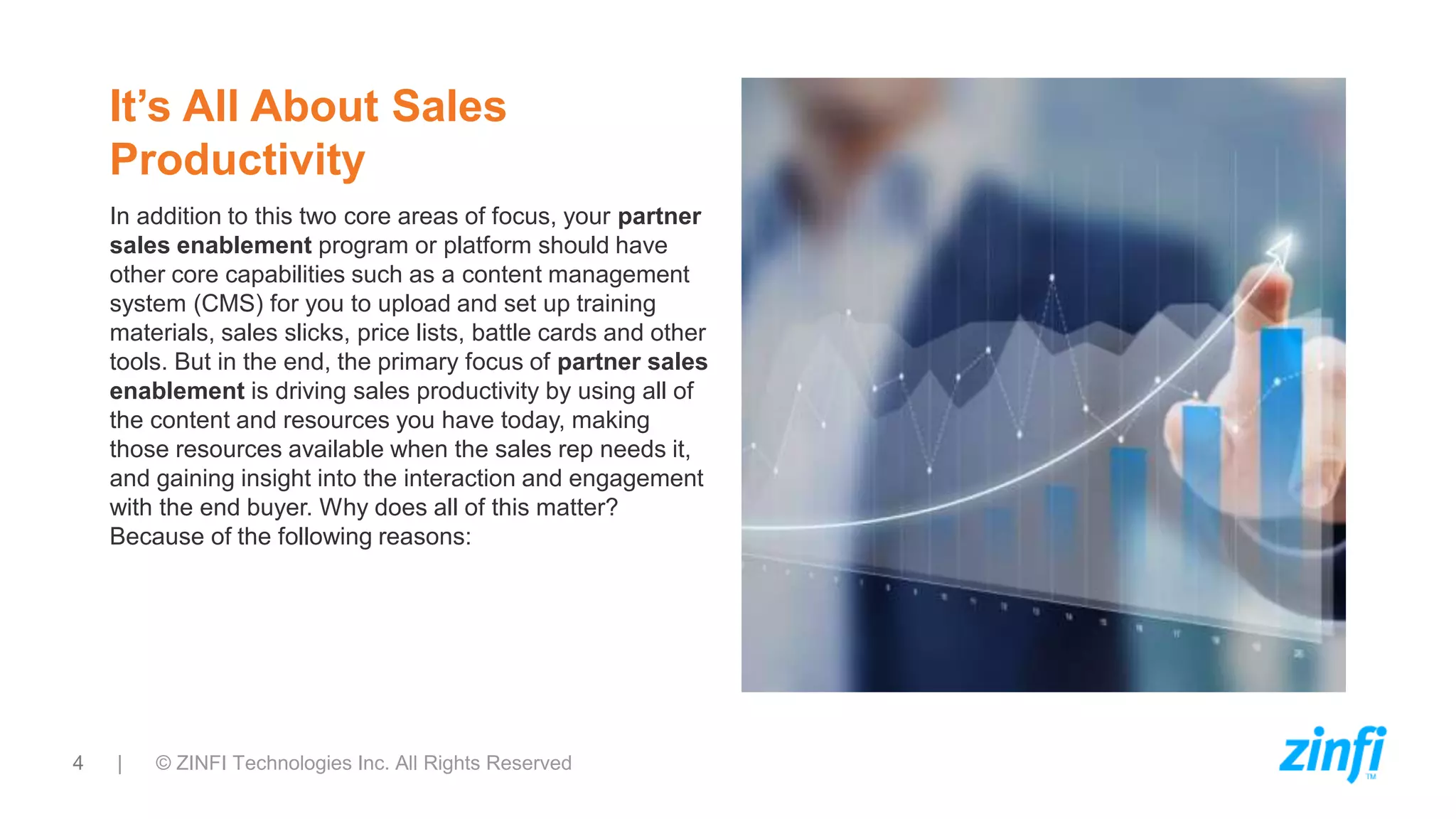
It’s All About Sales
Productivity
In addition to this two core areas of focus, your partner
sales enablement program or platform should have
other core capabilities such as a content management
system (CMS) for you to upload and set up training
materials, sales slicks, price lists, battle cards and other
tools. But in the end, the primary focus of partner sales
enablement is driving sales productivity by using all of
the content and resources you have today, making
those resources available when the sales rep needs it,
and gaining insight into the interaction and engagement
with the end buyer. Why does all of this matter?
Because of the following reasons:
5 | © ZINFI Technologies Inc. All Rights Reserved
1. Sales People Are
Overwhelmed
Most sales people have to deal with half a dozen
product lines, if not more. With the rate of changes that
are happening in the market place, it is almost
impossible for them to be fully conversant with every
product or service they are selling.
2. All Sales People Are Not
Created Equal
While many great sales people are highly organized and
can absorb a lot of complex content, they are not all
equally capable. Therefore, making relevant content
available for them to learn from as a part of the sales
process reduces the overload. It also makes them better
learners in the long run.
6 | © ZINFI Technologies Inc. All Rights Reserved
3. Sales People Should Be
Treated As Consumers of Content
Product marketing tends to create volumes of materials
and content, but organizations rarely understand what is
actually effective or not. When they have a system that
allows content delivery in stages, as well as precise
tracking of consumption patterns, product marketers
can become much more effective in creating useful
content.
7 | © ZINFI Technologies Inc. All Rights Reserved
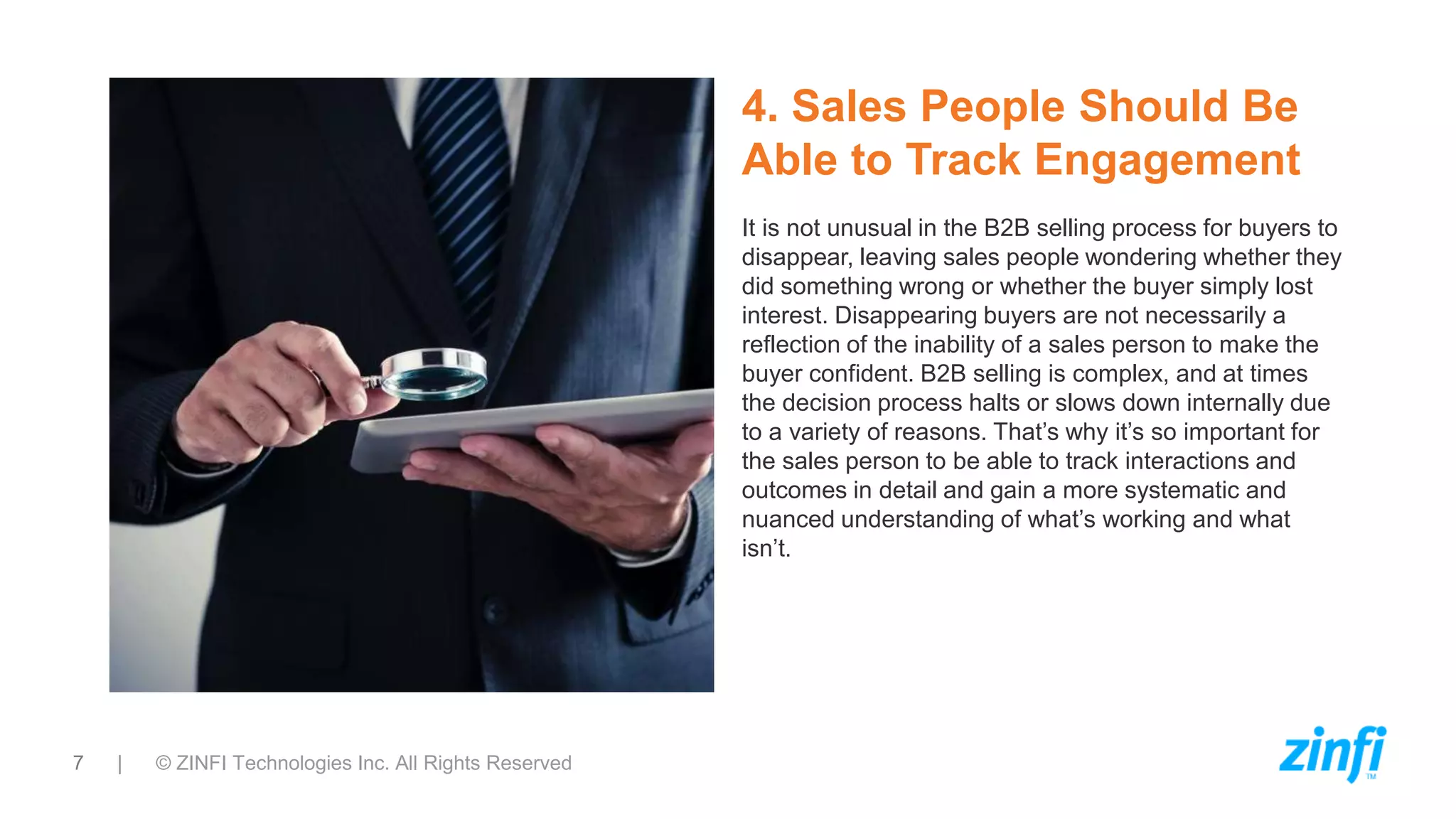
4. Sales People Should Be
Able to Track Engagement
It is not unusual in the B2B selling process for buyers to
disappear, leaving sales people wondering whether they
did something wrong or whether the buyer simply lost
interest. Disappearing buyers are not necessarily a
reflection of the inability of a sales person to make the
buyer confident. B2B selling is complex, and at times
the decision process halts or slows down internally due
to a variety of reasons. That’s why it’s so important for
the sales person to be able to track interactions and
outcomes in detail and gain a more systematic and
nuanced understanding of what’s working and what
isn’t.
8 | © ZINFI Technologies Inc. All Rights Reserved
5. Selling Is a Competitive
Sport
An effective partner sales enablement platform can
offer leader boards, gamification, rewards alignment,
and other motivators to create a highly competitive—yet
sharing—environment. Gone are the days where sales
people are expected to smile, dial and close. Today
most B2B sales people are assumed to be sales or
solution consultants, roles that requires deeper
knowledge of the customer’s environment. This is where
cross-learning and sharing are critical.
9 | © ZINFI Technologies Inc. All Rights Reserved
Efficacy Through Automation
Partner sales enablement automation can be a big help
in establishing a distributed sales team that connects,
collaborates and communicates to become more effective.
It can also create a highly competitive and transparent
selling environment, and encourage increased sharing
among reps and teams. The great news is there are
multiple tools available for direct sales teams, and
new partner sales enablement automation solutions are
being offered by several companies—including ZINFI.
A typical deployment cycle for partner sales enablement
typically takes two to three months. It takes about a month
or so to organize content that is already available and tag
it by sales stage and by product line. Once the content
has been organized, the next step is training the sales
team and making them aware of how to use the existing
content and tools to track buyers’ engagement. Once
these two steps have been completed, a partner sales
enablement platform is ready for rollout and can start
producing results.
© ZINFI Technologies Inc. All Rights Reserved.
Thank You
North American Marketing Operations Center
ZINFI Technologies, Inc.
6200 Stoneridge Mall Road, Suite 300
Pleasanton, CA 94588
1.866.707.1944 or sales.noram@zinfitech.com

What is Partner Sales Enablement?

  • 1.
  • 2.
    2 | ©ZINFI Technologies Inc. All Rights Reserved Ways to Increase Your Partner Efficiency Over the past couple of decades, two major channel management automation platforms have attracted widespread attention: partner relationship management (PRM) automation and partner marketing management (PMM) automation. However, the most important area in channel automation—an area that has been neglected and remains a major opportunity—is partner sales enablement or partner sales management. If you are considering an investment in channel automation, you should look at partner sales enablement automation first. Why? It’s simple: If you can make your current reseller even 10% more productive (selling more at the same channel investment rate), the result will be a huge impact on both your top and bottom lines—and it can happen almost instantly.
  • 3.
    3 | ©ZINFI Technologies Inc. All Rights Reserved Partner Sales Enablement - Explained Before we delve into the details, let’s very briefly discuss partner sales enablement and how you can make this happen, either through the infrastructure you have today or by investing in a partner sales enablement automation platform. Partner sales enablement has two core points of focus: 1) contextual sales training and enablement (i.e., during the selling process), which leverages the relative wealth of sales resources vs. technical or marketing resources; and 2) buyer engagement tracking and measurement to assess how the end buyer is engaged in the sales process.
  • 4.
    4 | ©ZINFI Technologies Inc. All Rights Reserved It’s All About Sales Productivity In addition to this two core areas of focus, your partner sales enablement program or platform should have other core capabilities such as a content management system (CMS) for you to upload and set up training materials, sales slicks, price lists, battle cards and other tools. But in the end, the primary focus of partner sales enablement is driving sales productivity by using all of the content and resources you have today, making those resources available when the sales rep needs it, and gaining insight into the interaction and engagement with the end buyer. Why does all of this matter? Because of the following reasons:
  • 5.
    5 | ©ZINFI Technologies Inc. All Rights Reserved 1. Sales People Are Overwhelmed Most sales people have to deal with half a dozen product lines, if not more. With the rate of changes that are happening in the market place, it is almost impossible for them to be fully conversant with every product or service they are selling. 2. All Sales People Are Not Created Equal While many great sales people are highly organized and can absorb a lot of complex content, they are not all equally capable. Therefore, making relevant content available for them to learn from as a part of the sales process reduces the overload. It also makes them better learners in the long run.
  • 6.
    6 | ©ZINFI Technologies Inc. All Rights Reserved 3. Sales People Should Be Treated As Consumers of Content Product marketing tends to create volumes of materials and content, but organizations rarely understand what is actually effective or not. When they have a system that allows content delivery in stages, as well as precise tracking of consumption patterns, product marketers can become much more effective in creating useful content.
  • 7.
    7 | ©ZINFI Technologies Inc. All Rights Reserved 4. Sales People Should Be Able to Track Engagement It is not unusual in the B2B selling process for buyers to disappear, leaving sales people wondering whether they did something wrong or whether the buyer simply lost interest. Disappearing buyers are not necessarily a reflection of the inability of a sales person to make the buyer confident. B2B selling is complex, and at times the decision process halts or slows down internally due to a variety of reasons. That’s why it’s so important for the sales person to be able to track interactions and outcomes in detail and gain a more systematic and nuanced understanding of what’s working and what isn’t.
  • 8.
    8 | ©ZINFI Technologies Inc. All Rights Reserved 5. Selling Is a Competitive Sport An effective partner sales enablement platform can offer leader boards, gamification, rewards alignment, and other motivators to create a highly competitive—yet sharing—environment. Gone are the days where sales people are expected to smile, dial and close. Today most B2B sales people are assumed to be sales or solution consultants, roles that requires deeper knowledge of the customer’s environment. This is where cross-learning and sharing are critical.
  • 9.
    9 | ©ZINFI Technologies Inc. All Rights Reserved Efficacy Through Automation Partner sales enablement automation can be a big help in establishing a distributed sales team that connects, collaborates and communicates to become more effective. It can also create a highly competitive and transparent selling environment, and encourage increased sharing among reps and teams. The great news is there are multiple tools available for direct sales teams, and new partner sales enablement automation solutions are being offered by several companies—including ZINFI. A typical deployment cycle for partner sales enablement typically takes two to three months. It takes about a month or so to organize content that is already available and tag it by sales stage and by product line. Once the content has been organized, the next step is training the sales team and making them aware of how to use the existing content and tools to track buyers’ engagement. Once these two steps have been completed, a partner sales enablement platform is ready for rollout and can start producing results.
  • 10.
    © ZINFI TechnologiesInc. All Rights Reserved. Thank You North American Marketing Operations Center ZINFI Technologies, Inc. 6200 Stoneridge Mall Road, Suite 300 Pleasanton, CA 94588 1.866.707.1944 or sales.noram@zinfitech.com