05/11/2017
1
Kari Smith
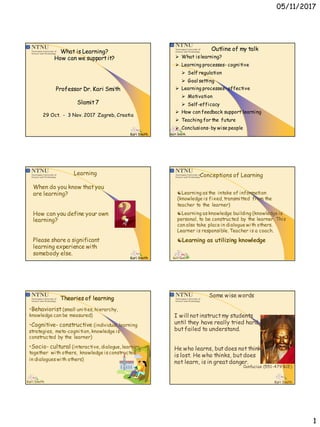
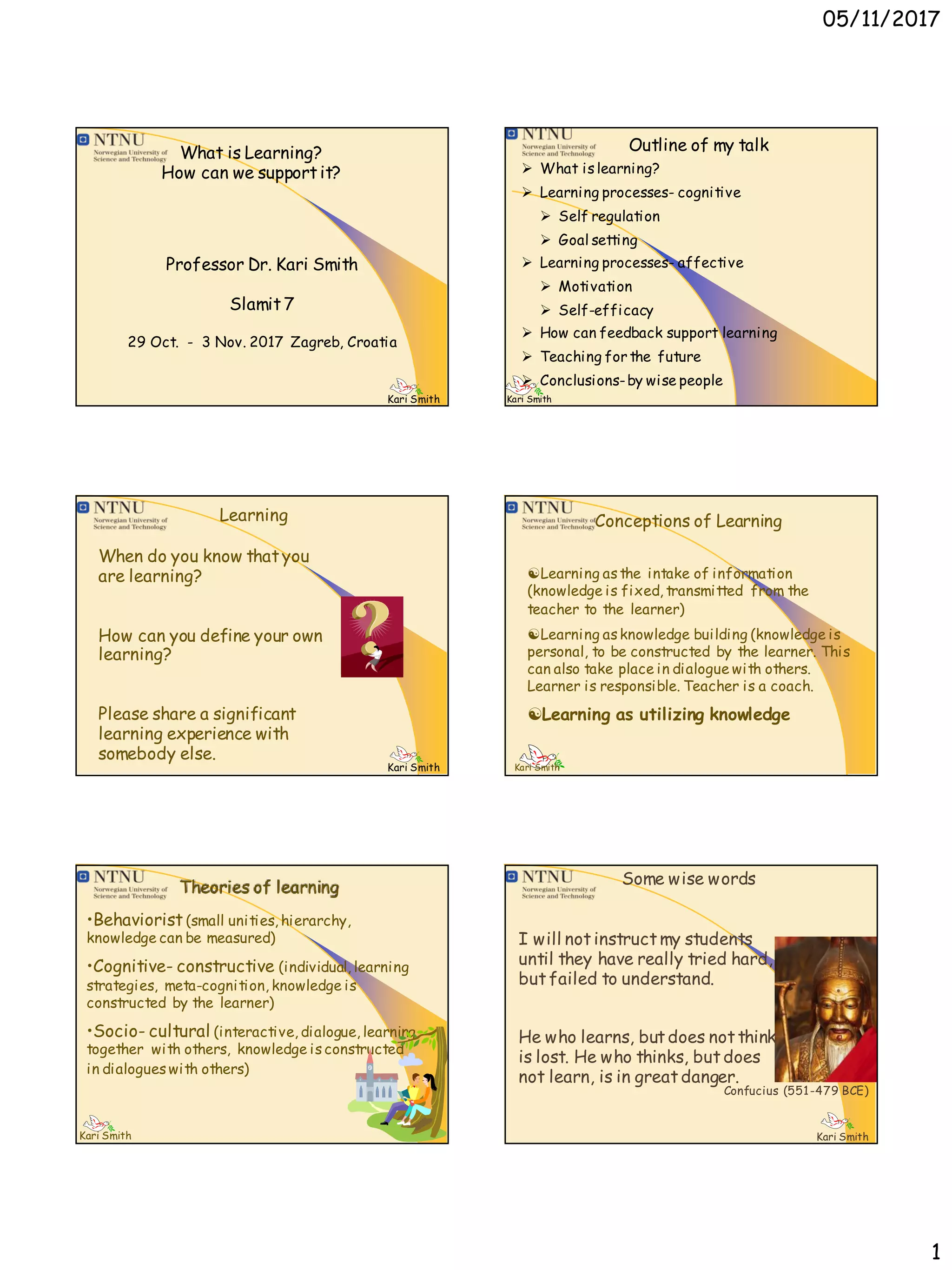
What is Learning?
How can we supportit?
Professor Dr. Kari Smith
Slamit 7
29 Oct. - 3 Nov. 2017 Zagreb, Croatia
Kari Smith
Outline of my talk
 What islearning?
 Learning processes- cognitive
 Self regulation
 Goal setting
 Learning processes- affective
 Motivation
 Self-efficacy
 How can feedback support learning
 Teaching for the future
 Conclusions-by wise people
Kari Smith
When do you know thatyou
are learning?
How can you define your own
learning?
Please share a significant
learning experience with
somebody else.
Learning Conceptions of Learning
Learning asthe intake of information
(knowledge is fixed, transmitted from the
teacher to the learner)
Learning asknowledge building (knowledge is
personal, to be constructed by the learner. This
can also take place in dialogue with others.
Learner is responsible. Teacher is a coach.
Learning as utilizing knowledge
Kari Smith
Kari Smith
Theories of learning
•Behaviorist (small unities, hierarchy,
knowledge can be measured)
•Cognitive- constructive (individual, learning
strategies, meta-cognition, knowledge is
constructed by the learner)
•Socio- cultural (interactive, dialogue, learning
together with others, knowledge isconstructed
in dialogueswith others)
Kari Smith
I will notinstructmy students
until they have really tried hard,
butfailed to understand.
He who learns, butdoes notthink
is lost. He who thinks, butdoes
not learn, is in greatdanger.
Some wise words
Confucius (551-479 BCE)
05/11/2017
2
Kari Smith
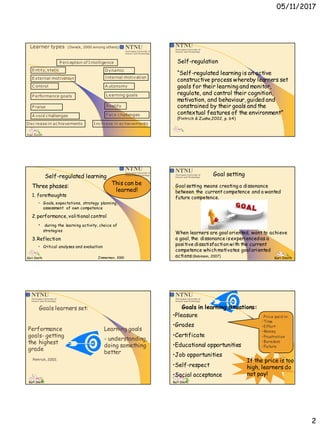
Learner types (Dweck, 2000 among others)
P erception of Intelligence
Entity, static Dynamic
External motivation Internal motivation
C ontrol A utonomy
P erformance goals Learning goals
P raise Reality
A void challenges Face challenges
Decrease in achievements Increase in achievements
Self-regulation
“Self-regulated learning is an active
constructive process whereby learners set
goals for their learning and monitor,
regulate, and control their cognition,
motivation, and behaviour, guided and
constrained by their goals and the
contextual features of the environment”
(Pintrich & Zusho,2002, p. 64)
Kari Smith
Self-regulated learning
Three phases:
1. forethoughts
• Goals, expectations, strategy planning,
assessment of own competence
2.performance, volitional control
• during the learning activity, choice of
strategies
3.Reflection
• Critical analyses and evaluation
This can be
learned!
Zimmerman, 2000 Kari Smith
Goal setting
Goal setting means creating a dissonance
between the current competence and a wanted
future competence.
When learners are goal oriented, want to achieve
a goal, the dissonance isexperiencedas a
positive dissatisfaction with the current
competence whichmotivates goal oriented
actions (Robinson, 2007)
Goals learners set:
Performance
goals- getting
the highest
grade
Learning goals
- understanding,
doing something
better
Pintrich, 2002.
Kari Smith Kari Smith
Goals in learning situations:
•Pleasure
•Grades
•Certificate
•Educational opportunities
•Job opportunities
•Self-respect
•Social acceptance
Price paid in:
•Time
•Effort
•Money
•Frustration
•Boredom
•Failure
If the price is too
high, learners do
not pay!
05/11/2017
3
Kari Smith
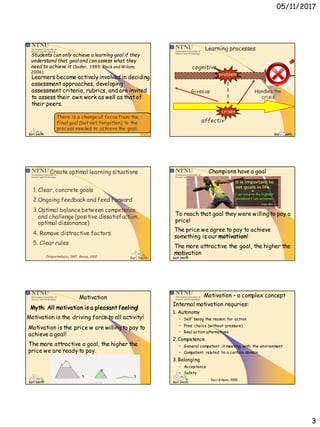
Students can only achieve a learning goal if they
understand that goal and can assess what they
need to achieve it (Sadler, 1989; Black and Wiliam,
2006).
Learners become actively involved in deciding
assessment approaches, developing
assessment criteria, rubrics, and are invited
to assess their own work as well as thatof
their peers.
There is a change of focusfrom the
final goal (but not forgotten) to the
process needed to achieve the goal.
Kari Smith
Learning processes
cognitive
affectiv
problem
crises
Handles the
crisis
Givesup
Kari Smith
Create optimal learning situations
1.Clear, concrete goals
2.Ongoing feedback and feed forward
3.Optimal balancebetween competence
and challenge(positive dissatisfaction,
optimal dissonance)
4. Remove distractive factors
5. Clear rules
Chiszentmihalyi, 1997, Knoop, 2002 Kari Smith
Champions have a goal
To reach that goal they were willing to pay a
price!
The price we agree to pay to achieve
something is our motivation!
The more attractive the goal, the higher the
motivation
Kari Smith
Motivation
Motivation is the driving force to all activity!
Motivation is the price w are willing to pay to
achieve a goal!
The more attractive a goal, the higher the
price we are ready to pay.
Myth: All motivation is a pleasantfeeling!
Kari Smith
Motivation – a complex concept
Internal motivation requries:
1. Autonomy
• Self being the reason for action
• Free choice (without pressure)
• Real action alternatives
2.Competence
• General competent in meeting with the environment
• Competent related to a certain domain
3.Belonging
• Acceptance
• Safety
Deci & Ryan, 2000
05/11/2017
4
Kari Smith
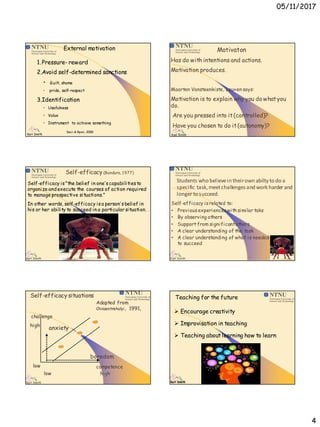
External motivation
1.Pressure- reward
2.Avoid self-determined sanctions
• Guilt, shame
• pride, self-respect
3.Identification
• Usefulness
• Value
• Instrument to achieve something
Deci & Ryan, 2000
Kari Smith
Motivaton
Has do with intentions and actions.
Motivation produces.
Maarten Vansteenkiste, Leuven says:
Motivation is to explain why you do whatyou
do.
Are you pressed into it(controlled)?
Have you chosen to do it(autonomy)?
Kari Smith
Self-efficacy is"the belief in one’scapabilitiesto
organize andexecute the courses of action required
to manage prospective situations."
In other words, self-efficacy isa person’sbelief in
his or her ability to succeed in a particular situation. .
Self-efficacy (Bandura, 1977)
Kari Smith
Students who believein theirown abilty to do a
specific task,meetchallengesand work harder and
longer to succeed.
Self-efficacy isrelated to:
• Previousexperienceswith similar taks
• By observing others
• Support from significantothers
• A clear understanding of the task
• A clear understanding of what is needed
to succeed
Kari Smith
Self-efficacy situations
competence
low
challenge
low
high
boredom
anxiety
Adapted from
Chiszentmihalyi, 1991,
high
Kari Smith
 Encourage creativity
 Improvisation in teaching
 Teaching aboutlearning how to learn
Teaching for the future
05/11/2017
5
Kari Smith
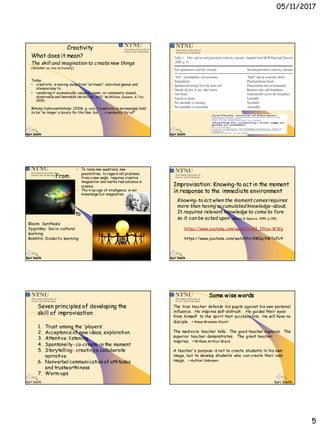
Creativity
What does it mean?
The skill and imagination to create new things
(Webster on-line dictionary)
Today
• creativity is moving away from “artiness”, individual genius and
idiosyncrasy to
• rendering it economically valuable, team- or community-based,
observable and learnable (McWilliam, 2007; McWilliam, Dawson, & Tan,
2009)
Mihalyi Csikszentmihalyi (2006, p. xviii,) ‘creativity is increasingly held
to be “no longer a luxury for the few, but . . . a necessity for all”
Kari Smith
Kari Smith
From
to
Bloom: Synthesis
Vygotsky: Socio-cultural
learning
Bakhtin: Dialectic learning
• To raise new questions, new
possibilities, to regard old problems
from a new angle, requires creative
imagination and marks real advance in
science.
• The true sign of intelligence is not
knowledge but imagination.
Kari Smith
Improvisation: Knowing-to actin the moment
in response to the immediate environment
Knowing-to act when the moment comesrequires
more than having accumulatedknowledge-about.
It requires relevant knowledge to come to fore
so it can be acted upon (Mason & Spence, 1999, p.139).
https://www.youtube.com/watch?v=4I_NYya-WWg
https://www.youtube.com/watch?v=9MQc9MTafU4
Kari Smith
Seven principles of developing the
skill of improvisation
1. Trust among the ‘players’
2. Acceptance of new ideas, exploration
3. Attentive listening
4. Spontaneity- co-create in the moment
5. Storytelling- creating a collaborate
narrative
6. Nonverbal communication of attitudes
and trustworthiness
7. Warm-ups
Kari Smith
The true teacher defends his pupils against his own personal
influence. He inspires self-distrust. He guides their eyes
from himself to the spirit that quickens him. He will have no
disciple. ~Amos Bronson Alcott
The mediocre teacher tells. The good teacher explains. The
superior teacher demonstrates. The great teacher
inspires. ~William Arthur Ward
A teacher's purpose is not to create students in his own
image, but to develop students who can create their own
image. ~Author Unknown
Some wise words

What is learning and how to support it? prof. Kari Smith

  • 1.
    05/11/2017 1 Kari Smith What isLearning? How can we supportit? Professor Dr. Kari Smith Slamit 7 29 Oct. - 3 Nov. 2017 Zagreb, Croatia Kari Smith Outline of my talk  What islearning?  Learning processes- cognitive  Self regulation  Goal setting  Learning processes- affective  Motivation  Self-efficacy  How can feedback support learning  Teaching for the future  Conclusions-by wise people Kari Smith When do you know thatyou are learning? How can you define your own learning? Please share a significant learning experience with somebody else. Learning Conceptions of Learning Learning asthe intake of information (knowledge is fixed, transmitted from the teacher to the learner) Learning asknowledge building (knowledge is personal, to be constructed by the learner. This can also take place in dialogue with others. Learner is responsible. Teacher is a coach. Learning as utilizing knowledge Kari Smith Kari Smith Theories of learning •Behaviorist (small unities, hierarchy, knowledge can be measured) •Cognitive- constructive (individual, learning strategies, meta-cognition, knowledge is constructed by the learner) •Socio- cultural (interactive, dialogue, learning together with others, knowledge isconstructed in dialogueswith others) Kari Smith I will notinstructmy students until they have really tried hard, butfailed to understand. He who learns, butdoes notthink is lost. He who thinks, butdoes not learn, is in greatdanger. Some wise words Confucius (551-479 BCE)
  • 2.
    05/11/2017 2 Kari Smith Learner types(Dweck, 2000 among others) P erception of Intelligence Entity, static Dynamic External motivation Internal motivation C ontrol A utonomy P erformance goals Learning goals P raise Reality A void challenges Face challenges Decrease in achievements Increase in achievements Self-regulation “Self-regulated learning is an active constructive process whereby learners set goals for their learning and monitor, regulate, and control their cognition, motivation, and behaviour, guided and constrained by their goals and the contextual features of the environment” (Pintrich & Zusho,2002, p. 64) Kari Smith Self-regulated learning Three phases: 1. forethoughts • Goals, expectations, strategy planning, assessment of own competence 2.performance, volitional control • during the learning activity, choice of strategies 3.Reflection • Critical analyses and evaluation This can be learned! Zimmerman, 2000 Kari Smith Goal setting Goal setting means creating a dissonance between the current competence and a wanted future competence. When learners are goal oriented, want to achieve a goal, the dissonance isexperiencedas a positive dissatisfaction with the current competence whichmotivates goal oriented actions (Robinson, 2007) Goals learners set: Performance goals- getting the highest grade Learning goals - understanding, doing something better Pintrich, 2002. Kari Smith Kari Smith Goals in learning situations: •Pleasure •Grades •Certificate •Educational opportunities •Job opportunities •Self-respect •Social acceptance Price paid in: •Time •Effort •Money •Frustration •Boredom •Failure If the price is too high, learners do not pay!
  • 3.
    05/11/2017 3 Kari Smith Students canonly achieve a learning goal if they understand that goal and can assess what they need to achieve it (Sadler, 1989; Black and Wiliam, 2006). Learners become actively involved in deciding assessment approaches, developing assessment criteria, rubrics, and are invited to assess their own work as well as thatof their peers. There is a change of focusfrom the final goal (but not forgotten) to the process needed to achieve the goal. Kari Smith Learning processes cognitive affectiv problem crises Handles the crisis Givesup Kari Smith Create optimal learning situations 1.Clear, concrete goals 2.Ongoing feedback and feed forward 3.Optimal balancebetween competence and challenge(positive dissatisfaction, optimal dissonance) 4. Remove distractive factors 5. Clear rules Chiszentmihalyi, 1997, Knoop, 2002 Kari Smith Champions have a goal To reach that goal they were willing to pay a price! The price we agree to pay to achieve something is our motivation! The more attractive the goal, the higher the motivation Kari Smith Motivation Motivation is the driving force to all activity! Motivation is the price w are willing to pay to achieve a goal! The more attractive a goal, the higher the price we are ready to pay. Myth: All motivation is a pleasantfeeling! Kari Smith Motivation – a complex concept Internal motivation requries: 1. Autonomy • Self being the reason for action • Free choice (without pressure) • Real action alternatives 2.Competence • General competent in meeting with the environment • Competent related to a certain domain 3.Belonging • Acceptance • Safety Deci & Ryan, 2000
  • 4.
    05/11/2017 4 Kari Smith External motivation 1.Pressure-reward 2.Avoid self-determined sanctions • Guilt, shame • pride, self-respect 3.Identification • Usefulness • Value • Instrument to achieve something Deci & Ryan, 2000 Kari Smith Motivaton Has do with intentions and actions. Motivation produces. Maarten Vansteenkiste, Leuven says: Motivation is to explain why you do whatyou do. Are you pressed into it(controlled)? Have you chosen to do it(autonomy)? Kari Smith Self-efficacy is"the belief in one’scapabilitiesto organize andexecute the courses of action required to manage prospective situations." In other words, self-efficacy isa person’sbelief in his or her ability to succeed in a particular situation. . Self-efficacy (Bandura, 1977) Kari Smith Students who believein theirown abilty to do a specific task,meetchallengesand work harder and longer to succeed. Self-efficacy isrelated to: • Previousexperienceswith similar taks • By observing others • Support from significantothers • A clear understanding of the task • A clear understanding of what is needed to succeed Kari Smith Self-efficacy situations competence low challenge low high boredom anxiety Adapted from Chiszentmihalyi, 1991, high Kari Smith  Encourage creativity  Improvisation in teaching  Teaching aboutlearning how to learn Teaching for the future
  • 5.
    05/11/2017 5 Kari Smith Creativity What doesit mean? The skill and imagination to create new things (Webster on-line dictionary) Today • creativity is moving away from “artiness”, individual genius and idiosyncrasy to • rendering it economically valuable, team- or community-based, observable and learnable (McWilliam, 2007; McWilliam, Dawson, & Tan, 2009) Mihalyi Csikszentmihalyi (2006, p. xviii,) ‘creativity is increasingly held to be “no longer a luxury for the few, but . . . a necessity for all” Kari Smith Kari Smith From to Bloom: Synthesis Vygotsky: Socio-cultural learning Bakhtin: Dialectic learning • To raise new questions, new possibilities, to regard old problems from a new angle, requires creative imagination and marks real advance in science. • The true sign of intelligence is not knowledge but imagination. Kari Smith Improvisation: Knowing-to actin the moment in response to the immediate environment Knowing-to act when the moment comesrequires more than having accumulatedknowledge-about. It requires relevant knowledge to come to fore so it can be acted upon (Mason & Spence, 1999, p.139). https://www.youtube.com/watch?v=4I_NYya-WWg https://www.youtube.com/watch?v=9MQc9MTafU4 Kari Smith Seven principles of developing the skill of improvisation 1. Trust among the ‘players’ 2. Acceptance of new ideas, exploration 3. Attentive listening 4. Spontaneity- co-create in the moment 5. Storytelling- creating a collaborate narrative 6. Nonverbal communication of attitudes and trustworthiness 7. Warm-ups Kari Smith The true teacher defends his pupils against his own personal influence. He inspires self-distrust. He guides their eyes from himself to the spirit that quickens him. He will have no disciple. ~Amos Bronson Alcott The mediocre teacher tells. The good teacher explains. The superior teacher demonstrates. The great teacher inspires. ~William Arthur Ward A teacher's purpose is not to create students in his own image, but to develop students who can create their own image. ~Author Unknown Some wise words