Writing Skill For
Executives Branding

Kresnayana Yahya, M. Sc
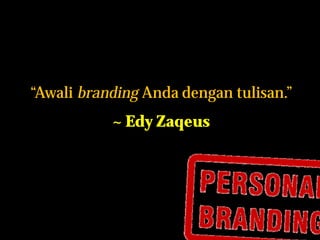
“Awali branding Anda dengan tulisan.”
~ Edy Zaqeus
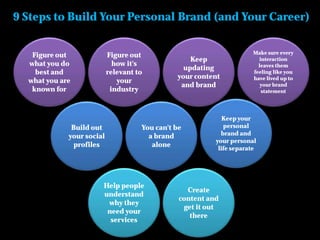
9 Steps to Build Your Personal Brand (and Your Career)
Figure out
what you do
best and
what you are
known for

Figure out
how it's
relevant to
your
industry

Build out
your social
profiles

Keep
updating
your content
and brand

You can't be
a brand
alone

Help people
understand
why they
need your
services

Make sure every
interaction
leaves them
feeling like you
have lived up to
your brand
statement

Keep your
personal
brand and
your personal
life separate

Create
content and
get it out
there
Last Words…
A Personal Brand Must Sincerely Care
about Achieving Destiny! “Success
means never letting the competition
define you. Instead you have to define
yourself based on a point of view you
care deeply about.”
Tom Chappell, CEO, Tom’s of Maine
WhoAmI.com

Marketing yourself and your skills online , on time and every where

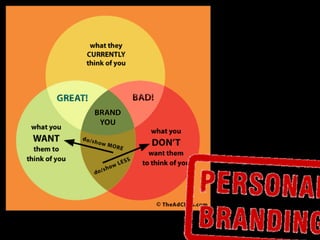
Are you a BRAND
OBJECTIVES
Create Awareness On Personal Branding
Take Home Ideas You Can Implement
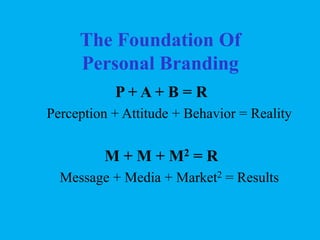
The Foundation Of
Personal Branding
P+A+ B = R
Perception + Attitude + Behavior = Reality

M + M + M2 = R
Message + Media + Market2 = Results
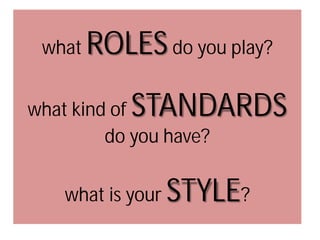
what

ROLES do you play?
STANDARDS

what kind of
do you have?
what is your

STYLE?
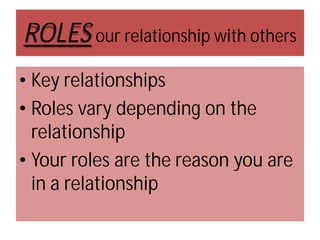
ROLES our relationship with others
• Key relationships
• Roles vary depending on the
relationship
• Your roles are the reason you are
in a relationship
Our ROLES with others in business
• What a brand does for you.
• The customer is the most important
relationship in a business.
• The customer sets the bar for the
relationship but the company sets
the expectations.
Example of ROLES
• Father/Mother
• Daughter/Son
• Sister/Brother
• Student
• Employee
ROLES vs. JOBS
• Your role is defined by what you
do for the customer.
• Your job is defined by what you
do.
• Roles in jobs can change
depending on the customer.
ROLES and Responsibilities
• After you define a role, responsibilities
are implied.
• Figuring out the responsibilities and
keeping up with them is part of a brand
role.
• Your brand is based on how effectively
you meet your responsibilities and live
up to your roles.
STANDARDS as modifiers.
• It’s not who you are, but what you
do and how you do it.
• Sometimes overlaps with style.
• How you do things can shape the
nature of the relationship with
others i.e. consumers, subordinates,
family, community.
Perception
• Perception becomes reality.
• Want to be perceived as a detail oriented
individual, then the actions must speak for
themselves.
• We set our standards for how we want the
relationship to be seen, and understood.
• Perception is built through our actions not
intentions.
Judging by STANDARDS
• People make judgment of your actions.
Not only what you do, but also how well
you choose to do it.
• One must invest time and effort to create
a standard for themselves.
Ex: You want your boss and coworkers to rely on you for certain
tasks requiring a specific level of expertise. You must have
demonstrated that quality by placing enough research time
and effort to acquiring that level of experience.
Examples of STANDARDS
• Reliably efficient - Creatively undisciplined
• Non-judgmental listener - Assertively
opinionated
• Proficient net-worker - Focused on a close
circle of friends
• Open-minded - Orthodox
• Unfocused - Detail Oriented
• Situational Values - Consistent Values
Stick by your guns.
• Can’t please everyone.
• Focus on what you hold true and the
message you want to send.
• Standards could be positive and
attractive to one and the complete
opposite to another.
• Standards vary depending on the nature
of the relationship.
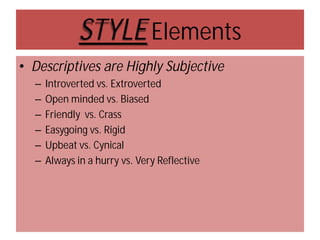
STYLE Elements
• Descriptives are Highly Subjective
–
–
–
–
–
–

Introverted vs. Extroverted
Open minded vs. Biased
Friendly vs. Crass
Easygoing vs. Rigid
Upbeat vs. Cynical
Always in a hurry vs. Very Reflective
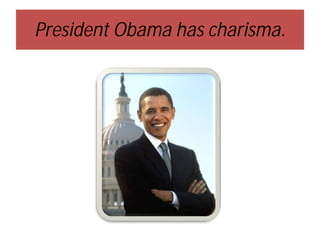
It’s not uncommon for
people to describe the
brands in their lives
strictly in terms of style.
President Obama has charisma.
Personal Brands
The Next Revolution!

(manufacturing revolution)
Get The Edge!
What Words, Phrases,
Emotions Do You Own?
Be An Orange!
Stand Out In The Barrel
Of Apples
Be An Sunkist Orange
BRAND MANAGEMENT TOOLS
GUIDELINES: have standards that will be used
as your manifesto

TRAINING: improve yourself
SPECIAL EVENTS: promote and create special
focus on your brand dynamics

REWARD AND RECOGNITION: don’t take
things for granted

… QUESTION, PROBE, EVALUATE,
CHALLENGE…
BRAND MOMENTS are
the times when your unique
combination of roles,

standards, and style will be
put to test.

YOUR BRAND WILL SHINE
OR FADE.
PERSONAL BRAND

The
you create will become a dynamic
presence in your life. But to remain
strong, it must be renewed everyday. It
must become a part of everything you
do.

BRANDS are relationships. They
reflect values.
“Success Is The Progression
Of A Worthy Ideal”
-- Earl Nightingale
Personal Branding
vs.
Personal Development
Skills = Possibilities
Take inventory of what YOU offer
— Major skills and abilities
— Social, technical or field-specific skills
— Important personal attributes (hard-working,

trustworthy, results-oriented, decisive)

— Ask: Where have I successfully used these abilities,

skills and attributes?
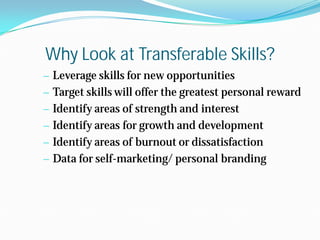
Why Look at Transferable Skills?
— Leverage skills for new opportunities
— Target skills will offer the greatest personal reward
— Identify areas of strength and interest
— Identify areas for growth and development
— Identify areas of burnout or dissatisfaction
— Data for self-marketing/ personal branding
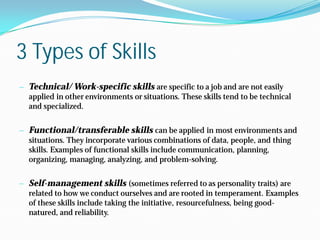
3 Types of Skills
— Technical/ Work-specific skills are specific to a job and are not easily

applied in other environments or situations. These skills tend to be technical
and specialized.

— Functional/transferable skills can be applied in most environments and
situations. They incorporate various combinations of data, people, and thing
skills. Examples of functional skills include communication, planning,
organizing, managing, analyzing, and problem-solving.

— Self-management skills (sometimes referred to as personality traits) are
related to how we conduct ourselves and are rooted in temperament. Examples
of these skills include taking the initiative, resourcefulness, being goodnatured, and reliability.
Competency Curve
Rise From The
“Sea of Sameness”
(vague vs. specialized)
“Its not what you are that counts,
but what people think you are.”
-- Joseph Kennedy
The Reality
Its NOT That You Have To Think
Like A CEO; Its That you HAVE To
Be Perceived As A CEO
(Jack Welch to Hugh Heffner)
Image Is What They See,
A Brand Is What They Think &
Feel, It Conveys Ownership!
(attract / repel)
Personal Brand?
The unfair advantage every individual has
by capturing the value of our Personal
Characteristics, Attributes and Life
Experiences in a package that we effectively
communicate to our audience, leveraging the
specific ‘use value’ that comes from our
Unique TalentTM. (intrinsic genius)
What Does a Brand Represent?
• Positive Expectation (benefits)
• Promise to your Market
• Preferred (privileged) Position
• Owns Equity of the Mind
• Highest Level of TRUST
• Unique (cannot be copied)
Objectives
n
n

n

What is Branding? Understand its
importance in the fullest sense.
Understand your personal brand
promise and how your distinct talent
contributes to the strategic direction of
your team and organization.
Design your personal brand to better
distinguish your talent and contribution
and to deliver inspired performance.

54
Experiences
Equate Credibility
Unique Experiences
• Specialized Knowledge Creates a
Higher Use Value
(specialist vs. generalist)
• Ownership, YOU are the
Undisputed Authority
Wheaties
The Breakfast Of Champions
Vs.
Special K
One Word
Branding is Summed-up
as
TRUST
Reasons Why
1. Trust Person
2. Respect Person
3. Respect Company
4. Product Benefits
5. Product Price
+ 11. Like-ability
Managing Your Brand
Your Personal
Communication
& Positioning
3M’s
Message + Media + Market2
= Powerful Brand!
Why Personal Brands Fail
• Ignorance, People FAIL to recognize they are a Brand!
• Try to be All Things to all people [Need Laser Focus]
• Fail to tap into their True Passion/Unique Talent in Life
• Professionals don’t realize their External Perception
• Lack of consistency in behavior and image portrayed
• Right Message, Wrong Market!
• Fail to recognize Competitors Brand [Emotion]
• Fail to have a Mentor to Advise them (lone wolf)
• Fail to Reposition properly against another brand
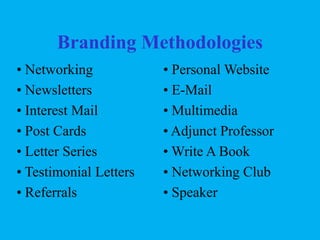
Branding Methodologies
• Networking
• Newsletters
• Interest Mail
• Post Cards
• Letter Series
• Testimonial Letters
• Referrals

• Personal Website
• E-Mail
• Multimedia
• Adjunct Professor
• Write A Book
• Networking Club
• Speaker
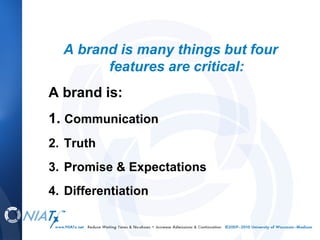
A brand is many things but four
features are critical:
A brand is:
1. Communication
2. Truth
3. Promise & Expectations
4. Differentiation
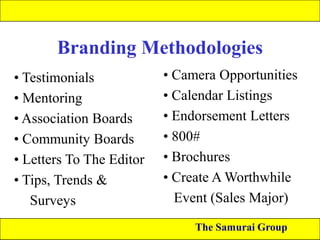
Branding Methodologies
• Testimonials
• Mentoring
• Association Boards
• Community Boards
• Letters To The Editor
• Tips, Trends &
Surveys

• Camera Opportunities
• Calendar Listings
• Endorsement Letters
• 800#
• Brochures
• Create A Worthwhile
Event (Sales Major)
The Samurai Group
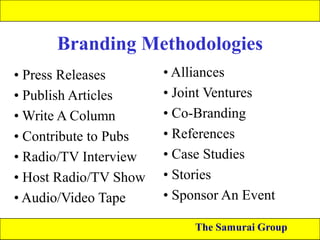
Branding Methodologies
• Press Releases
• Publish Articles
• Write A Column
• Contribute to Pubs
• Radio/TV Interview
• Host Radio/TV Show
• Audio/Video Tape

• Alliances
• Joint Ventures
• Co-Branding
• References
• Case Studies
• Stories
• Sponsor An Event
The Samurai Group
Great brands are characterized by:

Their ability to
Communicate
Kupas bisnis personal branding

Kupas bisnis personal branding

  • 1.
    Writing Skill For ExecutivesBranding Kresnayana Yahya, M. Sc
  • 3.
    “Awali branding Andadengan tulisan.” ~ Edy Zaqeus
  • 5.
    9 Steps toBuild Your Personal Brand (and Your Career) Figure out what you do best and what you are known for Figure out how it's relevant to your industry Build out your social profiles Keep updating your content and brand You can't be a brand alone Help people understand why they need your services Make sure every interaction leaves them feeling like you have lived up to your brand statement Keep your personal brand and your personal life separate Create content and get it out there
  • 18.
    Last Words… A PersonalBrand Must Sincerely Care about Achieving Destiny! “Success means never letting the competition define you. Instead you have to define yourself based on a point of view you care deeply about.” Tom Chappell, CEO, Tom’s of Maine
  • 19.
    WhoAmI.com Marketing yourself andyour skills online , on time and every where Are you a BRAND
  • 20.
    OBJECTIVES Create Awareness OnPersonal Branding Take Home Ideas You Can Implement
  • 21.
    The Foundation Of PersonalBranding P+A+ B = R Perception + Attitude + Behavior = Reality M + M + M2 = R Message + Media + Market2 = Results
  • 22.
    what ROLES do youplay? STANDARDS what kind of do you have? what is your STYLE?
  • 23.
    ROLES our relationshipwith others • Key relationships • Roles vary depending on the relationship • Your roles are the reason you are in a relationship
  • 24.
    Our ROLES withothers in business • What a brand does for you. • The customer is the most important relationship in a business. • The customer sets the bar for the relationship but the company sets the expectations.
  • 25.
    Example of ROLES •Father/Mother • Daughter/Son • Sister/Brother • Student • Employee
  • 26.
    ROLES vs. JOBS •Your role is defined by what you do for the customer. • Your job is defined by what you do. • Roles in jobs can change depending on the customer.
  • 27.
    ROLES and Responsibilities •After you define a role, responsibilities are implied. • Figuring out the responsibilities and keeping up with them is part of a brand role. • Your brand is based on how effectively you meet your responsibilities and live up to your roles.
  • 28.
    STANDARDS as modifiers. •It’s not who you are, but what you do and how you do it. • Sometimes overlaps with style. • How you do things can shape the nature of the relationship with others i.e. consumers, subordinates, family, community.
  • 29.
    Perception • Perception becomesreality. • Want to be perceived as a detail oriented individual, then the actions must speak for themselves. • We set our standards for how we want the relationship to be seen, and understood. • Perception is built through our actions not intentions.
  • 30.
    Judging by STANDARDS •People make judgment of your actions. Not only what you do, but also how well you choose to do it. • One must invest time and effort to create a standard for themselves. Ex: You want your boss and coworkers to rely on you for certain tasks requiring a specific level of expertise. You must have demonstrated that quality by placing enough research time and effort to acquiring that level of experience.
  • 31.
    Examples of STANDARDS •Reliably efficient - Creatively undisciplined • Non-judgmental listener - Assertively opinionated • Proficient net-worker - Focused on a close circle of friends • Open-minded - Orthodox • Unfocused - Detail Oriented • Situational Values - Consistent Values
  • 32.
    Stick by yourguns. • Can’t please everyone. • Focus on what you hold true and the message you want to send. • Standards could be positive and attractive to one and the complete opposite to another. • Standards vary depending on the nature of the relationship.
  • 33.
    STYLE Elements • Descriptivesare Highly Subjective – – – – – – Introverted vs. Extroverted Open minded vs. Biased Friendly vs. Crass Easygoing vs. Rigid Upbeat vs. Cynical Always in a hurry vs. Very Reflective
  • 34.
    It’s not uncommonfor people to describe the brands in their lives strictly in terms of style.
  • 35.
  • 36.
    Personal Brands The NextRevolution! (manufacturing revolution)
  • 37.
    Get The Edge! WhatWords, Phrases, Emotions Do You Own?
  • 38.
    Be An Orange! StandOut In The Barrel Of Apples Be An Sunkist Orange
  • 39.
    BRAND MANAGEMENT TOOLS GUIDELINES:have standards that will be used as your manifesto TRAINING: improve yourself SPECIAL EVENTS: promote and create special focus on your brand dynamics REWARD AND RECOGNITION: don’t take things for granted … QUESTION, PROBE, EVALUATE, CHALLENGE…
  • 40.
    BRAND MOMENTS are thetimes when your unique combination of roles, standards, and style will be put to test. YOUR BRAND WILL SHINE OR FADE.
  • 41.
    PERSONAL BRAND The you createwill become a dynamic presence in your life. But to remain strong, it must be renewed everyday. It must become a part of everything you do. BRANDS are relationships. They reflect values.
  • 42.
    “Success Is TheProgression Of A Worthy Ideal” -- Earl Nightingale
  • 43.
  • 44.
  • 45.
    Take inventory ofwhat YOU offer — Major skills and abilities — Social, technical or field-specific skills — Important personal attributes (hard-working, trustworthy, results-oriented, decisive) — Ask: Where have I successfully used these abilities, skills and attributes?
  • 46.
    Why Look atTransferable Skills? — Leverage skills for new opportunities — Target skills will offer the greatest personal reward — Identify areas of strength and interest — Identify areas for growth and development — Identify areas of burnout or dissatisfaction — Data for self-marketing/ personal branding
  • 47.
    3 Types ofSkills — Technical/ Work-specific skills are specific to a job and are not easily applied in other environments or situations. These skills tend to be technical and specialized. — Functional/transferable skills can be applied in most environments and situations. They incorporate various combinations of data, people, and thing skills. Examples of functional skills include communication, planning, organizing, managing, analyzing, and problem-solving. — Self-management skills (sometimes referred to as personality traits) are related to how we conduct ourselves and are rooted in temperament. Examples of these skills include taking the initiative, resourcefulness, being goodnatured, and reliability.
  • 48.
    Competency Curve Rise FromThe “Sea of Sameness” (vague vs. specialized)
  • 49.
    “Its not whatyou are that counts, but what people think you are.” -- Joseph Kennedy
  • 50.
    The Reality Its NOTThat You Have To Think Like A CEO; Its That you HAVE To Be Perceived As A CEO (Jack Welch to Hugh Heffner)
  • 51.
    Image Is WhatThey See, A Brand Is What They Think & Feel, It Conveys Ownership! (attract / repel)
  • 52.
    Personal Brand? The unfairadvantage every individual has by capturing the value of our Personal Characteristics, Attributes and Life Experiences in a package that we effectively communicate to our audience, leveraging the specific ‘use value’ that comes from our Unique TalentTM. (intrinsic genius)
  • 53.
    What Does aBrand Represent? • Positive Expectation (benefits) • Promise to your Market • Preferred (privileged) Position • Owns Equity of the Mind • Highest Level of TRUST • Unique (cannot be copied)
  • 54.
    Objectives n n n What is Branding?Understand its importance in the fullest sense. Understand your personal brand promise and how your distinct talent contributes to the strategic direction of your team and organization. Design your personal brand to better distinguish your talent and contribution and to deliver inspired performance. 54
  • 55.
  • 56.
    Unique Experiences • SpecializedKnowledge Creates a Higher Use Value (specialist vs. generalist) • Ownership, YOU are the Undisputed Authority
  • 57.
    Wheaties The Breakfast OfChampions Vs. Special K
  • 58.
    One Word Branding isSummed-up as TRUST
  • 59.
    Reasons Why 1. TrustPerson 2. Respect Person 3. Respect Company 4. Product Benefits 5. Product Price + 11. Like-ability
  • 60.
    Managing Your Brand YourPersonal Communication & Positioning
  • 61.
    3M’s Message + Media+ Market2 = Powerful Brand!
  • 62.
    Why Personal BrandsFail • Ignorance, People FAIL to recognize they are a Brand! • Try to be All Things to all people [Need Laser Focus] • Fail to tap into their True Passion/Unique Talent in Life • Professionals don’t realize their External Perception • Lack of consistency in behavior and image portrayed • Right Message, Wrong Market! • Fail to recognize Competitors Brand [Emotion] • Fail to have a Mentor to Advise them (lone wolf) • Fail to Reposition properly against another brand
  • 63.
    Branding Methodologies • Networking •Newsletters • Interest Mail • Post Cards • Letter Series • Testimonial Letters • Referrals • Personal Website • E-Mail • Multimedia • Adjunct Professor • Write A Book • Networking Club • Speaker
  • 64.
    A brand ismany things but four features are critical: A brand is: 1. Communication 2. Truth 3. Promise & Expectations 4. Differentiation
  • 65.
    Branding Methodologies • Testimonials •Mentoring • Association Boards • Community Boards • Letters To The Editor • Tips, Trends & Surveys • Camera Opportunities • Calendar Listings • Endorsement Letters • 800# • Brochures • Create A Worthwhile Event (Sales Major) The Samurai Group
  • 66.
    Branding Methodologies • PressReleases • Publish Articles • Write A Column • Contribute to Pubs • Radio/TV Interview • Host Radio/TV Show • Audio/Video Tape • Alliances • Joint Ventures • Co-Branding • References • Case Studies • Stories • Sponsor An Event The Samurai Group
  • 67.
    Great brands arecharacterized by: Their ability to Communicate