Australian Islamic College –
         Dianella
      By Year 10 Girls
As Salaam U Alaikum

We begin: ‘In the name of God, Most Gracious, Most
  Merciful’.
We praise God and Glorify Him.
To all the teachers and students, we greet you with the
  Islamic greeting of ‘As Salaam U Alaikum’ which
  means ‘Peace Be Upon You All’.
We, the students of Australian Islamic College, Dianella
  Campus, are greatly honored to be here and to present
  to you a very brief outline of our religion – ISLAM.
What is Islam?

Islam means: “ Total Submission to The Will Of God
  – One God”.
We are Muslims, our religion is called ISLAM and our
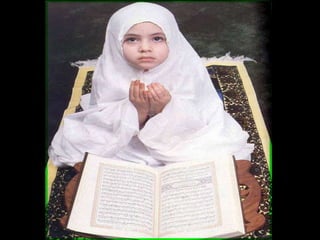
  Holy Book is called the Quran.
The language of the Quran is written in Arabic, we
  use the word: “Allah” meaning ONE GOD.
Islam is a religion:
                        of mercy
                        of guidance
                        of rationality
                        of love and kindness
                        of knowledge and wisdom
                        of high morality
                        of justice


Islam nurtures the soul of man through acts of
worship.
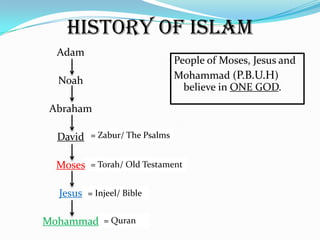
History of islam
  Adam
                              People of Moses, Jesus and
  Noah                        Mohammad (P.B.U.H)
                                believe in ONE GOD.

 Abraham

  David = Zabur/ The Psalms

  Moses = Torah/ Old Testament

  Jesus = Injeel/ Bible

Mohammad = Quran
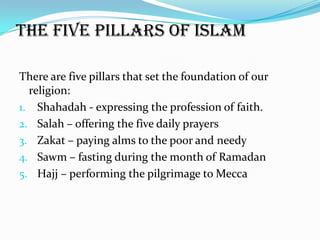
The five pillars of Islam

There are five pillars that set the foundation of our
  religion:
1. Shahadah - expressing the profession of faith.
2. Salah – offering the five daily prayers
3. Zakat – paying alms to the poor and needy
4. Sawm – fasting during the month of Ramadan
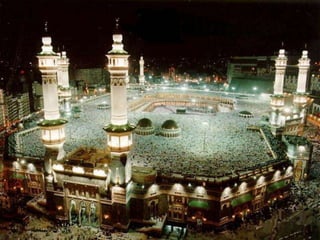
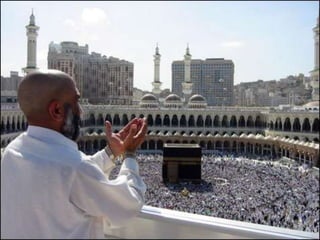
5. Hajj – performing the pilgrimage to Mecca
SHAHADAH(faith)
The first pillar - Shahadah
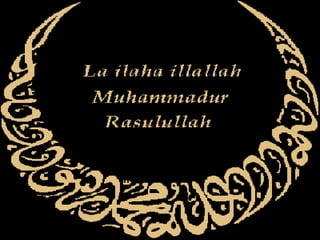
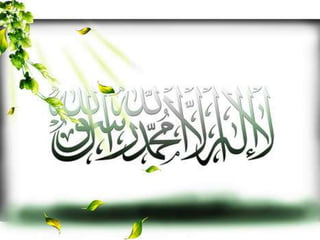
‘La illaha illallah, Muhammad Rasulullah’ means
  ‘There is no God but Allah and Muhammad is
  His Messenger’

 This is a sentence bearing witness to the
 oneness and unity of God and to the acceptance
 of Prophet Muhammad (PBUH) as God’s last
 messenger.

 By uttering these words with acceptance and
 sincerity, one becomes a Muslim.
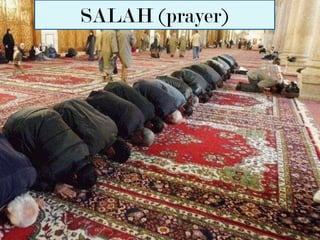
SALAH (prayer)
The second pillar - Salah
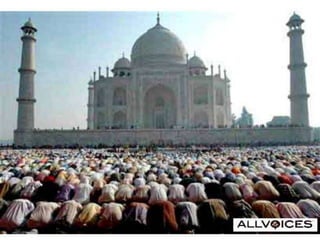
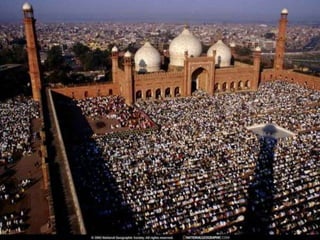
 Salah is the central act of worship for all
  Muslims and is performed 5 times in a day -
  before dawn, at midday, late afternoon, after
  sunset and in the late evening.

 Prayer is a time to thank God for His blessings
  and ask Him for forgiveness, guidance and
  protection.

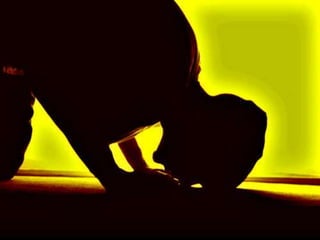
 Each step in the prayer expresses praise,
  adoration and submission to God.
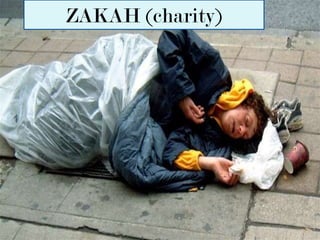
ZAKAH (charity)
The third pillar - Zakat
 Muslims are obliged to pay 2.5% of their wealth
 once in a year.

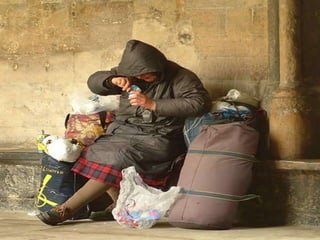
 Islam commanded the payment of Zakat, in
 order to prevent human beings from becoming
 selfish and greedy over their increasing wealth,
 and looking down upon the poor people.

 The distribution of alms decreases the gap
 between the rich and the poor, pleases the less
 fortunate ones and cleanses man from jealousy,
 pride, arrogance and greed.
SAWM (fasting)
The fourth pillar - Sawm
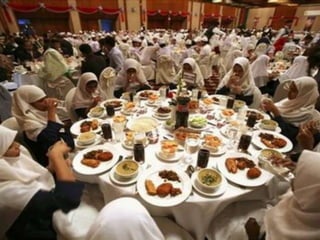
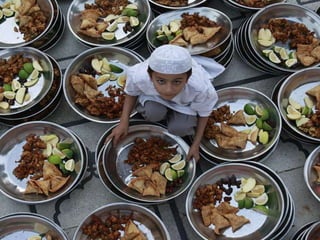
 Fasting takes place in Ramadan, the 9th month of the
  Islamic calendar.

 The fast begins from dawn until sunset; within this
  period we don’t eat nor drink anything.

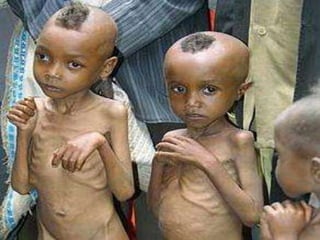
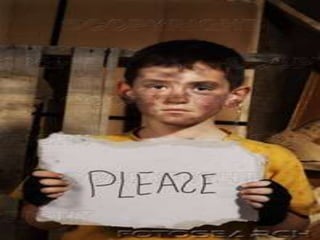
 The aim of fasting is to be grateful for all the things that
  God has blessed us with and feel for the poor people
  around the world, who suffer from lack of food.

 This month develops our courage and resistance in
  times of hardships and calamities; and we can attain
  high qualities such as patience, strong will and
  discipline.
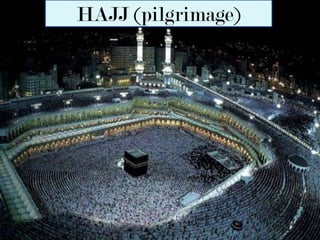
HAJJ (pilgrimage)
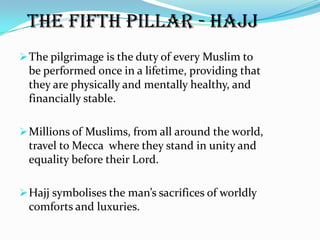
The fifth pillar - Hajj
 The pilgrimage is the duty of every Muslim to
 be performed once in a lifetime, providing that
 they are physically and mentally healthy, and
 financially stable.

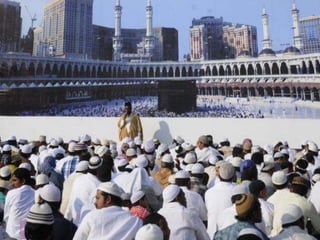
 Millions of Muslims, from all around the world,
 travel to Mecca where they stand in unity and
 equality before their Lord.

 Hajj symbolises the man’s sacrifices of worldly
 comforts and luxuries.
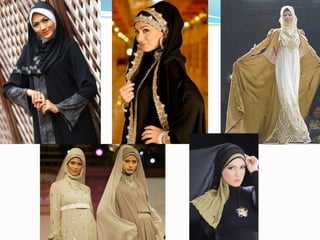
Islamic Clothing
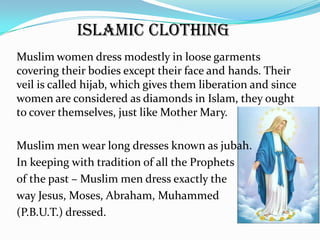
Muslim women dress modestly in loose garments
covering their bodies except their face and hands. Their
veil is called hijab, which gives them liberation and since
women are considered as diamonds in Islam, they ought
to cover themselves, just like Mother Mary.

Muslim men wear long dresses known as jubah.
In keeping with tradition of all the Prophets
of the past – Muslim men dress exactly the
way Jesus, Moses, Abraham, Muhammed
(P.B.U.T.) dressed.
Important Religious Leaders
The only important leader of Muslims is Prophet Muhammad
(P.B.U.H), who perfected Islam by displaying high morals and
values, and by being an exceptional role model with such humility
and modesty.

Despite the fact that he was illiterate, he brought the Holy Quran,
which till today has never been and will never be changed. The
Quran itself is a miracle, for it is the true words of God passed
down as a guidance for mankind via Angel Gabriel to the Prophet
(P.B.U.H).

The Holy Quran explains the entire universe in immense detail,
from the creation of mankind to the laws and regulations in
society. The Holy Quran also teaches us about living in harmony
and peace with everyone, showing great respect, honesty, love and
kindness towards one another.
the story on kindness
One of the outstanding characteristics of the Prophet
(P.B.U.H) was his kindness –

The Prophet had a Jewish neighbour. Everyday the neighbour
would throw his garbage at the Prophet’s door! Then, one
day, the garbage stopped appearing. The Prophet wondered
why and asked people about what had happened to his
neighbour. He was told that the neighbour was sick, in bed.
So, the Prophet went and visited his Jewish neighbour to
make sure he’s ok and to wish him well. The Jewish
neighbour was so touched that he later converted to Islam.
Festivals and Celebrations
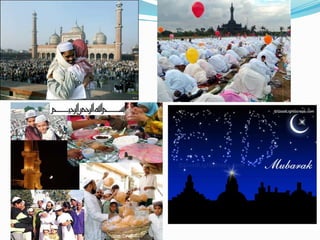
Eid-ul-Fitr - After 30 days of fasting, Muslims celebrate
  Eid-ul-Fitr, which is a day of celebration to signify the end
  of the holy month of Ramadan. Muslims visit their family
  and friends, and pay charity to the poor and needy.

Eid-ul-Adha - At the end of the Hajj (annual pilgrimage to
  Mecca), Muslims throughout the world celebrate the
  holiday of Eid al-Adha (Festival of Sacrifice) to
  commemorate the trials and triumphs of the Prophet
  Abraham.
THANK YOU
What is islam

What is islam

  • 1.
    Australian Islamic College– Dianella By Year 10 Girls
  • 2.
    As Salaam UAlaikum We begin: ‘In the name of God, Most Gracious, Most Merciful’. We praise God and Glorify Him. To all the teachers and students, we greet you with the Islamic greeting of ‘As Salaam U Alaikum’ which means ‘Peace Be Upon You All’. We, the students of Australian Islamic College, Dianella Campus, are greatly honored to be here and to present to you a very brief outline of our religion – ISLAM.
  • 3.
    What is Islam? Islammeans: “ Total Submission to The Will Of God – One God”. We are Muslims, our religion is called ISLAM and our Holy Book is called the Quran. The language of the Quran is written in Arabic, we use the word: “Allah” meaning ONE GOD.
  • 4.
    Islam is areligion:  of mercy  of guidance  of rationality  of love and kindness  of knowledge and wisdom  of high morality  of justice Islam nurtures the soul of man through acts of worship.
  • 5.
    History of islam Adam People of Moses, Jesus and Noah Mohammad (P.B.U.H) believe in ONE GOD. Abraham David = Zabur/ The Psalms Moses = Torah/ Old Testament Jesus = Injeel/ Bible Mohammad = Quran
  • 6.
    The five pillarsof Islam There are five pillars that set the foundation of our religion: 1. Shahadah - expressing the profession of faith. 2. Salah – offering the five daily prayers 3. Zakat – paying alms to the poor and needy 4. Sawm – fasting during the month of Ramadan 5. Hajj – performing the pilgrimage to Mecca
  • 7.
  • 8.
    The first pillar- Shahadah ‘La illaha illallah, Muhammad Rasulullah’ means ‘There is no God but Allah and Muhammad is His Messenger’  This is a sentence bearing witness to the oneness and unity of God and to the acceptance of Prophet Muhammad (PBUH) as God’s last messenger.  By uttering these words with acceptance and sincerity, one becomes a Muslim.
  • 13.
  • 14.
    The second pillar- Salah  Salah is the central act of worship for all Muslims and is performed 5 times in a day - before dawn, at midday, late afternoon, after sunset and in the late evening.  Prayer is a time to thank God for His blessings and ask Him for forgiveness, guidance and protection.  Each step in the prayer expresses praise, adoration and submission to God.
  • 17.
  • 18.
    The third pillar- Zakat  Muslims are obliged to pay 2.5% of their wealth once in a year.  Islam commanded the payment of Zakat, in order to prevent human beings from becoming selfish and greedy over their increasing wealth, and looking down upon the poor people.  The distribution of alms decreases the gap between the rich and the poor, pleases the less fortunate ones and cleanses man from jealousy, pride, arrogance and greed.
  • 22.
  • 23.
    The fourth pillar- Sawm  Fasting takes place in Ramadan, the 9th month of the Islamic calendar.  The fast begins from dawn until sunset; within this period we don’t eat nor drink anything.  The aim of fasting is to be grateful for all the things that God has blessed us with and feel for the poor people around the world, who suffer from lack of food.  This month develops our courage and resistance in times of hardships and calamities; and we can attain high qualities such as patience, strong will and discipline.
  • 27.
  • 28.
    The fifth pillar- Hajj  The pilgrimage is the duty of every Muslim to be performed once in a lifetime, providing that they are physically and mentally healthy, and financially stable.  Millions of Muslims, from all around the world, travel to Mecca where they stand in unity and equality before their Lord.  Hajj symbolises the man’s sacrifices of worldly comforts and luxuries.
  • 32.
    Islamic Clothing Muslim womendress modestly in loose garments covering their bodies except their face and hands. Their veil is called hijab, which gives them liberation and since women are considered as diamonds in Islam, they ought to cover themselves, just like Mother Mary. Muslim men wear long dresses known as jubah. In keeping with tradition of all the Prophets of the past – Muslim men dress exactly the way Jesus, Moses, Abraham, Muhammed (P.B.U.T.) dressed.
  • 34.
    Important Religious Leaders Theonly important leader of Muslims is Prophet Muhammad (P.B.U.H), who perfected Islam by displaying high morals and values, and by being an exceptional role model with such humility and modesty. Despite the fact that he was illiterate, he brought the Holy Quran, which till today has never been and will never be changed. The Quran itself is a miracle, for it is the true words of God passed down as a guidance for mankind via Angel Gabriel to the Prophet (P.B.U.H). The Holy Quran explains the entire universe in immense detail, from the creation of mankind to the laws and regulations in society. The Holy Quran also teaches us about living in harmony and peace with everyone, showing great respect, honesty, love and kindness towards one another.
  • 35.
    the story onkindness One of the outstanding characteristics of the Prophet (P.B.U.H) was his kindness – The Prophet had a Jewish neighbour. Everyday the neighbour would throw his garbage at the Prophet’s door! Then, one day, the garbage stopped appearing. The Prophet wondered why and asked people about what had happened to his neighbour. He was told that the neighbour was sick, in bed. So, the Prophet went and visited his Jewish neighbour to make sure he’s ok and to wish him well. The Jewish neighbour was so touched that he later converted to Islam.
  • 36.
    Festivals and Celebrations Eid-ul-Fitr- After 30 days of fasting, Muslims celebrate Eid-ul-Fitr, which is a day of celebration to signify the end of the holy month of Ramadan. Muslims visit their family and friends, and pay charity to the poor and needy. Eid-ul-Adha - At the end of the Hajj (annual pilgrimage to Mecca), Muslims throughout the world celebrate the holiday of Eid al-Adha (Festival of Sacrifice) to commemorate the trials and triumphs of the Prophet Abraham.
  • 38.