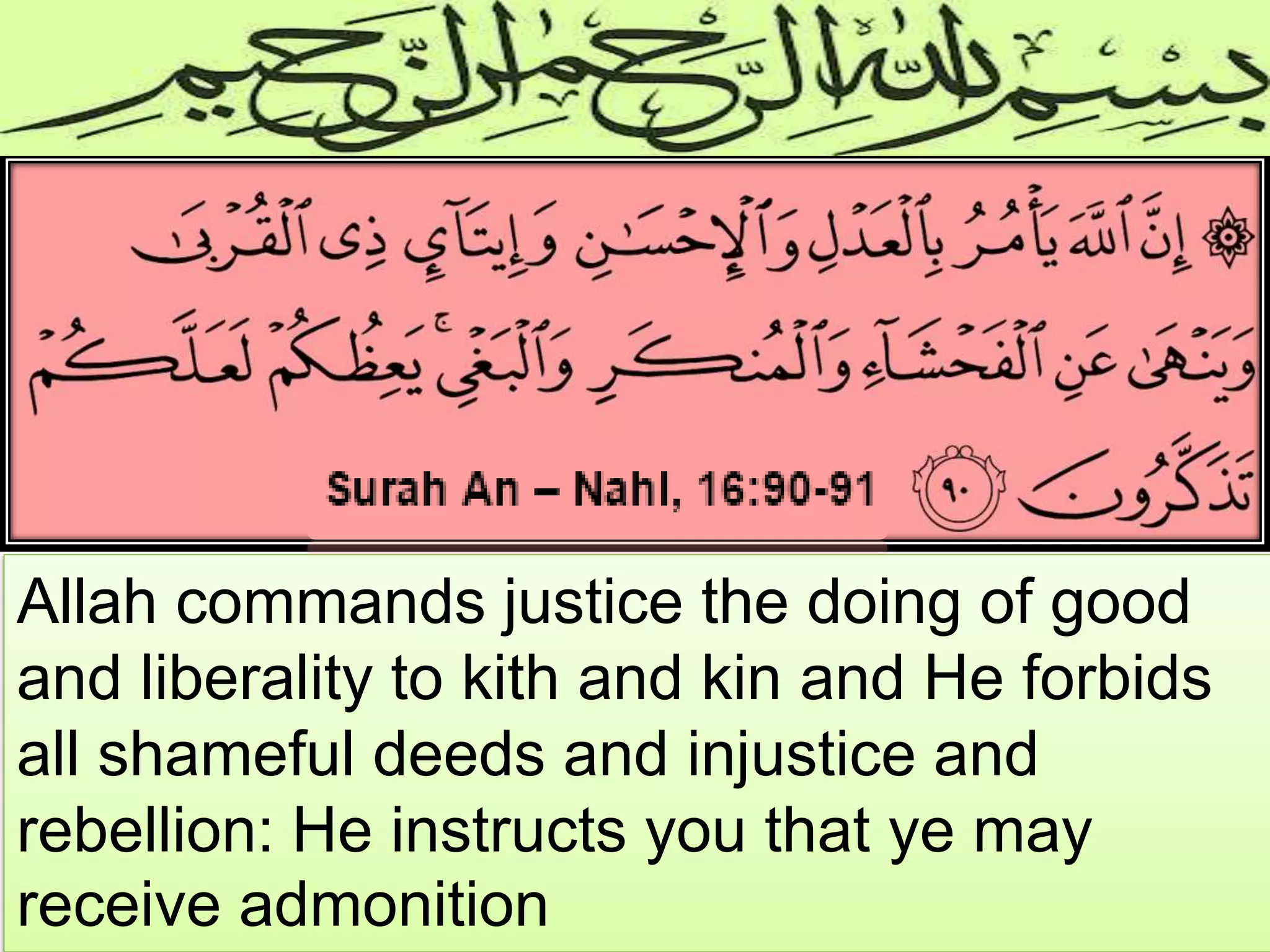
Allah commands justice the doing of good
and liberality to kith and kin and He forbids
all shameful deeds and injustice and
rebellion: He instructs you that ye may
receive admonition
Entire range of commands
condensed in one verse
• Abdullah Ibn Masood (RA) says that most
comprehensive verse of the Holy Qur‘an appears in
An-Nahl and it is(16:90). (Ibn Kathir)
• The essence of the entire range of Islamic teachings
have been condensed into a few words.
• From the blessed period of the most righteous
elders up to this day, the practice has continued
that this verse is recited at the end of the Khutbah
(address) of Jumu'ah and the two Eids.
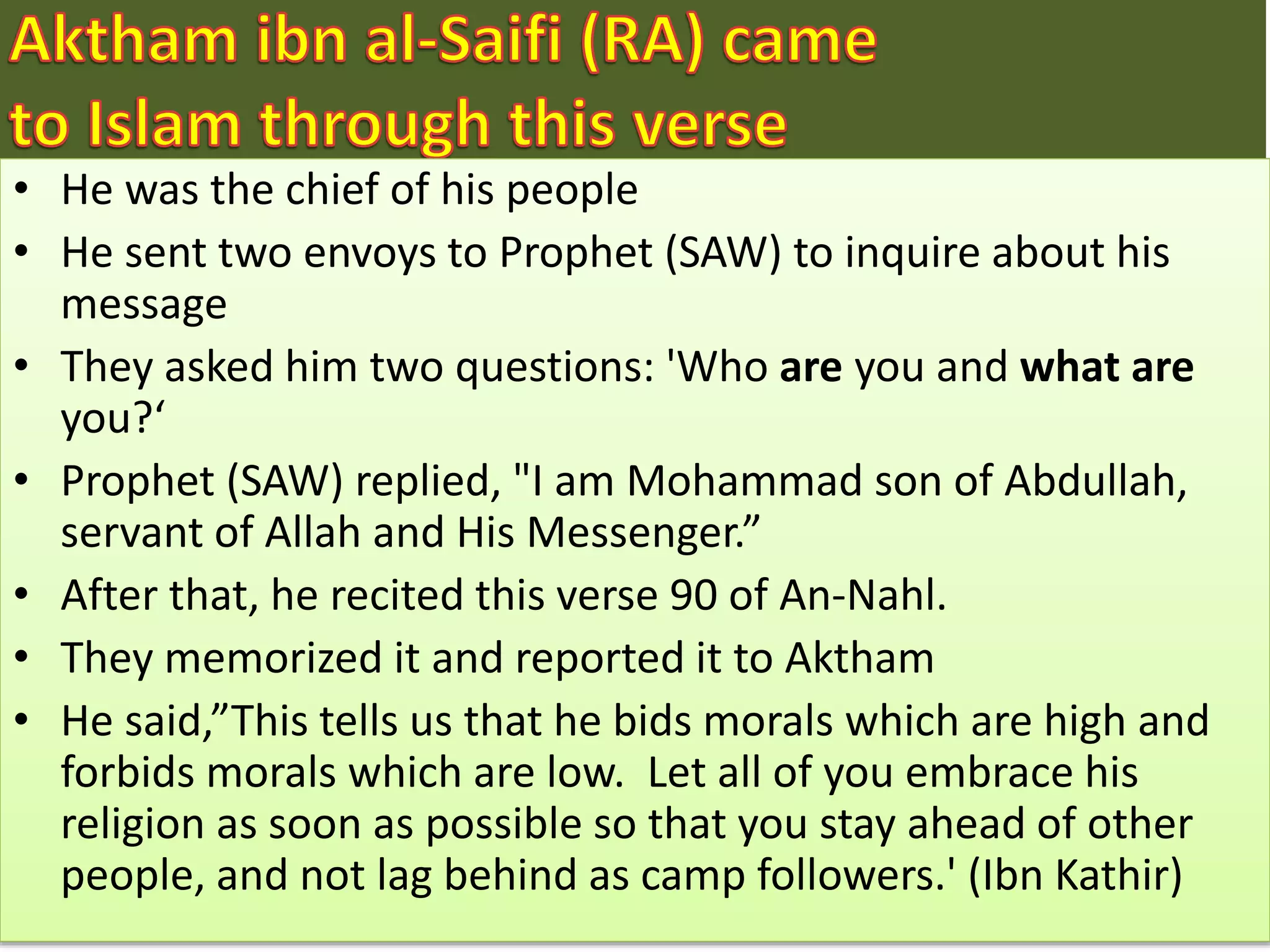
• He was the chief of his people
• He sent two envoys to Prophet (SAW) to inquire about his
message
• They asked him two questions: 'Who are you and what are
you?‘
• Prophet (SAW) replied, "I am Mohammad son of Abdullah,
servant of Allah and His Messenger.”
• After that, he recited this verse 90 of An-Nahl.
• They memorized it and reported it to Aktham
• He said,”This tells us that he bids morals which are high and
forbids morals which are low. Let all of you embrace his
religion as soon as possible so that you stay ahead of other
people, and not lag behind as camp followers.' (Ibn Kathir)
• “At the initial stage, I had embraced Islam because
people around said so.
• But, Islam had not taken roots in my heart.
• Then, there came a day when I was present in the
blessed company of the Holy Prophet (SAW)
• At that time revelation from Allah came and the
Prophet(SAW) recited this verse 90 of Surah Nahal
• When I heard this verse, my faith became all firm and
fortified in my heart and the love for Rasool of Allah
settled there for good.”
• Ibn Kathir reported that it has strong and
authentic chain of transmission.
• He went to report his impression before his people,
the Quraysh of Makkah, in the following words:
• By God, in it, there is a special sweetness and,
• above it there is a unique hallow of light,
• and leaves are going to sprout out from its roots
• and fruits are going to show up on its branches
• and this can never be the speech of any human
being.
• Literal meaning of this word is to make equal.
• Equitable judgement of officials in the disputed cases of
people is called Al-'Adl or justice.
• Al-'Adl (justice) also refers to moderation (al-i'tidal)
between the two extremes of excess (al-ifrat) and
deficiency (at-tafrit).
• Some Tafsir authorities have explained Al-'Adl at this
place as the equality of the outward and the inward
state of a person.
• Statements must be compatible with what one believes
in and lives by.
• In fact, Al-'Adl here has been used in its general sense
which is inclusive of all these forms and shades
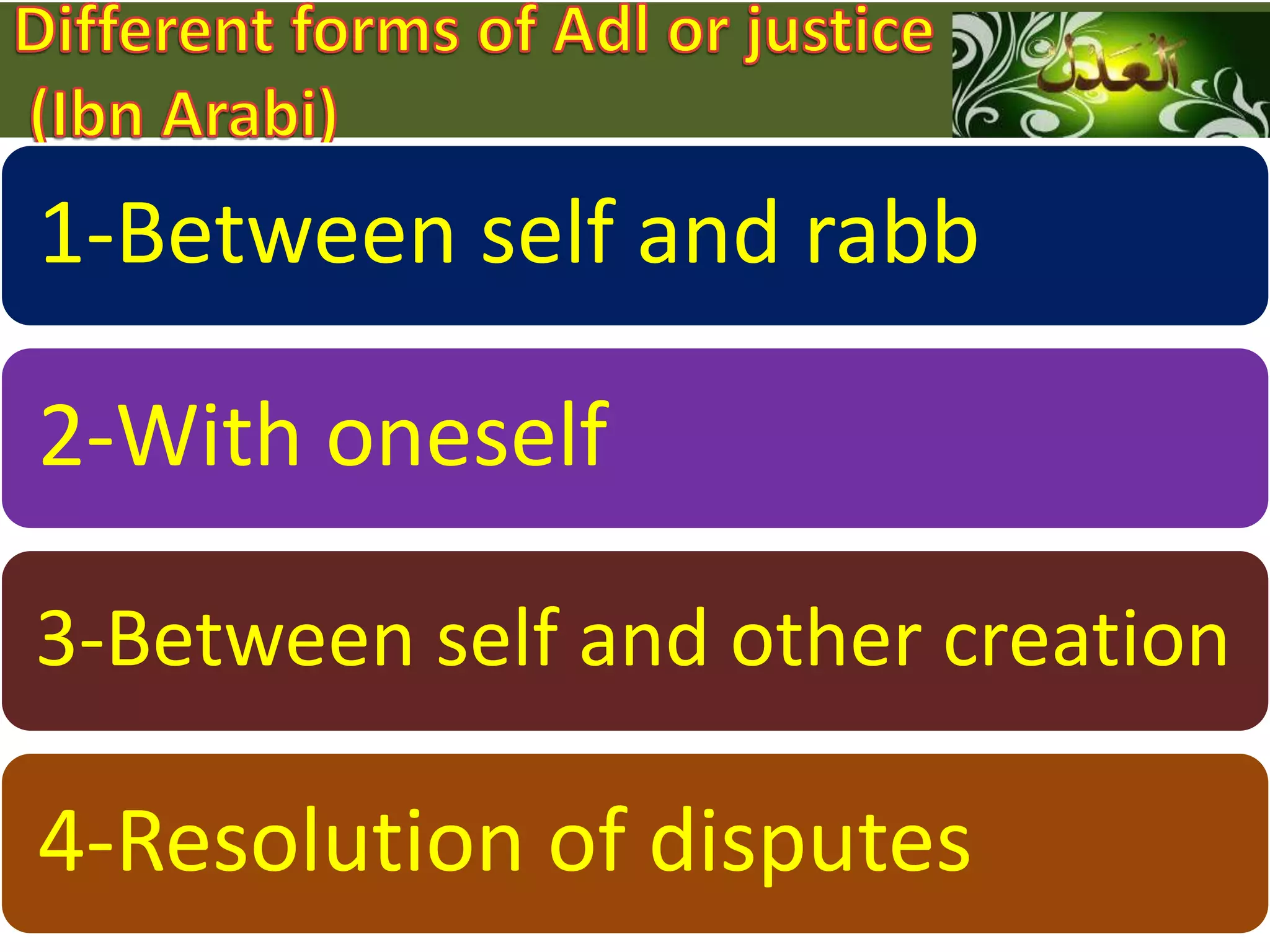
1-Between self and rabb
2-With oneself
3-Between self and other creation
4-Resolution of disputes
• Intrinsic meaning of Al-'Adl is to make equal
• (1)One sense of Al-'Adl or justice is that man should
do justice between his Nafs (self) and his Rabb
(Allah.
• If so, it would mean that he should give preference
to the right of Allah over the self pleasure and
• He should make the seeking of Allah’s pleasure far
more urgent than the pursuit of his own desires
• He must obey His commands and totally abstain
from what He has forbidden
• It requires that one enter into a deal of justice with
his own self
• One must protect his self from all such challenges
which bring physical or spiritual destruction upon
him.
• One must refuse to fulfill such desires of his self
which are harmful for him in the end,
• One must be content and satisfied observing
patience, and avoid putting unnecessary burden on
his self without valid excuse.
• In this case, the essential sense is that one should
deal with the whole creation in a cooperative spirit
wishing well, doing good and having sympathy
• Never betray anyone with the slightest breach of
trust in any transaction whether minor or major,
• Demand from his self justice for everyone, and see
to it that no human being is hurt by anything said
or done by him whether apparent or concealed.
• Similarly, there is the justice done when two parties
bring one of their cases for adjudication before a
person,
• Then, it is the duty of that person that he must
decide the case without any tilt towards anyone
• He should judge in accordance with what is the
truth.
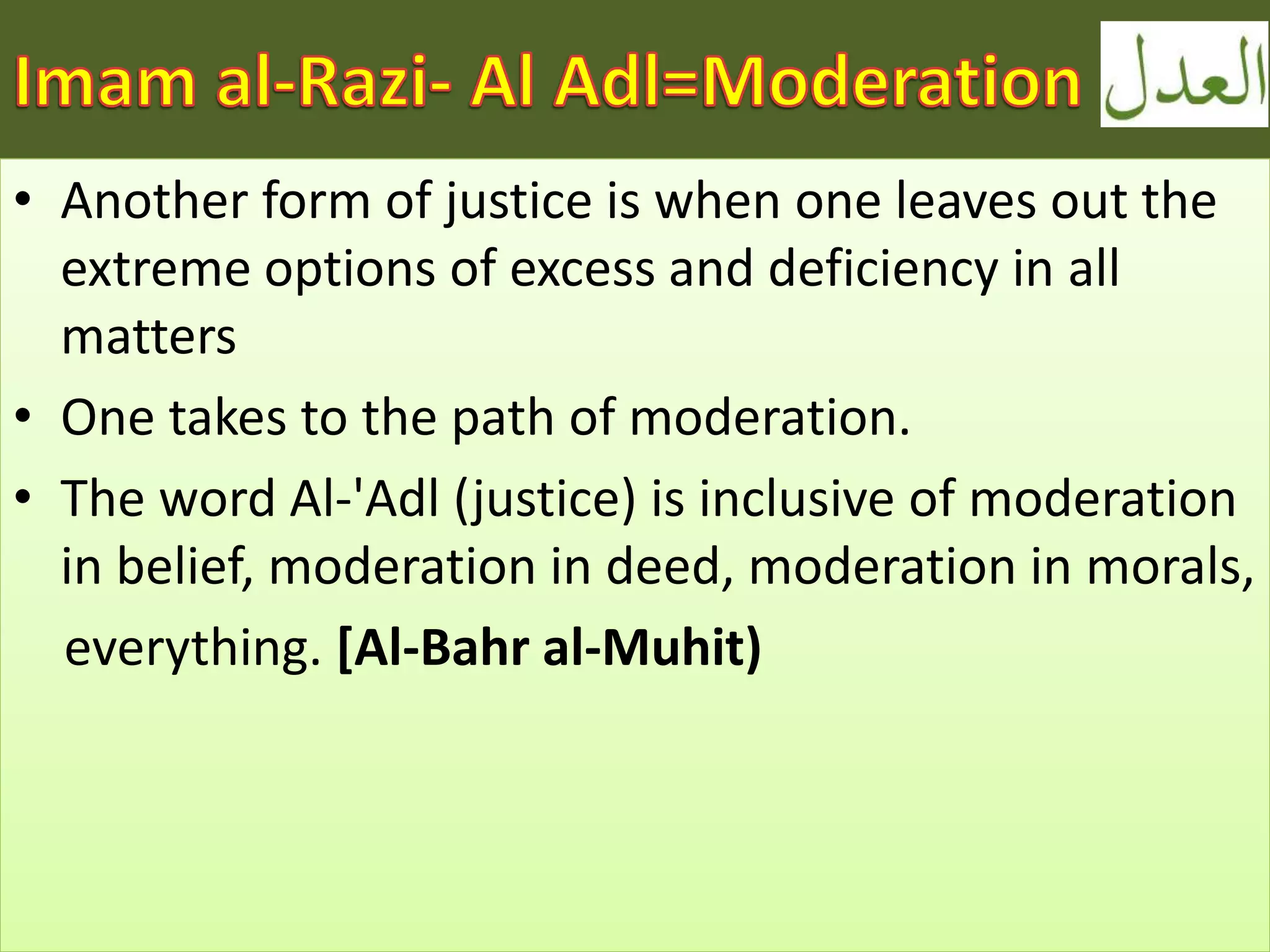
• Another form of justice is when one leaves out the
extreme options of excess and deficiency in all
matters
• One takes to the path of moderation.
• The word Al-'Adl (justice) is inclusive of moderation
in belief, moderation in deed, moderation in morals,
everything. [Al-Bahr al-Muhit)
• Gives all the details to determine the sense of Al-
Adl and considers it good for the purpose
• This tells us that the one single word, Al-'Adl, in this
verse is comprehensive
• It encompasses in itself the adherence to all good
morals and deeds
• It also includes the avoidance of all bad morals and
deeds.
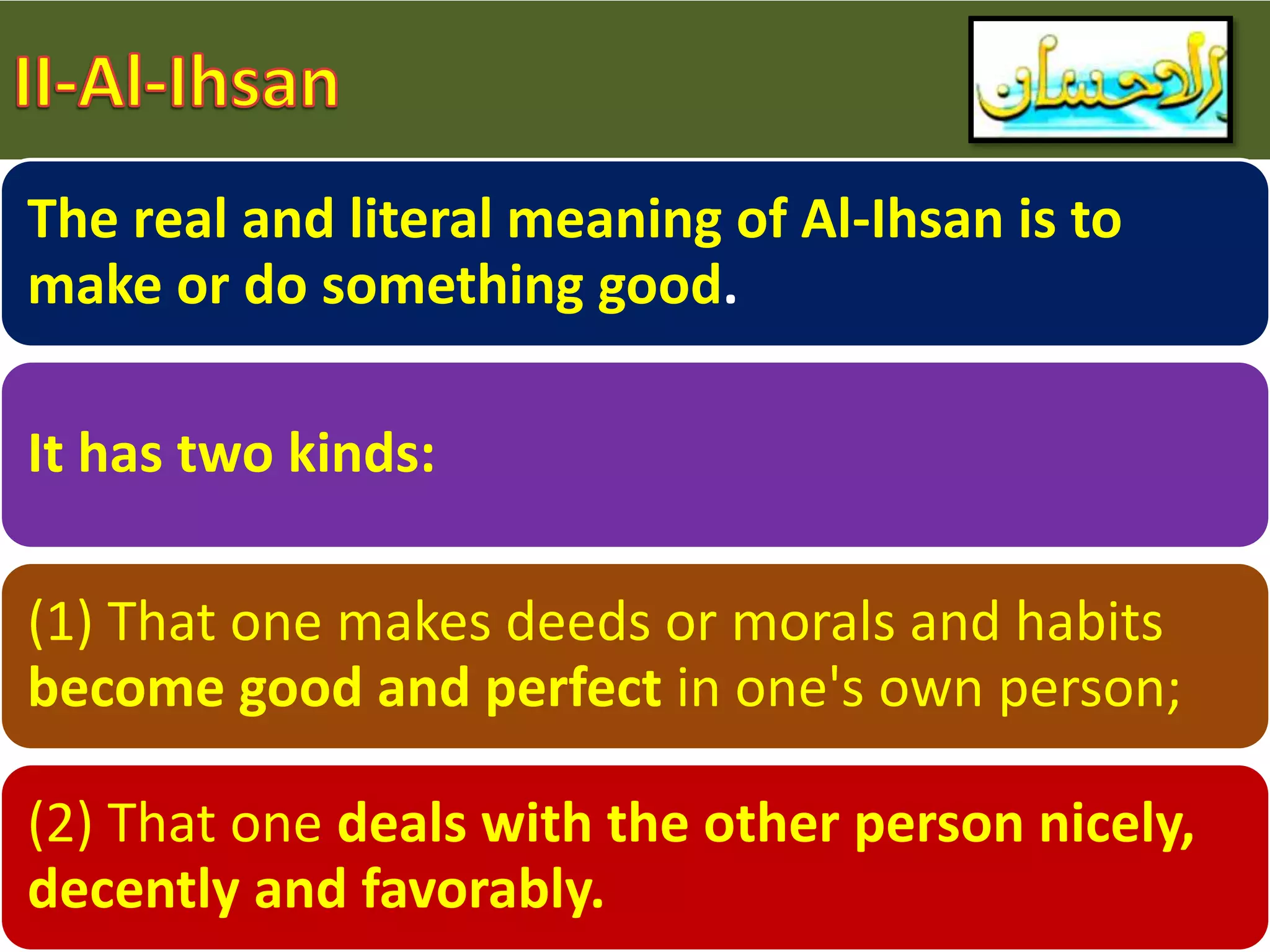
The real and literal meaning of Al-Ihsan is to
make or do something good.
It has two kinds:
(1) That one makes deeds or morals and habits
become good and perfect in one's own person;
(2) That one deals with the other person nicely,
decently and favorably.
• This word has been used in its general sense in the
cited verse
• It is inclusive of both kinds of Ihsan.
• The first kind of Ihsan, that is, doing something well
in its own right, is also general - for instance, to
come out with acts of worship in their best possible
form
• To make efforts to improve upon personal deeds
and morals and to seek betterment in dealings with
others
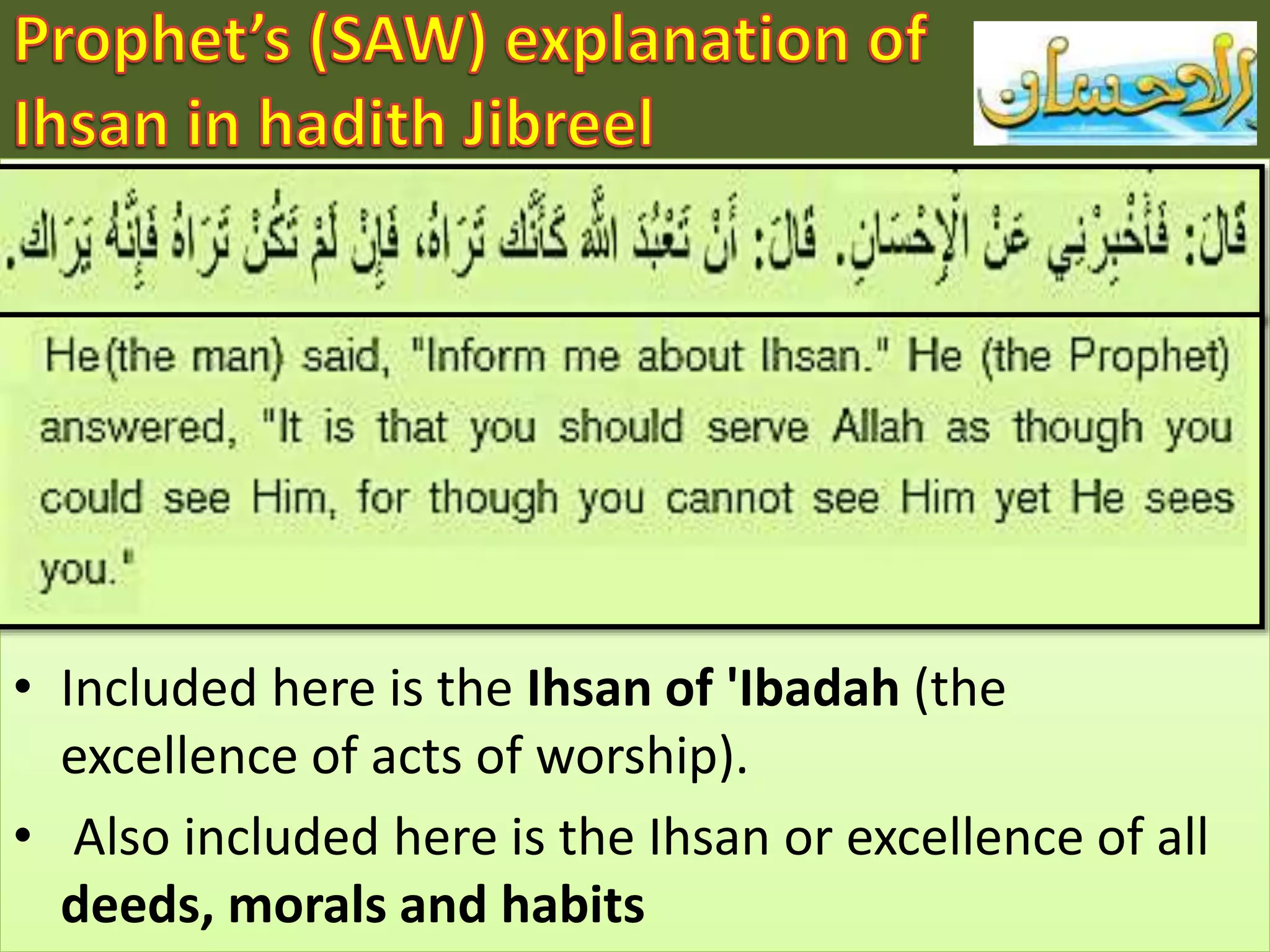
• Included here is the Ihsan of 'Ibadah (the
excellence of acts of worship).
• Also included here is the Ihsan or excellence of all
deeds, morals and habits
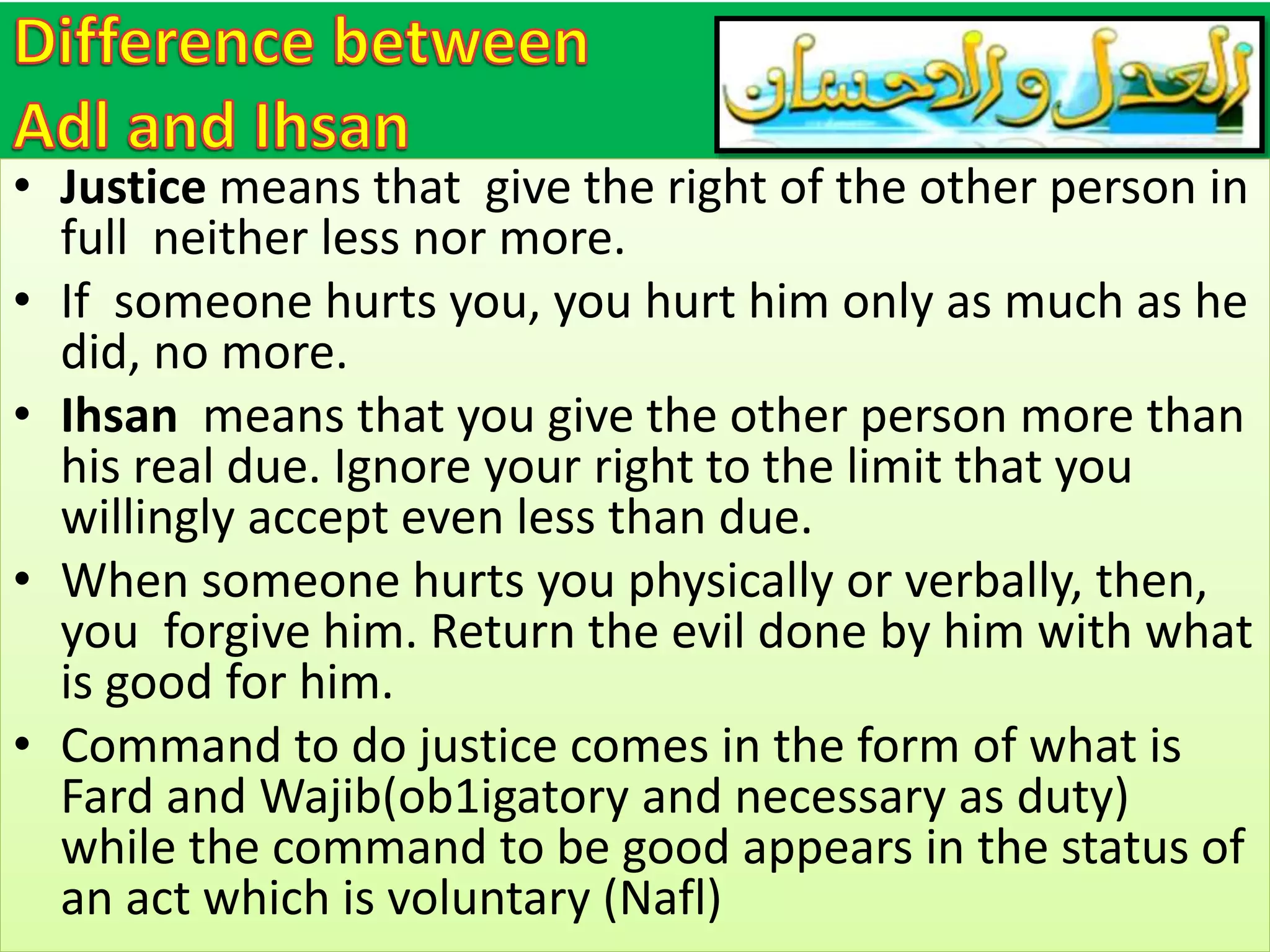
• Justice means that give the right of the other person in
full neither less nor more.
• If someone hurts you, you hurt him only as much as he
did, no more.
• Ihsan means that you give the other person more than
his real due. Ignore your right to the limit that you
willingly accept even less than due.
• When someone hurts you physically or verbally, then,
you forgive him. Return the evil done by him with what
is good for him.
• Command to do justice comes in the form of what is
Fard and Wajib(ob1igatory and necessary as duty)
while the command to be good appears in the status of
an act which is voluntary (Nafl)
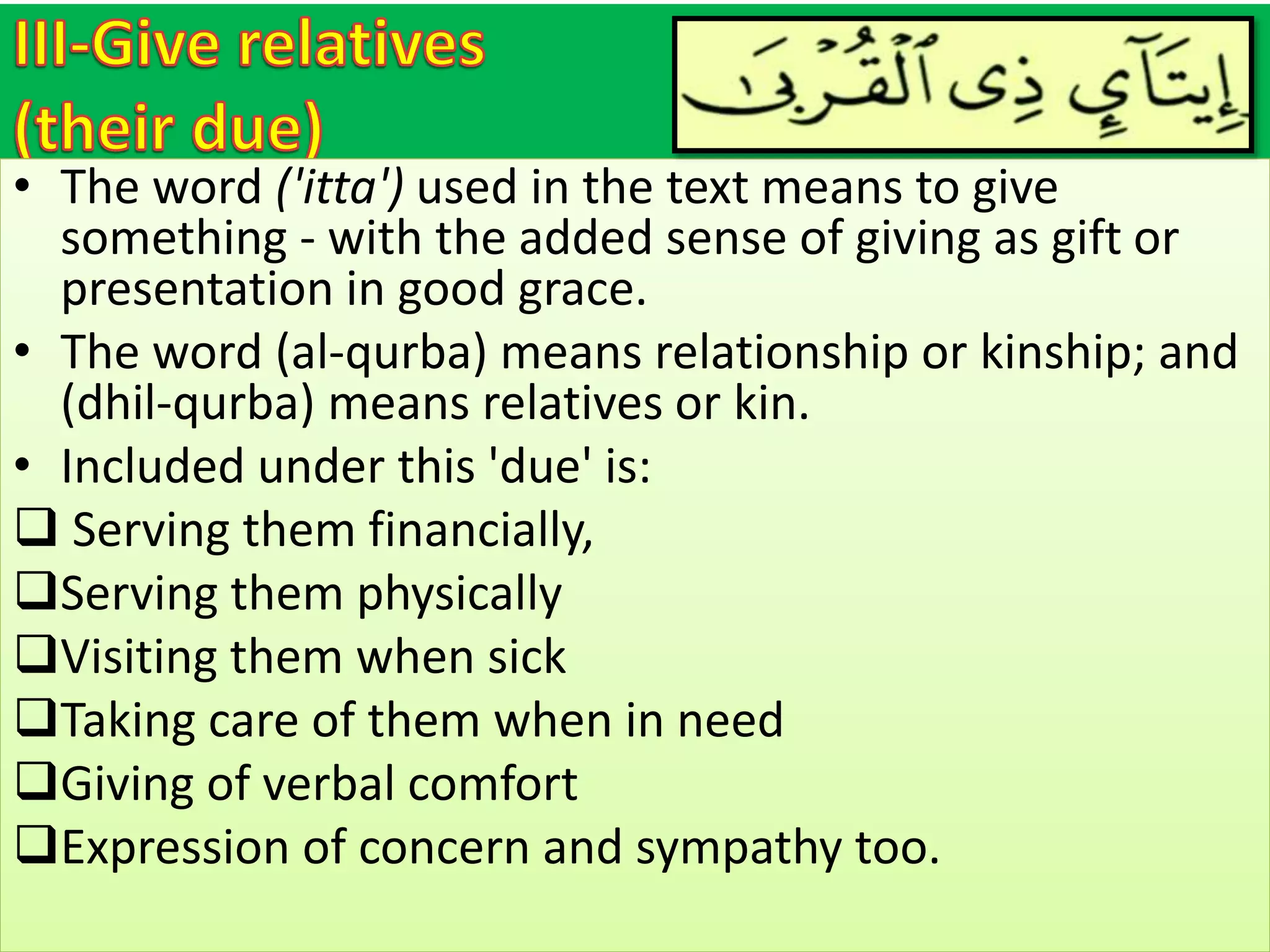
• The word ('itta') used in the text means to give
something - with the added sense of giving as gift or
presentation in good grace.
• The word (al-qurba) means relationship or kinship; and
(dhil-qurba) means relatives or kin.
• Included under this 'due' is:
 Serving them financially,
Serving them physically
Visiting them when sick
Taking care of them when in need
Giving of verbal comfort
Expression of concern and sympathy too.
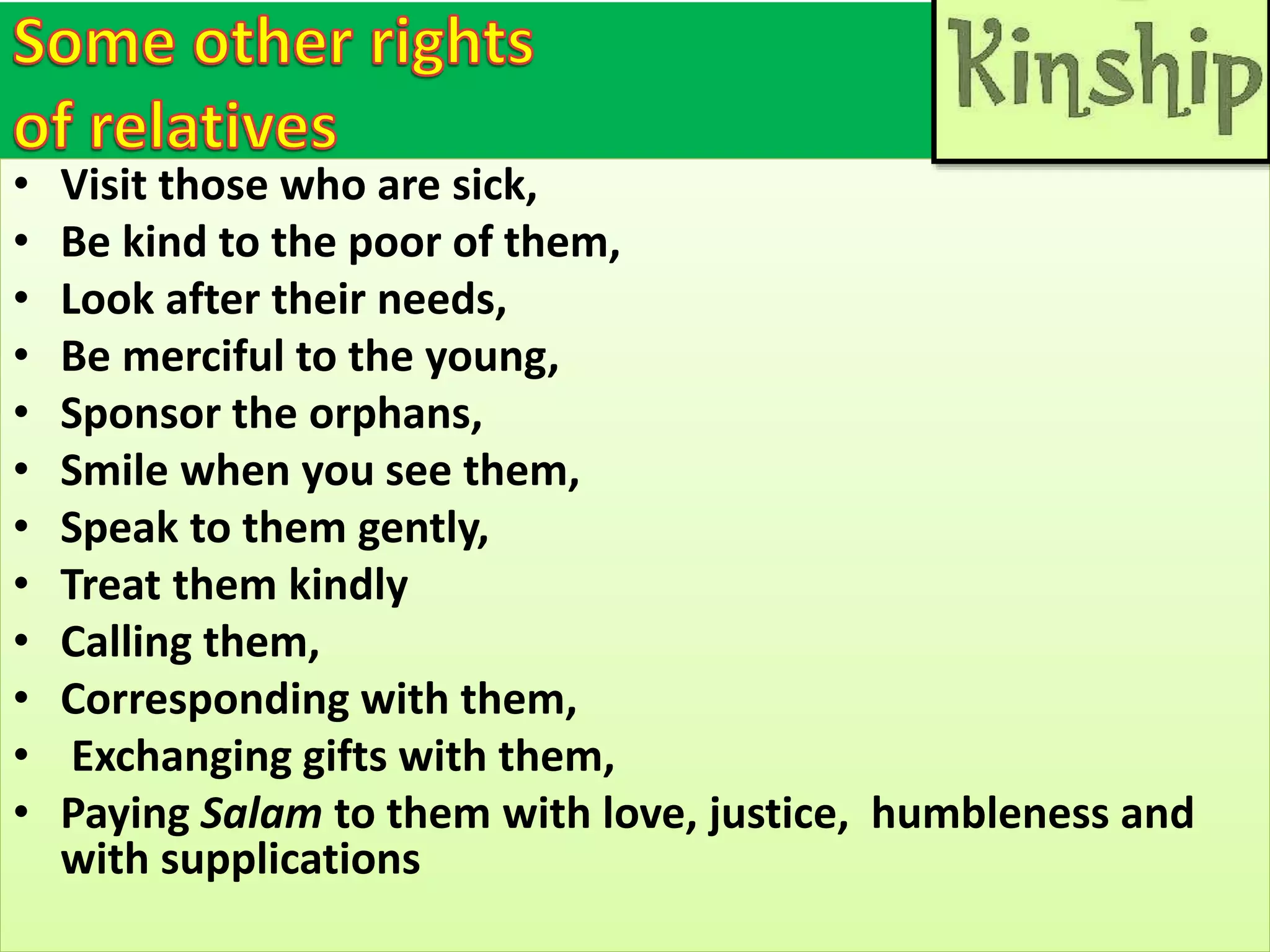
• Visit those who are sick,
• Be kind to the poor of them,
• Look after their needs,
• Be merciful to the young,
• Sponsor the orphans,
• Smile when you see them,
• Speak to them gently,
• Treat them kindly
• Calling them,
• Corresponding with them,
• Exchanging gifts with them,
• Paying Salam to them with love, justice, humbleness and
with supplications
• There are two opinions about the meaning of Fahisha.
Fawahish is simply the plural form of Fahisha
1- Something which is gross, or lewd and obscene.
 This could be in speech or language (as in uttering foul, evil,
lewd or obscene speech)
 An indecent act per Quran like fornication and adultery
2- Any major sin for which Sharia has prescribed a Hadd
(specific punishment). Examples are :
 Killing an innocent soul,
 Dealing with Riba (usury, interest),
 Adultery,
 Fornication,
 Giving false testimonies, etc
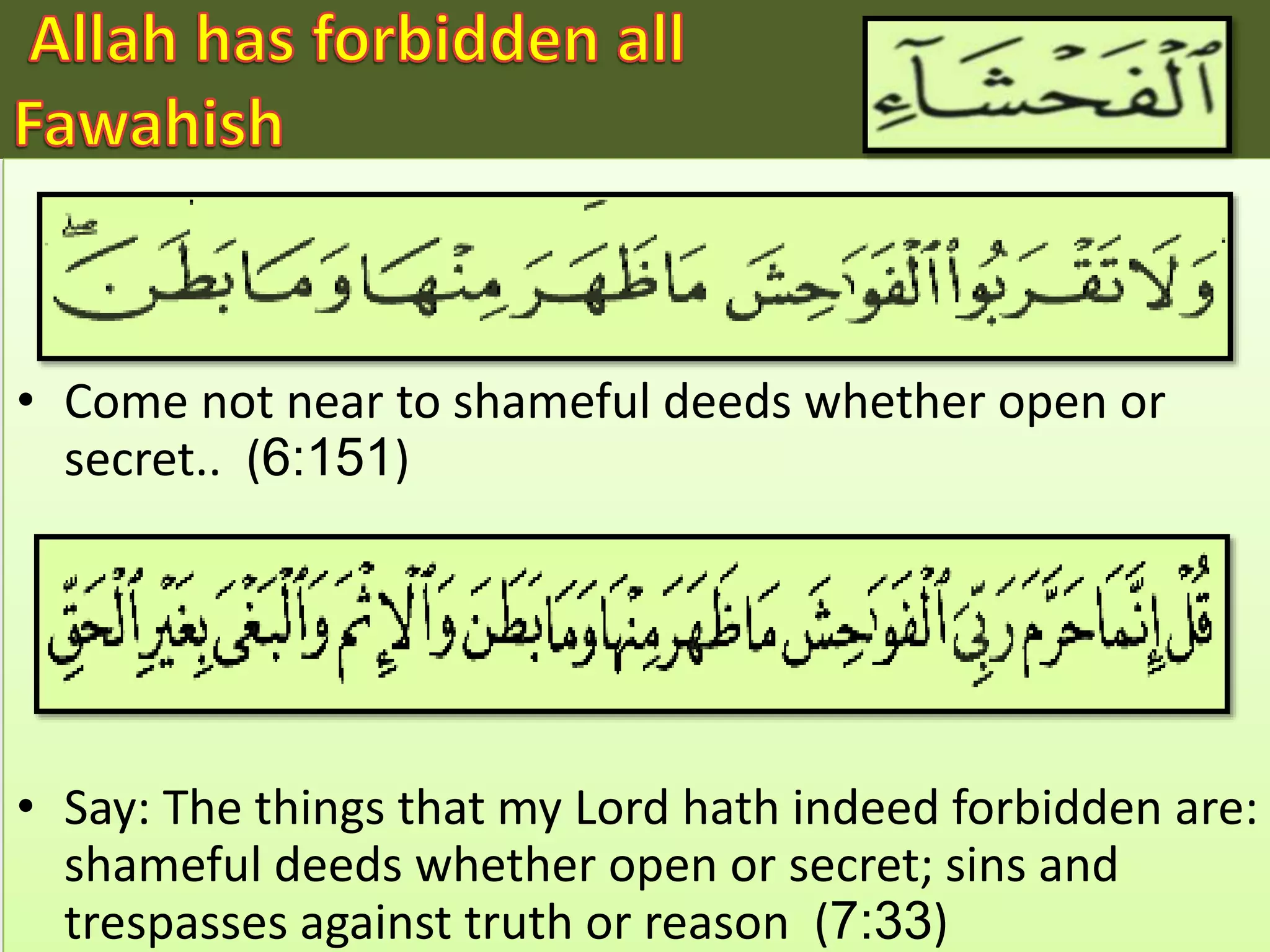
• Come not near to shameful deeds whether open or
secret.. (6:151)
• Say: The things that my Lord hath indeed forbidden are:
shameful deeds whether open or secret; sins and
trespasses against truth or reason (7:33)
• Amara starts from suggesting and it moves on to
command.
• The more control Shaytan has will determine whether
he can command you or not.
• Shaytan takes full control of some people.
• They are addicted to Zina and pornography. They
cannot stop themselves.
• God promises you His forgiveness and His abundance:
God is limitless and all knowing,
• Read and follow what has been revealed to you from the book
and establish prayer, no doubt about it, it is in fact prayer
that prevents you from all forms of shamelessness and evil
behavior. (26:45)
• you might say: I have been praying five times a day but i still
have a boyfriend or a girlfriend. I am still addicted to filthy
stuff online but i still pray five times
• Something is wrong with your prayer, if you are still up to this
stuff. Something is missing because you are not really praying.
• It applies to words or deeds, unlawfulness which is
mentioned in Quran and Sunnah
• Al-Munkar is also defined as polytheism and disbelief
and all that Islam has forbidden.
• Al-Munkar" appears 15 times in 15 verses in Quran
• Al-Munkar (forbidden and evil actions) are two kinds:
Not doing what Allah and His Prophet (SAW) have
absolutely ordained on us like giving up Salah
Doing what Allah and His Prophet (SAW) have
absolutely forbidden for us like committing Zina
(fornication or adultery).
• Word 'munkar' occurs in Quran in the opposite
sense of "Maroof".
• Maroof means "known" or "recognized" as good in
Islam
• Its opposite munkar means "unrecognized“ as good
in Islam
• Both these words Maroof and munkar are loosely
translated as "good" and "bad" (actions)
• But more specific terms: "saalihaath" and
"sayyiaath" has been used in Quran for "good" and
"bad" (actions).
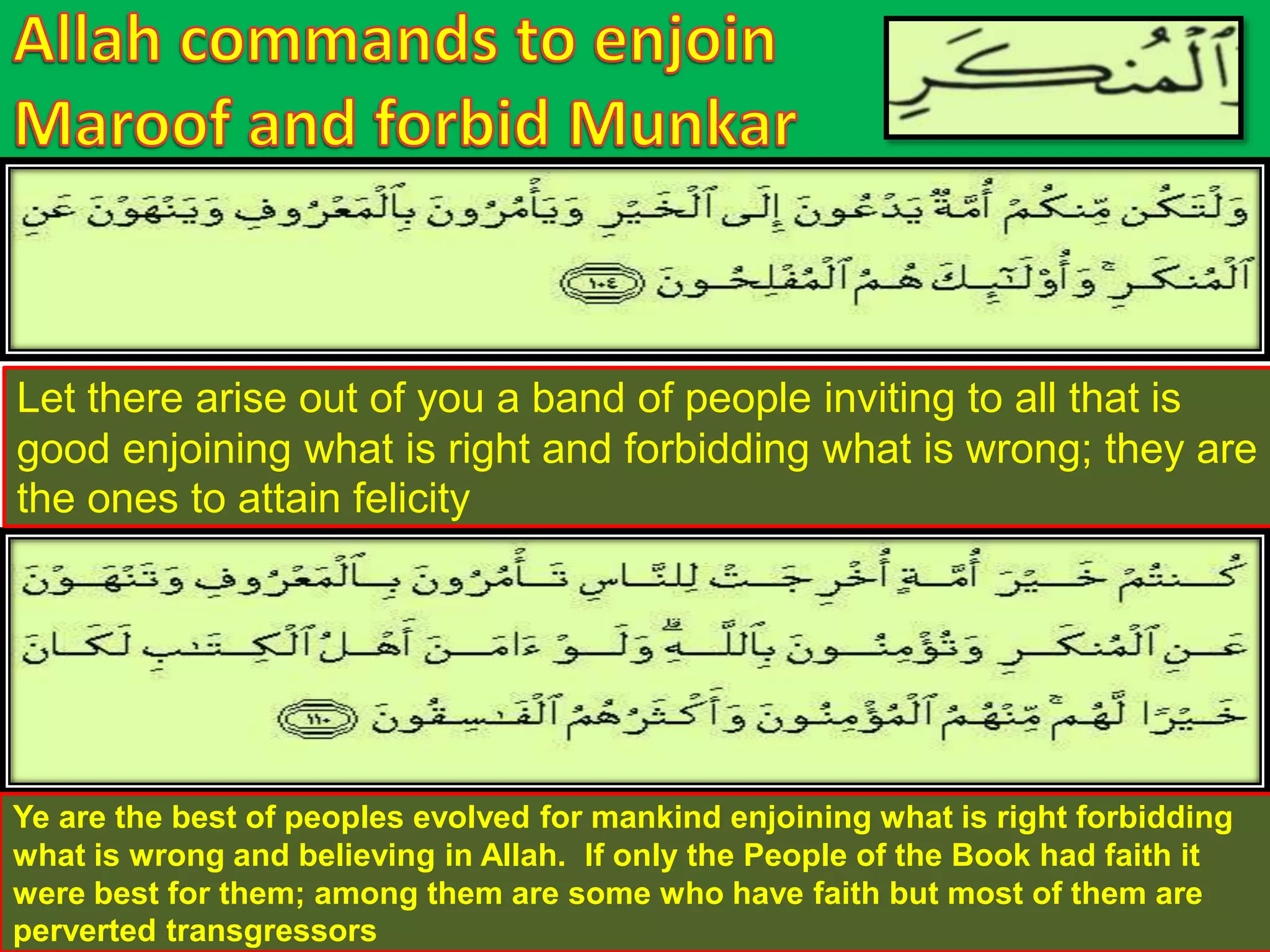
Let there arise out of you a band of people inviting to all that is
good enjoining what is right and forbidding what is wrong; they are
the ones to attain felicity
Ye are the best of peoples evolved for mankind enjoining what is right forbidding
what is wrong and believing in Allah. If only the People of the Book had faith it
were best for them; among them are some who have faith but most of them are
perverted transgressors
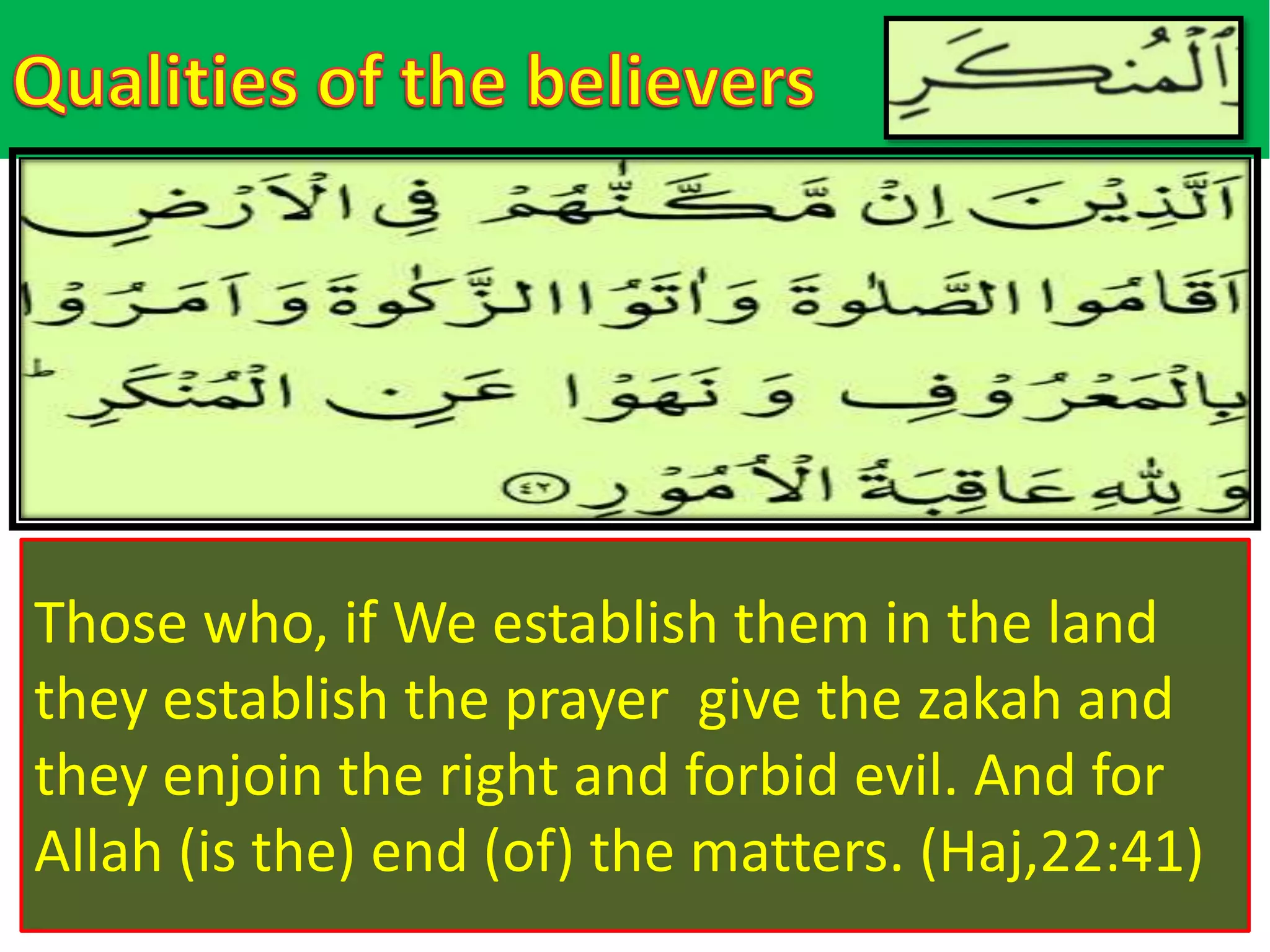
Those who, if We establish them in the land
they establish the prayer give the zakah and
they enjoin the right and forbid evil. And for
Allah (is the) end (of) the matters. (Haj,22:41)
" And the believers, men and women, are friends one of
another; they enjoin the recognized (conduct) and forbid
the unrecognized, and they establish Salah and they pay
the Zakah, and they obey Allah and His messenger. As for
these, Allah will have mercy on them. Indeed, Allah is
Mighty, Wise. (9:71)
"The hypocrites, both men and women, proceed one from
another. They enjoin the unrecognized, and they forbid the
recognized, and they withhold their hands (from spending
). They forget Allah, so He has forgotten them. Indeed, the
hypocrites, they are the transgressors. " (9:67)
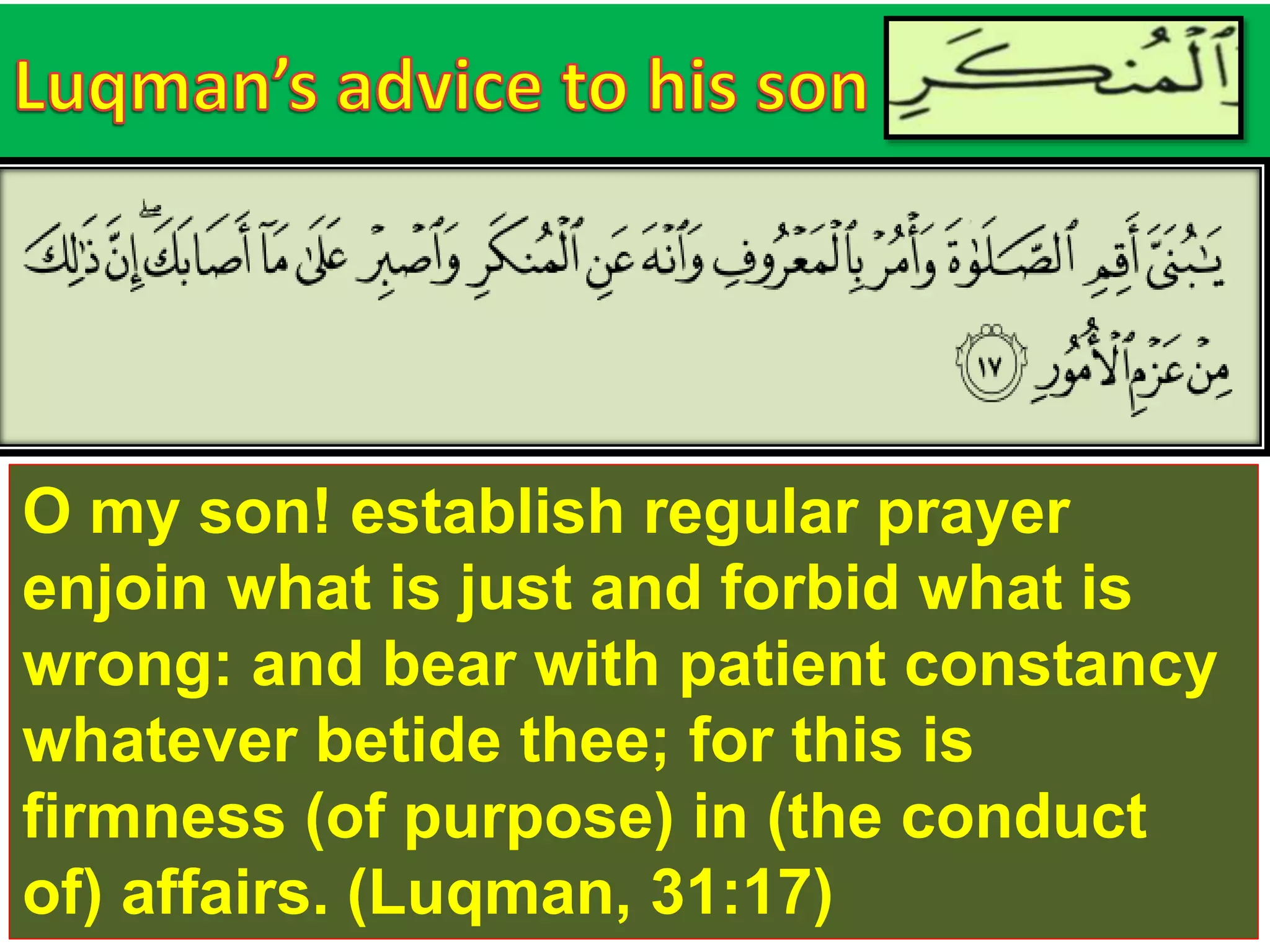
O my son! establish regular prayer
enjoin what is just and forbid what is
wrong: and bear with patient constancy
whatever betide thee; for this is
firmness (of purpose) in (the conduct
of) affairs. (Luqman, 31:17)
Rebellion
ArroganceTransgression
Baghi is rebellion against truth and righteousness
knowingly and/or by use one's power and
influence.
Arrogance, pride, kufr etc.
Transgressing by attacking people's life, wealth,
honor and freedom of expression;
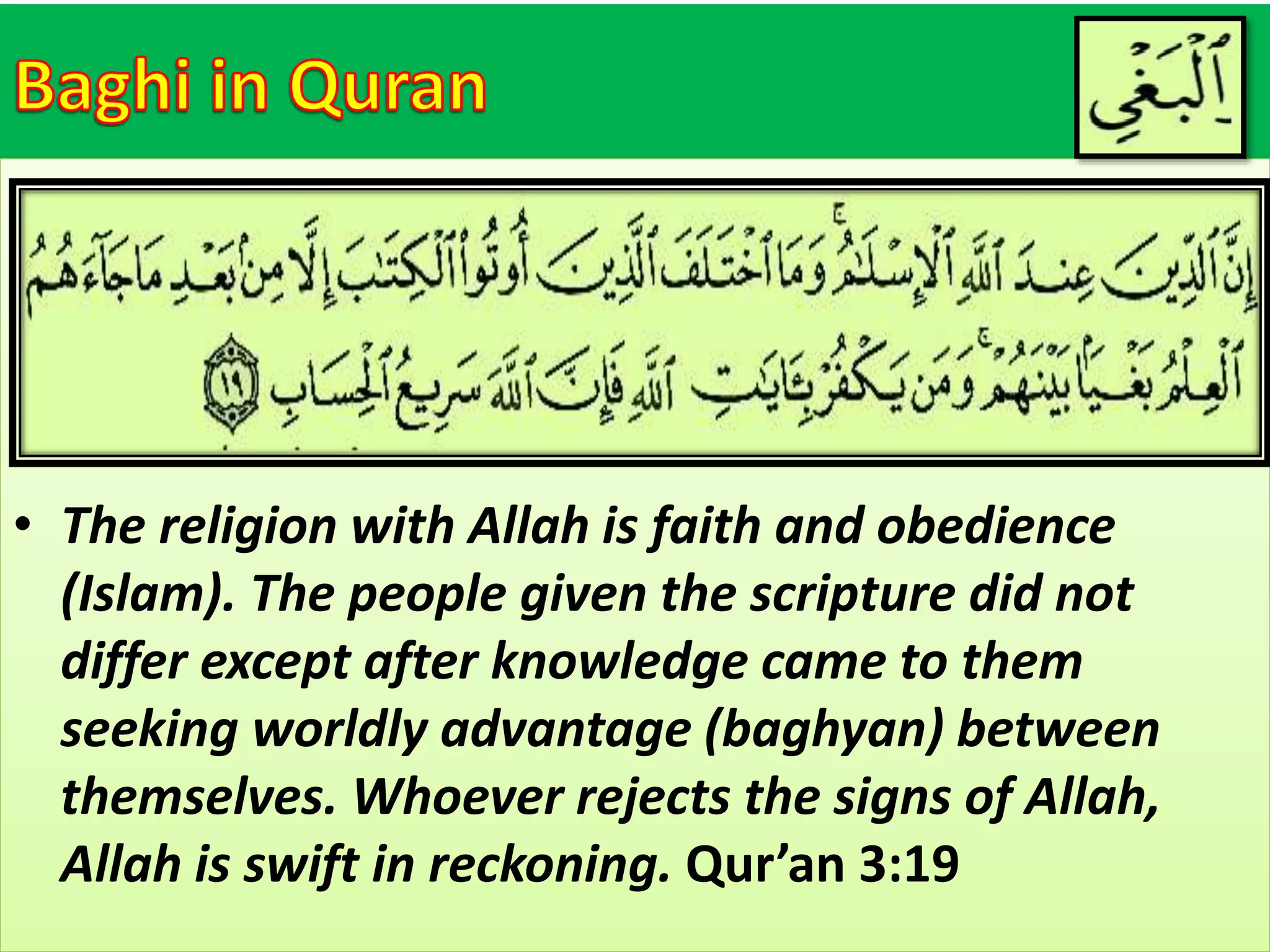
• The religion with Allah is faith and obedience
(Islam). The people given the scripture did not
differ except after knowledge came to them
seeking worldly advantage (baghyan) between
themselves. Whoever rejects the signs of Allah,
Allah is swift in reckoning. Qur’an 3:19
But when He delivers them Behold! they
transgress insolently through the earth in
defiance of right! O mankind! your insolence is
against your own souls an enjoyment of the life
of the Present: in the end to Us is your return
and We shall show you the truth of all that ye did.
Yunus, 10:23
Most comprehensive verse in quran

Most comprehensive verse in quran

  • 2.
    Allah commands justicethe doing of good and liberality to kith and kin and He forbids all shameful deeds and injustice and rebellion: He instructs you that ye may receive admonition
  • 4.
    Entire range ofcommands condensed in one verse • Abdullah Ibn Masood (RA) says that most comprehensive verse of the Holy Qur‘an appears in An-Nahl and it is(16:90). (Ibn Kathir) • The essence of the entire range of Islamic teachings have been condensed into a few words. • From the blessed period of the most righteous elders up to this day, the practice has continued that this verse is recited at the end of the Khutbah (address) of Jumu'ah and the two Eids.
  • 5.
    • He wasthe chief of his people • He sent two envoys to Prophet (SAW) to inquire about his message • They asked him two questions: 'Who are you and what are you?‘ • Prophet (SAW) replied, "I am Mohammad son of Abdullah, servant of Allah and His Messenger.” • After that, he recited this verse 90 of An-Nahl. • They memorized it and reported it to Aktham • He said,”This tells us that he bids morals which are high and forbids morals which are low. Let all of you embrace his religion as soon as possible so that you stay ahead of other people, and not lag behind as camp followers.' (Ibn Kathir)
  • 6.
    • “At theinitial stage, I had embraced Islam because people around said so. • But, Islam had not taken roots in my heart. • Then, there came a day when I was present in the blessed company of the Holy Prophet (SAW) • At that time revelation from Allah came and the Prophet(SAW) recited this verse 90 of Surah Nahal • When I heard this verse, my faith became all firm and fortified in my heart and the love for Rasool of Allah settled there for good.” • Ibn Kathir reported that it has strong and authentic chain of transmission.
  • 7.
    • He wentto report his impression before his people, the Quraysh of Makkah, in the following words: • By God, in it, there is a special sweetness and, • above it there is a unique hallow of light, • and leaves are going to sprout out from its roots • and fruits are going to show up on its branches • and this can never be the speech of any human being.
  • 8.
    • Literal meaningof this word is to make equal. • Equitable judgement of officials in the disputed cases of people is called Al-'Adl or justice. • Al-'Adl (justice) also refers to moderation (al-i'tidal) between the two extremes of excess (al-ifrat) and deficiency (at-tafrit). • Some Tafsir authorities have explained Al-'Adl at this place as the equality of the outward and the inward state of a person. • Statements must be compatible with what one believes in and lives by. • In fact, Al-'Adl here has been used in its general sense which is inclusive of all these forms and shades
  • 9.
    1-Between self andrabb 2-With oneself 3-Between self and other creation 4-Resolution of disputes
  • 10.
    • Intrinsic meaningof Al-'Adl is to make equal • (1)One sense of Al-'Adl or justice is that man should do justice between his Nafs (self) and his Rabb (Allah. • If so, it would mean that he should give preference to the right of Allah over the self pleasure and • He should make the seeking of Allah’s pleasure far more urgent than the pursuit of his own desires • He must obey His commands and totally abstain from what He has forbidden
  • 11.
    • It requiresthat one enter into a deal of justice with his own self • One must protect his self from all such challenges which bring physical or spiritual destruction upon him. • One must refuse to fulfill such desires of his self which are harmful for him in the end, • One must be content and satisfied observing patience, and avoid putting unnecessary burden on his self without valid excuse.
  • 12.
    • In thiscase, the essential sense is that one should deal with the whole creation in a cooperative spirit wishing well, doing good and having sympathy • Never betray anyone with the slightest breach of trust in any transaction whether minor or major, • Demand from his self justice for everyone, and see to it that no human being is hurt by anything said or done by him whether apparent or concealed.
  • 13.
    • Similarly, thereis the justice done when two parties bring one of their cases for adjudication before a person, • Then, it is the duty of that person that he must decide the case without any tilt towards anyone • He should judge in accordance with what is the truth.
  • 14.
    • Another formof justice is when one leaves out the extreme options of excess and deficiency in all matters • One takes to the path of moderation. • The word Al-'Adl (justice) is inclusive of moderation in belief, moderation in deed, moderation in morals, everything. [Al-Bahr al-Muhit)
  • 15.
    • Gives allthe details to determine the sense of Al- Adl and considers it good for the purpose • This tells us that the one single word, Al-'Adl, in this verse is comprehensive • It encompasses in itself the adherence to all good morals and deeds • It also includes the avoidance of all bad morals and deeds.
  • 16.
    The real andliteral meaning of Al-Ihsan is to make or do something good. It has two kinds: (1) That one makes deeds or morals and habits become good and perfect in one's own person; (2) That one deals with the other person nicely, decently and favorably.
  • 17.
    • This wordhas been used in its general sense in the cited verse • It is inclusive of both kinds of Ihsan. • The first kind of Ihsan, that is, doing something well in its own right, is also general - for instance, to come out with acts of worship in their best possible form • To make efforts to improve upon personal deeds and morals and to seek betterment in dealings with others
  • 18.
    • Included hereis the Ihsan of 'Ibadah (the excellence of acts of worship). • Also included here is the Ihsan or excellence of all deeds, morals and habits
  • 19.
    • Justice meansthat give the right of the other person in full neither less nor more. • If someone hurts you, you hurt him only as much as he did, no more. • Ihsan means that you give the other person more than his real due. Ignore your right to the limit that you willingly accept even less than due. • When someone hurts you physically or verbally, then, you forgive him. Return the evil done by him with what is good for him. • Command to do justice comes in the form of what is Fard and Wajib(ob1igatory and necessary as duty) while the command to be good appears in the status of an act which is voluntary (Nafl)
  • 20.
    • The word('itta') used in the text means to give something - with the added sense of giving as gift or presentation in good grace. • The word (al-qurba) means relationship or kinship; and (dhil-qurba) means relatives or kin. • Included under this 'due' is:  Serving them financially, Serving them physically Visiting them when sick Taking care of them when in need Giving of verbal comfort Expression of concern and sympathy too.
  • 21.
    • Visit thosewho are sick, • Be kind to the poor of them, • Look after their needs, • Be merciful to the young, • Sponsor the orphans, • Smile when you see them, • Speak to them gently, • Treat them kindly • Calling them, • Corresponding with them, • Exchanging gifts with them, • Paying Salam to them with love, justice, humbleness and with supplications
  • 23.
    • There aretwo opinions about the meaning of Fahisha. Fawahish is simply the plural form of Fahisha 1- Something which is gross, or lewd and obscene.  This could be in speech or language (as in uttering foul, evil, lewd or obscene speech)  An indecent act per Quran like fornication and adultery 2- Any major sin for which Sharia has prescribed a Hadd (specific punishment). Examples are :  Killing an innocent soul,  Dealing with Riba (usury, interest),  Adultery,  Fornication,  Giving false testimonies, etc
  • 24.
    • Come notnear to shameful deeds whether open or secret.. (6:151) • Say: The things that my Lord hath indeed forbidden are: shameful deeds whether open or secret; sins and trespasses against truth or reason (7:33)
  • 25.
    • Amara startsfrom suggesting and it moves on to command. • The more control Shaytan has will determine whether he can command you or not. • Shaytan takes full control of some people. • They are addicted to Zina and pornography. They cannot stop themselves. • God promises you His forgiveness and His abundance: God is limitless and all knowing,
  • 26.
    • Read andfollow what has been revealed to you from the book and establish prayer, no doubt about it, it is in fact prayer that prevents you from all forms of shamelessness and evil behavior. (26:45) • you might say: I have been praying five times a day but i still have a boyfriend or a girlfriend. I am still addicted to filthy stuff online but i still pray five times • Something is wrong with your prayer, if you are still up to this stuff. Something is missing because you are not really praying.
  • 27.
    • It appliesto words or deeds, unlawfulness which is mentioned in Quran and Sunnah • Al-Munkar is also defined as polytheism and disbelief and all that Islam has forbidden. • Al-Munkar" appears 15 times in 15 verses in Quran • Al-Munkar (forbidden and evil actions) are two kinds: Not doing what Allah and His Prophet (SAW) have absolutely ordained on us like giving up Salah Doing what Allah and His Prophet (SAW) have absolutely forbidden for us like committing Zina (fornication or adultery).
  • 28.
    • Word 'munkar'occurs in Quran in the opposite sense of "Maroof". • Maroof means "known" or "recognized" as good in Islam • Its opposite munkar means "unrecognized“ as good in Islam • Both these words Maroof and munkar are loosely translated as "good" and "bad" (actions) • But more specific terms: "saalihaath" and "sayyiaath" has been used in Quran for "good" and "bad" (actions).
  • 29.
    Let there ariseout of you a band of people inviting to all that is good enjoining what is right and forbidding what is wrong; they are the ones to attain felicity Ye are the best of peoples evolved for mankind enjoining what is right forbidding what is wrong and believing in Allah. If only the People of the Book had faith it were best for them; among them are some who have faith but most of them are perverted transgressors
  • 33.
    Those who, ifWe establish them in the land they establish the prayer give the zakah and they enjoin the right and forbid evil. And for Allah (is the) end (of) the matters. (Haj,22:41)
  • 34.
    " And thebelievers, men and women, are friends one of another; they enjoin the recognized (conduct) and forbid the unrecognized, and they establish Salah and they pay the Zakah, and they obey Allah and His messenger. As for these, Allah will have mercy on them. Indeed, Allah is Mighty, Wise. (9:71)
  • 35.
    "The hypocrites, bothmen and women, proceed one from another. They enjoin the unrecognized, and they forbid the recognized, and they withhold their hands (from spending ). They forget Allah, so He has forgotten them. Indeed, the hypocrites, they are the transgressors. " (9:67)
  • 36.
    O my son!establish regular prayer enjoin what is just and forbid what is wrong: and bear with patient constancy whatever betide thee; for this is firmness (of purpose) in (the conduct of) affairs. (Luqman, 31:17)
  • 37.
  • 38.
    Baghi is rebellionagainst truth and righteousness knowingly and/or by use one's power and influence. Arrogance, pride, kufr etc. Transgressing by attacking people's life, wealth, honor and freedom of expression;
  • 39.
    • The religionwith Allah is faith and obedience (Islam). The people given the scripture did not differ except after knowledge came to them seeking worldly advantage (baghyan) between themselves. Whoever rejects the signs of Allah, Allah is swift in reckoning. Qur’an 3:19
  • 40.
    But when Hedelivers them Behold! they transgress insolently through the earth in defiance of right! O mankind! your insolence is against your own souls an enjoyment of the life of the Present: in the end to Us is your return and We shall show you the truth of all that ye did. Yunus, 10:23