Women in Islam By: Sally Attar "I urge you to treat women well"  said the Prophet (PBUH)
Women in Medieval Times Women were basically treated like domesticated pets Had to take care of all household responsibilities Worked in fields and helped their husbands Marriage was compulsory  Treated with little or no respect
Women in Asia Widows were burnt alive  Remarriage was prohibited Widows became slaves to their brother-in-laws
Women in Arabia before Islam Women were not equal to men when it came to issues such as marriage, inheritance or education Women had no legal rights Female infants were buried alive Polygamy was widespread
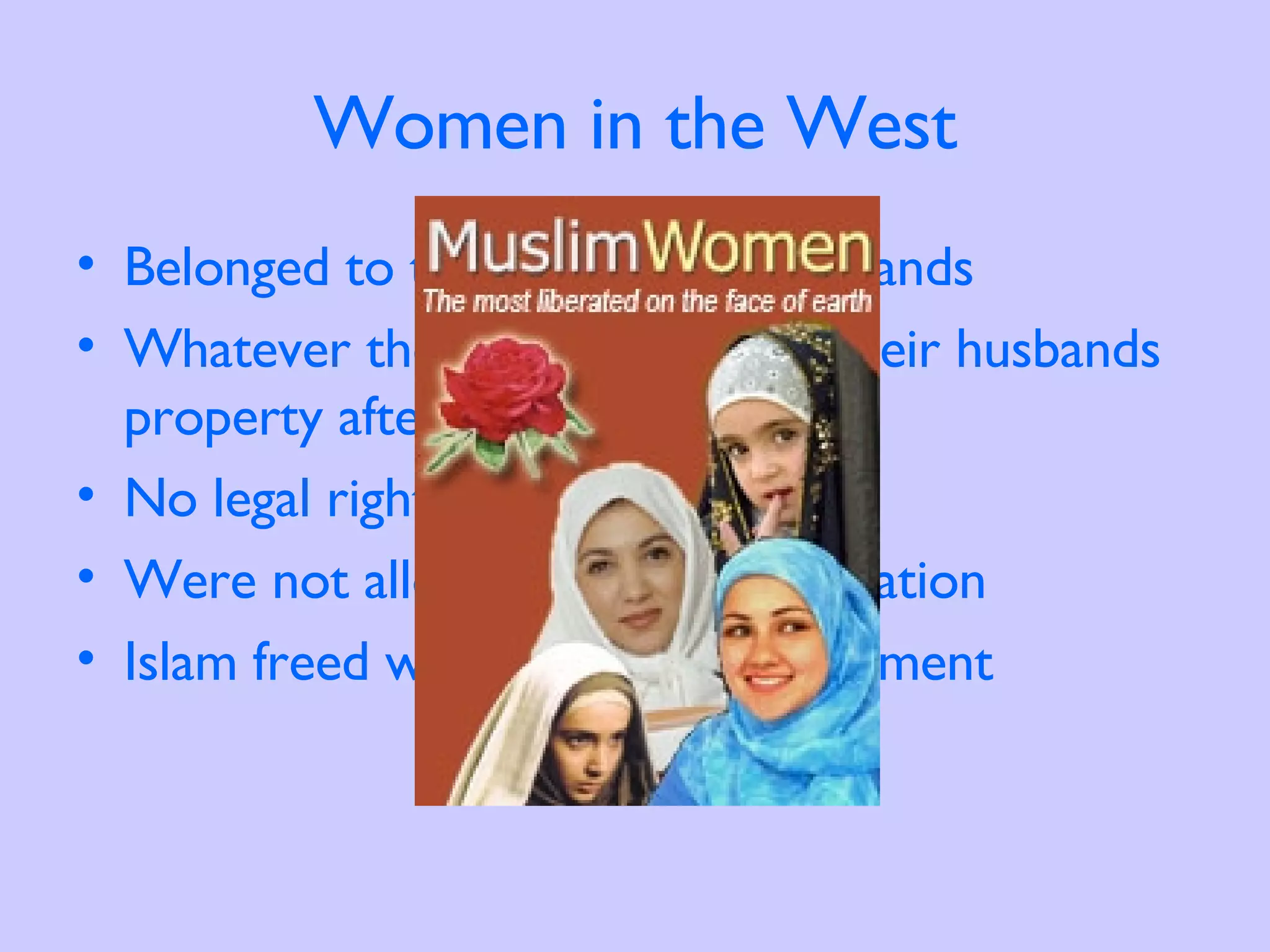
Women in the West Belonged to their fathers or husbands Whatever they owned became their husbands property after marriage No legal rights Were not allowed to get an education Islam freed women from mistreatment
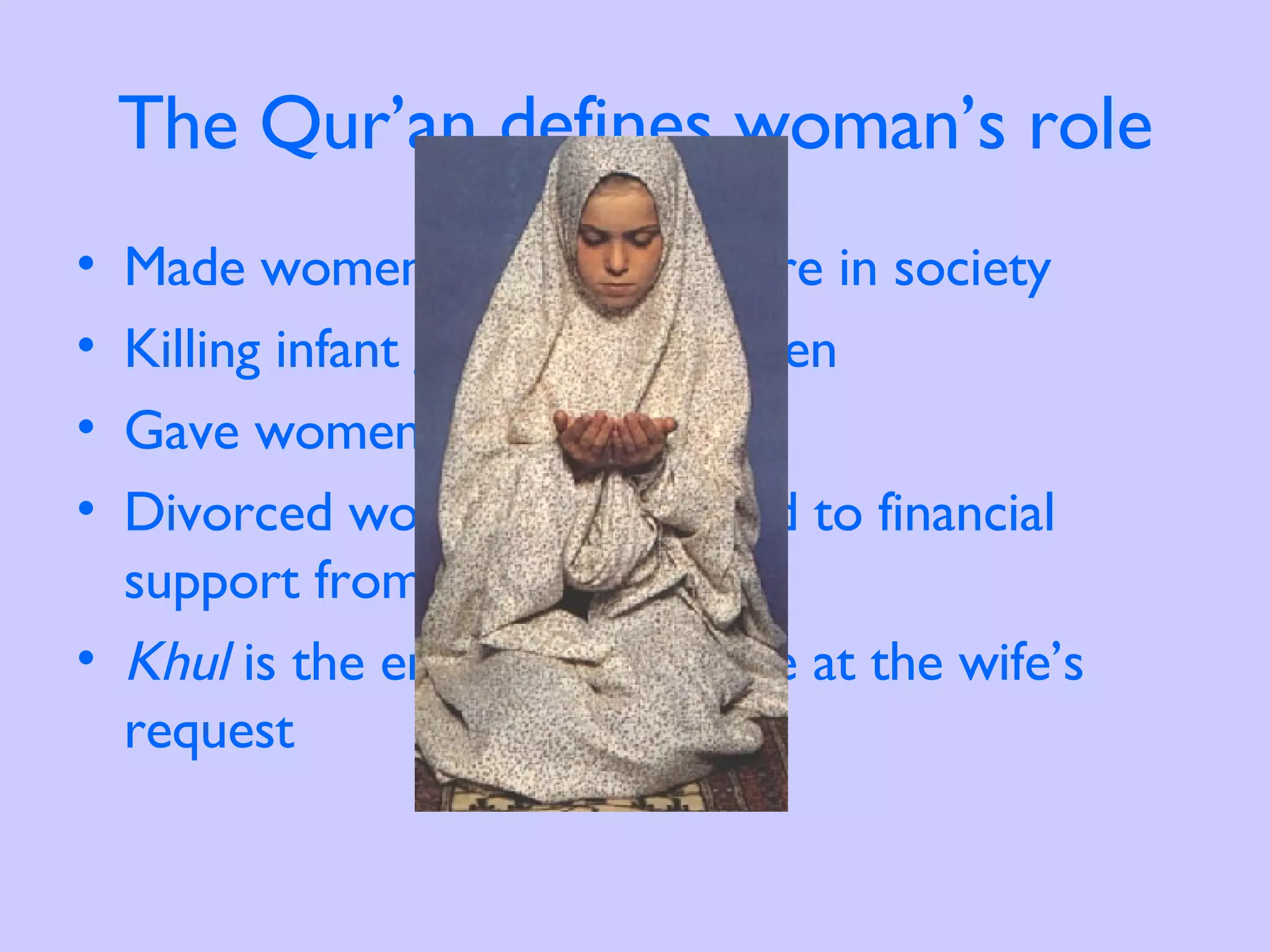
The Qur’an defines woman’s role Made women feel more secure in society Killing infant girls was forbidden Gave women birthrights Divorced woman was entitled to financial support from her ex-husband Khul  is the ending of marriage at the wife’s request
Different but complementary roles Quran portrays men and women equal although they still have corresponding functions Woman is the work of art of Allah’s formations Woman’s basis of self-respect is equal to man Both can choose the path they want to follow Value is equal, qualities differ Laws such as woman’s rights to owning property, divorce, inheriting family values, owning businesses, and getting an education have existed in Islam since the Prophet’s (PBUH) time Role model woman should be kind and committed Muslim women are entitled to the same rights as Western women, although it doesn’t always appear that way
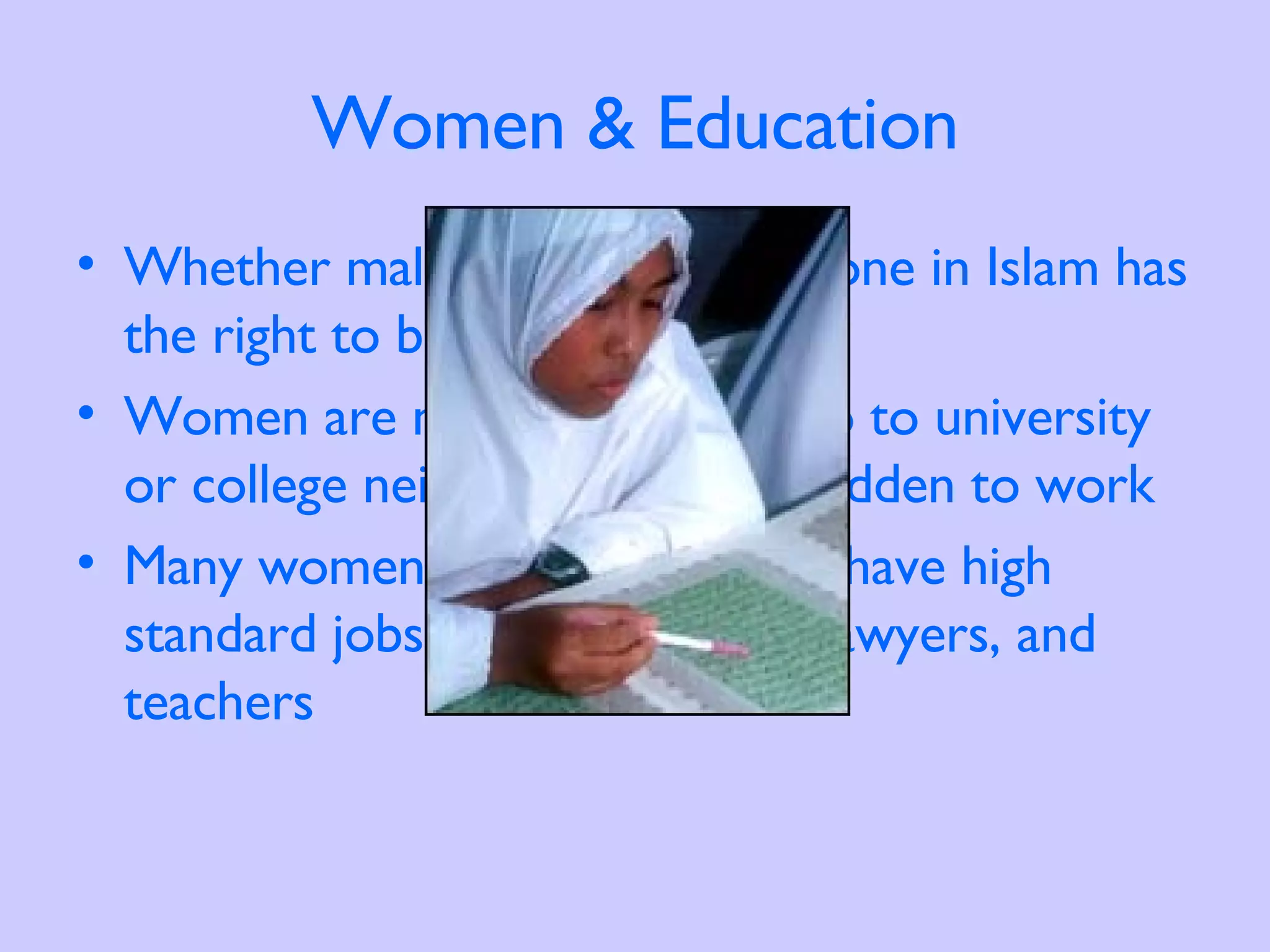
Women & Education Whether male or female, everyone in Islam has the right to be educated Women are not forbidden to go to university or college neither are they forbidden to work Many women in today’s society have high standard jobs such as doctors, lawyers, and teachers
Who is superior? Man or Woman? Although they are both viewed equally, women have different responsibilities in life Both are superior in Islam At the same time, women are treated as delicate figures Technically speaking, the man is responsible for providing for the family and the woman is responsible for taking care of her home
Man’s treatment of his wife As mentioned earlier in this presentation, the Prophet (PBUH) urged men to treat women with respect The Prophet (PBUH) said, “The best among you is the one who is best towards his wives.” “ Whoever takes care of two girls until they reach adulthood, he and I will come like this on the Day of Resurrection,” and he held his fingers together
Polygamy Polygamy, the marriage to more than one woman, is permitted in Islam but only with a legitimate reason A Muslim man may have up to four wives but he must be in a situation similar to: His wife has a incurable disease His wife cannot have children There are many widows due to war
Marriage & Divorce Quran encourages Muslims to marry Enforces that sexual relationships before marriage are sinful  In most cases, parents find a husband for their daughter, if she agrees then they can successfully get married The daughter has the right to object if she does not want the marriage Divorce can be demanded by either the husband or the wife It is forbidden for the husband to get his wife out by force The woman must wait three monthly cycles to ensure she is not expecting When two people are divorcing, it is possible for them to change their mind; it is also possible for them to change their mind once again and decide to divorce again; however, after the third time it becomes final Divorce is not encouraged, but if a couple is unhappy and divorce is the only solution, it is permitted
In conclusion, women before Islam were mistreated and looked down upon. In today’s society, thanks to Islam, women have rights equal to men and are able to be independent. Thank you for your attention.

Women In Islam

  • 1.
    Women in IslamBy: Sally Attar "I urge you to treat women well" said the Prophet (PBUH)
  • 2.
    Women in MedievalTimes Women were basically treated like domesticated pets Had to take care of all household responsibilities Worked in fields and helped their husbands Marriage was compulsory Treated with little or no respect
  • 3.
    Women in AsiaWidows were burnt alive Remarriage was prohibited Widows became slaves to their brother-in-laws
  • 4.
    Women in Arabiabefore Islam Women were not equal to men when it came to issues such as marriage, inheritance or education Women had no legal rights Female infants were buried alive Polygamy was widespread
  • 5.
    Women in theWest Belonged to their fathers or husbands Whatever they owned became their husbands property after marriage No legal rights Were not allowed to get an education Islam freed women from mistreatment
  • 6.
    The Qur’an defineswoman’s role Made women feel more secure in society Killing infant girls was forbidden Gave women birthrights Divorced woman was entitled to financial support from her ex-husband Khul is the ending of marriage at the wife’s request
  • 7.
    Different but complementaryroles Quran portrays men and women equal although they still have corresponding functions Woman is the work of art of Allah’s formations Woman’s basis of self-respect is equal to man Both can choose the path they want to follow Value is equal, qualities differ Laws such as woman’s rights to owning property, divorce, inheriting family values, owning businesses, and getting an education have existed in Islam since the Prophet’s (PBUH) time Role model woman should be kind and committed Muslim women are entitled to the same rights as Western women, although it doesn’t always appear that way
  • 8.
    Women & EducationWhether male or female, everyone in Islam has the right to be educated Women are not forbidden to go to university or college neither are they forbidden to work Many women in today’s society have high standard jobs such as doctors, lawyers, and teachers
  • 9.
    Who is superior?Man or Woman? Although they are both viewed equally, women have different responsibilities in life Both are superior in Islam At the same time, women are treated as delicate figures Technically speaking, the man is responsible for providing for the family and the woman is responsible for taking care of her home
  • 10.
    Man’s treatment ofhis wife As mentioned earlier in this presentation, the Prophet (PBUH) urged men to treat women with respect The Prophet (PBUH) said, “The best among you is the one who is best towards his wives.” “ Whoever takes care of two girls until they reach adulthood, he and I will come like this on the Day of Resurrection,” and he held his fingers together
  • 11.
    Polygamy Polygamy, themarriage to more than one woman, is permitted in Islam but only with a legitimate reason A Muslim man may have up to four wives but he must be in a situation similar to: His wife has a incurable disease His wife cannot have children There are many widows due to war
  • 12.
    Marriage & DivorceQuran encourages Muslims to marry Enforces that sexual relationships before marriage are sinful In most cases, parents find a husband for their daughter, if she agrees then they can successfully get married The daughter has the right to object if she does not want the marriage Divorce can be demanded by either the husband or the wife It is forbidden for the husband to get his wife out by force The woman must wait three monthly cycles to ensure she is not expecting When two people are divorcing, it is possible for them to change their mind; it is also possible for them to change their mind once again and decide to divorce again; however, after the third time it becomes final Divorce is not encouraged, but if a couple is unhappy and divorce is the only solution, it is permitted
  • 13.
    In conclusion, womenbefore Islam were mistreated and looked down upon. In today’s society, thanks to Islam, women have rights equal to men and are able to be independent. Thank you for your attention.