Dalit Literature: An
Overview
Department of English, MKBU.
Prepared by: Aakash Chavda
What is Dalit Literature?
● Dalit literature is a genre of Indian writing in
English that focuses on the lives, experiences,
and struggles of the marginalized Dalit
community, who have faced caste-based
oppression and discrimination for centuries.
● Their experiences as Dalit have led them to
depict their inhuman condition which is made by
the infamous caste system prevailed in India
since ages.
● Dalit Literature is at once the expression of a
“Dalit consciousness” about identity, human
rights and human dignity, and the community.
‘In that Country the laws of religion,
the laws of the land, and the laws of
honour, are all united and consolidated
in one, and bind a man eternally to the
rules of what is called his caste.’
- Edmund Burke
Pillars of Dalit Movement
B. R. Ambedkar Jyotiba Phule Periyar
● Beginning of the dalit writing was started with anti-brahmin and anti-caste
consciousness of Phule and Ambedkar.
● Jyotiba Phule founded the ‘Truth Seeker Society’, and pioneered in the field of
dalit women’s education.
● his revolutionary writings such as Trutiya Ratna, Gulamgiri, and Powada has
influence many writers.
● He was an economist, lawyer and professor, and inspired dalit buddhist
movement.
● He truly brought a revolution in the history of the anti-caste movement in
India.
● He successfully brought anti-caste laws and provisions in the constitution.
● His writings such as “The Annihilation of Caste” (1936), “Caste in India: Their
Mechanics, Genesis and Development” ( 1916), and “Waiting for a Visa” (1990)
has inspired countless dalit writers.
● He had written weeklies like, ‘Mook Nayak’, and ‘Janta’, and famous newspaper
“Bahishkrit Bharat” .
Foundational Writings
● “The Black Panther” of U. S. has inspired and led to the
establishment of “Dalit Panther” movement in India
during 1972.
● When a group of young writers and activists from
India’s Dalit community “discovered a copy of the Time
Magazine that featured the Black Panthers of the US,”
they decided to build something similar in India. This
led to the formation of the Dalit Panthers, “a resistance
group against caste discrimination.
● Namdeo Dhasal, Arjun Dangle, Raja Dhale, and J. V.
Pawar were the founders of dalit panther movement.
● The members of the Dalit Panther organization started
publishing pamphlets full of revolutionary poetry,
magazines covering their ideas and the state of things
at that time, and literary writings to create conscience
among the Dalit community.
● The movement sought to diminish the caste based
discrimination and reform the social hierarchies.
Dalit Panther Movement
● Namdeo Dhasal is a political activist belonging to
the Dalit Panther Party in Maharashtra, is a poet
and fiction writer of repute.
● Dhasal received the Nehru award for Golpitha.
Named after Mumbai's red light district, and
publication of Golpitha set a realistic trend in
Marathi poetry in the 1970s.
"most important poet in Dalit literature in recent
times is Namdev Dhasal, as no one can beat Dhasal
in the powerful imagery, evocative language and
bold statements against the system".
- Dr. Eleanor Zelliot
● Poet of The Underworld: Poems (2007) - Translated
poems by Dilip Chitre.
Namdeo Dhasal
● Arun Kolatkar is one of the famous modern
Indian English Poet who wrote both in Marathi
and in English language.
● His poems are known for expressing the
humour in everyday life.
● His first collection of poetry helped him won
literary fame along with Commonwealth Prize of
1977.
● His third Marathi publication, Bhijki Vahi, won a
Sahitya Akademi Award in 2004.
● Kolatkar's poetry is characterized by its wit,
irony, and conversational style, often
incorporating elements of everyday life,
cityscapes, and observations of human nature.
● Jejuri is a collection of 31 poems by Arun
Kolatkar.
● The poems depict Kolatkar's visit to the city of
Jejuri in Pune in 1964.
● The Bus, Heart of Ruin, The Door, The Manohar…
Arun Kolatkar
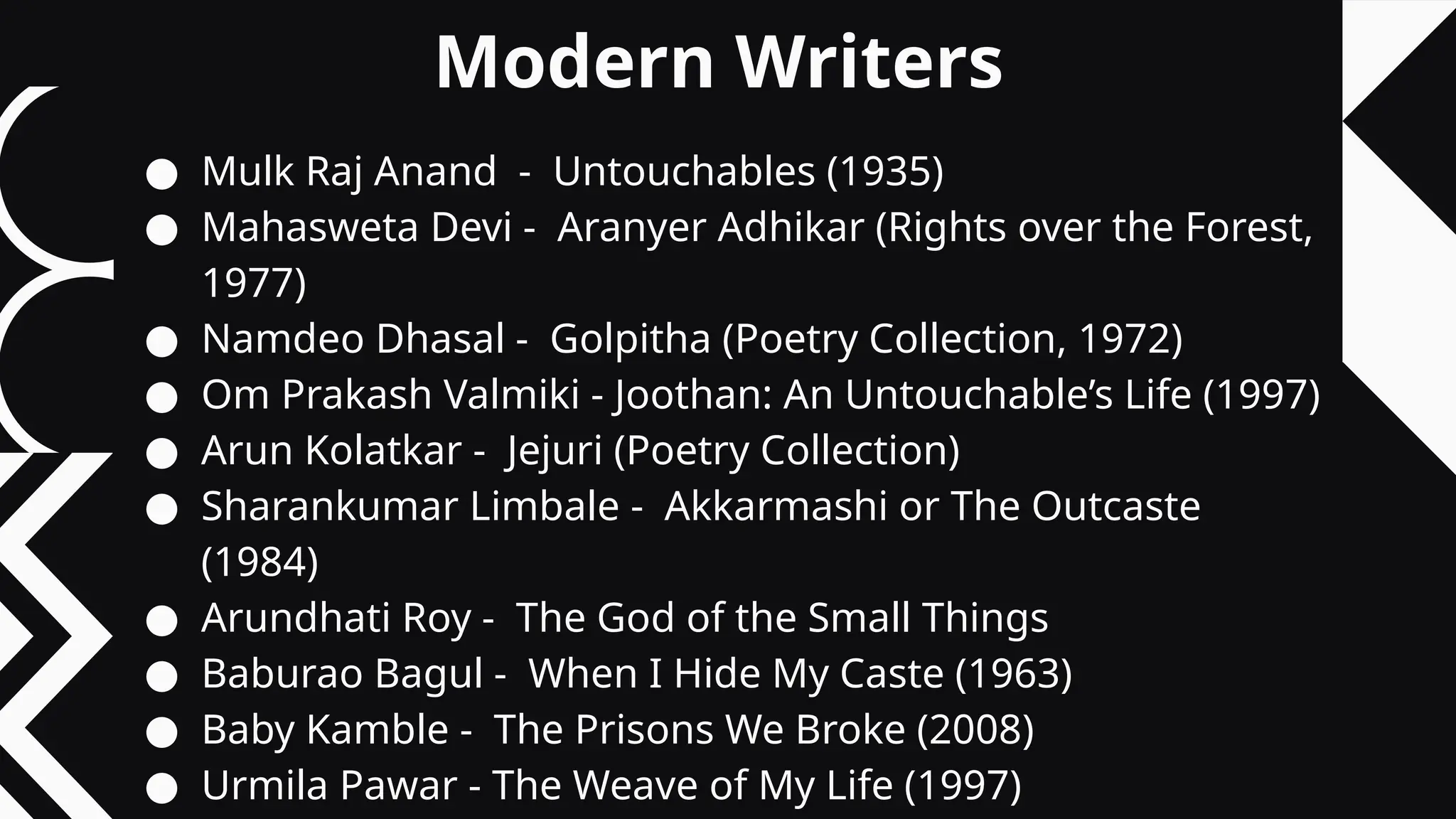
● Mulk Raj Anand - Untouchables (1935)
● Mahasweta Devi - Aranyer Adhikar (Rights over the Forest,
1977)
● Namdeo Dhasal - Golpitha (Poetry Collection, 1972)
● Om Prakash Valmiki - Joothan: An Untouchable’s Life (1997)
● Arun Kolatkar - Jejuri (Poetry Collection)
● Sharankumar Limbale - Akkarmashi or The Outcaste
(1984)
● Arundhati Roy - The God of the Small Things
● Baburao Bagul - When I Hide My Caste (1963)
● Baby Kamble - The Prisons We Broke (2008)
● Urmila Pawar - The Weave of My Life (1997)
Modern Writers
● Dalit literature has introduced new narrative forms and language
that reflect the lived realities of Dalits, enriching Indian literature with
its distinct style and perspective.
● By shedding light on the harsh realities of caste discrimination, Dalit
literature continues to inspire movements towards equality, justice,
and human dignity.
Conclusion
● Ananthamurthy, UR, and Jesus Christ. Dalit Writings and New Literatures – ‘New’ Literatures in English,
https://ebooks.inflibnet.ac.in/engp08/chapter/dalit-writings-and-new-literatures/. Accessed 28 August 2024.
● Kolatkar, Arun, and Robert Adamson. “Arun Kolatkar.” Bloodaxe Books,
https://www.bloodaxebooks.com/ecs/category/arun-kolatkar. Accessed 31 August 2024.
● Nayar, Pramod K. “Dalit Literature - Literary and Critical Theory.” Oxford Bibliographies, 12 January 2021,
https://www.oxfordbibliographies.com/display/document/obo-9780190221911/obo-9780190221911-0101.xml.
Accessed 28 August 2024.
● Taghavi, Kiana. “Disha Wadekar | Black Panthers and Dalit Panthers – Coöperism 13/13.” Coöperism 13/13, 4
May 2024, https://cooperism.law.columbia.edu/disha-wadekar-black-panthers-and-dalit-panthers/. Accessed 29
August 2024.
● “Twelve books that form part of the arsenal of Dalit writing.” The Caravan, 11 January 2021,
https://caravanmagazine.in/books/twelve-books-dalit-writing. Accessed 28 August 2024.
Citations
Thank you

Dalit Literature__ A brief Overview.pptx

  • 1.
    Dalit Literature: An Overview Departmentof English, MKBU. Prepared by: Aakash Chavda
  • 2.
    What is DalitLiterature? ● Dalit literature is a genre of Indian writing in English that focuses on the lives, experiences, and struggles of the marginalized Dalit community, who have faced caste-based oppression and discrimination for centuries. ● Their experiences as Dalit have led them to depict their inhuman condition which is made by the infamous caste system prevailed in India since ages. ● Dalit Literature is at once the expression of a “Dalit consciousness” about identity, human rights and human dignity, and the community.
  • 3.
    ‘In that Countrythe laws of religion, the laws of the land, and the laws of honour, are all united and consolidated in one, and bind a man eternally to the rules of what is called his caste.’ - Edmund Burke
  • 4.
    Pillars of DalitMovement B. R. Ambedkar Jyotiba Phule Periyar
  • 5.
    ● Beginning ofthe dalit writing was started with anti-brahmin and anti-caste consciousness of Phule and Ambedkar. ● Jyotiba Phule founded the ‘Truth Seeker Society’, and pioneered in the field of dalit women’s education. ● his revolutionary writings such as Trutiya Ratna, Gulamgiri, and Powada has influence many writers. ● He was an economist, lawyer and professor, and inspired dalit buddhist movement. ● He truly brought a revolution in the history of the anti-caste movement in India. ● He successfully brought anti-caste laws and provisions in the constitution. ● His writings such as “The Annihilation of Caste” (1936), “Caste in India: Their Mechanics, Genesis and Development” ( 1916), and “Waiting for a Visa” (1990) has inspired countless dalit writers. ● He had written weeklies like, ‘Mook Nayak’, and ‘Janta’, and famous newspaper “Bahishkrit Bharat” . Foundational Writings
  • 6.
    ● “The BlackPanther” of U. S. has inspired and led to the establishment of “Dalit Panther” movement in India during 1972. ● When a group of young writers and activists from India’s Dalit community “discovered a copy of the Time Magazine that featured the Black Panthers of the US,” they decided to build something similar in India. This led to the formation of the Dalit Panthers, “a resistance group against caste discrimination. ● Namdeo Dhasal, Arjun Dangle, Raja Dhale, and J. V. Pawar were the founders of dalit panther movement. ● The members of the Dalit Panther organization started publishing pamphlets full of revolutionary poetry, magazines covering their ideas and the state of things at that time, and literary writings to create conscience among the Dalit community. ● The movement sought to diminish the caste based discrimination and reform the social hierarchies. Dalit Panther Movement
  • 7.
    ● Namdeo Dhasalis a political activist belonging to the Dalit Panther Party in Maharashtra, is a poet and fiction writer of repute. ● Dhasal received the Nehru award for Golpitha. Named after Mumbai's red light district, and publication of Golpitha set a realistic trend in Marathi poetry in the 1970s. "most important poet in Dalit literature in recent times is Namdev Dhasal, as no one can beat Dhasal in the powerful imagery, evocative language and bold statements against the system". - Dr. Eleanor Zelliot ● Poet of The Underworld: Poems (2007) - Translated poems by Dilip Chitre. Namdeo Dhasal
  • 8.
    ● Arun Kolatkaris one of the famous modern Indian English Poet who wrote both in Marathi and in English language. ● His poems are known for expressing the humour in everyday life. ● His first collection of poetry helped him won literary fame along with Commonwealth Prize of 1977. ● His third Marathi publication, Bhijki Vahi, won a Sahitya Akademi Award in 2004. ● Kolatkar's poetry is characterized by its wit, irony, and conversational style, often incorporating elements of everyday life, cityscapes, and observations of human nature. ● Jejuri is a collection of 31 poems by Arun Kolatkar. ● The poems depict Kolatkar's visit to the city of Jejuri in Pune in 1964. ● The Bus, Heart of Ruin, The Door, The Manohar… Arun Kolatkar
  • 9.
    ● Mulk RajAnand - Untouchables (1935) ● Mahasweta Devi - Aranyer Adhikar (Rights over the Forest, 1977) ● Namdeo Dhasal - Golpitha (Poetry Collection, 1972) ● Om Prakash Valmiki - Joothan: An Untouchable’s Life (1997) ● Arun Kolatkar - Jejuri (Poetry Collection) ● Sharankumar Limbale - Akkarmashi or The Outcaste (1984) ● Arundhati Roy - The God of the Small Things ● Baburao Bagul - When I Hide My Caste (1963) ● Baby Kamble - The Prisons We Broke (2008) ● Urmila Pawar - The Weave of My Life (1997) Modern Writers
  • 10.
    ● Dalit literaturehas introduced new narrative forms and language that reflect the lived realities of Dalits, enriching Indian literature with its distinct style and perspective. ● By shedding light on the harsh realities of caste discrimination, Dalit literature continues to inspire movements towards equality, justice, and human dignity. Conclusion
  • 11.
    ● Ananthamurthy, UR,and Jesus Christ. Dalit Writings and New Literatures – ‘New’ Literatures in English, https://ebooks.inflibnet.ac.in/engp08/chapter/dalit-writings-and-new-literatures/. Accessed 28 August 2024. ● Kolatkar, Arun, and Robert Adamson. “Arun Kolatkar.” Bloodaxe Books, https://www.bloodaxebooks.com/ecs/category/arun-kolatkar. Accessed 31 August 2024. ● Nayar, Pramod K. “Dalit Literature - Literary and Critical Theory.” Oxford Bibliographies, 12 January 2021, https://www.oxfordbibliographies.com/display/document/obo-9780190221911/obo-9780190221911-0101.xml. Accessed 28 August 2024. ● Taghavi, Kiana. “Disha Wadekar | Black Panthers and Dalit Panthers – Coöperism 13/13.” Coöperism 13/13, 4 May 2024, https://cooperism.law.columbia.edu/disha-wadekar-black-panthers-and-dalit-panthers/. Accessed 29 August 2024. ● “Twelve books that form part of the arsenal of Dalit writing.” The Caravan, 11 January 2021, https://caravanmagazine.in/books/twelve-books-dalit-writing. Accessed 28 August 2024. Citations
  • 12.