5 Pillars
of Islam
Slide: Islamic bite-sized learning
Copyright © 2011 Syukran.com Private Ltd.
For online education use only.

No part of this ebook may be published, sold, or
otherwise used for profit without the written permission
of Syukran.

Please contact shahib@syukran.com for permission.
What you will Learn

What is the 5 Pillar of Islam.

Why it is important to understand as a
Muslim.

How each of 5 Pillars is connected to
each other and create relevancy.
01
The 5 Pillars of Islam
The meaning of Islam

The five pillars of Islam give you the
framework that gives schedule, controls
and state of mind necessaries to
prepare you into the real actions.

It is the first to understand as a Muslim
to get started and practice Islam fully.
“   So whoever hopes for the
    Meeting with his Lord, let
    him work rightousness.


                  Surah Al-Kafh (18:10)
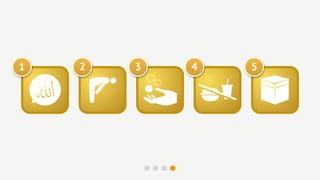
There are 5 Pillars of Islam which will be
discussed and breakdown as follows.
1   2   3   4   5
Witnessing
(Shahadah)
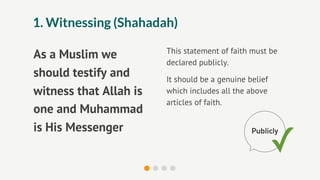
1. Witnessing (Shahadah)

                        This statement of faith must be
As a Muslim we
                        declared publicly.
should testify and      It should be a genuine belief
witness that Allah is   which includes all the above
                        articles of faith.
one and Muhammad
is His Messenger
                                                        ✓
                                                Publicly
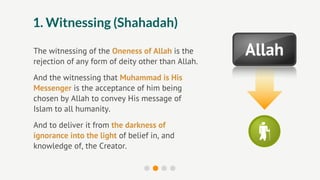
1. Witnessing (Shahadah)

The witnessing of the Oneness of Allah is the      Allah
rejection of any form of deity other than Allah.
And the witnessing that Muhammad is His
Messenger is the acceptance of him being
chosen by Allah to convey His message of
Islam to all humanity.
And to deliver it from the darkness of
ignorance into the light of belief in, and
knowledge of, the Creator.
1. Witnessing (Shahadah)


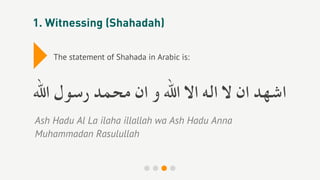
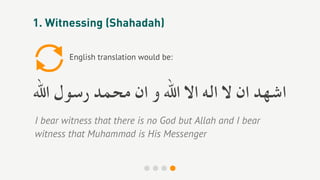
▸   The statement of Shahada in Arabic is:


‫اﺷﻬﺪ ان ﻻ اﻟﻪ اﻻ اﷲ و ان ﻣﺤﻤﺪ رﺳﻮل اﷲ‬
Ash Hadu Al La ilaha illallah wa Ash Hadu Anna
Muhammadan Rasulullah
1. Witnessing (Shahadah)

        English translation would be:


‫اﺷﻬﺪ ان ﻻ اﻟﻪ اﻻ اﷲ و ان ﻣﺤﻤﺪ رﺳﻮل اﷲ‬
I bear witness that there is no God but Allah and I bear
witness that Muhammad is His Messenger
Prayer (salah)
2. Prayer (salah)

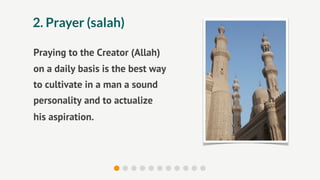
Praying to the Creator (Allah)
on a daily basis is the best way
to cultivate in a man a sound
personality and to actualize
his aspiration.
2. Prayer (salah)

Allah does not need man's prayer
because He is free of all needs.

Prayer is for our immeasurable
benefit, and the blessings are
beyond imagination.
2. Prayer (salah)

In prayer, every muscle of     It is a matchless and
the body joins the soul and    unprecedented formula of
the mind in the worship        intellectual meditation and
and glory of Allah.            spiritual devotion, of moral
                               elevation and physical
Prayer is an act of worship.
                               exercise, all combined.
2. Prayer (salah)

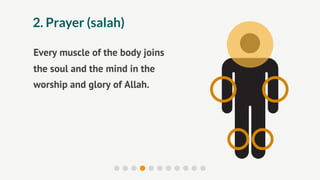
Every muscle of the body joins
the soul and the mind in the
worship and glory of Allah.
2. Prayer (salah)

Offering of prayers is obligatory
                                    Prayers is
upon every Muslim male and
female who is sane, mature and      obligatory
in the case of women free from
                                    upon every
menstruation and confinement
due to child birth.                 Muslim
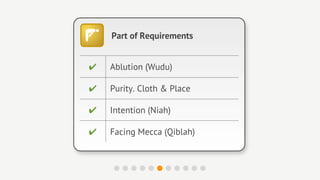
Part of Requirements


✔   Ablution (Wudu)

✔   Purity. Cloth & Place

✔   Intention (Niah)

✔   Facing Mecca (Qiblah)
2. Prayer (salah)

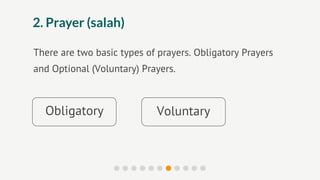
There are two basic types of prayers. Obligatory Prayers
and Optional (Voluntary) Prayers.


  Obligatory                Voluntary
2. Prayer (salah)

  Obligatory                 Voluntary


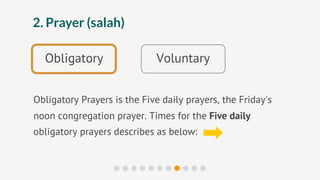
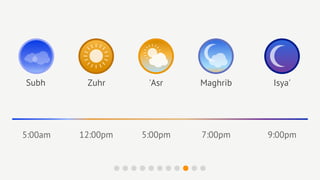
Obligatory Prayers is the Five daily prayers, the Friday's
noon congregation prayer. Times for the Five daily
obligatory prayers describes as below:
Subh      Zuhr      'Asr    Maghrib    Isya'


5:00am   12:00pm   5:00pm   7:00pm    9:00pm
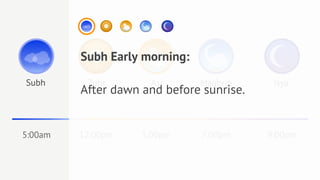
Subh Early morning:
Subh      Zuhr       'Asr      Maghrib     Isya'
         After dawn and before sunrise.


5:00am   12:00pm    5:00pm     7:00pm     9:00pm
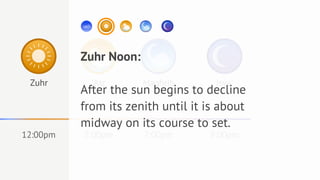
Zuhr Noon:
 Zuhr       'Asr       Maghrib       Isya'
          After the sun begins to decline
          from its zenith until it is about
          midway on its course to set.
12:00pm   5:00pm       7:00pm      9:00pm
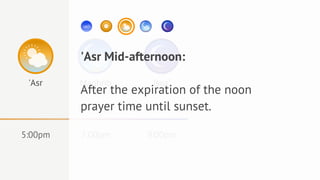
'Asr Mid-afternoon:
 'Asr    Maghrib      Isya'
         After the expiration of the noon
         prayer time until sunset.

5:00pm   7:00pm      9:00pm
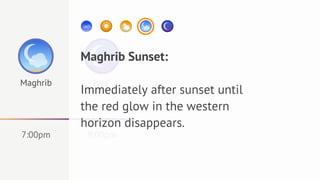
Maghrib Sunset:
Maghrib     Isya'
          Immediately after sunset until
          the red glow in the western
          horizon disappears.
7:00pm     9:00pm
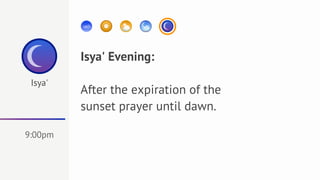
Isya' Evening:
 Isya'
         After the expiration of the
         sunset prayer until dawn.

9:00pm
2. Prayer (salah)

  Obligatory                Voluntary


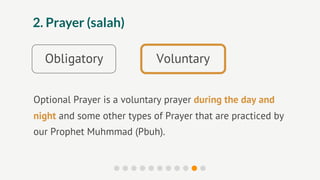
Optional Prayer is a voluntary prayer during the day and
night and some other types of Prayer that are practiced by
our Prophet Muhmmad (Pbuh).
2. Prayer (salah)

Obligatory Prayer should be
offered in its due time, unless
there is a reasonable excuse.

Delayed obligatory prayers
must be made up.                  ✓
Charity (Zakah)
3. Charity (Zakah)

                        The literal meaning of Zakah is
Obligatory charity
                        purity and it refers to the annual
giving is an act of     amount in kind which a Muslim
worship and spiritual   with means must distribute
                        among the rightful beneficiaries.
investment.
3. Charity (Zakah)

Zakah does not only purify the
property of the contributor but also
purifies his heart from selfishness
and greed.
3. Charity (Zakah)

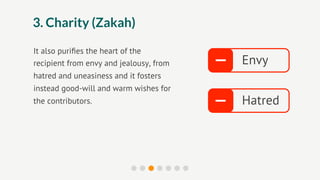
It also purifies the heart of the
recipient from envy and jealousy, from   –   Envy
hatred and uneasiness and it fosters
instead good-will and warm wishes for
the contributors.                        –   Hatred
3. Charity (Zakah)

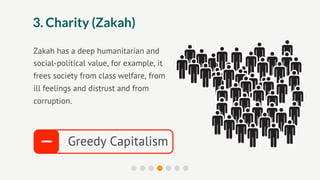
Zakah has a deep humanitarian and
social-political value, for example, it
frees society from class welfare, from
ill feelings and distrust and from
corruption.


  –       Greedy Capitalism
3. Charity (Zakah)

Zakah is paid on the net balance after


                                         $
paying personal expenses, family
expenses, due credits, taxes, etc.
Personal expenses       Due credits


                    $
 Family expenses        Taxes
$   The recipients (Asnaf) of Zakah

1   The poor, the needy
2   The new Muslim converts
3   The Muslim prisoners of war
4   Muslims in debt
5   Employees appointed to collect Zakah
6   Muslims in service of research or study
7   Foreigners in need of help
Fasting (sawm)
4. Fasting (sawm)

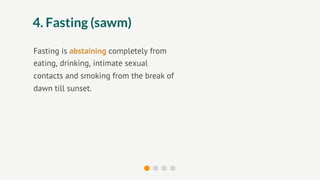
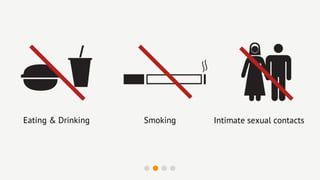
Fasting is abstaining completely from
eating, drinking, intimate sexual
contacts and smoking from the break of
dawn till sunset.
Eating & Drinking   Smoking   Intimate sexual contacts
4. Fasting (sawm)

                       Fasting teaches man a creative
It is a matchless      sense of hope, devotion, patience,
Islamic institution    unselfishness, moderation,
                       willpower, wise saving, sound
which teaches man      budgeting, mature adaptability,
the principle of       healthy survival, discipline, spirit
                       of social belonging, unity and
sincere love to God.   brotherhood.
4. Fasting (sawm)

Obligatory fasting is done once a
year for the period of the month    Ramadan


                                     1
of Ramadan, the ninth month of
the Islamic year.
The Pilgrimage
(hajj)
5. The Pilgrimage (hajj)

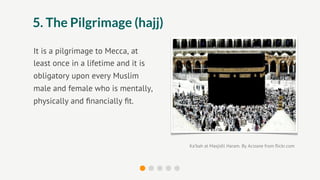
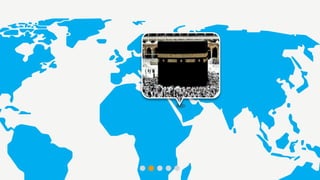
It is a pilgrimage to Mecca, at
least once in a lifetime and it is
obligatory upon every Muslim
male and female who is mentally,
physically and financially fit.


                                     Ka’bah at Masjidil Haram. By Acizane from flickr.com
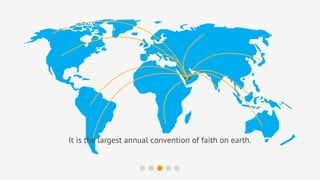
It is the largest annual convention of faith on earth.
5. The Pilgrimage (hajj)

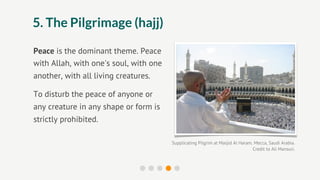
Peace is the dominant theme. Peace
with Allah, with one's soul, with one
another, with all living creatures.

To disturb the peace of anyone or
any creature in any shape or form is
strictly prohibited.

                                        Supplicating Pilgrim at Masjid Al Haram. Mecca, Saudi Arabia.
                                                                                Credit to Ali Mansuri.
5. The Pilgrimage (hajj)

Muslims from all walks of        There is no royalty, but there is
life, from every corner of the   loyalty of all to Allah, the
globe assemble in Mecca in       Creator.
response to the call of Allah.   Muslims go to Mecca to glorify
                                 Allah, not to worship a man.
Credit
Design & Graphics by Shahib Amin.
Founder of Syukran.com Private Ltd


Resources
Islam way of life. Wikibooks, the open-content textbooks collection.
Images by wikipedia.com, qurancomplex.com.


What you can do
You can print out pages and put them in your office, school's waiting room or Mosques.
You may not alter this book in any way, though, and you may not charge for it.

You may not use it as your schools curriculum or as part of your education system.
Please contact Shahib at shahib@syukran.com for permission.
5 Pillars of Islam

5 Pillars of Islam

  • 1.
    5 Pillars of Islam Slide:Islamic bite-sized learning
  • 3.
    Copyright © 2011Syukran.com Private Ltd. For online education use only. No part of this ebook may be published, sold, or otherwise used for profit without the written permission of Syukran. Please contact shahib@syukran.com for permission.
  • 4.
    What you willLearn What is the 5 Pillar of Islam. Why it is important to understand as a Muslim. How each of 5 Pillars is connected to each other and create relevancy.
  • 5.
  • 6.
    The meaning ofIslam The five pillars of Islam give you the framework that gives schedule, controls and state of mind necessaries to prepare you into the real actions. It is the first to understand as a Muslim to get started and practice Islam fully.
  • 7.
    So whoever hopes for the Meeting with his Lord, let him work rightousness. Surah Al-Kafh (18:10)
  • 8.
    There are 5Pillars of Islam which will be discussed and breakdown as follows.
  • 9.
    1 2 3 4 5
  • 10.
  • 11.
    1. Witnessing (Shahadah) This statement of faith must be As a Muslim we declared publicly. should testify and It should be a genuine belief witness that Allah is which includes all the above articles of faith. one and Muhammad is His Messenger ✓ Publicly
  • 12.
    1. Witnessing (Shahadah) Thewitnessing of the Oneness of Allah is the Allah rejection of any form of deity other than Allah. And the witnessing that Muhammad is His Messenger is the acceptance of him being chosen by Allah to convey His message of Islam to all humanity. And to deliver it from the darkness of ignorance into the light of belief in, and knowledge of, the Creator.
  • 13.
    1. Witnessing (Shahadah) ▸ The statement of Shahada in Arabic is: ‫اﺷﻬﺪ ان ﻻ اﻟﻪ اﻻ اﷲ و ان ﻣﺤﻤﺪ رﺳﻮل اﷲ‬ Ash Hadu Al La ilaha illallah wa Ash Hadu Anna Muhammadan Rasulullah
  • 14.
    1. Witnessing (Shahadah) English translation would be: ‫اﺷﻬﺪ ان ﻻ اﻟﻪ اﻻ اﷲ و ان ﻣﺤﻤﺪ رﺳﻮل اﷲ‬ I bear witness that there is no God but Allah and I bear witness that Muhammad is His Messenger
  • 15.
  • 16.
    2. Prayer (salah) Prayingto the Creator (Allah) on a daily basis is the best way to cultivate in a man a sound personality and to actualize his aspiration.
  • 17.
    2. Prayer (salah) Allahdoes not need man's prayer because He is free of all needs. Prayer is for our immeasurable benefit, and the blessings are beyond imagination.
  • 18.
    2. Prayer (salah) Inprayer, every muscle of It is a matchless and the body joins the soul and unprecedented formula of the mind in the worship intellectual meditation and and glory of Allah. spiritual devotion, of moral elevation and physical Prayer is an act of worship. exercise, all combined.
  • 19.
    2. Prayer (salah) Everymuscle of the body joins the soul and the mind in the worship and glory of Allah.
  • 20.
    2. Prayer (salah) Offeringof prayers is obligatory Prayers is upon every Muslim male and female who is sane, mature and obligatory in the case of women free from upon every menstruation and confinement due to child birth. Muslim
  • 21.
    Part of Requirements ✔ Ablution (Wudu) ✔ Purity. Cloth & Place ✔ Intention (Niah) ✔ Facing Mecca (Qiblah)
  • 22.
    2. Prayer (salah) Thereare two basic types of prayers. Obligatory Prayers and Optional (Voluntary) Prayers. Obligatory Voluntary
  • 23.
    2. Prayer (salah) Obligatory Voluntary Obligatory Prayers is the Five daily prayers, the Friday's noon congregation prayer. Times for the Five daily obligatory prayers describes as below:


  • 24.
    Subh Zuhr 'Asr Maghrib Isya' 5:00am 12:00pm 5:00pm 7:00pm 9:00pm
  • 25.
    Subh Early morning: Subh Zuhr 'Asr Maghrib Isya' After dawn and before sunrise. 5:00am 12:00pm 5:00pm 7:00pm 9:00pm
  • 26.
    Zuhr Noon: Zuhr 'Asr Maghrib Isya' After the sun begins to decline from its zenith until it is about midway on its course to set. 12:00pm 5:00pm 7:00pm 9:00pm
  • 27.
    'Asr Mid-afternoon: 'Asr Maghrib Isya' After the expiration of the noon prayer time until sunset. 5:00pm 7:00pm 9:00pm
  • 28.
    Maghrib Sunset: Maghrib Isya' Immediately after sunset until the red glow in the western horizon disappears. 7:00pm 9:00pm
  • 29.
    Isya' Evening: Isya' After the expiration of the sunset prayer until dawn. 9:00pm
  • 30.
    2. Prayer (salah) Obligatory Voluntary Optional Prayer is a voluntary prayer during the day and night and some other types of Prayer that are practiced by our Prophet Muhmmad (Pbuh).
  • 31.
    2. Prayer (salah) ObligatoryPrayer should be offered in its due time, unless there is a reasonable excuse. Delayed obligatory prayers must be made up. ✓
  • 32.
  • 33.
    3. Charity (Zakah) The literal meaning of Zakah is Obligatory charity purity and it refers to the annual giving is an act of amount in kind which a Muslim worship and spiritual with means must distribute among the rightful beneficiaries. investment.
  • 34.
    3. Charity (Zakah) Zakahdoes not only purify the property of the contributor but also purifies his heart from selfishness and greed.
  • 35.
    3. Charity (Zakah) Italso purifies the heart of the recipient from envy and jealousy, from – Envy hatred and uneasiness and it fosters instead good-will and warm wishes for the contributors. – Hatred
  • 36.
    3. Charity (Zakah) Zakahhas a deep humanitarian and social-political value, for example, it frees society from class welfare, from ill feelings and distrust and from corruption. – Greedy Capitalism
  • 37.
    3. Charity (Zakah) Zakahis paid on the net balance after $ paying personal expenses, family expenses, due credits, taxes, etc.
  • 38.
    Personal expenses Due credits $ Family expenses Taxes
  • 39.
    $ The recipients (Asnaf) of Zakah 1 The poor, the needy 2 The new Muslim converts 3 The Muslim prisoners of war 4 Muslims in debt 5 Employees appointed to collect Zakah 6 Muslims in service of research or study 7 Foreigners in need of help
  • 40.
  • 41.
    4. Fasting (sawm) Fastingis abstaining completely from eating, drinking, intimate sexual contacts and smoking from the break of dawn till sunset.
  • 42.
    Eating & Drinking Smoking Intimate sexual contacts
  • 43.
    4. Fasting (sawm) Fasting teaches man a creative It is a matchless sense of hope, devotion, patience, Islamic institution unselfishness, moderation, willpower, wise saving, sound which teaches man budgeting, mature adaptability, the principle of healthy survival, discipline, spirit of social belonging, unity and sincere love to God. brotherhood.
  • 44.
    4. Fasting (sawm) Obligatoryfasting is done once a year for the period of the month Ramadan 1 of Ramadan, the ninth month of the Islamic year.
  • 45.
  • 46.
    5. The Pilgrimage(hajj) It is a pilgrimage to Mecca, at least once in a lifetime and it is obligatory upon every Muslim male and female who is mentally, physically and financially fit. Ka’bah at Masjidil Haram. By Acizane from flickr.com
  • 48.
    It is thelargest annual convention of faith on earth.
  • 49.
    5. The Pilgrimage(hajj) Peace is the dominant theme. Peace with Allah, with one's soul, with one another, with all living creatures. To disturb the peace of anyone or any creature in any shape or form is strictly prohibited. Supplicating Pilgrim at Masjid Al Haram. Mecca, Saudi Arabia. Credit to Ali Mansuri.
  • 50.
    5. The Pilgrimage(hajj) Muslims from all walks of There is no royalty, but there is life, from every corner of the loyalty of all to Allah, the globe assemble in Mecca in Creator. response to the call of Allah. Muslims go to Mecca to glorify Allah, not to worship a man.
  • 51.
    Credit Design & Graphicsby Shahib Amin. Founder of Syukran.com Private Ltd Resources Islam way of life. Wikibooks, the open-content textbooks collection. Images by wikipedia.com, qurancomplex.com. What you can do You can print out pages and put them in your office, school's waiting room or Mosques. You may not alter this book in any way, though, and you may not charge for it. You may not use it as your schools curriculum or as part of your education system. Please contact Shahib at shahib@syukran.com for permission.