

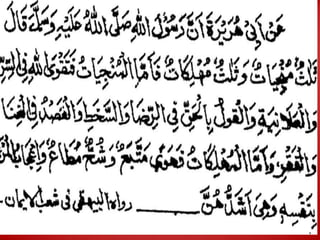



3 Munjiyaat (Saving Virtues)

  3 Muhlikaat (Destructive Vices)
3 Munjiyaat (Saving Virtues)
1. Taqwah of Allah (SWT) in hiding or in
   open
2. To speak the truth in (state of ) anger or
   pleasure
3. Moderation in prosperity as well as in
   poverty.
3 Muhlikaat (Destructive Vices)
1. Inordinate desire which is followed
2. Stinginess which is obeyed
3. Self-Conceit ( Covetousness). This is the
   worst of all.
Abu Huraira (R) the narrator of this
              hadith
• His actual name is Abdul Rahman Bin Sakhr
• He was borne 18 years before Hijrah
• He embraced Islam in 7th Hijrah.
• He lived in Prophet‟s Masjid and remained in
  the company of the Prophet.
• He is one of the people of Suffah.
• He was a keen student of the Prophet for 4-5
  years.
• He narrated 5374 ahadith
Abu Huraira
• He narrated , I said to the Prophet, “I hear
  many ahadith from you but I forget them.”
  Prophet said, “Spread your garment.” I did
  accordingly. He moved his hands as if filling
  with something and then emptied them in my
  garment. Then he said, “ Take this garment
  and wrap it over your body.” I did it and I
  never ever forgot any thing since then.
• He continued to teach Islam for 50 years and
  died at the age of 78.
1- Taqwah of Allah in open or in
              hiding
• This word is derived from „Wiqaya‟ which
  means to protect.
• Taqwah means to protect oneself or fear from
  anger and chastisement of Allah.
• And Allah warns you about Himself. 3:28
• O‟Believers! Save yourself and your family
  from the fire of Hell. Tahreem: 6
• O‟our Rabb! Grant us success in this world
  and the hereafter and protect us from fire of
  Hell. 2:201
Taqwah
• Abu Zar (R) requested the Prophet to give
  him advice. He said I advise you with
  Taqwah of Allah because this is the root of
  every righteous deed.
3 degrees of Taqwah
• 1-The lowest minimal level is to avoid Kufr and Shirk. In this
  sense, every Muslim can be counted as Muttaqi even if he is
  involved in sins.
• 2- Desirable falls under the second degree of Taqwah that
• is, to avoid that which is disliked by Allah and His Messenger.
  The
• merits and blessings of Taqwah in the Qur„an and Hadith
• have been promised on this degree of avoidance and
  abstinence.
• 3- Third degree or the highest level is achieved by the
  prophets, companions and special servants of Allah, for it is
  not within the grasp of everybody. It requires to stand guard
  over one's heart against the onslaught of what does not
  please Allah, and to keep it filled with the remembrance of
  Allah and the efforts to get closer to Allah.
Achieve Taqwah which it deserves
'Abdullah ibn-Mas„ud, RabI', Qatadah and
Hasan al Basari said:

   A fear which is His due' means that
• One obeys, then does not disobey;
• Remembers then does not forget;
• Is grateful, then does not become
  ungrateful. (Al-Bahr Al-Muhit)
How to achieve Taqwah?
• Abide by the commandments of
  Allah and stay away from his prohibitions.
• Abdullah Bin Masood (R) said, “ Taqwah
  means to obey Allah and not to
  disobey, remember Him and do not
  forget, to be grateful and then do not
  become ungrateful.”
Ali Ibn Abi Talib ®
•   Taqwah is to fear Allah the Magnificent
•   To abide by His revelation, i.e., Quran
•   To be satisfied with little provision
•   To be ready for the departure from this
    world, i.e., death.
Ibn Motambar (Rahimahullah)
• Give up the sins, whether minor or major
• This is the essence of Taqwah
• Walk on the earth like the person who is
  careful about thorny shrubs on the sides
• Don‟t consider minor sins as trivial
  because the mountain is made of small
  pieces of rocks.
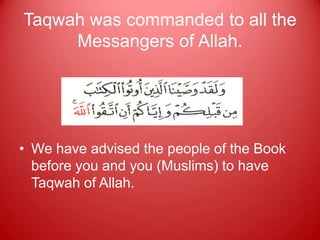
Taqwah was commanded to all the
     Messangers of Allah.


• We have advised the people of the Book
  before you and you (Muslims) to have
  Taqwah of Allah.
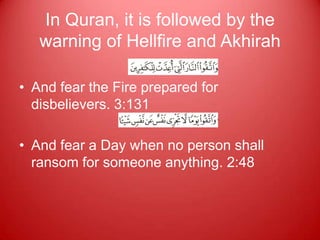
In Quran, it is followed by the
   warning of Hellfire and Akhirah

• And fear the Fire prepared for
  disbelievers. 3:131

• And fear a Day when no person shall
  ransom for someone anything. 2:48
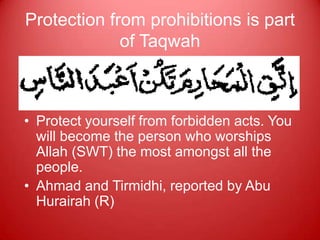
Protection from prohibitions is part
             of Taqwah


• Protect yourself from forbidden acts. You
  will become the person who worships
  Allah (SWT) the most amongst all the
  people.
• Ahmad and Tirmidhi, reported by Abu
  Hurairah (R)
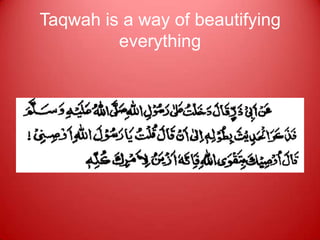
Taqwah is a way of beautifying
         everything
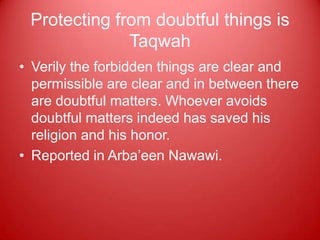
Protecting from doubtful things is
              Taqwah
• Verily the forbidden things are clear and
  permissible are clear and in between there
  are doubtful matters. Whoever avoids
  doubtful matters indeed has saved his
  religion and his honor.
• Reported in Arba‟een Nawawi.
Dua of the Prophet (SA) for Taqwah
•
  O Allah! Give my soul its good. You are its
Guardian and Master, and the best to purify it.
  At-Tabarani, reported by Ibn Abbas
•

   O Allah! Give my soul its good and purify it,
for You are the best to purify it. You are its
Guardian and Master.
  Ahmad, reported by Zaid Ibn Arqam
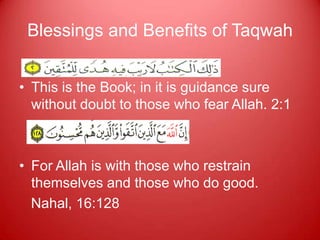
Blessings and Benefits of Taqwah


• This is the Book; in it is guidance sure
  without doubt to those who fear Allah. 2:1


• For Allah is with those who restrain
  themselves and those who do good.
  Nahal, 16:128
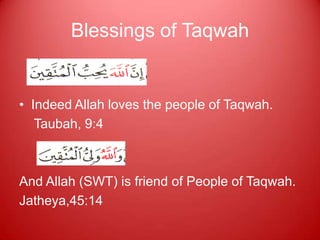
Blessings of Taqwah


• Indeed Allah loves the people of Taqwah.
   Taubah, 9:4


And Allah (SWT) is friend of People of Taqwah.
Jatheya,45:14
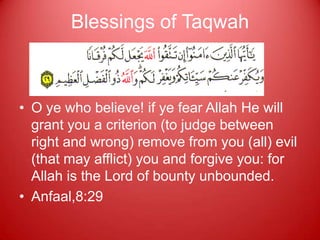
Blessings of Taqwah


• O ye who believe! if ye fear Allah He will
  grant you a criterion (to judge between
  right and wrong) remove from you (all) evil
  (that may afflict) you and forgive you: for
  Allah is the Lord of bounty unbounded.
• Anfaal,8:29
Blessings of Taqwah

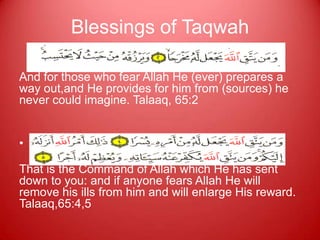
And for those who fear Allah He (ever) prepares a
way out,and He provides for him from (sources) he
never could imagine. Talaaq, 65:2


• or those who fear Allah He will make their path
  easy. 5513 5514
That is the Command of Allah which He has sent
down to you: and if anyone fears Allah He will
remove his ills from him and will enlarge His reward.
Talaaq,65:4,5
Blessings of Taqwah


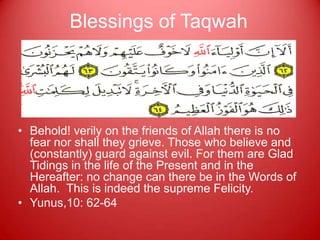
• Behold! verily on the friends of Allah there is no
  fear nor shall they grieve. Those who believe and
  (constantly) guard against evil. For them are Glad
  Tidings in the life of the Present and in the
  Hereafter: no change can there be in the Words of
  Allah. This is indeed the supreme Felicity.
• Yunus,10: 62-64
Taqwah leads to Jannah


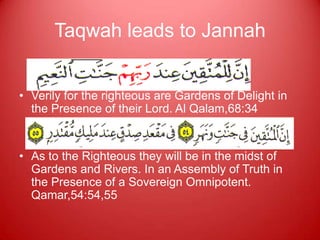
• Verily for the righteous are Gardens of Delight in
  the Presence of their Lord. Al Qalam,68:34


• As to the Righteous they will be in the midst of
  Gardens and Rivers. In an Assembly of Truth in
  the Presence of a Sovereign Omnipotent.
  Qamar,54:54,55
2- To Speak the Truth


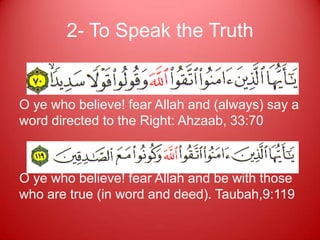
O ye who believe! fear Allah and (always) say a
word directed to the Right: Ahzaab, 33:70


O ye who believe! fear Allah and be with those
who are true (in word and deed). Taubah,9:119
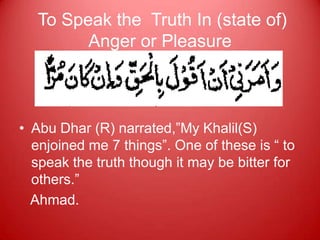
To Speak the Truth In (state of)
         Anger or Pleasure


• Abu Dhar (R) narrated,”My Khalil(S)
  enjoined me 7 things”. One of these is “ to
  speak the truth though it may be bitter for
  others.”
  Ahmad.
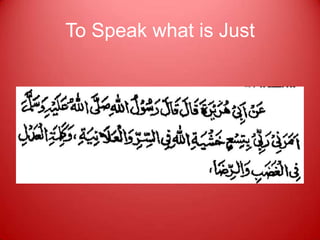
To Speak what is Just
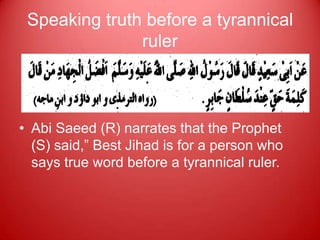
Speaking truth before a tyrannical
               ruler


• Abi Saeed (R) narrates that the Prophet
  (S) said,” Best Jihad is for a person who
  says true word before a tyrannical ruler.
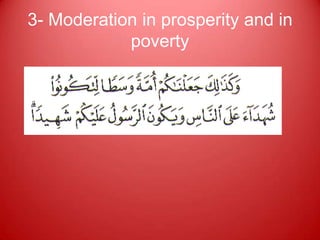
3- Moderation in prosperity and in
            poverty
Be moderate in spending


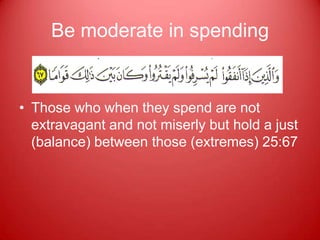
• Those who when they spend are not
  extravagant and not miserly but hold a just
  (balance) between those (extremes) 25:67
Extremist are blameworthy and
              destitute


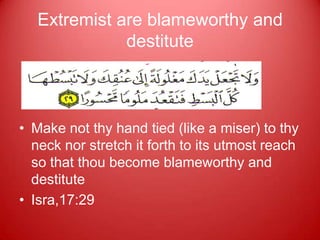
• Make not thy hand tied (like a miser) to thy
  neck nor stretch it forth to its utmost reach
  so that thou become blameworthy and
  destitute
• Isra,17:29
A part of the people of the Book are
       on middle or right path


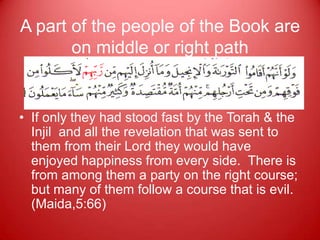
• If only they had stood fast by the Torah & the
  Injil and all the revelation that was sent to
  them from their Lord they would have
  enjoyed happiness from every side. There is
  from among them a party on the right course;
  but many of them follow a course that is evil.
  (Maida,5:66)
3 Categories of Muslims


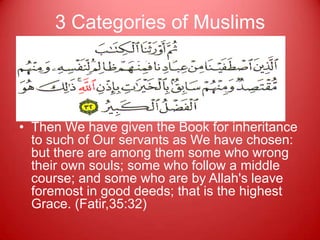
• Then We have given the Book for inheritance
  to such of Our servants as We have chosen:
  but there are among them some who wrong
  their own souls; some who follow a middle
  course; and some who are by Allah's leave
  foremost in good deeds; that is the highest
  Grace. (Fatir,35:32)
3 Muhlikaat (Destructive Vices)
     1-Inordinate Desire which is
               followed
• “Hawa” literally means to fall down.
• It means to blindly follow physical desires
  regardless of permissibility.
• This attitude lets person fall down from his
  high moral status to the lowest level. In the
  hereafter, it will lead to his fall in “Hawiah”
  (a place in Hellfire). Imam Raghib Isfahani.
Do not follow Hawa!

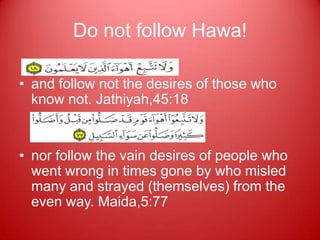
• and follow not the desires of those who
  know not. Jathiyah,45:18


• nor follow the vain desires of people who
  went wrong in times gone by who misled
  many and strayed (themselves) from the
  even way. Maida,5:77
Following inordinate desires leads
          to misguidance

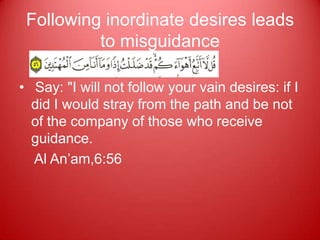
• Say: "I will not follow your vain desires: if I
  did I would stray from the path and be not
  of the company of those who receive
  guidance.
  Al An‟am,6:56
Follower of desires is most
             misguided


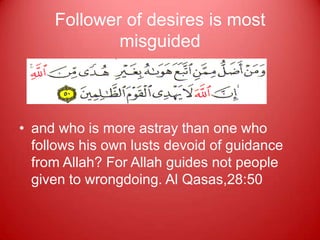
• and who is more astray than one who
  follows his own lusts devoid of guidance
  from Allah? For Allah guides not people
  given to wrongdoing. Al Qasas,28:50
es


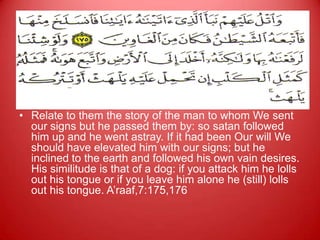
• Relate to them the story of the man to whom We sent
  our signs but he passed them by: so satan followed
  him up and he went astray. If it had been Our will We
  should have elevated him with our signs; but he
  inclined to the earth and followed his own vain desires.
  His similitude is that of a dog: if you attack him he lolls
  out his tongue or if you leave him alone he (still) lolls
  out his tongue. A‟raaf,7:175,176
One who controls his desires shall
         enter Jannah


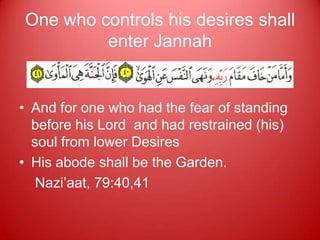
• And for one who had the fear of standing
  before his Lord and had restrained (his)
  soul from lower Desires
• His abode shall be the Garden.
   Nazi‟aat, 79:40,41
2-Shuh Mut‟a
     Covetousness or stinginess
• Shuh (Covetousness) is defined as
  inordinate desire for wealth or possessions
  or for another's possessions.
• Its synonym is avaricious implies
  obsessive acquisitiveness especially of
  money and strongly suggests stinginess
Shuh Mut‟a
STINGINESS WHICH IS OBEYED

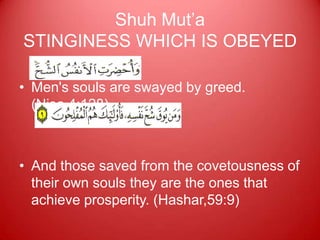
• Men's souls are swayed by greed.
  (Nisa,4:128)


• And those saved from the covetousness of
  their own souls they are the ones that
  achieve prosperity. (Hashar,59:9)
Hadith explaining stinginess
          Prophet(S) said:
•

• Be on your guard against committing
  oppression, for oppression is a darkness on the
  Day of Resurrection. Be on your guard against
  being stingy, for being stingy is what destroyed
  those who were before you. It made them shed
  blood and make lawful what was unlawful for
  them.
• Reported by Jarir bin Abdullah in Musnad Ahmad
Components of Shuh or
           Covetousness
Covetousness is composed of the four faults:
Cowardice:
Greed: desire to possess everything which is
  insatiable and ever increasing in its demands.
Injustice:
Ignorance:
• (Ibn HazmFrom “Al-Akhlaq wa’l Siyar” –
  Morality and Behaviour Published in “In
  Pursuit of Virtue” by M. Abu Laylah, Ta-Ha
  Publishers 1990)
Hadith about Greed
• It is reported from the Holy Prophet
  (s.a.w):
 If the son of Adam had two valleys full of
gold, in fact, he would remain in search of a
third one and nothing but dust can fill the
belly of the son of Adam and God forgives
everyone who repents.
Opposite of covetousness is
            disinterest
    in amassing material wealth
• A virtuous quality which includes:
Generosity: stops him fretting about property
  which is lost to him.
Courage: gives birth to a greatness of spirit
  which makes him disinterested.
 Justice: His equitable nature makes him love
  reserve and moderation in his desires.
Intelligence: He understands the vanity of
  covetousness and prefers disinterest
3- Self - Deception And Egotism
           Ijaab or Ujb
• Ujb: Man due to attributes or blessing he
  has thinks that he is great and becomes
  unmindful of the one who granted all that
  to him.
• Kibr: In case of pride, it is necessary that
  there is someone else so that the proud
  may be able to imagine himself to be
  better than the other
Stages of Egotism
• Ujb when man becomes happy with himself
• Pride and self-centeredness also branch out
  from this stage and he considers himself to
  be better than others.
• As a result of some of his good deeds he
  thinks has acquired some rights over Allah.
• Bad deed appears good to one, and he
  becomes happy with it.
Harms of ujb or covetousness

• Person with Ujb does not benefit from
  knowledgeable persons, as he imagines
  himself on their level and sometimes even
  above them
• Ujb makes a person unpleasant among the
  people who become displeased with him and
  do not care for him.
• Egotism takes man away from reality. He is
  not able to benefit from good deeds
• Egotist mostly has failed and will fail
General Remedy For Egotism
• Man should ponder over the Greatness of the
  Creator of the Universe. He must understand
  that Greatness belongs only to Him.
• Power and Eternity are only Allah‟s attributes
• Smallness and mortality belongs to man
  himself
• He must think over his earlier stages of life
• Finally at the end also he will turn into a
  carcass and will be placed in a grave.
Specific Remedies.
• If egotism of man is due to his strength and
  power, he must remember that this power is
  inferior even to a microbe
• If egotism is based on wisdom and
  intelligence and abundance of knowledge we
  ought to know that this is a Divine bounty for
  which we must be thankful to God.
• If his egotism is because of his race he must
  realize he is descendent of Adam who was
  created from dust.
More Remedies.
• If man's pride is due to abundance of wealth and
  children he should know that these are some of
  the bounties bestowed by Allah and have been
  entrusted to him for some days by way of a trust
  for his trial
• If property and children were the cause of man's
  greatness, God would not have given it to His
  enemies.
• “And not your wealth nor your children, are the
  things which bring you near us” Quran
• Before other people also he should consider
  himself little.

3 actions leading to salvation

  • 1.
    3 Munjiyaat (SavingVirtues) 3 Muhlikaat (Destructive Vices)
  • 3.
    3 Munjiyaat (SavingVirtues) 1. Taqwah of Allah (SWT) in hiding or in open 2. To speak the truth in (state of ) anger or pleasure 3. Moderation in prosperity as well as in poverty.
  • 4.
    3 Muhlikaat (DestructiveVices) 1. Inordinate desire which is followed 2. Stinginess which is obeyed 3. Self-Conceit ( Covetousness). This is the worst of all.
  • 5.
    Abu Huraira (R)the narrator of this hadith • His actual name is Abdul Rahman Bin Sakhr • He was borne 18 years before Hijrah • He embraced Islam in 7th Hijrah. • He lived in Prophet‟s Masjid and remained in the company of the Prophet. • He is one of the people of Suffah. • He was a keen student of the Prophet for 4-5 years. • He narrated 5374 ahadith
  • 6.
    Abu Huraira • Henarrated , I said to the Prophet, “I hear many ahadith from you but I forget them.” Prophet said, “Spread your garment.” I did accordingly. He moved his hands as if filling with something and then emptied them in my garment. Then he said, “ Take this garment and wrap it over your body.” I did it and I never ever forgot any thing since then. • He continued to teach Islam for 50 years and died at the age of 78.
  • 7.
    1- Taqwah ofAllah in open or in hiding • This word is derived from „Wiqaya‟ which means to protect. • Taqwah means to protect oneself or fear from anger and chastisement of Allah. • And Allah warns you about Himself. 3:28 • O‟Believers! Save yourself and your family from the fire of Hell. Tahreem: 6 • O‟our Rabb! Grant us success in this world and the hereafter and protect us from fire of Hell. 2:201
  • 8.
    Taqwah • Abu Zar(R) requested the Prophet to give him advice. He said I advise you with Taqwah of Allah because this is the root of every righteous deed.
  • 9.
    3 degrees ofTaqwah • 1-The lowest minimal level is to avoid Kufr and Shirk. In this sense, every Muslim can be counted as Muttaqi even if he is involved in sins. • 2- Desirable falls under the second degree of Taqwah that • is, to avoid that which is disliked by Allah and His Messenger. The • merits and blessings of Taqwah in the Qur„an and Hadith • have been promised on this degree of avoidance and abstinence. • 3- Third degree or the highest level is achieved by the prophets, companions and special servants of Allah, for it is not within the grasp of everybody. It requires to stand guard over one's heart against the onslaught of what does not please Allah, and to keep it filled with the remembrance of Allah and the efforts to get closer to Allah.
  • 10.
    Achieve Taqwah whichit deserves 'Abdullah ibn-Mas„ud, RabI', Qatadah and Hasan al Basari said: A fear which is His due' means that • One obeys, then does not disobey; • Remembers then does not forget; • Is grateful, then does not become ungrateful. (Al-Bahr Al-Muhit)
  • 11.
    How to achieveTaqwah? • Abide by the commandments of Allah and stay away from his prohibitions. • Abdullah Bin Masood (R) said, “ Taqwah means to obey Allah and not to disobey, remember Him and do not forget, to be grateful and then do not become ungrateful.”
  • 12.
    Ali Ibn AbiTalib ® • Taqwah is to fear Allah the Magnificent • To abide by His revelation, i.e., Quran • To be satisfied with little provision • To be ready for the departure from this world, i.e., death.
  • 13.
    Ibn Motambar (Rahimahullah) •Give up the sins, whether minor or major • This is the essence of Taqwah • Walk on the earth like the person who is careful about thorny shrubs on the sides • Don‟t consider minor sins as trivial because the mountain is made of small pieces of rocks.
  • 14.
    Taqwah was commandedto all the Messangers of Allah. • We have advised the people of the Book before you and you (Muslims) to have Taqwah of Allah.
  • 15.
    In Quran, itis followed by the warning of Hellfire and Akhirah • And fear the Fire prepared for disbelievers. 3:131 • And fear a Day when no person shall ransom for someone anything. 2:48
  • 16.
    Protection from prohibitionsis part of Taqwah • Protect yourself from forbidden acts. You will become the person who worships Allah (SWT) the most amongst all the people. • Ahmad and Tirmidhi, reported by Abu Hurairah (R)
  • 17.
    Taqwah is away of beautifying everything
  • 18.
    Protecting from doubtfulthings is Taqwah • Verily the forbidden things are clear and permissible are clear and in between there are doubtful matters. Whoever avoids doubtful matters indeed has saved his religion and his honor. • Reported in Arba‟een Nawawi.
  • 19.
    Dua of theProphet (SA) for Taqwah • O Allah! Give my soul its good. You are its Guardian and Master, and the best to purify it. At-Tabarani, reported by Ibn Abbas • O Allah! Give my soul its good and purify it, for You are the best to purify it. You are its Guardian and Master. Ahmad, reported by Zaid Ibn Arqam
  • 20.
    Blessings and Benefitsof Taqwah • This is the Book; in it is guidance sure without doubt to those who fear Allah. 2:1 • For Allah is with those who restrain themselves and those who do good. Nahal, 16:128
  • 21.
    Blessings of Taqwah •Indeed Allah loves the people of Taqwah. Taubah, 9:4 And Allah (SWT) is friend of People of Taqwah. Jatheya,45:14
  • 22.
    Blessings of Taqwah •O ye who believe! if ye fear Allah He will grant you a criterion (to judge between right and wrong) remove from you (all) evil (that may afflict) you and forgive you: for Allah is the Lord of bounty unbounded. • Anfaal,8:29
  • 23.
    Blessings of Taqwah Andfor those who fear Allah He (ever) prepares a way out,and He provides for him from (sources) he never could imagine. Talaaq, 65:2 • or those who fear Allah He will make their path easy. 5513 5514 That is the Command of Allah which He has sent down to you: and if anyone fears Allah He will remove his ills from him and will enlarge His reward. Talaaq,65:4,5
  • 24.
    Blessings of Taqwah •Behold! verily on the friends of Allah there is no fear nor shall they grieve. Those who believe and (constantly) guard against evil. For them are Glad Tidings in the life of the Present and in the Hereafter: no change can there be in the Words of Allah. This is indeed the supreme Felicity. • Yunus,10: 62-64
  • 25.
    Taqwah leads toJannah • Verily for the righteous are Gardens of Delight in the Presence of their Lord. Al Qalam,68:34 • As to the Righteous they will be in the midst of Gardens and Rivers. In an Assembly of Truth in the Presence of a Sovereign Omnipotent. Qamar,54:54,55
  • 26.
    2- To Speakthe Truth O ye who believe! fear Allah and (always) say a word directed to the Right: Ahzaab, 33:70 O ye who believe! fear Allah and be with those who are true (in word and deed). Taubah,9:119
  • 27.
    To Speak theTruth In (state of) Anger or Pleasure • Abu Dhar (R) narrated,”My Khalil(S) enjoined me 7 things”. One of these is “ to speak the truth though it may be bitter for others.” Ahmad.
  • 28.
  • 29.
    Speaking truth beforea tyrannical ruler • Abi Saeed (R) narrates that the Prophet (S) said,” Best Jihad is for a person who says true word before a tyrannical ruler.
  • 30.
    3- Moderation inprosperity and in poverty
  • 31.
    Be moderate inspending • Those who when they spend are not extravagant and not miserly but hold a just (balance) between those (extremes) 25:67
  • 32.
    Extremist are blameworthyand destitute • Make not thy hand tied (like a miser) to thy neck nor stretch it forth to its utmost reach so that thou become blameworthy and destitute • Isra,17:29
  • 33.
    A part ofthe people of the Book are on middle or right path • If only they had stood fast by the Torah & the Injil and all the revelation that was sent to them from their Lord they would have enjoyed happiness from every side. There is from among them a party on the right course; but many of them follow a course that is evil. (Maida,5:66)
  • 34.
    3 Categories ofMuslims • Then We have given the Book for inheritance to such of Our servants as We have chosen: but there are among them some who wrong their own souls; some who follow a middle course; and some who are by Allah's leave foremost in good deeds; that is the highest Grace. (Fatir,35:32)
  • 35.
    3 Muhlikaat (DestructiveVices) 1-Inordinate Desire which is followed • “Hawa” literally means to fall down. • It means to blindly follow physical desires regardless of permissibility. • This attitude lets person fall down from his high moral status to the lowest level. In the hereafter, it will lead to his fall in “Hawiah” (a place in Hellfire). Imam Raghib Isfahani.
  • 36.
    Do not followHawa! • and follow not the desires of those who know not. Jathiyah,45:18 • nor follow the vain desires of people who went wrong in times gone by who misled many and strayed (themselves) from the even way. Maida,5:77
  • 37.
    Following inordinate desiresleads to misguidance • Say: "I will not follow your vain desires: if I did I would stray from the path and be not of the company of those who receive guidance. Al An‟am,6:56
  • 38.
    Follower of desiresis most misguided • and who is more astray than one who follows his own lusts devoid of guidance from Allah? For Allah guides not people given to wrongdoing. Al Qasas,28:50
  • 39.
    es • Relate tothem the story of the man to whom We sent our signs but he passed them by: so satan followed him up and he went astray. If it had been Our will We should have elevated him with our signs; but he inclined to the earth and followed his own vain desires. His similitude is that of a dog: if you attack him he lolls out his tongue or if you leave him alone he (still) lolls out his tongue. A‟raaf,7:175,176
  • 40.
    One who controlshis desires shall enter Jannah • And for one who had the fear of standing before his Lord and had restrained (his) soul from lower Desires • His abode shall be the Garden. Nazi‟aat, 79:40,41
  • 41.
    2-Shuh Mut‟a Covetousness or stinginess • Shuh (Covetousness) is defined as inordinate desire for wealth or possessions or for another's possessions. • Its synonym is avaricious implies obsessive acquisitiveness especially of money and strongly suggests stinginess
  • 42.
    Shuh Mut‟a STINGINESS WHICHIS OBEYED • Men's souls are swayed by greed. (Nisa,4:128) • And those saved from the covetousness of their own souls they are the ones that achieve prosperity. (Hashar,59:9)
  • 43.
    Hadith explaining stinginess Prophet(S) said: • • Be on your guard against committing oppression, for oppression is a darkness on the Day of Resurrection. Be on your guard against being stingy, for being stingy is what destroyed those who were before you. It made them shed blood and make lawful what was unlawful for them. • Reported by Jarir bin Abdullah in Musnad Ahmad
  • 44.
    Components of Shuhor Covetousness Covetousness is composed of the four faults: Cowardice: Greed: desire to possess everything which is insatiable and ever increasing in its demands. Injustice: Ignorance: • (Ibn HazmFrom “Al-Akhlaq wa’l Siyar” – Morality and Behaviour Published in “In Pursuit of Virtue” by M. Abu Laylah, Ta-Ha Publishers 1990)
  • 45.
    Hadith about Greed •It is reported from the Holy Prophet (s.a.w): If the son of Adam had two valleys full of gold, in fact, he would remain in search of a third one and nothing but dust can fill the belly of the son of Adam and God forgives everyone who repents.
  • 46.
    Opposite of covetousnessis disinterest in amassing material wealth • A virtuous quality which includes: Generosity: stops him fretting about property which is lost to him. Courage: gives birth to a greatness of spirit which makes him disinterested.  Justice: His equitable nature makes him love reserve and moderation in his desires. Intelligence: He understands the vanity of covetousness and prefers disinterest
  • 47.
    3- Self -Deception And Egotism Ijaab or Ujb • Ujb: Man due to attributes or blessing he has thinks that he is great and becomes unmindful of the one who granted all that to him. • Kibr: In case of pride, it is necessary that there is someone else so that the proud may be able to imagine himself to be better than the other
  • 48.
    Stages of Egotism •Ujb when man becomes happy with himself • Pride and self-centeredness also branch out from this stage and he considers himself to be better than others. • As a result of some of his good deeds he thinks has acquired some rights over Allah. • Bad deed appears good to one, and he becomes happy with it.
  • 49.
    Harms of ujbor covetousness • Person with Ujb does not benefit from knowledgeable persons, as he imagines himself on their level and sometimes even above them • Ujb makes a person unpleasant among the people who become displeased with him and do not care for him. • Egotism takes man away from reality. He is not able to benefit from good deeds • Egotist mostly has failed and will fail
  • 50.
    General Remedy ForEgotism • Man should ponder over the Greatness of the Creator of the Universe. He must understand that Greatness belongs only to Him. • Power and Eternity are only Allah‟s attributes • Smallness and mortality belongs to man himself • He must think over his earlier stages of life • Finally at the end also he will turn into a carcass and will be placed in a grave.
  • 51.
    Specific Remedies. • Ifegotism of man is due to his strength and power, he must remember that this power is inferior even to a microbe • If egotism is based on wisdom and intelligence and abundance of knowledge we ought to know that this is a Divine bounty for which we must be thankful to God. • If his egotism is because of his race he must realize he is descendent of Adam who was created from dust.
  • 52.
    More Remedies. • Ifman's pride is due to abundance of wealth and children he should know that these are some of the bounties bestowed by Allah and have been entrusted to him for some days by way of a trust for his trial • If property and children were the cause of man's greatness, God would not have given it to His enemies. • “And not your wealth nor your children, are the things which bring you near us” Quran • Before other people also he should consider himself little.