Fabulous Flint Laura McLean  Essex Finds Liaison Officer
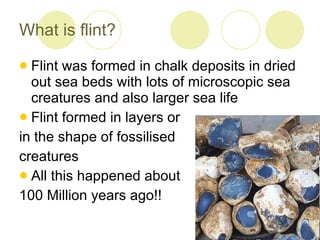
What is flint? Flint was formed in chalk deposits in dried out sea beds with lots of microscopic sea creatures and also larger sea life Flint formed in layers or in the shape of fossilised  creatures All this happened about 100 Million years ago!!
Flint Facts Flint is sharper than a metal blade Diamonds are one of the few things harder than flint Flint was used by humans over years ago, and is still used today
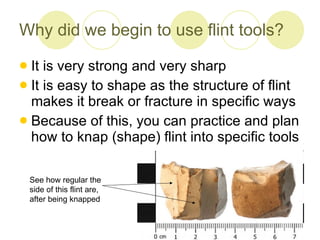
Why did we begin to use flint tools? It is very strong and very sharp  It is easy to shape as the structure of flint makes it break or fracture in specific ways Because of this, you can practice and plan how to knap (shape) flint into specific tools See how regular the side of this flint are, after being knapped
The Palaeolithic The first use of flint was in the  Palaeolithic (Old Stone Age)  which started 600,000 years ago and lasted until 10,000 years ago – that’s a really long time!!!  The Palaeolithic is most famous for its hand axes
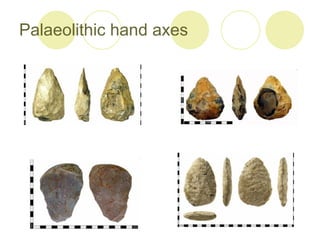
Palaeolithic hand axes
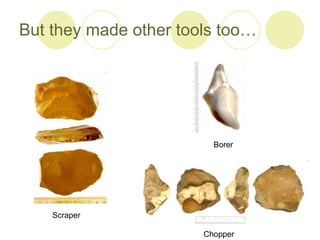
But they made other tools too… Borer Chopper Scraper
Mesolithic The  Mesolithic (Middle Stone Age)  began about 10,000 years ago and ended about 5,500 years ago Mesolithic man lived ‘hunter-gatherer’ groups Most tools from this age reflect their hunter lifestyle
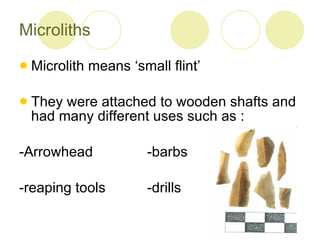
Microliths Microlith means ‘small flint’ They were attached to wooden shafts and had many different uses such as : -Arrowhead  -barbs  -reaping tools  -drills
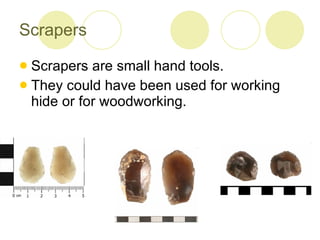
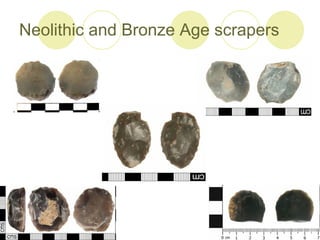
Scrapers Scrapers are small hand tools. They could have been used for working hide or for woodworking.
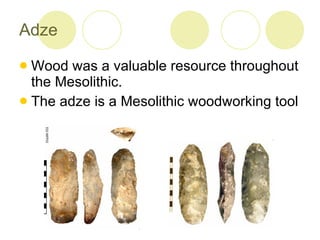
Adze Wood was a valuable resource throughout the Mesolithic.  The adze is a Mesolithic woodworking tool
Neolithic and Bronze Age The  Neolithic (New Stone Age)  5,500 years ago to 4,000 years ago Metal working began 4,000 years ago and marked the beginning of the  Bronze Age  but they didn’t abandon the use of flint and stone tools
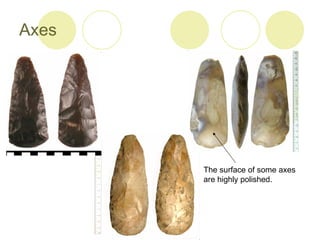
Axes The surface of some axes  are highly polished.
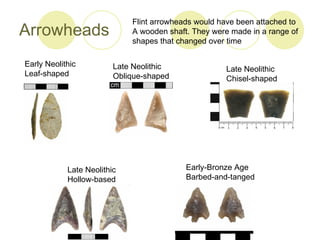
Arrowheads Early Neolithic Leaf-shaped  Late Neolithic Oblique-shaped  Late Neolithic Chisel-shaped  Late Neolithic Hollow-based Early-Bronze Age Barbed-and-tanged Flint arrowheads would have been attached to  A wooden shaft. They were made in a range of  shapes that changed over time
Neolithic and Bronze Age scrapers
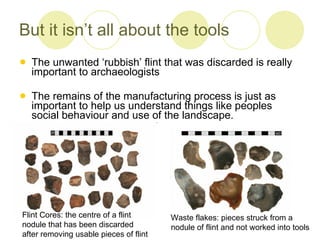
But it isn’t all about the tools The unwanted ‘rubbish’ flint that was discarded is really important to archaeologists The remains of the manufacturing process is just as important to help us understand things like peoples social behaviour and use of the landscape.  Flint Cores: the centre of a flint  nodule that has been discarded  after removing usable pieces of flint Waste flakes: pieces struck from a  nodule of flint and not worked into tools

What is flint?

  • 1.
    Fabulous Flint LauraMcLean Essex Finds Liaison Officer
  • 2.
    What is flint?Flint was formed in chalk deposits in dried out sea beds with lots of microscopic sea creatures and also larger sea life Flint formed in layers or in the shape of fossilised creatures All this happened about 100 Million years ago!!
  • 3.
    Flint Facts Flintis sharper than a metal blade Diamonds are one of the few things harder than flint Flint was used by humans over years ago, and is still used today
  • 4.
    Why did webegin to use flint tools? It is very strong and very sharp It is easy to shape as the structure of flint makes it break or fracture in specific ways Because of this, you can practice and plan how to knap (shape) flint into specific tools See how regular the side of this flint are, after being knapped
  • 5.
    The Palaeolithic Thefirst use of flint was in the Palaeolithic (Old Stone Age) which started 600,000 years ago and lasted until 10,000 years ago – that’s a really long time!!! The Palaeolithic is most famous for its hand axes
  • 6.
  • 7.
    But they madeother tools too… Borer Chopper Scraper
  • 8.
    Mesolithic The Mesolithic (Middle Stone Age) began about 10,000 years ago and ended about 5,500 years ago Mesolithic man lived ‘hunter-gatherer’ groups Most tools from this age reflect their hunter lifestyle
  • 9.
    Microliths Microlith means‘small flint’ They were attached to wooden shafts and had many different uses such as : -Arrowhead -barbs -reaping tools -drills
  • 10.
    Scrapers Scrapers aresmall hand tools. They could have been used for working hide or for woodworking.
  • 11.
    Adze Wood wasa valuable resource throughout the Mesolithic. The adze is a Mesolithic woodworking tool
  • 12.
    Neolithic and BronzeAge The Neolithic (New Stone Age) 5,500 years ago to 4,000 years ago Metal working began 4,000 years ago and marked the beginning of the Bronze Age but they didn’t abandon the use of flint and stone tools
  • 13.
    Axes The surfaceof some axes are highly polished.
  • 14.
    Arrowheads Early NeolithicLeaf-shaped Late Neolithic Oblique-shaped Late Neolithic Chisel-shaped Late Neolithic Hollow-based Early-Bronze Age Barbed-and-tanged Flint arrowheads would have been attached to A wooden shaft. They were made in a range of shapes that changed over time
  • 15.
  • 16.
    But it isn’tall about the tools The unwanted ‘rubbish’ flint that was discarded is really important to archaeologists The remains of the manufacturing process is just as important to help us understand things like peoples social behaviour and use of the landscape. Flint Cores: the centre of a flint nodule that has been discarded after removing usable pieces of flint Waste flakes: pieces struck from a nodule of flint and not worked into tools