Download as PDF, PPTX
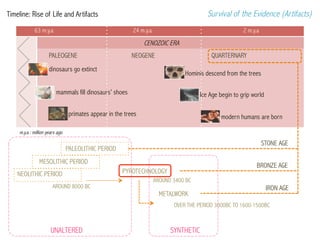
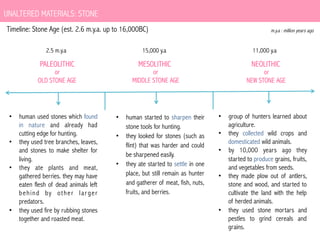
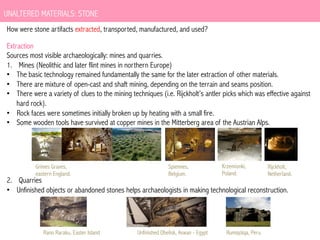
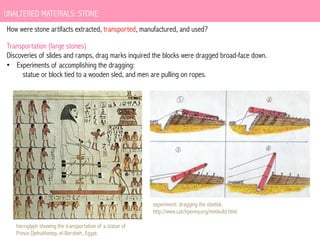
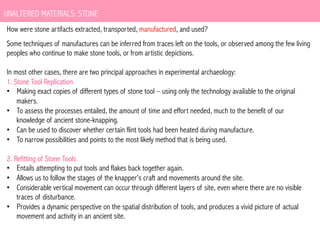
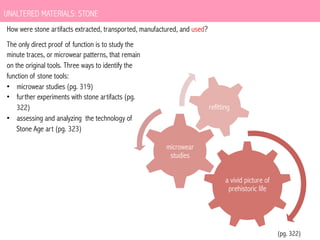
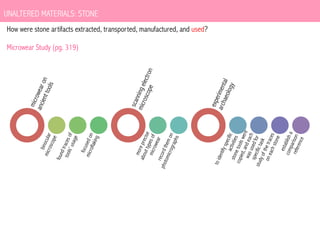
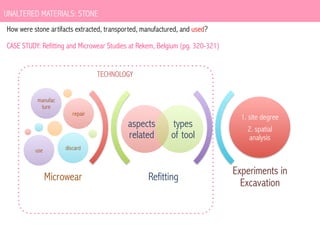
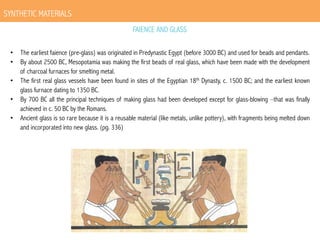
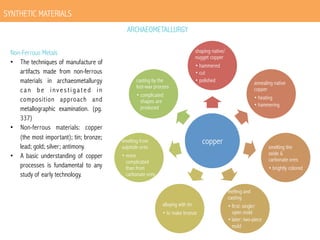
![OTHER UNALTERED MATERIALS : [Bone, Antler, Shell, Leather], [Wood], [Plant & Animal Fibers]
Bone, Antler, Shell, Leather
deducing techniques
of manufacture
deducing function
archaeological process [to
reveal complexities, sequence,
and tools involved] –case study:
South African site of Kasteelberg
(pg. 324)
experimental archaeology [to
deduce the function] –case
study: antler baton of La
Madeleine, France (pg. 325)
deer shoulder-blade,
Mugharet El Wad, Israel
study of wear patterns [to
deduce efficiency and
manufacturing process
especially about the importance
of organic materials]
microwear studies combined
with experimental archaeology
[to find characteristic traits of
historical artifacts]
points of arrow, San
Bushmen, Kalahari
antler projectile points,
Lower Magdalenian,
northern Spain](https://image.slidesharecdn.com/maharani-chapter8-140123075922-phpapp02/85/How-Do-They-Make-and-Use-Tools-20-320.jpg)
![OTHER UNALTERED MATERIALS : [Bone, Antler, Shell, Leather], [Wood], [Plant & Animal Fibers]
Bone, Antler, Shell, Leather
deducing function – replication
experiment by John Coles
The Clonbrin Leather Shield,
from the Bronze Age (about 13th
Century BC) of Ireland.
Originally made of one piece of
tanned leather (probably ox).
Experiment result stated that the
leather shield was flexible and
deflected the blows of spear or
sword, thus functioned better in
combat rather than bronze
shield.
John Coles’ woodworking experiment in the Somerset Levels (England)
can be seen in pg. 326-327.](https://image.slidesharecdn.com/maharani-chapter8-140123075922-phpapp02/85/How-Do-They-Make-and-Use-Tools-21-320.jpg)
![OTHER UNALTERED MATERIALS : [Bone, Antler, Shell, Leather], [Wood], [Plant & Animal Fibers]
Wood
• Have been used to make tools
as long as stone and bone, if
wood survives in good condition,
it may preserve tool marks to
show how it was worked.
• Waterlogged wood has yielded
the richest information about
woodworking skills. (Experiment
by John and Bryony Coles, page
326-327).
• Can be categorized into small
(tools) and large wooden
objects (e.g. buildings, wheeled
transportation, and watercrafts).
• Investigating watercrafts: archaeological evidences is abundant in the
preserved remains of ships uncovered by underwater archaeology.
• Excavation results showed that vessels of earlier period in the
century were built with planks held together by mortise and tenon
joints.
• The best way to learn how a ship was built and function is to refit and
rebuild the vessel, either a full-size or a scale replica, preferably one
that can be tested on the water.
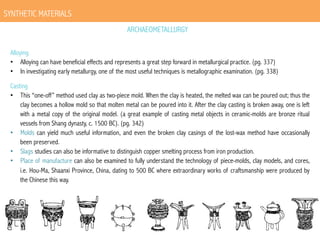
• Archaeology can demonstrate the presence of boats/crafts even
where no ship remains or artistic depictions exist.
wheel chariot in Assyrian
Relief, 9th Century BC
experimental archaeology:
4th Century BC Greek ship,
Kyrenia, Cyprus](https://image.slidesharecdn.com/maharani-chapter8-140123075922-phpapp02/85/How-Do-They-Make-and-Use-Tools-22-320.jpg)
![OTHER UNALTERED MATERIALS : [Bone, Antler, Shell, Leather], [Wood], [Plant & Animal Fibers]
Plant & Animal Fibers
• These fragile materials survive in very dry
(arid regions –i.e. study of basketry and
cordage as in Egypt) or wet (waterlogged
–i.e. well-preserved workshops of Viking
York in England) condition.
analyzing textiles
how they were made
of what they were made
microwear analysis of fibers
Peruvian textile at Guitarrero Cave (www.archaeology.about.com)](https://image.slidesharecdn.com/maharani-chapter8-140123075922-phpapp02/85/How-Do-They-Make-and-Use-Tools-23-320.jpg)
![OTHER UNALTERED MATERIALS : [Bone, Antler, Shell, Leather], [Wood], [Plant & Animal Fibers]
... how they were made ; of what they were made
Place
Peruvian
Andean
Time Period (circa)
1st Century AD
3000 BC
Technology
Weavings: big vertical loom; big horizontal loom; small loom
for clothing and bags. Material: animal fiber, dyed
Weavings, decoration, cotton textiles
Painted cotton fabrics
Chibca, Colombia
Thebes. Egypt
2000 BC
Weaving workshops in the tomb of Meketre
Kahun. Egypt
1890 BC
Weaving, slinging thread, coloring dye (madder
for red, indigo for blue)
Weaving, spindle, looms. Materials: animal fiber
Viking York, England
Hochdorf, Germany
550 BC
Weaving at Celtic chieftain's tomb
Cayonu, Turkey
7000 BC
White linen fragment made of flax clinging to
an antler tool
Pavlov, Czech
25,000 –
27,000 y.a
Weaving and textiles of flexible basketry on
fired clay
Dzudzuana, Georgia
30,000 y.a
Dyed flax fibers show the existence of colored
twine](https://image.slidesharecdn.com/maharani-chapter8-140123075922-phpapp02/85/How-Do-They-Make-and-Use-Tools-24-320.jpg)
![OTHER UNALTERED MATERIALS : [Bone, Antler, Shell, Leather], [Wood], [Plant & Animal Fibers]
... microwear analysis of fibers
• Different kinds of fracture, damage, and wear leave diagnostic traces
on different classes of fibers.
• Cutting of fibers is easy to identify, and razor-marks are readily
distinguishable from those made by shears or scissors.
• Even where textiles do not survive, they sometimes leave an
impression behind.
• similarly useful information can be derived from the study of imprints
of fabrics, cordage, and basketry that are found on fired clay.
An insole for a child’s shoe of Vindolanda, Northern England.
Soldier’s leg bandage of Vindolanda, Northern England.](https://image.slidesharecdn.com/maharani-chapter8-140123075922-phpapp02/85/How-Do-They-Make-and-Use-Tools-25-320.jpg)
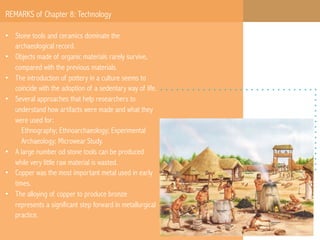

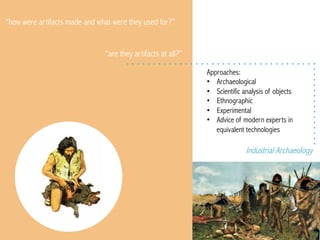
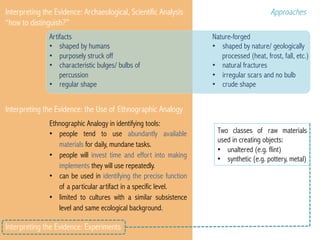
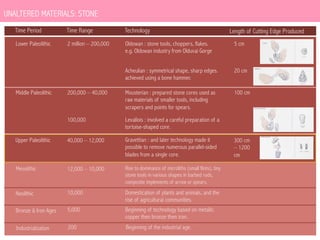
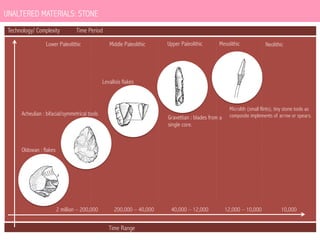
1) Various approaches are used to interpret evidence from artifacts in order to understand how they were made and used, including archaeological analysis, scientific analysis, ethnographic analogy, and experimental archaeology. 2) Stone tools were made through processes like knapping and were used as tools for hunting, butchery, and other tasks. Organic materials like bone, antler, wood, and plant fibers were also used to make tools and structures, and their forms and functions have been studied through replication experiments. 3) The evolution of stone tool technologies progressed from simple Oldowan tools in the Lower Paleolithic to more advanced blade-making in the Upper Paleolithic, showing increasing complexity over time.


![HISTORY OF ARCHITECTURE (ARC1101) new [Autosaved].pptx](https://cdn.slidesharecdn.com/ss_thumbnails/historyofarchitecturearc1101newautosaved-250413075445-4cff2a16-thumbnail.jpg?width=640&height=640&fit=bounds)


