


Mukta Aphale
Car.
A Product.
Customer
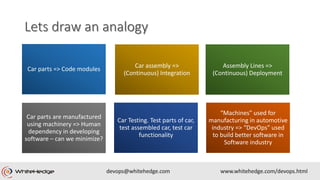
Car parts => Code modules
Car parts are manufactured
using machinery => Human
dependency in developing
software – can we minimize?
Car assembly =>
(Continuous) Integration
Assembly Lines =>
(Continuous) Deployment
Car Testing. Test parts of car,
test assembled car, test car
functionality
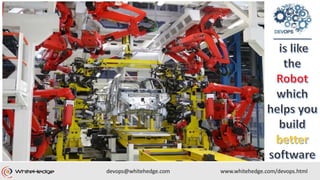
“Machines” used for
manufacturing in automotive
industry => “DevOps” used
to build better software in
Software industry
• DevOps replaces human tasks
• There are no limits to what you can
automate
• You will be creating Robots
• You need to be creative, innovative
• You need to be techy too
● Start with a clean slate
● Keep your past behind
● Be ready for change
● Understand you need to: learn-unlearn-learn-
repeat
● Keep your mind open
● Be proactive, you need to drive yourself
● DevOps brings in a new culture
● You won't have any requirements
● You won't be given any design
● You won't be shown any problem
● A lot of ideas would be thrown at you
● And you would be called to help!
● Follow the mantra: “Any task should be done only
once!”
● Start by writing small scripts to automate any task
you would have to do manually
● If it can't be scripted, document it
● The challenge should be: the 2nd time you have to
do the same task, it should take 10 times less time
than the first attempt!
●DevOps is here to automate nearly
everything
●But you can start with some tasks which
are the bare minimum needs of DevOps
automation
●Next few slides will explain these
fundamental concepts
● Source Code Version Control
o Github is the most popular
● Keep in mind that “Version Control” can also be
applied to infrastructure, configuration and
databases, but this can be studied in depth in
later stages of your Learning & Implementing
DevOps!
CI enables early detection of problems in
integration. It includes several components,
explained further
● Automated Code Review
● Automated Code Analysis
● Build Tools
● Automated Unit Tests
● Automated Integration Tests
● Dont go by the dull title. This is quite interesting when
implemented. It keeps the developer’s code on track and reduces
code quality issues!
● Tools like Gerrit can be used for setting up code review process
● Go through the concepts and explore the tools listed below
o Static Code Analysis
o Lint tools
o SonarQube
o JArchitect
o Codacy
o CodeClimate
Build tools convert source code to binary, create executables
(eg: jar), can run tests and create documentation. Listed
below are some popular build tools. Understand any one
build tool to know the intricacies of building a project.
● Maven
● Gradle
● Ant
● Make
● MSBuild
● Artifacts are generated as a result of the builds. They can also be
called as “application” or “executables”
● Artifacts are also those libraries needed by the build (called
“dependencies”)
● We need to control the version of the dependencies
● We need to manage releases of the application
● Hence artifact management is important
● Explore the existing popular solutions:
o Artifactory (PaaS offering)
o Sonatype Nexus
● Continuous Integration server can be setup in-
house or used as a PaaS solution.
● Try some hands-on with both CI servers
mentioned below
o Hosted: Travis-CI
o Jenkins
o Hosted: Shippable
● This literally translates to “Infrastructure
Automation”
● Following are the 3 most popular CM tools.
Study 2 of them well.
o Ansible
o Puppet
o Chef
CD is a natural extension to CI:
Teams can ensure that every change
to the system is releasable and that
any version can be released at the
click of a button.
● With the concepts we have learnt so far, you would realise that we would end
up with many versions of the build.
● We want to release the right versions, frequently, and get a feedback about
how it performs. This is release management.
● The solution to deployment and release management differs for every use case.
○ CM tools like Ansible can be used
○ CI Server like Jenkins can be used
○ Capistrano is a standalone tool
● Understand theoretically how each of the above works. Note the differences in
each approach and which would be used in which use cases.
Application and System Monitoring are one of the
important tenets of DevOps. Explore some of the
tools below, try some hands-on:
● ELK Stack (ElasticSearch, Logstash, Kibana)
● New Relic
● Server Density
● Datadog
● Zabbix
● Create a HelloWorld project on github
● Use hosted Travis-CI as build server
● With every git push:
o HelloWorld build should be triggered in Travis-CI
o Run unit tests
o If they pass, save the build output to Nexus
o Trigger a playlist in Ansible, which will deploy the build to a
another machine
● With every successful deployment, relay the feedback (send emails)
● With a failure in any of the steps, send the feedback to the
developer with the details of failure
● Document your understanding till now
● List down how you can better the CI/CD
pipeline
● List down what you think could also be
automated in your assignment
● Get set to take a deep dive into a topic that you
wish to master
What is dev ops?

What is dev ops?

  • 1.
  • 4.
  • 6.
    Car parts =>Code modules Car parts are manufactured using machinery => Human dependency in developing software – can we minimize? Car assembly => (Continuous) Integration Assembly Lines => (Continuous) Deployment Car Testing. Test parts of car, test assembled car, test car functionality “Machines” used for manufacturing in automotive industry => “DevOps” used to build better software in Software industry
  • 9.
    • DevOps replaceshuman tasks • There are no limits to what you can automate • You will be creating Robots • You need to be creative, innovative • You need to be techy too
  • 10.
    ● Start witha clean slate ● Keep your past behind ● Be ready for change ● Understand you need to: learn-unlearn-learn- repeat ● Keep your mind open ● Be proactive, you need to drive yourself
  • 11.
    ● DevOps bringsin a new culture ● You won't have any requirements ● You won't be given any design ● You won't be shown any problem ● A lot of ideas would be thrown at you ● And you would be called to help!
  • 12.
    ● Follow themantra: “Any task should be done only once!” ● Start by writing small scripts to automate any task you would have to do manually ● If it can't be scripted, document it ● The challenge should be: the 2nd time you have to do the same task, it should take 10 times less time than the first attempt!
  • 13.
    ●DevOps is hereto automate nearly everything ●But you can start with some tasks which are the bare minimum needs of DevOps automation ●Next few slides will explain these fundamental concepts
  • 14.
    ● Source CodeVersion Control o Github is the most popular ● Keep in mind that “Version Control” can also be applied to infrastructure, configuration and databases, but this can be studied in depth in later stages of your Learning & Implementing DevOps!
  • 15.
    CI enables earlydetection of problems in integration. It includes several components, explained further ● Automated Code Review ● Automated Code Analysis ● Build Tools ● Automated Unit Tests ● Automated Integration Tests
  • 16.
    ● Dont goby the dull title. This is quite interesting when implemented. It keeps the developer’s code on track and reduces code quality issues! ● Tools like Gerrit can be used for setting up code review process ● Go through the concepts and explore the tools listed below o Static Code Analysis o Lint tools o SonarQube o JArchitect o Codacy o CodeClimate
  • 17.
    Build tools convertsource code to binary, create executables (eg: jar), can run tests and create documentation. Listed below are some popular build tools. Understand any one build tool to know the intricacies of building a project. ● Maven ● Gradle ● Ant ● Make ● MSBuild
  • 18.
    ● Artifacts aregenerated as a result of the builds. They can also be called as “application” or “executables” ● Artifacts are also those libraries needed by the build (called “dependencies”) ● We need to control the version of the dependencies ● We need to manage releases of the application ● Hence artifact management is important ● Explore the existing popular solutions: o Artifactory (PaaS offering) o Sonatype Nexus
  • 19.
    ● Continuous Integrationserver can be setup in- house or used as a PaaS solution. ● Try some hands-on with both CI servers mentioned below o Hosted: Travis-CI o Jenkins o Hosted: Shippable
  • 20.
    ● This literallytranslates to “Infrastructure Automation” ● Following are the 3 most popular CM tools. Study 2 of them well. o Ansible o Puppet o Chef
  • 21.
    CD is anatural extension to CI: Teams can ensure that every change to the system is releasable and that any version can be released at the click of a button.
  • 22.
    ● With theconcepts we have learnt so far, you would realise that we would end up with many versions of the build. ● We want to release the right versions, frequently, and get a feedback about how it performs. This is release management. ● The solution to deployment and release management differs for every use case. ○ CM tools like Ansible can be used ○ CI Server like Jenkins can be used ○ Capistrano is a standalone tool ● Understand theoretically how each of the above works. Note the differences in each approach and which would be used in which use cases.
  • 23.
    Application and SystemMonitoring are one of the important tenets of DevOps. Explore some of the tools below, try some hands-on: ● ELK Stack (ElasticSearch, Logstash, Kibana) ● New Relic ● Server Density ● Datadog ● Zabbix
  • 24.
    ● Create aHelloWorld project on github ● Use hosted Travis-CI as build server ● With every git push: o HelloWorld build should be triggered in Travis-CI o Run unit tests o If they pass, save the build output to Nexus o Trigger a playlist in Ansible, which will deploy the build to a another machine ● With every successful deployment, relay the feedback (send emails) ● With a failure in any of the steps, send the feedback to the developer with the details of failure
  • 25.
    ● Document yourunderstanding till now ● List down how you can better the CI/CD pipeline ● List down what you think could also be automated in your assignment ● Get set to take a deep dive into a topic that you wish to master