what is college-level writing?
a workshop for writing instructors at SLCC
Justin M. Jory, English Faculty & Department Coordinator
justin.jory@slcc.edu, AAB 156, ext. 4192
Benjamin Solomon, English Faculty
benjamin.solomon@slcc.edu, AAB 237X, ext. 3930
Facilitated January 8, 2015
a question of disciplinarity
The field of rhetoric and composition has addressed this
question since at least the mid 1960’s.
Open admissions policies at U.S. institutions of higher
education led to a perceived “literacy crisis.”
First-year writing (fyw) courses became a site to solve the
crisis to ensure social mobility for students.
a question leading to disagreement
With the emergence of fyw as a “service course,” arose
disagreements between writing researchers/teachers and
individuals outside the discipline about the “work” of fyw.
The disagreement can perhaps best be captured by the
“myth of transience” (Russell, 1991).
a question leading to disagreement
Disagreements about the work of fyw exist even among
“insiders,” teachers and researchers in rhetoric and
composition.
These disagreements can perhaps best be captured by
tracing the major “theories of writing” predominant in the field since
the 1960’s (Berlin, 1988).
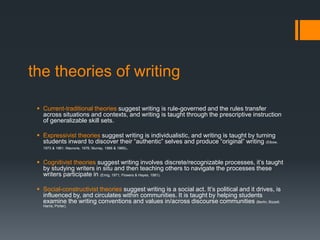
the theories of writing
 Current-traditional theories suggest writing is rule-governed and the rules transfer
across situations and contexts, and writing is taught through the prescriptive instruction
of generalizable skill sets.
 Expressivist theories suggest writing is individualistic, and writing is taught by turning
students inward to discover their “authentic” selves and produce “original” writing (Elbow,
1973 & 1981; Macrorie, 1976; Murray, 1968 & 1969).
 Cognitivist theories suggest writing involves discrete/recognizable processes, it’s taught
by studying writers in situ and then teaching others to navigate the processes these
writers participate in (Emig, 1971; Flowers & Hayes, 1981).
 Social-constructivist theories suggest writing is a social act. It’s political and it drives, is
influenced by, and circulates within communities. It is taught by helping students
examine the writing conventions and values in/across discourse communities (Berlin; Bizzell;
Harris; Porter).
 As students, what did you learn in composition courses?
 As teachers, what is your philosophy on the work of the
composition course?
 What kind of work have you moved away from and why?
 What kind of work are you moving toward and why?
reflection points
what is college-level writing?
let’s re-examine this question in the context of
threshold concepts
why threshold concepts (TCs)?
Threshold concepts “bind a subject together, [they are]
fundamental to ways of thinking and practicing in that
discipline” (Land et al, 2005).
Each is “akin to a portal [or conceptual gateway], opening up a
new and previously inaccessible way of thinking about
something” (Meyer & Land, 2006).
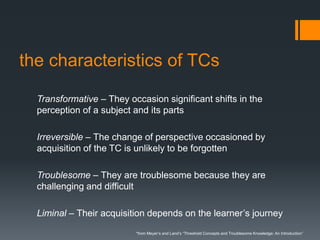
the characteristics of TCs
Transformative – They occasion significant shifts in the
perception of a subject and its parts
Irreversible – The change of perspective occasioned by
acquisition of the TC is unlikely to be forgotten
Troublesome – They are troublesome because they are
challenging and difficult
Liminal – Their acquisition depends on the learner’s journey
*from Meyer’s and Land’s “Threshold Concepts and Troublesome Knowledge: An Introduction”
rhetoric & composition’s TCs
 Writing is a subject of study and an activity
 Writing is social and rhetorical
 Writing reflects and perpetuates identities and ideologies
 Writing is a form of social action that can create change in
communities
* from Adler-Kassner’s “Threshold Concepts and Deliberate Action”
what are other possible TCs?
Work with at least two other instructors to identify
possible threshold concepts in your composition
courses.
the thresholdiness of these
TCs
How is this concept, or how might it be, transformative?
How is this concept, or how might it be, irreversible?
How is this concept, or how might it be, troublesome?
How is this concept, or how might it be, liminal?

What is college level writing?

  • 1.
    what is college-levelwriting? a workshop for writing instructors at SLCC Justin M. Jory, English Faculty & Department Coordinator justin.jory@slcc.edu, AAB 156, ext. 4192 Benjamin Solomon, English Faculty benjamin.solomon@slcc.edu, AAB 237X, ext. 3930 Facilitated January 8, 2015
  • 2.
    a question ofdisciplinarity The field of rhetoric and composition has addressed this question since at least the mid 1960’s. Open admissions policies at U.S. institutions of higher education led to a perceived “literacy crisis.” First-year writing (fyw) courses became a site to solve the crisis to ensure social mobility for students.
  • 3.
    a question leadingto disagreement With the emergence of fyw as a “service course,” arose disagreements between writing researchers/teachers and individuals outside the discipline about the “work” of fyw. The disagreement can perhaps best be captured by the “myth of transience” (Russell, 1991).
  • 4.
    a question leadingto disagreement Disagreements about the work of fyw exist even among “insiders,” teachers and researchers in rhetoric and composition. These disagreements can perhaps best be captured by tracing the major “theories of writing” predominant in the field since the 1960’s (Berlin, 1988).
  • 5.
    the theories ofwriting  Current-traditional theories suggest writing is rule-governed and the rules transfer across situations and contexts, and writing is taught through the prescriptive instruction of generalizable skill sets.  Expressivist theories suggest writing is individualistic, and writing is taught by turning students inward to discover their “authentic” selves and produce “original” writing (Elbow, 1973 & 1981; Macrorie, 1976; Murray, 1968 & 1969).  Cognitivist theories suggest writing involves discrete/recognizable processes, it’s taught by studying writers in situ and then teaching others to navigate the processes these writers participate in (Emig, 1971; Flowers & Hayes, 1981).  Social-constructivist theories suggest writing is a social act. It’s political and it drives, is influenced by, and circulates within communities. It is taught by helping students examine the writing conventions and values in/across discourse communities (Berlin; Bizzell; Harris; Porter).
  • 6.
     As students,what did you learn in composition courses?  As teachers, what is your philosophy on the work of the composition course?  What kind of work have you moved away from and why?  What kind of work are you moving toward and why? reflection points
  • 7.
    what is college-levelwriting? let’s re-examine this question in the context of threshold concepts
  • 8.
    why threshold concepts(TCs)? Threshold concepts “bind a subject together, [they are] fundamental to ways of thinking and practicing in that discipline” (Land et al, 2005). Each is “akin to a portal [or conceptual gateway], opening up a new and previously inaccessible way of thinking about something” (Meyer & Land, 2006).
  • 9.
    the characteristics ofTCs Transformative – They occasion significant shifts in the perception of a subject and its parts Irreversible – The change of perspective occasioned by acquisition of the TC is unlikely to be forgotten Troublesome – They are troublesome because they are challenging and difficult Liminal – Their acquisition depends on the learner’s journey *from Meyer’s and Land’s “Threshold Concepts and Troublesome Knowledge: An Introduction”
  • 10.
    rhetoric & composition’sTCs  Writing is a subject of study and an activity  Writing is social and rhetorical  Writing reflects and perpetuates identities and ideologies  Writing is a form of social action that can create change in communities * from Adler-Kassner’s “Threshold Concepts and Deliberate Action”
  • 11.
    what are otherpossible TCs? Work with at least two other instructors to identify possible threshold concepts in your composition courses.
  • 12.
    the thresholdiness ofthese TCs How is this concept, or how might it be, transformative? How is this concept, or how might it be, irreversible? How is this concept, or how might it be, troublesome? How is this concept, or how might it be, liminal?

Editor's Notes

  • #3 Today, we’re taking this question up in context of the discipline that college composition courses emerge from: rhetoric and composition.
  • #4 The myth of transience is one way to understand disagreements about the “work” of first-year writing (composition) courses. Importantly, much research has been devoted over the past four decades to show that what counts as “good” or “effective” writing is context-specific and community-specific, thus challenging the ideas that undergird the myth of transience.
  • #5 Disagreements about the work of college composition exist even among people “inside” the discipline. These disagreements can be understood by looking at the major theories of writing that are, and have been, predominant in the field.
  • #6 CTT: In line with the myth of transcience, generalizable set of skills that transfer across all contexts to make for good writing, teaching writing is a prescriptive practice, amounting to teaching students and having them practice these skills. Writing and teaching writing is mechanical. College level writing is about lecturing students on how to produce good written products; therefore, writing instruction in this vein is essay-driven. Done by emphasizing the skill sets necessary to produce such products: how to develop a 5 paragraph essay, how to develop grammatically correct and error free prose, ET: Emphasis on teachers acting as guides to help students through the process of developing voice and style through classroom writing activities like free-writing, peer review, etc. CT: Most notably, CTs of writing shifted from the CT emphasis on product to a focus on understanding and navigating process. So, college level writing might be about learning about the writing process – how social environments/stimulants influence the process and how individuals can manage their own process. Writing is non-linear and goal driven by individual. SCT: This is where we’re at now as a field. END w/look at CWPA Outcomes Statement to see how we currently understand college-level writing. (Access the statement here: http://wpacouncil.org/files/WPA%20Outcomes%20Statement%20Adopted%20Revisions%5B1%5D_0.pdf)
  • #8 The first half of this workshop, we considered this question in the context of histories: the disciplinary history of the field of composition and our own personal histories as students and teachers in composition courses. [Follow up sentence on histories and social/cultural issues?]. In this second half of the workshop, we want to revisit the question in the context of threshold theory.
  • #9 Threshold theory comes out of scholarship on teaching and learning. These concepts emerge from disciplinarity and they provide students with experience about how people think within particular disciplines. This is important. They help students understand how individuals think about subject matter, issues, etc. in a particular discipline. TCs provide an opportunity of reflection because they encourage instructors to pierce down through their pedagogies and courses to think about those most fundamental concepts students must learn about writing to “progress” in their thinking about it.
  • #10 Transformative: They are transformative to disciplinary learning—that is, they are those concepts that lead learners to a changed disciplinary view, a changed disciplinary understanding, or a change self-perception Irreversible: Not likely to be unlearned Troublesome: May be challenging or difficult for a number of reasons, such as they conceptually difficult, alien or foreign, counter-intuitive, tacit Liminal: