What is Audience Based Marketing (ABM)? 1
WHAT IS
ACCOUNT
BASED
MARKETING
(ABM)
AND WHY
DO YOU
NEED IT?
What is Audience Based Marketing (ABM)? 2
YOU’VE HEARD ALL OF THE BUZZ
IN THE BTOB COMMUNITY AND
WANT TO KNOW MORE…
WHAT IS
ACCOUNT BASED
MARKETING, OR ABM,
ANYWAY?
S
imply put, Account Based
Marketing (ABM) is when you
implement highly customized
marketing campaigns where each account
is considered to be a market of one. ABM
uses the latest technology to help you send
the right messages to influencers who are
actively researching products like yours.
And this is important in today’s
competitive marketplace because the days
of the linear buying process are over.
Sure, you may get a few leads by
sending a general email to a researched list
of potential buyers. This is fairly easy, but
you waste a significant amount of time,
money and effort… and a massive amount
of sales to the competition.
Your buying audience, and how they
make purchases, has changed. Today,
anyone can research products and services
online – anytime, anywhere.
This means that it’s no longer a matter
of simply reaching the C-level executives.
Instead, you need to reach a large group
of decision-makers on the buying team (an
average of 5.4 individuals and growing per
CEB Global).
And this includes people of various ages,
expertise and experience levels from top
executives down to the new-hire, fresh out
of school… all of whom will evaluate your
offering based on a set of criteria relevant
to their own, organizational discipline.
In fact, a recent Google survey of over
3,000 BtoB researchers reports that half
of all BtoB buyers are Millennials (a 70%
increase between 2012 and 2014). Plus, the
results indicate that, “81% of non-C-suite
employees influence purchase decisions.”
And where do all of these
decision makers start their research
process?
According to Google, “71% of BtoB
researchers start their research with a
generic search,” and on average, they
do “12 searches prior to engaging on a
specific brand's site.”
Now, you need to engage with an
increasing size and diversity of people with
individual roles at your target accounts…
who are all at different stages of the
buying process, simultaneously, so…
How do you connect the right people
with the right message at the right
time?
Enter Account Based Marketing.
Here, you focus on identifying members
of the buying committee. Then, you create
unique messages relevant to their needs.
And by using multiple channels at once,
you can reach your diverse audience at all
points of the buying process (at the same
time), and nurture the entire account more
effectively.
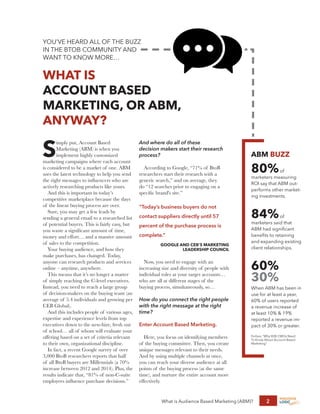
ABM BUZZ
80%of
marketers measuring
ROI say that ABM out-
performs other market-
ing investments.
84%of
marketers said that
ABM had significant
benefits to retaining
and expanding existing
client relationships.
60%
30%
When ABM has been in
use for at least a year,
60% of users reported
a revenue increase of
at least 10% & 19%
reported a revenue im-
pact of 30% or greater.
Forbes, “Why B2B CMOs Need
To Know About Account Based
Marketing”
“Today’s business buyers do not
contact suppliers directly until 57
percent of the purchase process is
complete.”
GOOGLE AND CEB’S MARKETING
LEADERSHIP COUNCIL
What is Audience Based Marketing (ABM)? 3
HOW AN
ABM SOLUTION
PROVIDES LEADS.
T
o create the right
messaging, a solid, data-
driven ABM platform
accesses multiple sources. This
includes: intent, install base
targeting, cross-device targeting,
demographic, firmographic,
account, interaction, and
predictive data to define an
account level audience and the
type of content that will engage
them at the right time.
Proper integration of these
data assets provides insight on
user interest and reveals surging
accounts, or those that statistically
perform an increased amount of
online research on topics related
to your solutions. You can then
use this information to plan your
multichannel approach, starting
with good content.
Content is (still) King!
The 2016 Content Preferences
Survey Report from Demand Gen
indicates that, “more than half
(51%) of B2B buyers said they rely
more on content now to research
their buying decisions than they
did a year ago,” and “47% of
buyers viewed three to five pieces
of content before contacting a
sales rep.”
In addition, The Content
Marketing Institute indicates that
76% of the most effective BtoB
marketers plan to spend more on
content creation and distribution
than they did last year.
“96% of respondents indicated
that they want content that
engages and informs — rather
than sells – with more insight
from industry thought leaders and
analysts,” per the DemandGen
2016 Content Preferences Survey
Report.
With this in mind, it’s important
to create valuable content
relative to the needs of your
target accounts and then share it
accordingly through syndication.
Content Syndication (CS)
is a powerful tactic to build
awareness and engage a select,
qualified audience pool.
With CS, you publish your
content on specific, third-party
sites to boost brand awareness,
get links back to a unique landing
page, build credibility, and more
(usually for a fee).
And while you may use articles,
blogs, Infographics, and more in
your CS efforts, this is not enough.
Is Display Advertising Dead?
While you may hear rumblings
in the BtoB community about
this, a new research study by The
Interactive Advertising Bureau and
C3Research indicates that this is
far from the truth.
Their Display Rising Star ads,
“attracted gaze at a 63% higher
rate than traditional UAP ads, had
significantly higher engagement
across the board with findings
demonstrating that these ads
were more entertaining, creative,
humorous, and evoked higher
emotional response, and the ads
generated significantly greater
scores on core measures of
persuasion.”
Display advertising is ever-
present content that can help keep
your company top-of mind and
includes: videos, social media,
native advertising, mobile, direct
publishing, and custom and
programmatic content. It lets
you nurture accounts rather than
specific individuals.
With CS, display advertising
and your multi-channel processes
in place, your ABM program will
help you engage target accounts
and get leads, but…
What do you do with this
information?
While a good ABM platform
delivers leads, it’s not a direct
response account. It provides
important insights, measurement
and data about your target
accounts and helps you create
valuable content and media that
engages your audience.
However, you still need to use your
marketing automation services, CMR
technology and sales tools to nurture
these accounts further to actually generate
revenue.
Generating sales is not just
about making a phone call
when you receive a lead from
your ABM data.
It’s about continuing your
multichannel approach to
nurture and engage an account
with pertinent messaging over a
period of time. You want them to
consume more assets before you
actually talk to them on the phone.
And if you have the right data, it
will be possible to make that call at
the right time and turn the account
into an actual buyer. The key is
to…
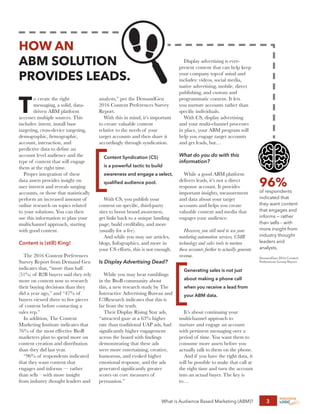
96%
of respondents
indicated that
they want content
that engages and
informs — rather
than sells – with
more insight from
industry thought
leaders and
analysts,
DemandGen 2016 Content
Preferences Survey Report.
What is Audience Based Marketing (ABM)? 4
MEASURE
THE METRICS
THAT MATTER.
T
he whole point of an effective, ABM
program is to discover and reach your
target accounts, provide valuable
content to them based on the data you receive
(topics where they actually show an interest
and that generate traffic to your site), and then
engage and nurture them through the buying
process.
To do this, it’s essential to optimize your
programs in real-time based on asset
performance, and this involves measuring the
appropriate metrics.
To start, review tactic goals. Each tactic in
your multi-channel approach needs a specific
goal so you know what you are trying to
accomplish with that unique tactic and why.
This is because each of your tactics plays a
specific and different role. But, all of your
tactics work together to simultaneously engage
perspective customers in an ongoing manner.
For example, to find out if your goals for each
tactic are actually working, you may ask:
n	
Which accounts actually viewed your
content?
n	
Which of your target accounts are
showing more site traffic?
n	
What content are your target
accounts more interested in viewing?
Remember, it’s not about raw impressions,
unique views and visits.
It’s about getting an account-level view of
your performance. Then, you can use this
information to help identify which accounts are
aware of your content and engaged the most.
With your real-time ABM data, you can
see if potential customers are looking at your
content. If not, you can make changes, review
your channel mix and test a different variation
immediately to optimize results.
This will help you save time and money by providing
the most effective messaging possible at any given time.
Once targeted accounts review your
content, you’ll want to look at more detailed
measurements related to engagement. For
example, your social-media posts, articles,
videos, and other, demand generation content
may have caught the eye of an individual in a
target account.
That person then exchanges their information
for helpful, lead generation content (white
papers, eBooks, webinars, and more from your
online resource center) and actually takes a
specific action… furthering your interaction and
engagement with them.
“Our research showed us that
engagement in today’s digital
communications ecosystem works
not like a funnel but like an engine
where brands and consumers
are synergistically interacting
with each other in new ways that
can have a powerful impact on
customer value.”
The Content Marketing Institute
What is Audience Based Marketing (ABM)? 5
Now, you can focus on metrics that show
how effective you are at interacting with
perspective targets such as:
n	
How long did they spend reading your
message?
n	
Did they go to other pages on your site
or ask for more information?
n	
How long did they spend on a
particular page and your website
overall?
n	
What is the speed and frequency at
which relevant content is consumed?
n	
Did they download your content and
share it with others?
This data reveals what content and marketing
tactics are really having an impact on your target
accounts. Then, you can create new tactics to
engage these individuals further.
Remember, today’s multi-channel marketing
approach with ABM is an ongoing journey.
Use your data to see what your targeted accounts
want, and then give them more of that content to
provide additional value throughout your entire
relationship with them.
And when looking at your metrics…
DON’T FORGET
SALES.
As you review content, display advertising and other
results, it’s essential to measure how all of your tactics
have actually improved sales outcomes.
Ask questions like:
n	
How effective were you in turning certain
accounts into actual buyers?
n	
Which channels played their roles most
effectively in doing that?
n	
Which tactics worked and what didn’t?
Then, you can apply these results to your overall,
multi-channel approach and make changes for future
improvements.
What is Audience Based Marketing (ABM)? 6
ABM
AND
REVENUE
GROWTH.
S
uccessful ABM involves a constant process of
creating goals and tactics with specific channels,
checking real-time metrics to see how your
activities affect sales and then making fast changes to
optimize your content and marketing channels for the
best results.
With a good ABM platform, you can see who your
targeted accounts are, what they are interested in and
when. Then, it’s up to you to use this data to create
the appropriate content and channel mix to increase
awareness and engagement that generates revenue
over time.
What are you waiting for?
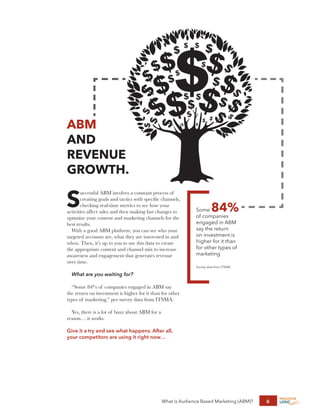
“Some 84% of companies engaged in ABM say
the return on investment is higher for it than for other
types of marketing,” per survey data from ITSMA.
Yes, there is a lot of buzz about ABM for a
reason… it works.
Give it a try and see what happens. After all,
your competitors are using it right now…
Some 84%
of companies
engaged in ABM
say the return
on investment is
higher for it than
for other types of
marketing
Survey data from ITSMA
What is Audience Based Marketing (ABM)? 7
To learn more about how you can
activate your ABM to power your
B2B marketing programs, contact
ActivateABM@madisonlogic.com.

What is Account-Based Marketing (ABM)

  • 1.
    What is AudienceBased Marketing (ABM)? 1 WHAT IS ACCOUNT BASED MARKETING (ABM) AND WHY DO YOU NEED IT?
  • 2.
    What is AudienceBased Marketing (ABM)? 2 YOU’VE HEARD ALL OF THE BUZZ IN THE BTOB COMMUNITY AND WANT TO KNOW MORE… WHAT IS ACCOUNT BASED MARKETING, OR ABM, ANYWAY? S imply put, Account Based Marketing (ABM) is when you implement highly customized marketing campaigns where each account is considered to be a market of one. ABM uses the latest technology to help you send the right messages to influencers who are actively researching products like yours. And this is important in today’s competitive marketplace because the days of the linear buying process are over. Sure, you may get a few leads by sending a general email to a researched list of potential buyers. This is fairly easy, but you waste a significant amount of time, money and effort… and a massive amount of sales to the competition. Your buying audience, and how they make purchases, has changed. Today, anyone can research products and services online – anytime, anywhere. This means that it’s no longer a matter of simply reaching the C-level executives. Instead, you need to reach a large group of decision-makers on the buying team (an average of 5.4 individuals and growing per CEB Global). And this includes people of various ages, expertise and experience levels from top executives down to the new-hire, fresh out of school… all of whom will evaluate your offering based on a set of criteria relevant to their own, organizational discipline. In fact, a recent Google survey of over 3,000 BtoB researchers reports that half of all BtoB buyers are Millennials (a 70% increase between 2012 and 2014). Plus, the results indicate that, “81% of non-C-suite employees influence purchase decisions.” And where do all of these decision makers start their research process? According to Google, “71% of BtoB researchers start their research with a generic search,” and on average, they do “12 searches prior to engaging on a specific brand's site.” Now, you need to engage with an increasing size and diversity of people with individual roles at your target accounts… who are all at different stages of the buying process, simultaneously, so… How do you connect the right people with the right message at the right time? Enter Account Based Marketing. Here, you focus on identifying members of the buying committee. Then, you create unique messages relevant to their needs. And by using multiple channels at once, you can reach your diverse audience at all points of the buying process (at the same time), and nurture the entire account more effectively. ABM BUZZ 80%of marketers measuring ROI say that ABM out- performs other market- ing investments. 84%of marketers said that ABM had significant benefits to retaining and expanding existing client relationships. 60% 30% When ABM has been in use for at least a year, 60% of users reported a revenue increase of at least 10% & 19% reported a revenue im- pact of 30% or greater. Forbes, “Why B2B CMOs Need To Know About Account Based Marketing” “Today’s business buyers do not contact suppliers directly until 57 percent of the purchase process is complete.” GOOGLE AND CEB’S MARKETING LEADERSHIP COUNCIL
  • 3.
    What is AudienceBased Marketing (ABM)? 3 HOW AN ABM SOLUTION PROVIDES LEADS. T o create the right messaging, a solid, data- driven ABM platform accesses multiple sources. This includes: intent, install base targeting, cross-device targeting, demographic, firmographic, account, interaction, and predictive data to define an account level audience and the type of content that will engage them at the right time. Proper integration of these data assets provides insight on user interest and reveals surging accounts, or those that statistically perform an increased amount of online research on topics related to your solutions. You can then use this information to plan your multichannel approach, starting with good content. Content is (still) King! The 2016 Content Preferences Survey Report from Demand Gen indicates that, “more than half (51%) of B2B buyers said they rely more on content now to research their buying decisions than they did a year ago,” and “47% of buyers viewed three to five pieces of content before contacting a sales rep.” In addition, The Content Marketing Institute indicates that 76% of the most effective BtoB marketers plan to spend more on content creation and distribution than they did last year. “96% of respondents indicated that they want content that engages and informs — rather than sells – with more insight from industry thought leaders and analysts,” per the DemandGen 2016 Content Preferences Survey Report. With this in mind, it’s important to create valuable content relative to the needs of your target accounts and then share it accordingly through syndication. Content Syndication (CS) is a powerful tactic to build awareness and engage a select, qualified audience pool. With CS, you publish your content on specific, third-party sites to boost brand awareness, get links back to a unique landing page, build credibility, and more (usually for a fee). And while you may use articles, blogs, Infographics, and more in your CS efforts, this is not enough. Is Display Advertising Dead? While you may hear rumblings in the BtoB community about this, a new research study by The Interactive Advertising Bureau and C3Research indicates that this is far from the truth. Their Display Rising Star ads, “attracted gaze at a 63% higher rate than traditional UAP ads, had significantly higher engagement across the board with findings demonstrating that these ads were more entertaining, creative, humorous, and evoked higher emotional response, and the ads generated significantly greater scores on core measures of persuasion.” Display advertising is ever- present content that can help keep your company top-of mind and includes: videos, social media, native advertising, mobile, direct publishing, and custom and programmatic content. It lets you nurture accounts rather than specific individuals. With CS, display advertising and your multi-channel processes in place, your ABM program will help you engage target accounts and get leads, but… What do you do with this information? While a good ABM platform delivers leads, it’s not a direct response account. It provides important insights, measurement and data about your target accounts and helps you create valuable content and media that engages your audience. However, you still need to use your marketing automation services, CMR technology and sales tools to nurture these accounts further to actually generate revenue. Generating sales is not just about making a phone call when you receive a lead from your ABM data. It’s about continuing your multichannel approach to nurture and engage an account with pertinent messaging over a period of time. You want them to consume more assets before you actually talk to them on the phone. And if you have the right data, it will be possible to make that call at the right time and turn the account into an actual buyer. The key is to… 96% of respondents indicated that they want content that engages and informs — rather than sells – with more insight from industry thought leaders and analysts, DemandGen 2016 Content Preferences Survey Report.
  • 4.
    What is AudienceBased Marketing (ABM)? 4 MEASURE THE METRICS THAT MATTER. T he whole point of an effective, ABM program is to discover and reach your target accounts, provide valuable content to them based on the data you receive (topics where they actually show an interest and that generate traffic to your site), and then engage and nurture them through the buying process. To do this, it’s essential to optimize your programs in real-time based on asset performance, and this involves measuring the appropriate metrics. To start, review tactic goals. Each tactic in your multi-channel approach needs a specific goal so you know what you are trying to accomplish with that unique tactic and why. This is because each of your tactics plays a specific and different role. But, all of your tactics work together to simultaneously engage perspective customers in an ongoing manner. For example, to find out if your goals for each tactic are actually working, you may ask: n Which accounts actually viewed your content? n Which of your target accounts are showing more site traffic? n What content are your target accounts more interested in viewing? Remember, it’s not about raw impressions, unique views and visits. It’s about getting an account-level view of your performance. Then, you can use this information to help identify which accounts are aware of your content and engaged the most. With your real-time ABM data, you can see if potential customers are looking at your content. If not, you can make changes, review your channel mix and test a different variation immediately to optimize results. This will help you save time and money by providing the most effective messaging possible at any given time. Once targeted accounts review your content, you’ll want to look at more detailed measurements related to engagement. For example, your social-media posts, articles, videos, and other, demand generation content may have caught the eye of an individual in a target account. That person then exchanges their information for helpful, lead generation content (white papers, eBooks, webinars, and more from your online resource center) and actually takes a specific action… furthering your interaction and engagement with them. “Our research showed us that engagement in today’s digital communications ecosystem works not like a funnel but like an engine where brands and consumers are synergistically interacting with each other in new ways that can have a powerful impact on customer value.” The Content Marketing Institute
  • 5.
    What is AudienceBased Marketing (ABM)? 5 Now, you can focus on metrics that show how effective you are at interacting with perspective targets such as: n How long did they spend reading your message? n Did they go to other pages on your site or ask for more information? n How long did they spend on a particular page and your website overall? n What is the speed and frequency at which relevant content is consumed? n Did they download your content and share it with others? This data reveals what content and marketing tactics are really having an impact on your target accounts. Then, you can create new tactics to engage these individuals further. Remember, today’s multi-channel marketing approach with ABM is an ongoing journey. Use your data to see what your targeted accounts want, and then give them more of that content to provide additional value throughout your entire relationship with them. And when looking at your metrics… DON’T FORGET SALES. As you review content, display advertising and other results, it’s essential to measure how all of your tactics have actually improved sales outcomes. Ask questions like: n How effective were you in turning certain accounts into actual buyers? n Which channels played their roles most effectively in doing that? n Which tactics worked and what didn’t? Then, you can apply these results to your overall, multi-channel approach and make changes for future improvements.
  • 6.
    What is AudienceBased Marketing (ABM)? 6 ABM AND REVENUE GROWTH. S uccessful ABM involves a constant process of creating goals and tactics with specific channels, checking real-time metrics to see how your activities affect sales and then making fast changes to optimize your content and marketing channels for the best results. With a good ABM platform, you can see who your targeted accounts are, what they are interested in and when. Then, it’s up to you to use this data to create the appropriate content and channel mix to increase awareness and engagement that generates revenue over time. What are you waiting for? “Some 84% of companies engaged in ABM say the return on investment is higher for it than for other types of marketing,” per survey data from ITSMA. Yes, there is a lot of buzz about ABM for a reason… it works. Give it a try and see what happens. After all, your competitors are using it right now… Some 84% of companies engaged in ABM say the return on investment is higher for it than for other types of marketing Survey data from ITSMA
  • 7.
    What is AudienceBased Marketing (ABM)? 7 To learn more about how you can activate your ABM to power your B2B marketing programs, contact ActivateABM@madisonlogic.com.