5
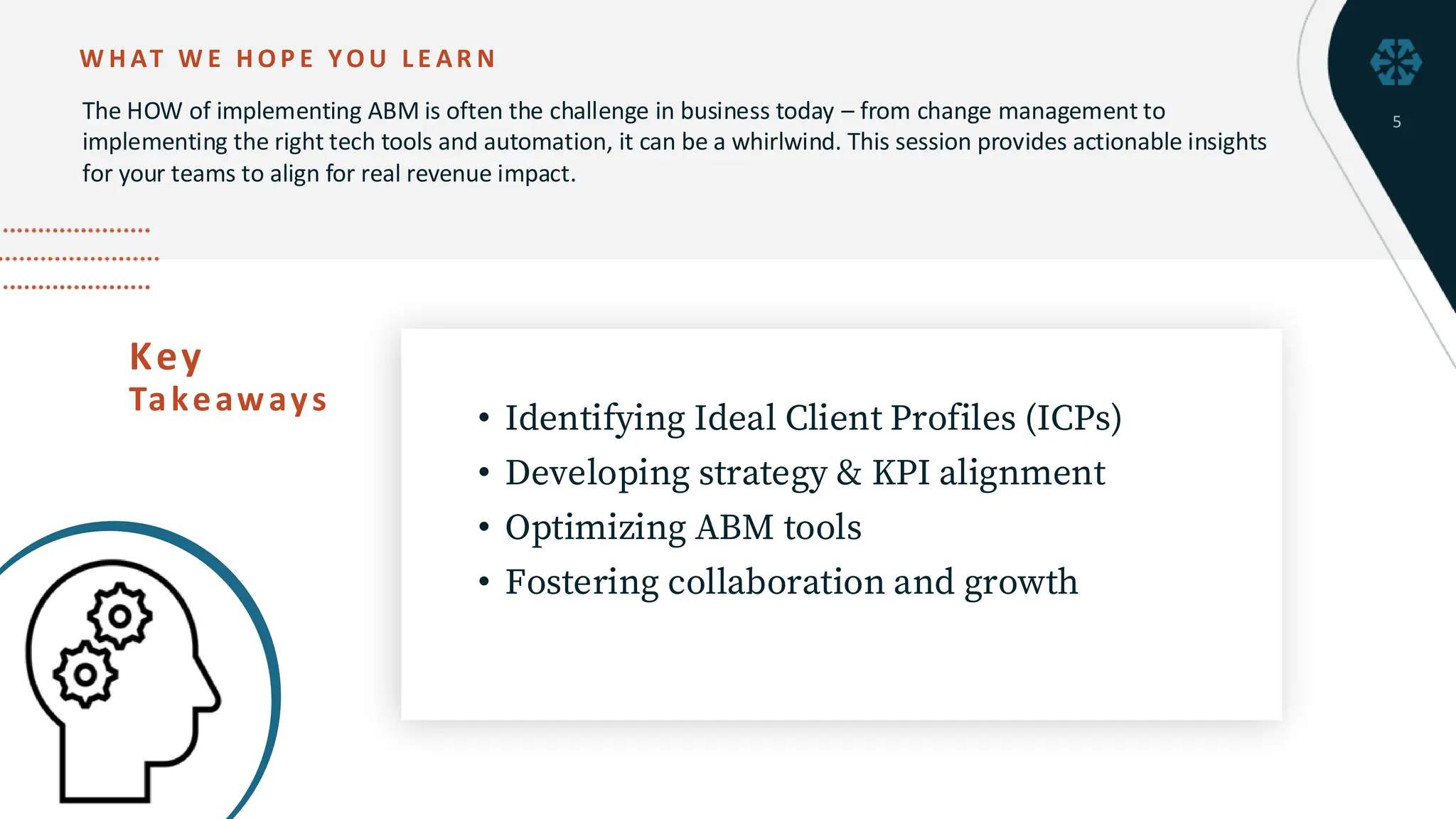
Key
Takeaways
• Identifying Ideal Client Profiles (ICPs)
• Developing strategy & KPI alignment
• Optimizing ABM tools
• Fostering collaboration and growth
The HOW of implementing ABM is often the challenge in business today – from change management to
implementing the right tech tools and automation, it can be a whirlwind. This session provides actionable insights
for your teams to align for real revenue impact.
W H AT W E H O P E YO U L E AR N
6
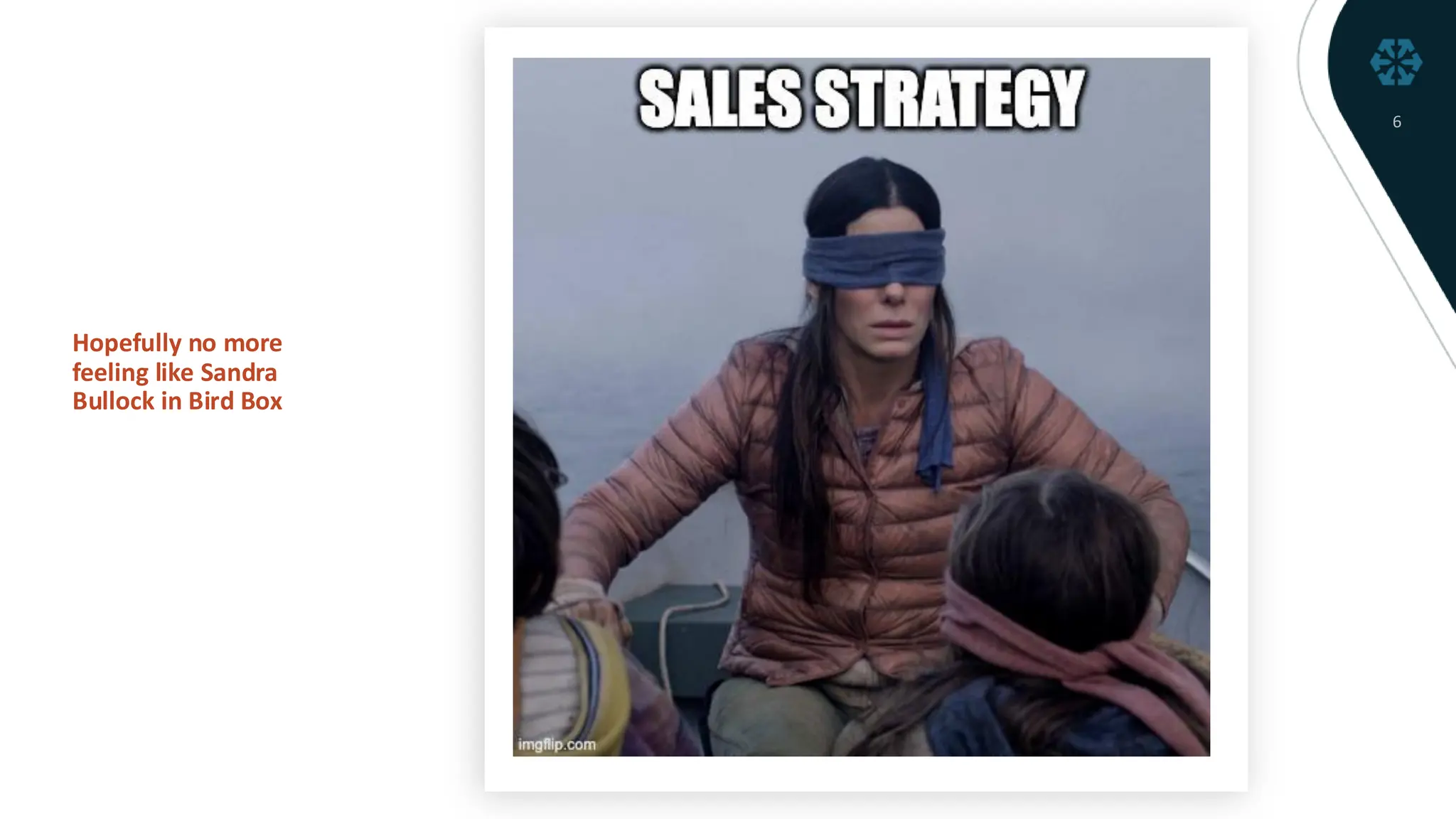
Hopefully no more
feeling like Sandra
Bullock in Bird Box
What is ABM?
7
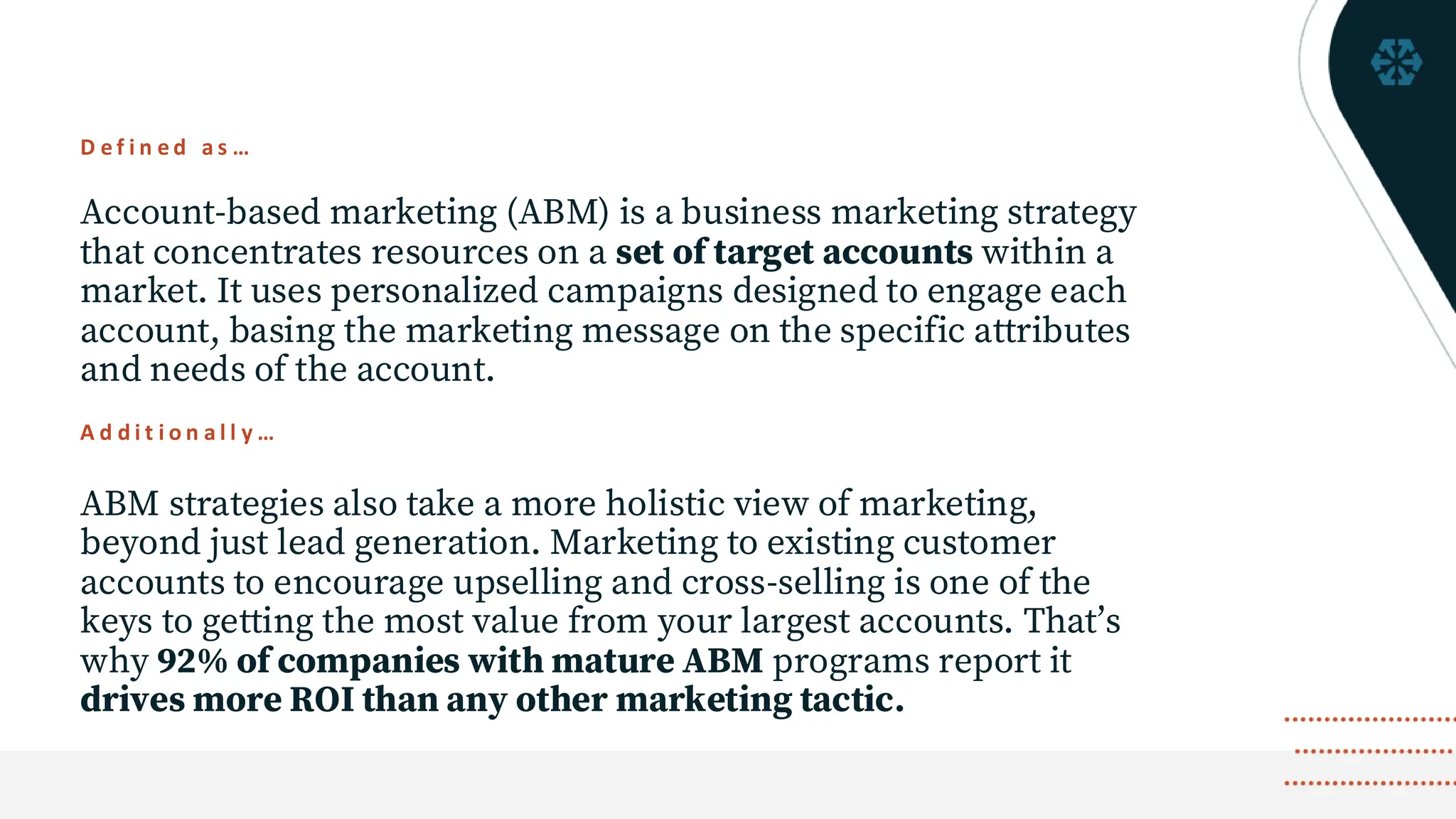
D e f i n e d a s …
Account-based marketing (ABM) is a business marketing strategy
that concentrates resources on a set of target accounts within a
market. It uses personalized campaigns designed to engage each
account, basing the marketing message on the specific attributes
and needs of the account.
ABM strategies also take a more holistic view of marketing,
beyond just lead generation. Marketing to existing customer
accounts to encourage upselling and cross-selling is one of the
keys to getting the most value from your largest accounts. That’s
why 92% of companies with mature ABM programs report it
drives more ROI than any other marketing tactic.
A d d i t i o n a l l y …
A
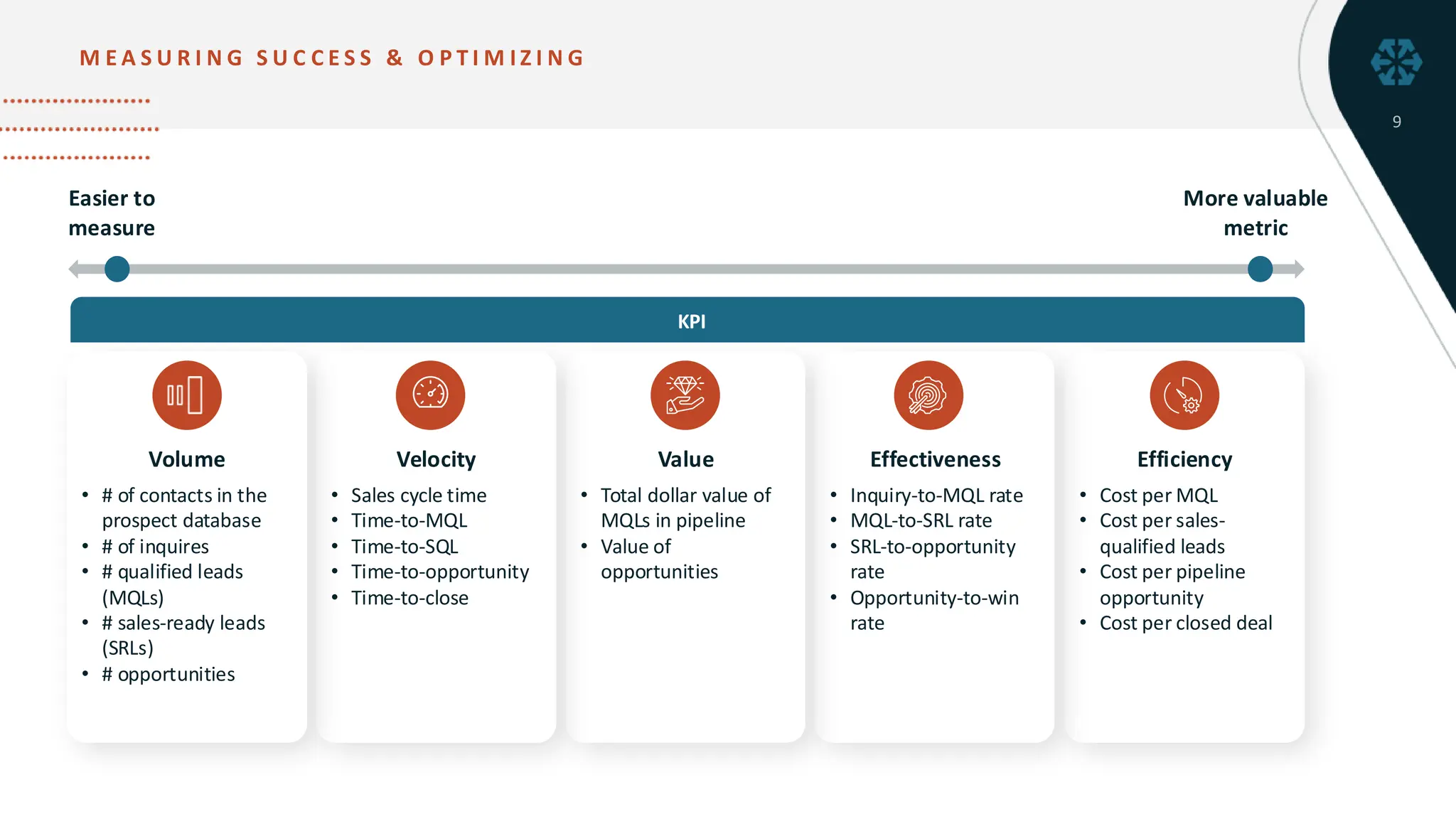
M E A S U R I N G S U C C E S S & O P T I M I Z I N G
9
KPI
01
Easier to
measure
More valuable
metric
Efficiency
• Cost per MQL
• Cost per sales-
qualified leads
• Cost per pipeline
opportunity
• Cost per closed deal
Effectiveness
• Inquiry-to-MQL rate
• MQL-to-SRL rate
• SRL-to-opportunity
rate
• Opportunity-to-win
rate
Value
• Total dollar value of
MQLs in pipeline
• Value of
opportunities
Velocity
• Sales cycle time
• Time-to-MQL
• Time-to-SQL
• Time-to-opportunity
• Time-to-close
Volume
• # of contacts in the
prospect database
• # of inquires
• # qualified leads
(MQLs)
• # sales-ready leads
(SRLs)
• # opportunities
10
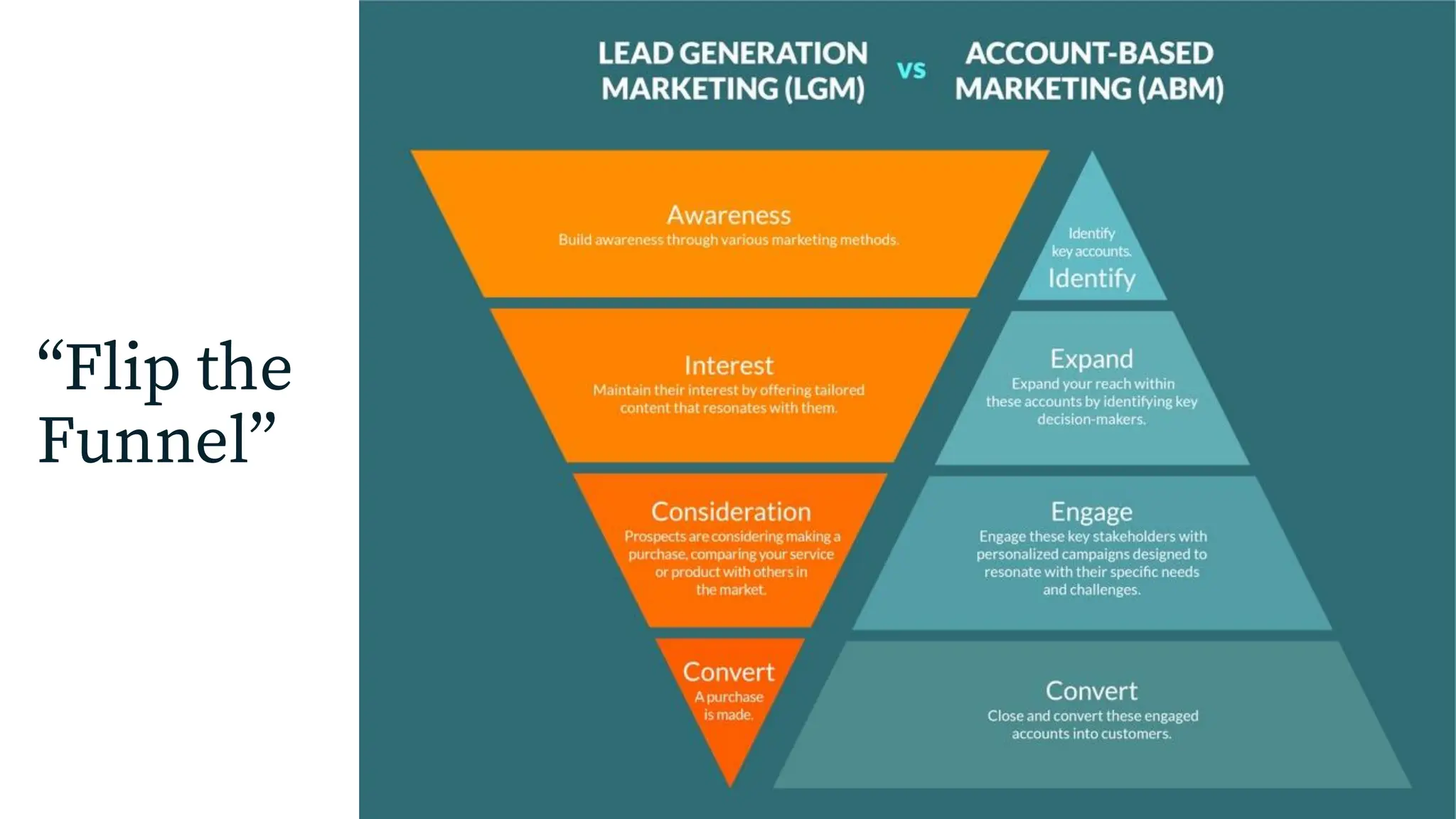
“Flip the
Funnel”
10
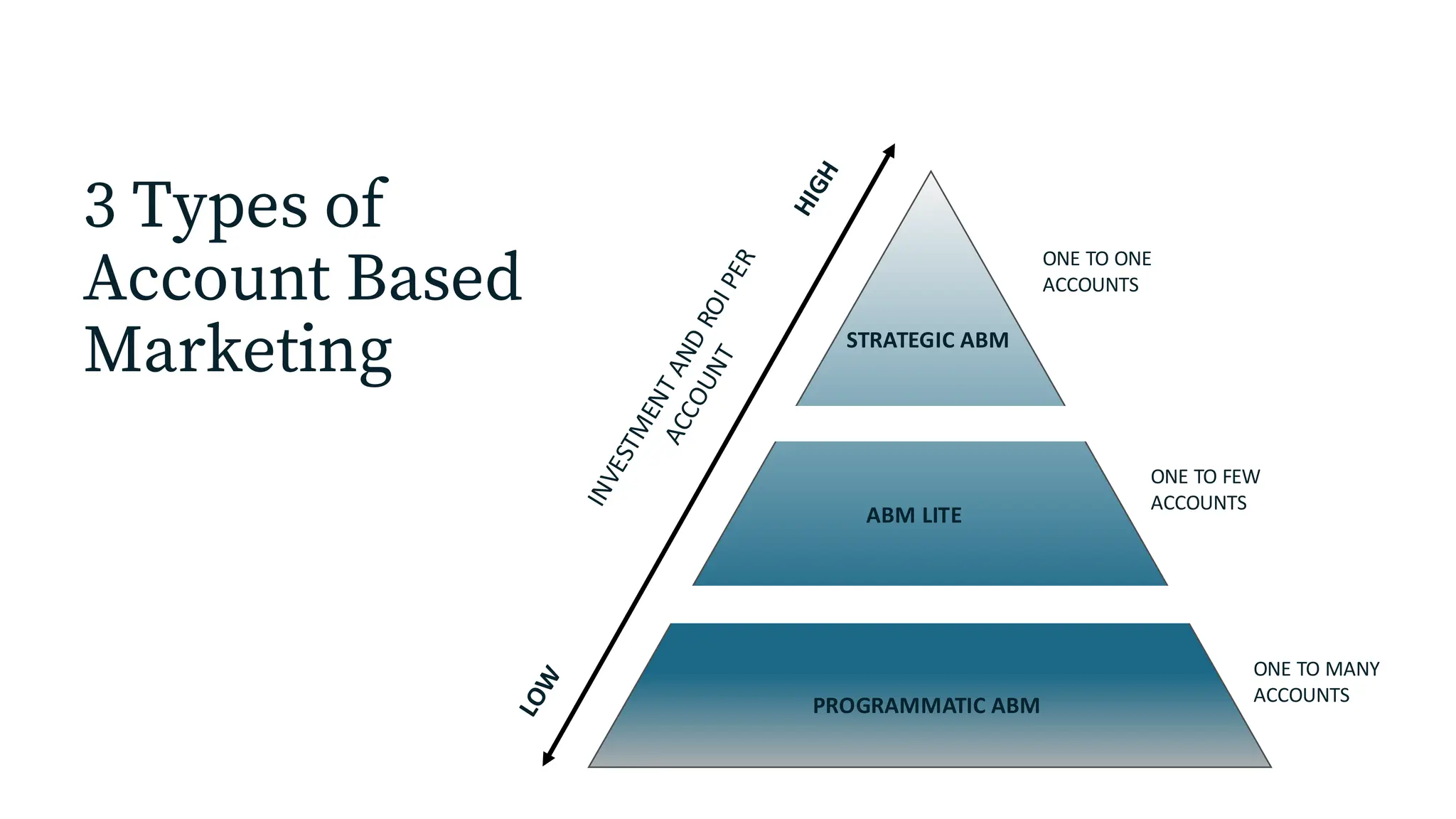
3 Types of
Account Based
Marketing
ONE TO ONE
ACCOUNTS
ONE TO MANY
ACCOUNTS
ONE TO FEW
ACCOUNTS
STRATEGIC ABM
ABM LITE
PROGRAMMATIC ABM
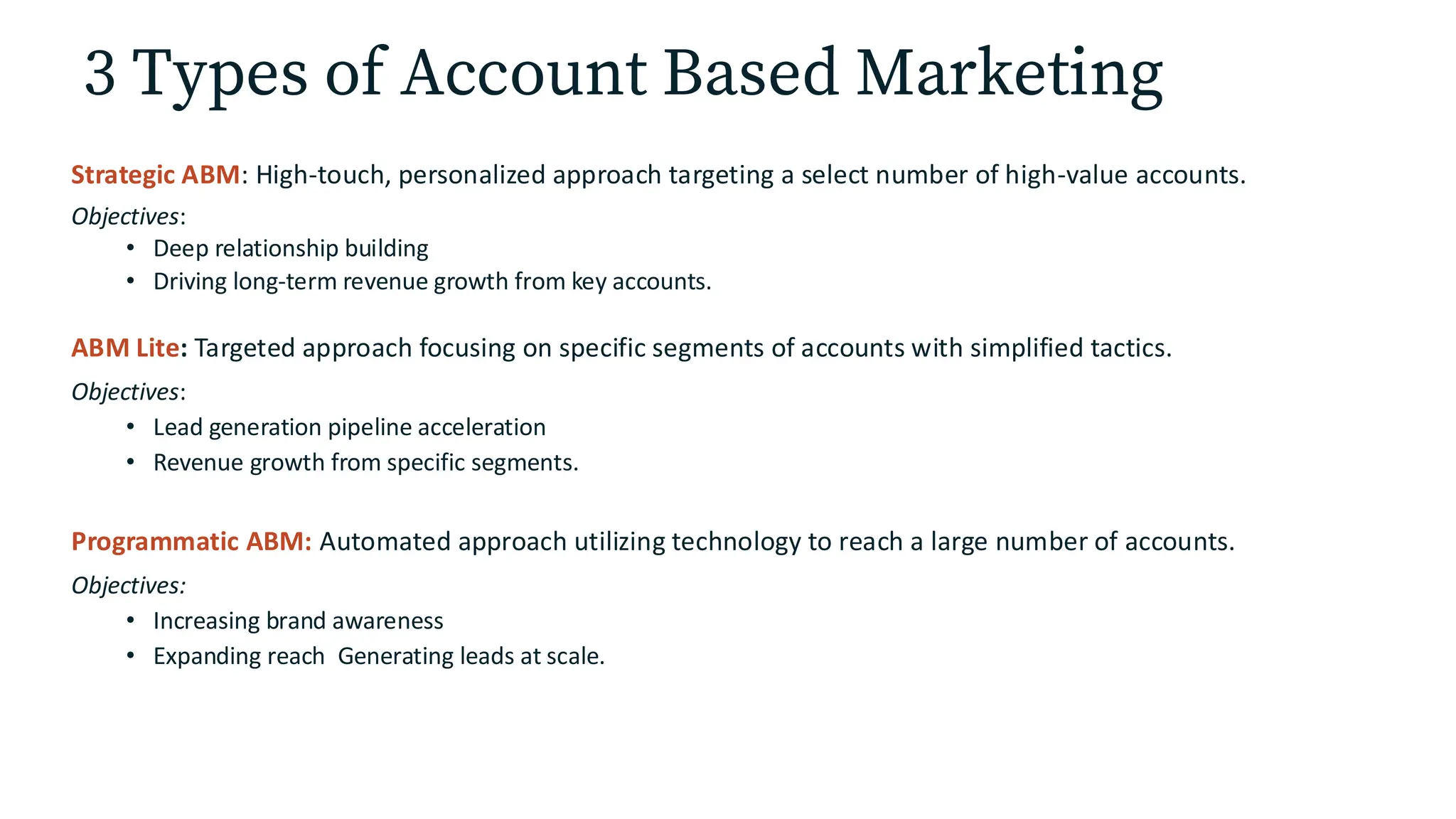
3 Types of Account Based Marketing
Strategic ABM: High-touch, personalized approach targeting a select number of high-value accounts.
Objectives:
• Deep relationship building
• Driving long-term revenue growth from key accounts.
ABM Lite: Targeted approach focusing on specific segments of accounts with simplified tactics.
Objectives:
• Lead generation pipeline acceleration
• Revenue growth from specific segments.
Programmatic ABM: Automated approach utilizing technology to reach a large number of accounts.
Objectives:
• Increasing brand awareness
• Expanding reach Generating leads at scale.
13
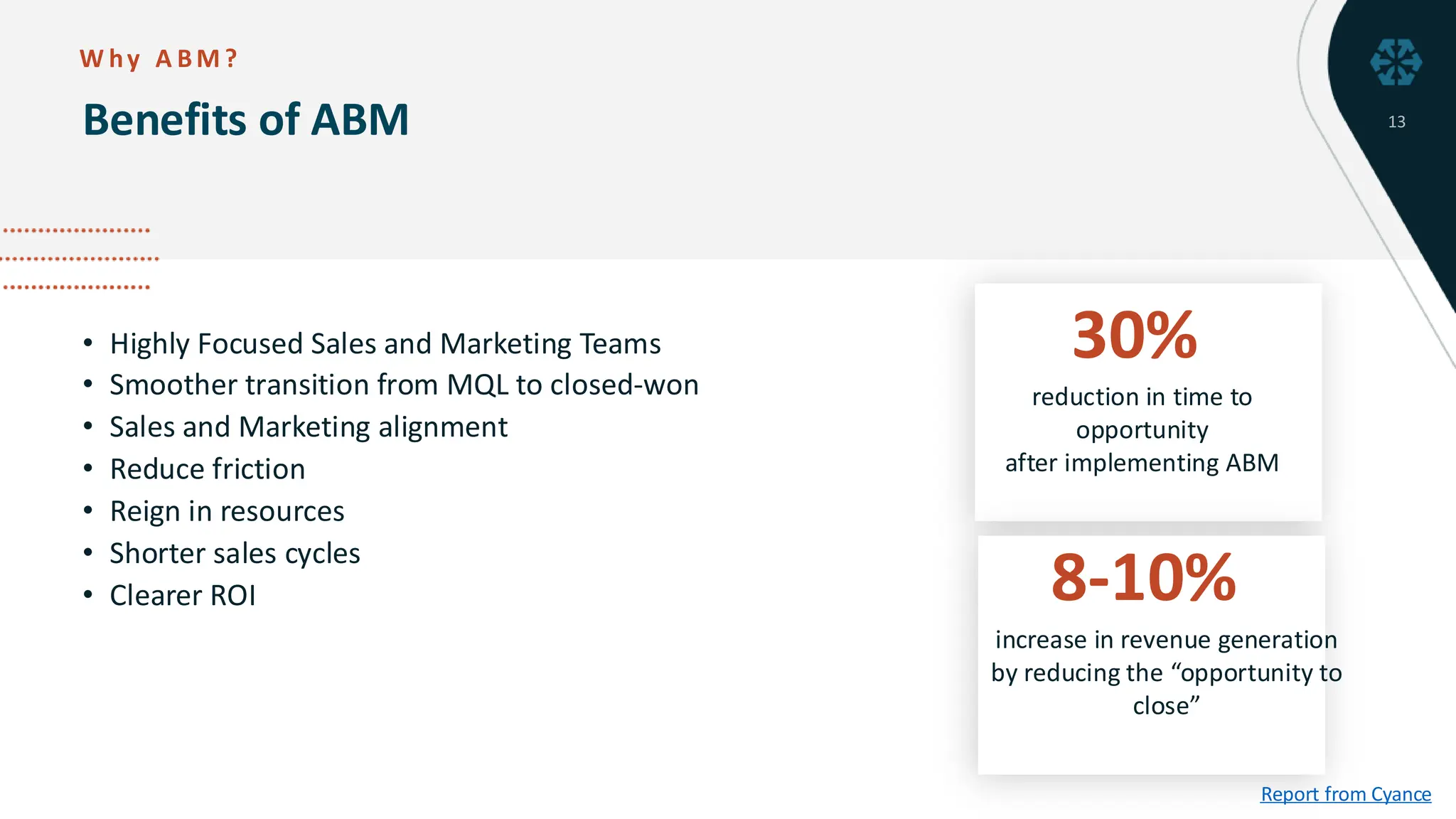
Benefits of ABM
W hy A BM ?
• Highly Focused Sales and Marketing Teams
• Smoother transition from MQL to closed-won
• Sales and Marketing alignment
• Reduce friction
• Reign in resources
• Shorter sales cycles
• Clearer ROI
reduction in time to
opportunity
after implementing ABM
30%
increase in revenue generation
by reducing the “opportunity to
close”
8-10%
Report from Cyance
A
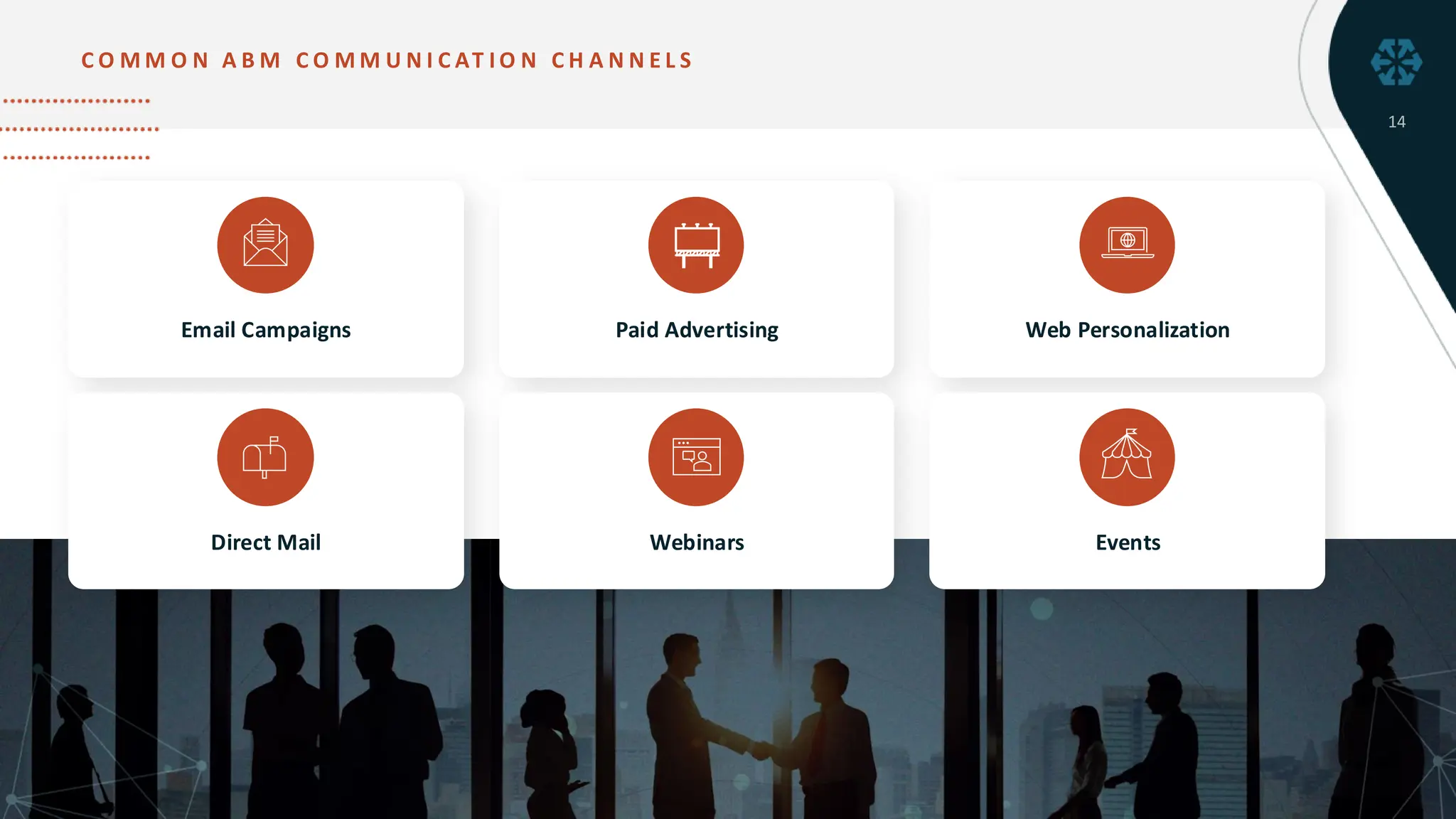
C O M M O N A B M C O M M U N I C AT I O N C H A N N E L S
14
Email Campaigns Paid Advertising Web Personalization
Direct Mail Webinars Events
Who should
be engaged?
15
A
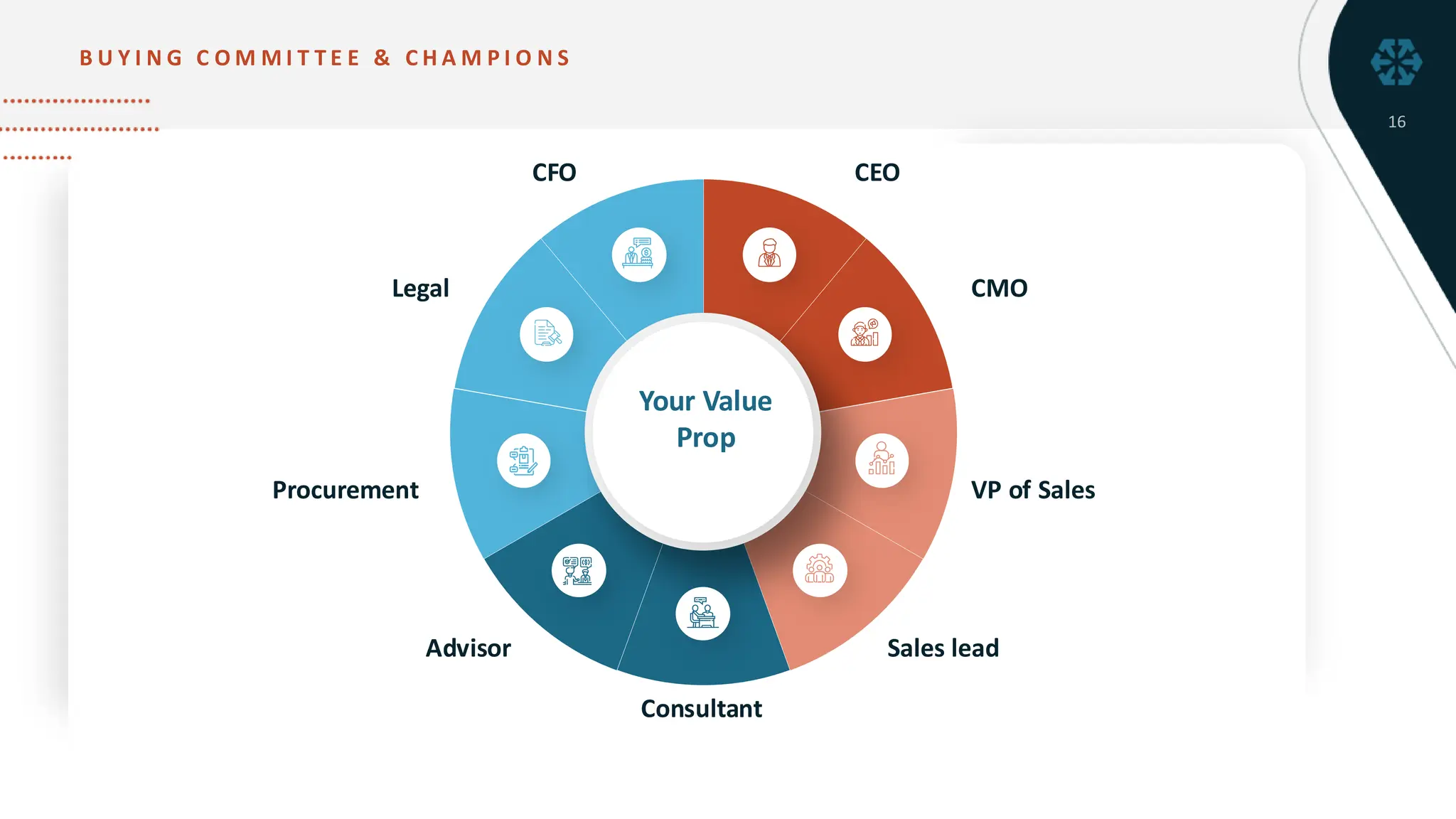
B U Y I N G C O M M I T T E E & C H A M P I O N S
16
CEO
CMO
VP of Sales
Sales lead
Consultant
Advisor
Procurement
Legal
CFO
Your Value
Prop
How to use ABM
17
18
Less of this….
A
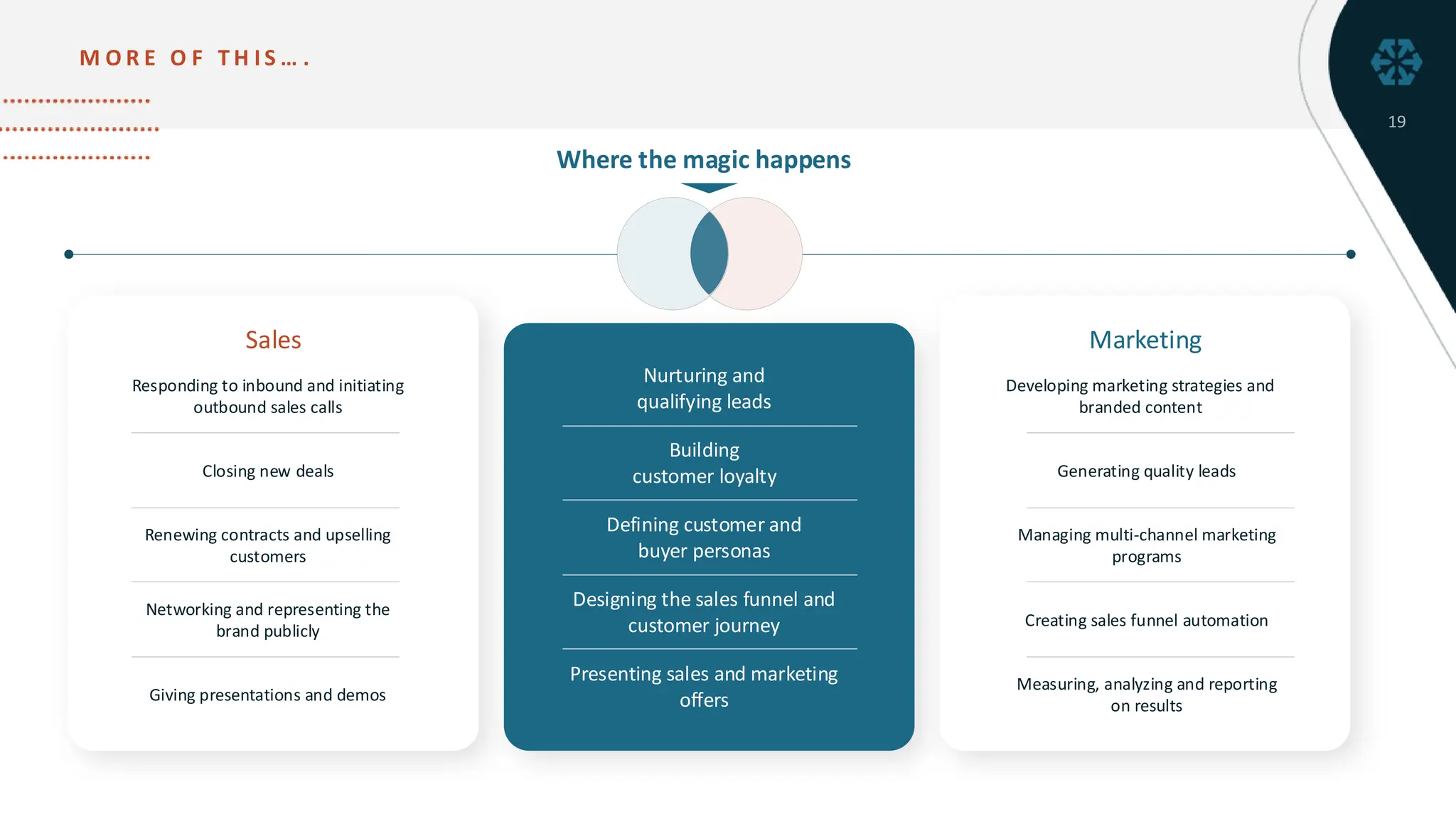
M O R E O F T H I S … .
19
Responding to inbound and initiating
outbound sales calls
Closing new deals
Renewing contracts and upselling
customers
Networking and representing the
brand publicly
Giving presentations and demos
Sales
Developing marketing strategies and
branded content
Generating quality leads
Managing multi-channel marketing
programs
Creating sales funnel automation
Measuring, analyzing and reporting
on results
Marketing
Nurturing and
qualifying leads
Building
customer loyalty
Defining customer and
buyer personas
Designing the sales funnel and
customer journey
Presenting sales and marketing
offers
Where the magic happens
A
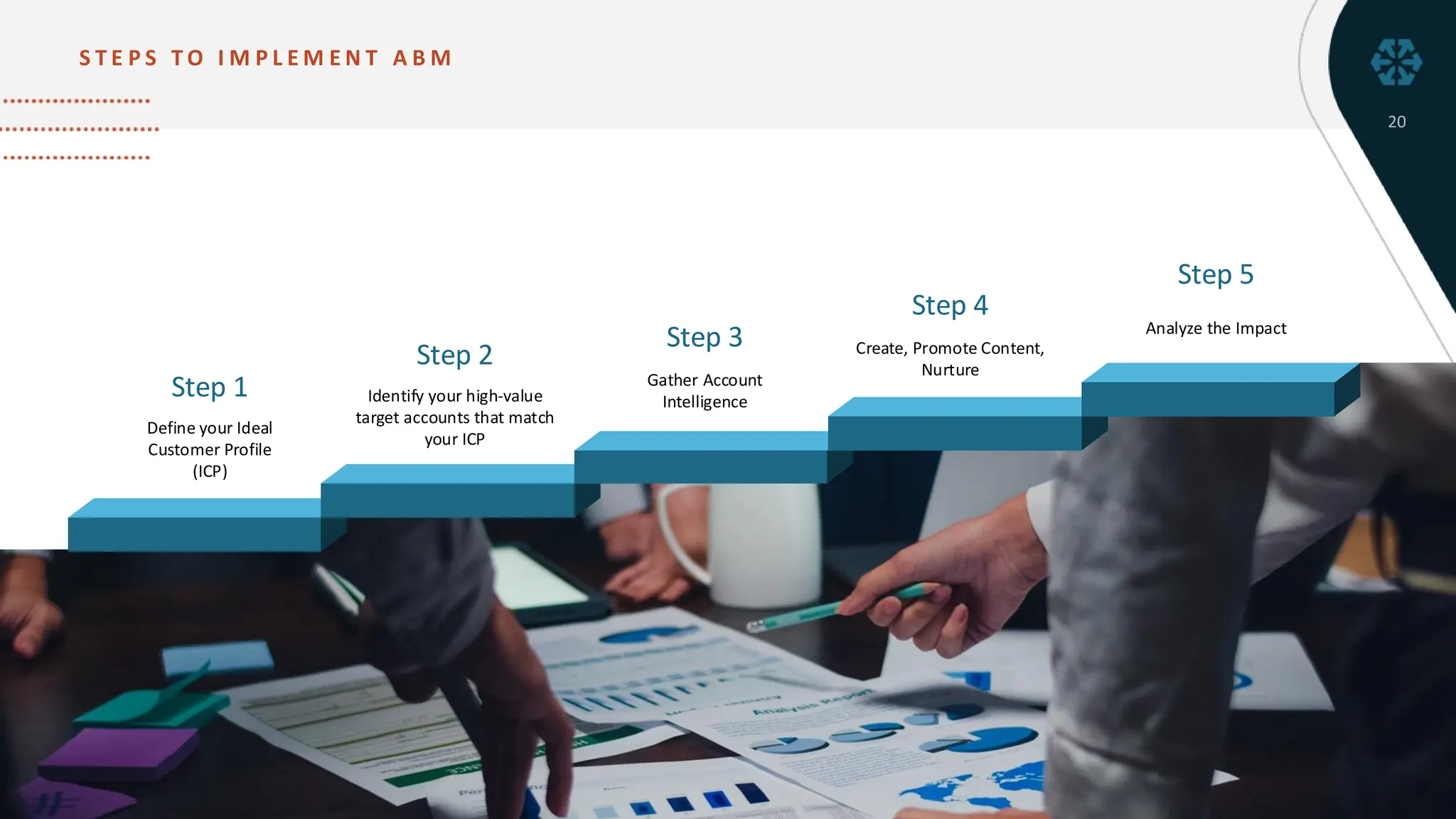
S T E P S T O I M P L E M E N T A B M
20
Step 1
Define your Ideal
Customer Profile
(ICP)
Step 2
Identify your high-value
target accounts that match
your ICP
Step 3
Gather Account
Intelligence
Step 4
Create, Promote Content,
Nurture
Step 5
Analyze the Impact
A
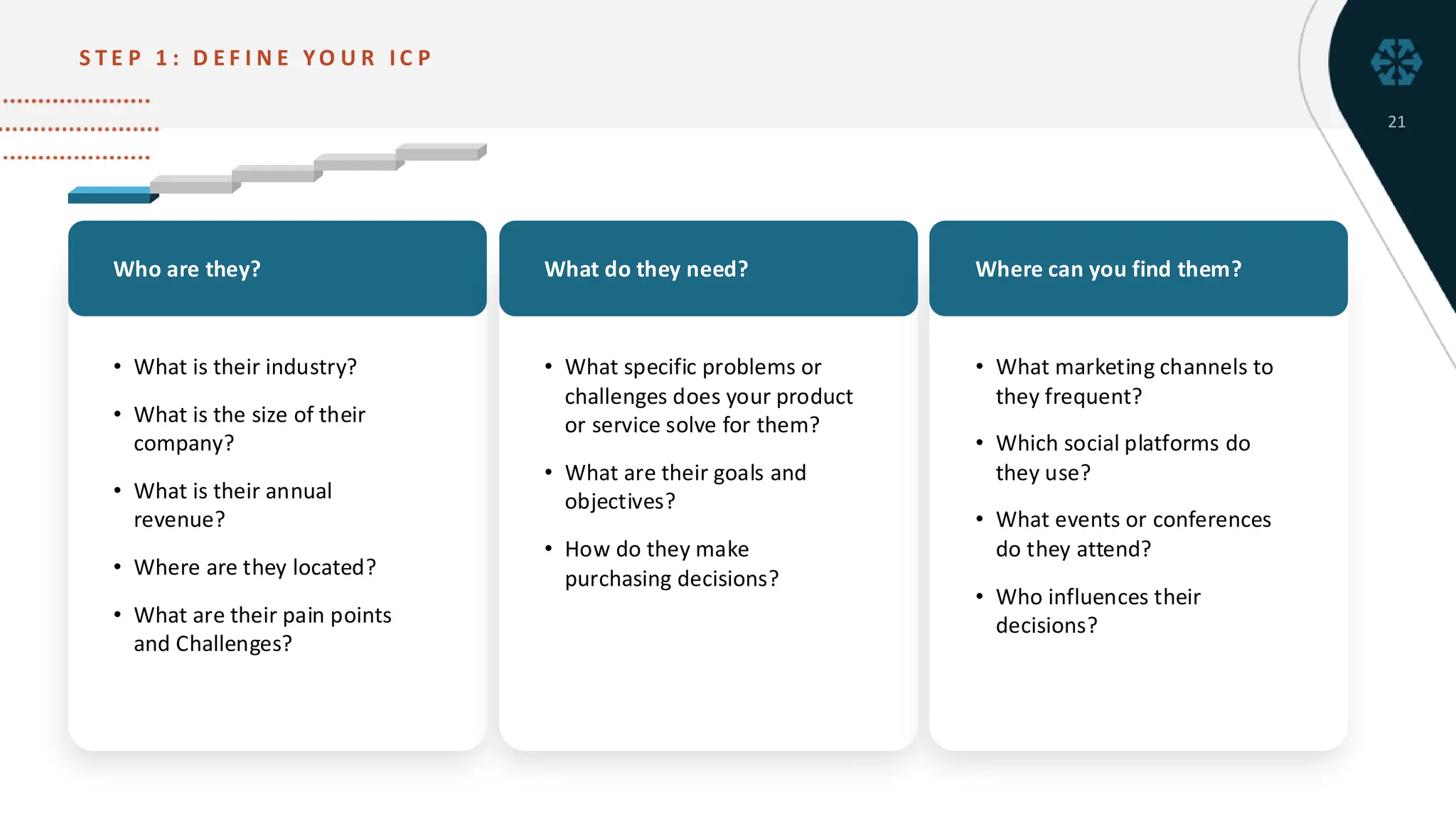
S T E P 1 : D E F I N E YO U R I C P
21
• What is their industry?
• What is the size of their
company?
• What is their annual
revenue?
• Where are they located?
• What are their pain points
and Challenges?
Who are they?
• What specific problems or
challenges does your product
or service solve for them?
• What are their goals and
objectives?
• How do they make
purchasing decisions?
What do they need?
• What marketing channels to
they frequent?
• Which social platforms do
they use?
• What events or conferences
do they attend?
• Who influences their
decisions?
Where can you find them?
A
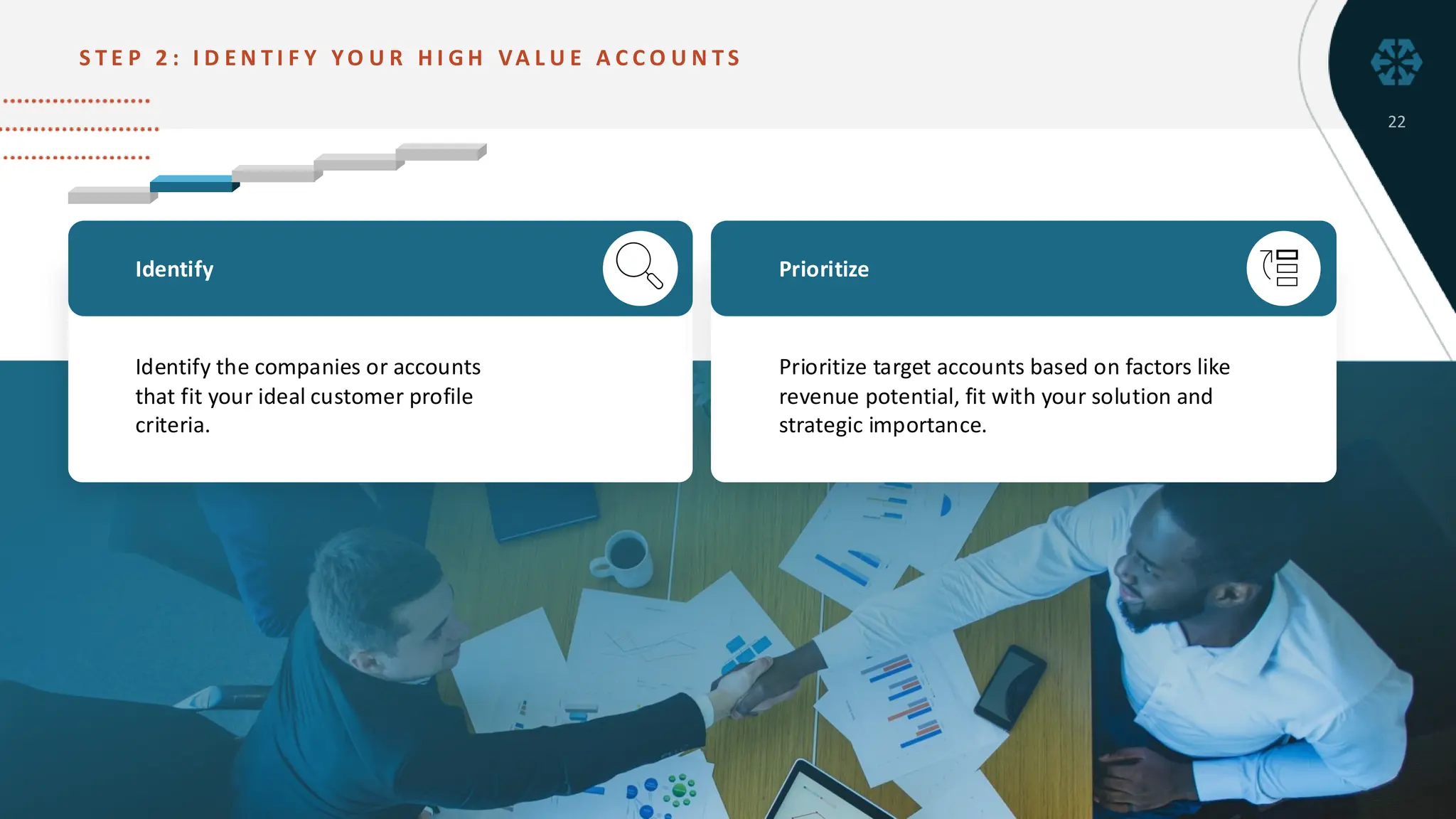
S T E P 2 : I D E N T I F Y YO U R H I G H VA L U E A C C O U N T S
22
Identify the companies or accounts
that fit your ideal customer profile
criteria.
Identify
Prioritize target accounts based on factors like
revenue potential, fit with your solution and
strategic importance.
Prioritize
A
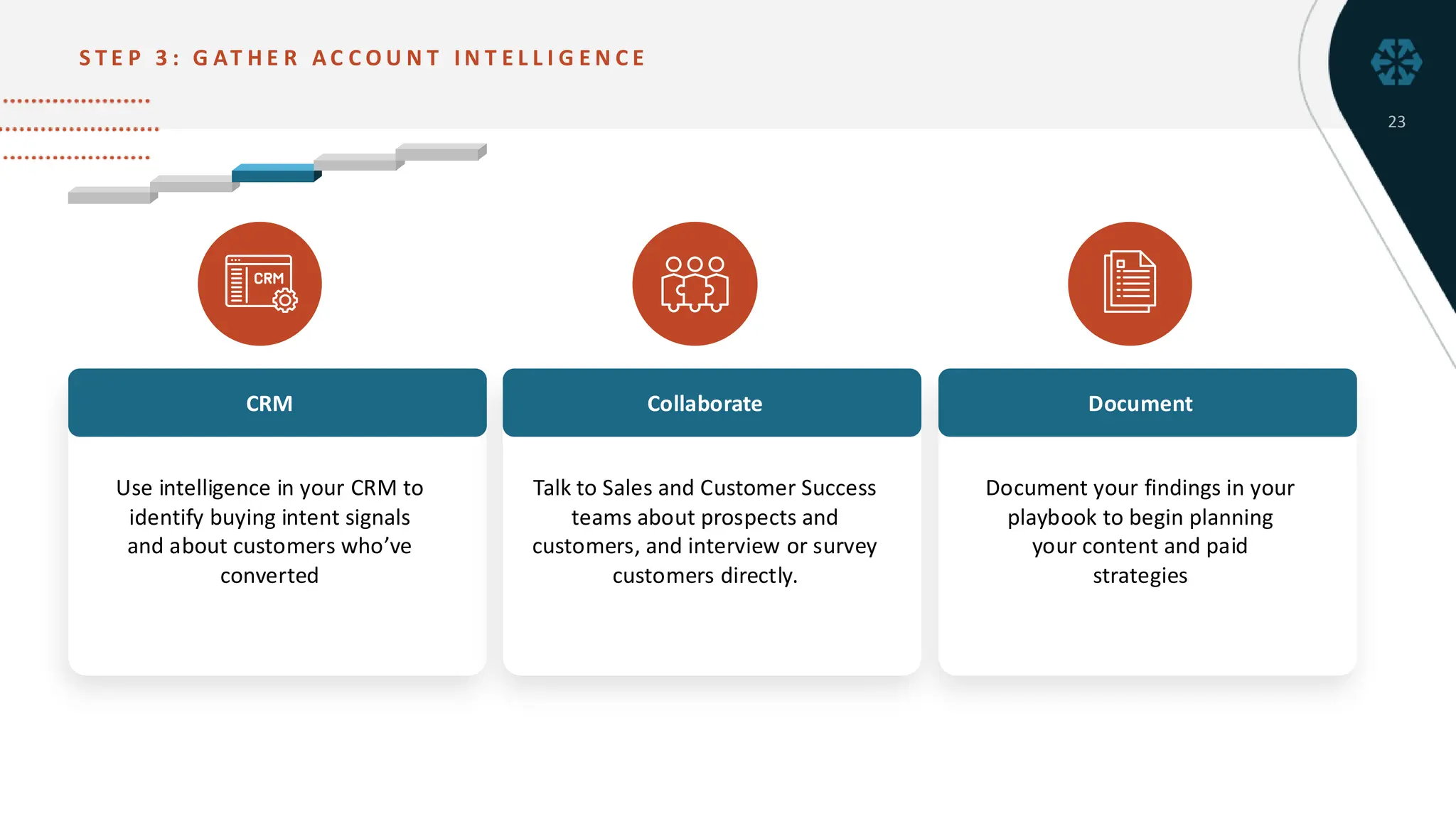
Document your findings in your
playbook to begin planning
your content and paid
strategies
Document
S T E P 3 : G AT H E R A C C O U N T I N T E L L I G E N C E
23
Use intelligence in your CRM to
identify buying intent signals
and about customers who’ve
converted
CRM
Talk to Sales and Customer Success
teams about prospects and
customers, and interview or survey
customers directly.
Collaborate
A
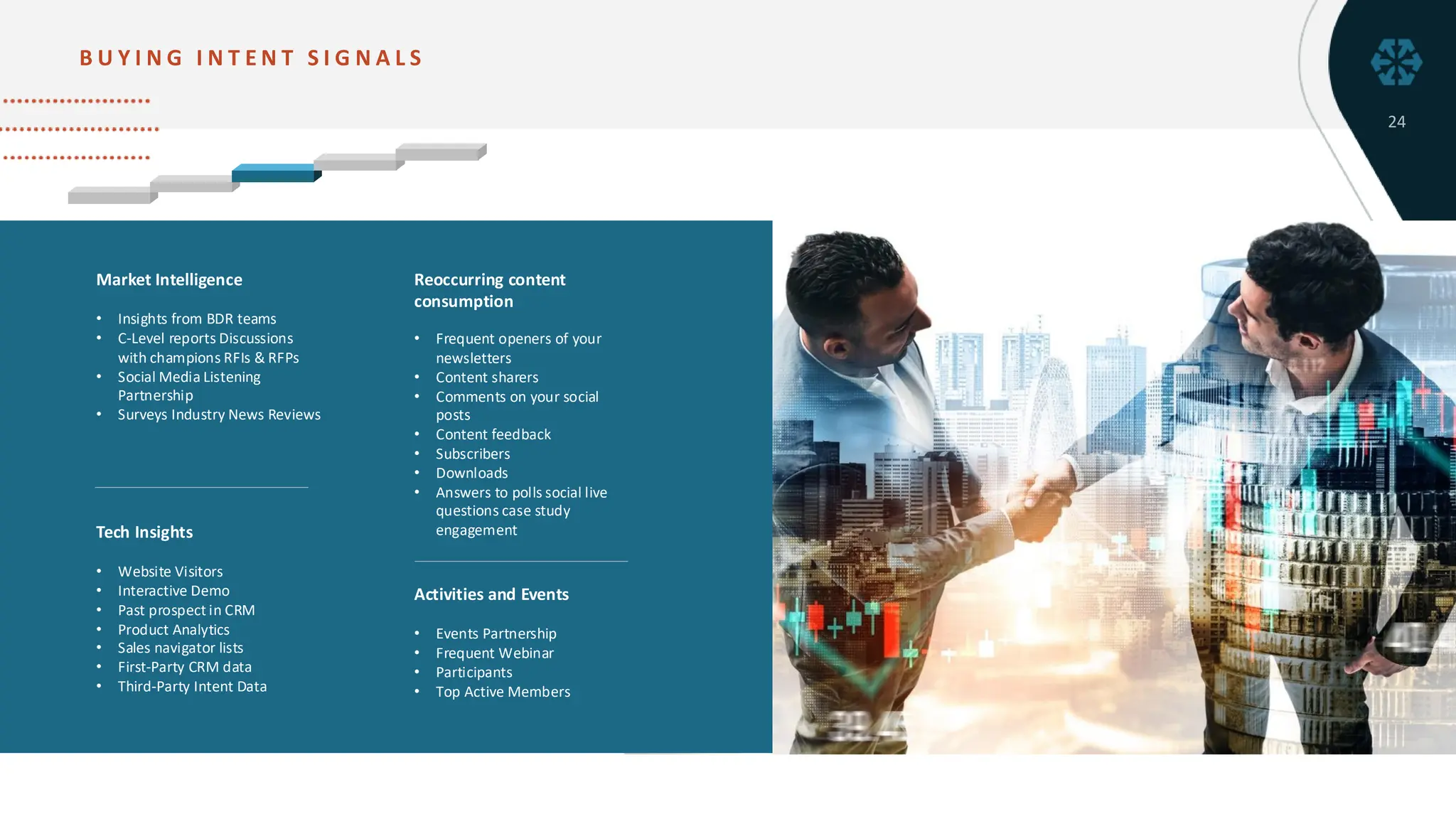
B U Y I N G I N T E N T S I G N A L S
24
• Insights from BDR teams
• C-Level reports Discussions
with champions RFIs & RFPs
• Social Media Listening
Partnership
• Surveys Industry News Reviews
Market Intelligence
• Website Visitors
• Interactive Demo
• Past prospect in CRM
• Product Analytics
• Sales navigator lists
• First-Party CRM data
• Third-Party Intent Data
Tech Insights
• Frequent openers of your
newsletters
• Content sharers
• Comments on your social
posts
• Content feedback
• Subscribers
• Downloads
• Answers to polls social live
questions case study
engagement
Reoccurring content
consumption
• Events Partnership
• Frequent Webinar
• Participants
• Top Active Members
Activities and Events
A
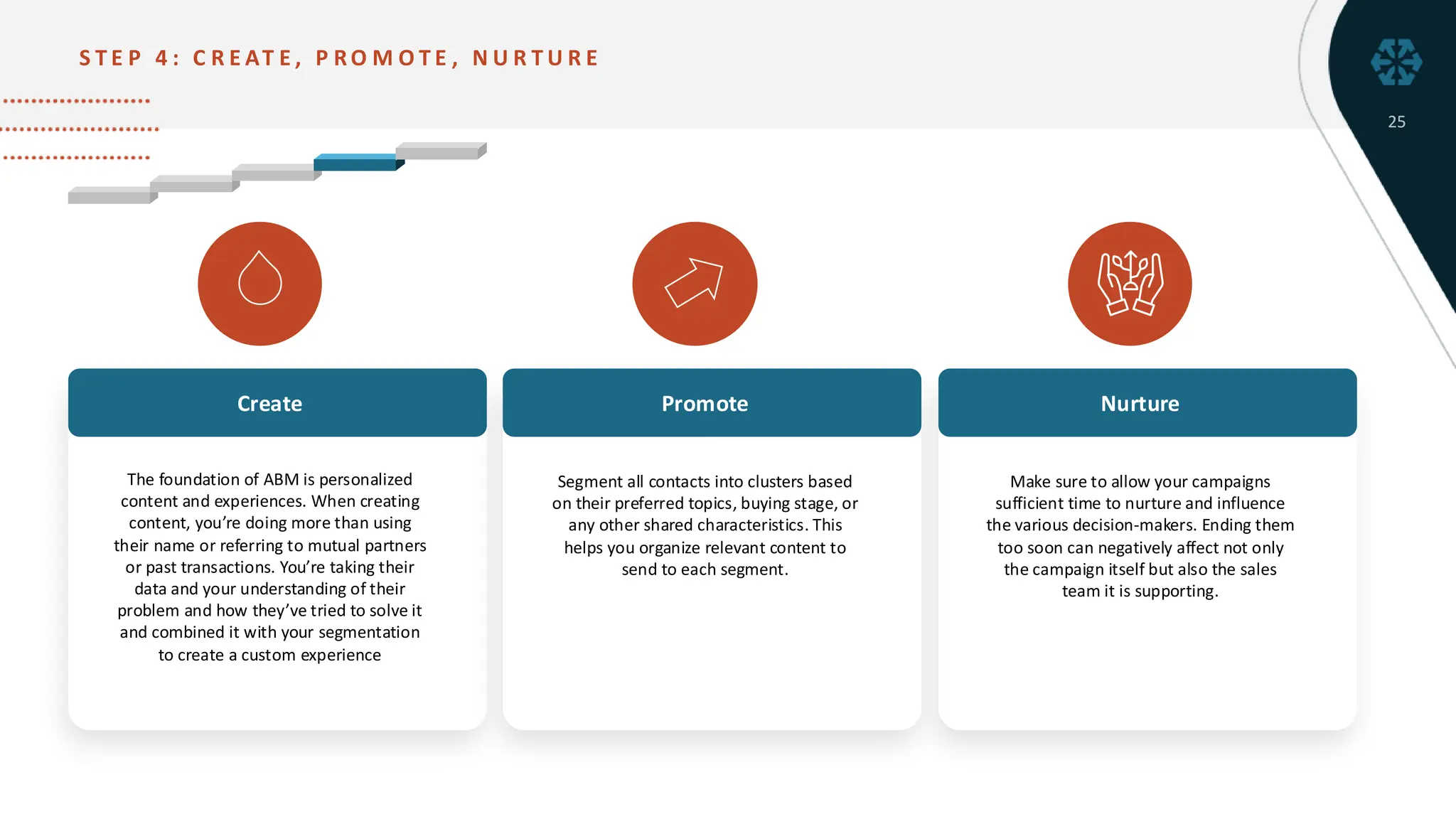
25
Make sure to allow your campaigns
sufficient time to nurture and influence
the various decision-makers. Ending them
too soon can negatively affect not only
the campaign itself but also the sales
team it is supporting.
Nurture
S T E P 4 : C R E AT E , P RO M O T E , N U R T U R E
25
The foundation of ABM is personalized
content and experiences. When creating
content, you’re doing more than using
their name or referring to mutual partners
or past transactions. You’re taking their
data and your understanding of their
problem and how they’ve tried to solve it
and combined it with your segmentation
to create a custom experience
Create
Segment all contacts into clusters based
on their preferred topics, buying stage, or
any other shared characteristics. This
helps you organize relevant content to
send to each segment.
Promote
A
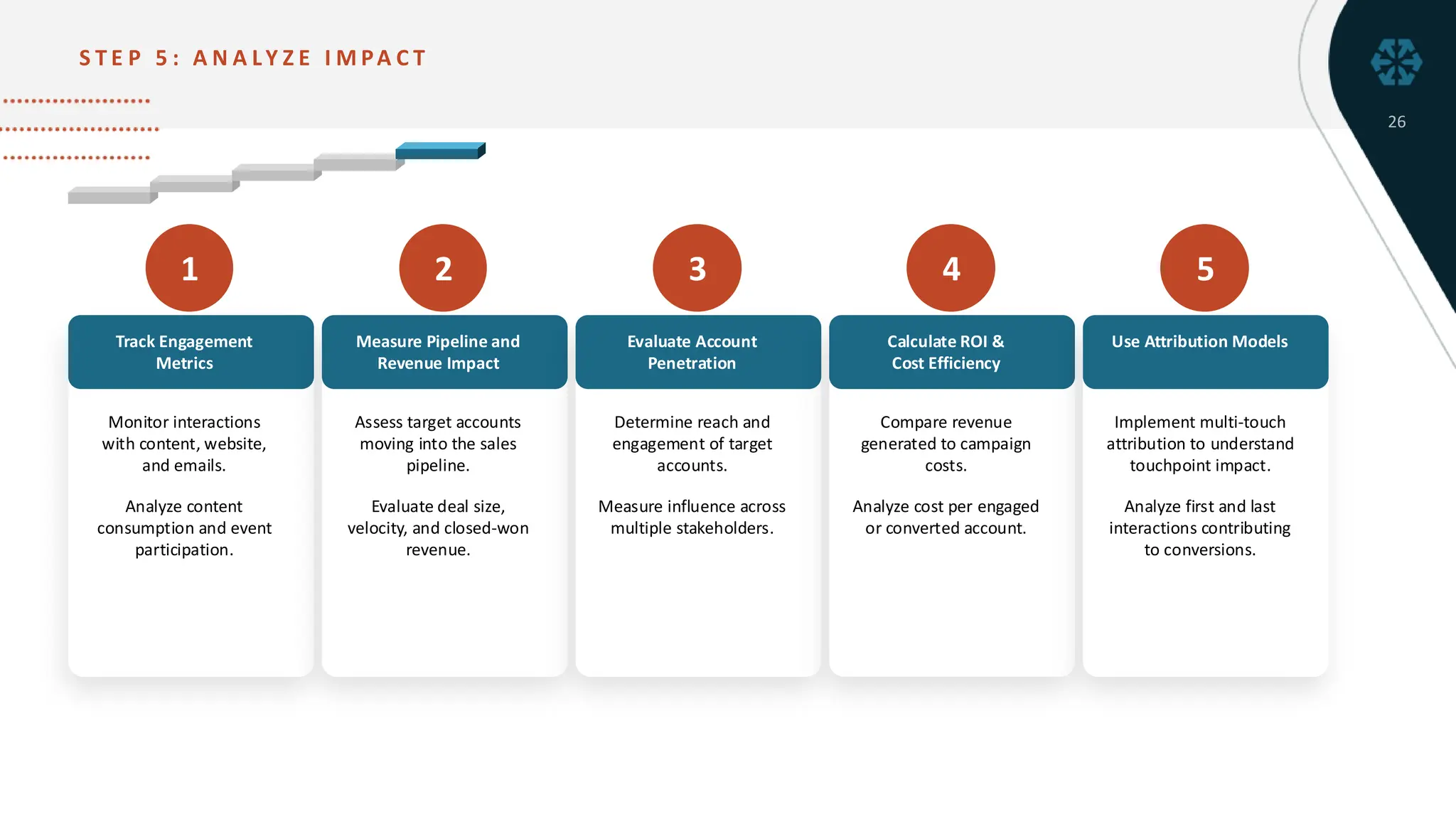
S T E P 5 : A N A LY Z E I M PA C T
26
Monitor interactions
with content, website,
and emails.
Analyze content
consumption and event
participation.
Track Engagement
Metrics
1
Assess target accounts
moving into the sales
pipeline.
Evaluate deal size,
velocity, and closed-won
revenue.
Measure Pipeline and
Revenue Impact
2
Determine reach and
engagement of target
accounts.
Measure influence across
multiple stakeholders.
Evaluate Account
Penetration
3
Compare revenue
generated to campaign
costs.
Analyze cost per engaged
or converted account.
Calculate ROI &
Cost Efficiency
4
Implement multi-touch
attribution to understand
touchpoint impact.
Analyze first and last
interactions contributing
to conversions.
Use Attribution Models
5
Why ABM Team’s Fail
27
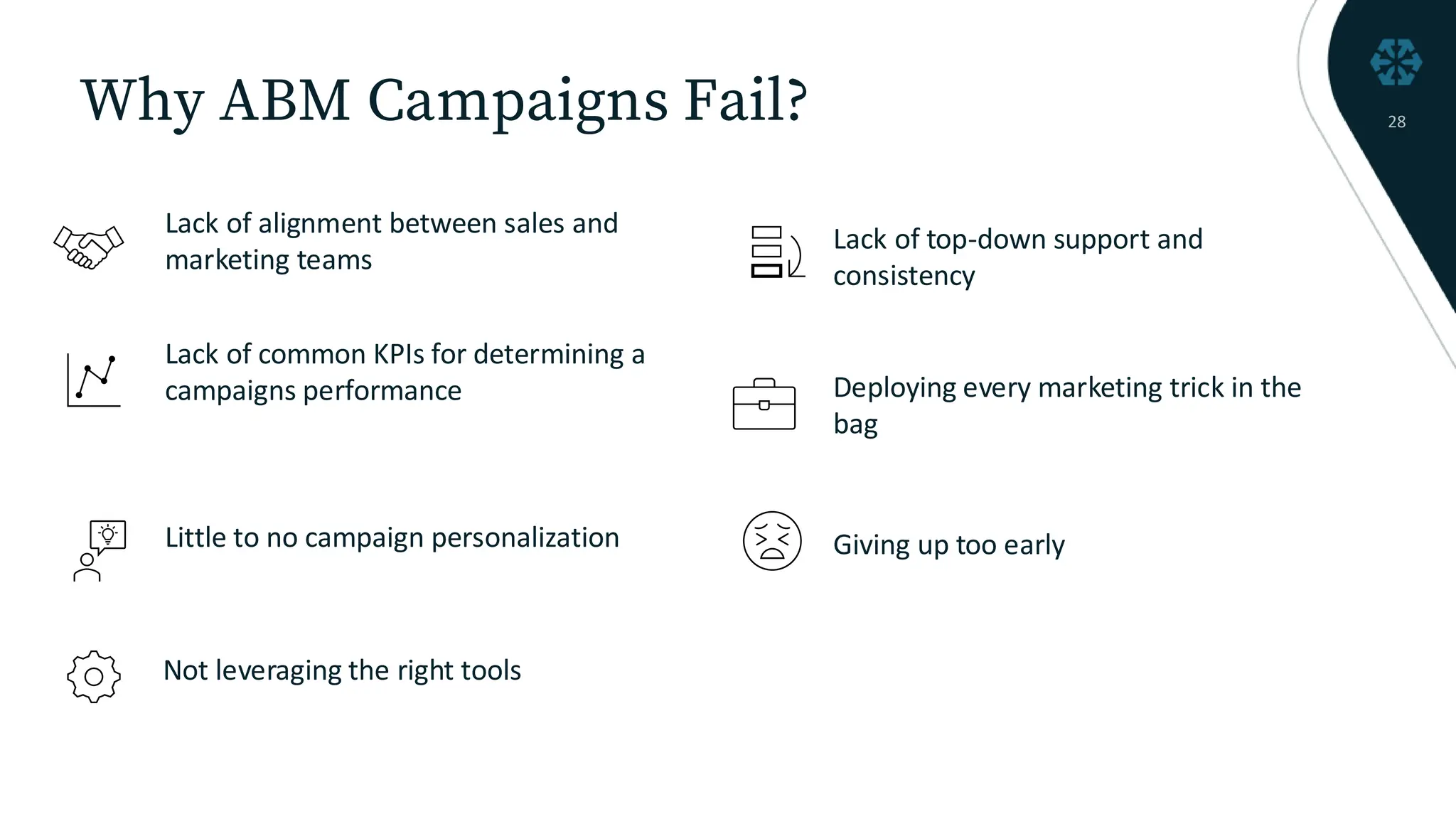
28
Why ABM Campaigns Fail?
Lack of alignment between sales and
marketing teams
Lack of common KPIs for determining a
campaigns performance
Little to no campaign personalization
Lack of top-down support and
consistency
Deploying every marketing trick in the
bag
Giving up too early
Not leveraging the right tools
Platform
Identification
for ABM
29
A
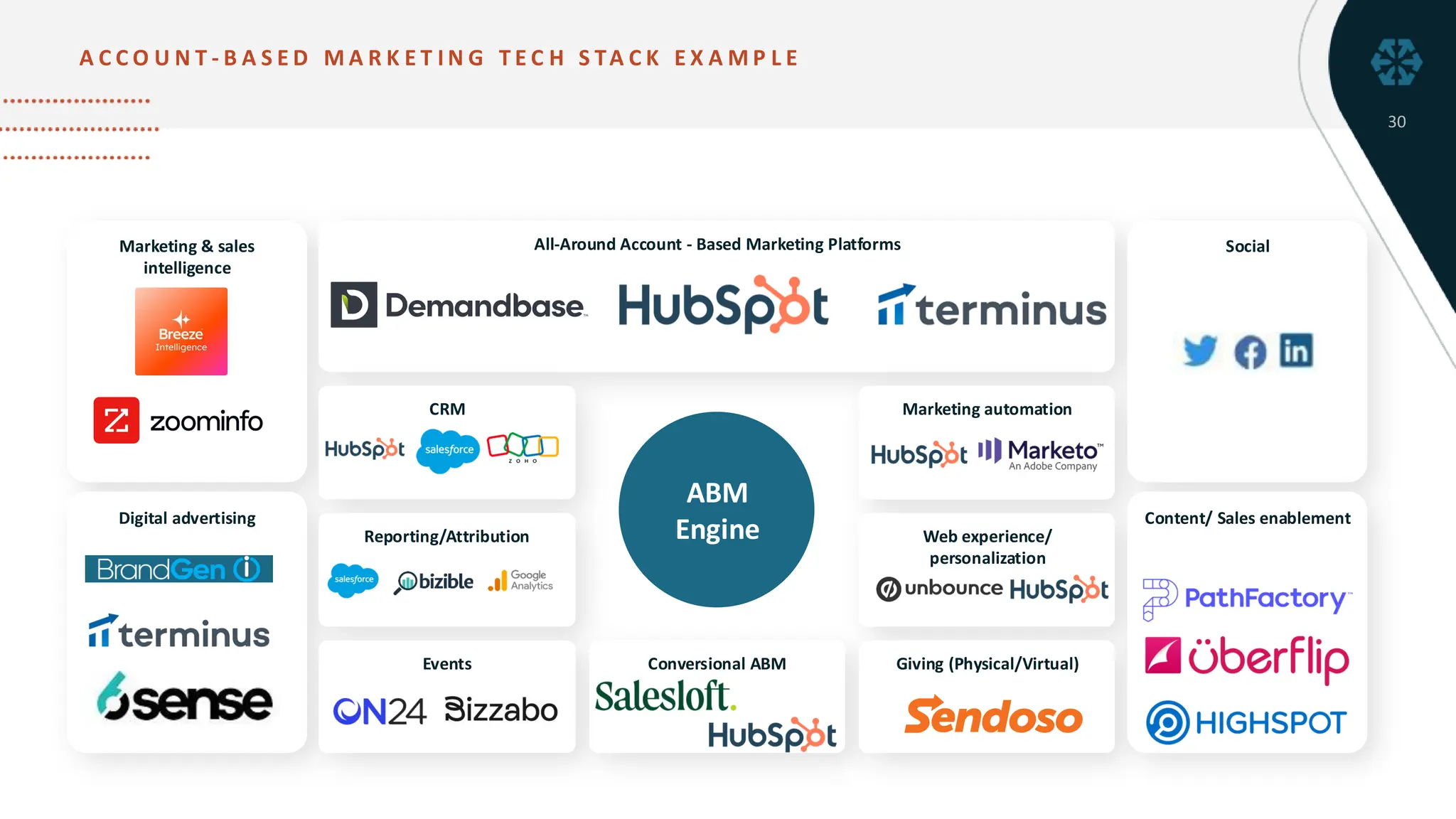
A C C O U N T - B A S E D M A R K E T I N G T E C H S TA C K E X A M P L E
30
Marketing & sales
intelligence
Digital advertising
All-Around Account - Based Marketing Platforms
CRM
Reporting/Attribution
Events Conversional ABM
Marketing automation
Web experience/
personalization
Giving (Physical/Virtual)
Social
Content/ Sales enablement
ABM
Engine
A B M Re s o u r c e
D o w n l o a d
31
How to Find Common Ground: Account-Based Marketing (ABM) for Team Alignment

How to Find Common Ground: Account-Based Marketing (ABM) for Team Alignment

  • 5.
    5 Key Takeaways • Identifying IdealClient Profiles (ICPs) • Developing strategy & KPI alignment • Optimizing ABM tools • Fostering collaboration and growth The HOW of implementing ABM is often the challenge in business today – from change management to implementing the right tech tools and automation, it can be a whirlwind. This session provides actionable insights for your teams to align for real revenue impact. W H AT W E H O P E YO U L E AR N
  • 6.
    6 Hopefully no more feelinglike Sandra Bullock in Bird Box
  • 7.
  • 8.
    D e fi n e d a s … Account-based marketing (ABM) is a business marketing strategy that concentrates resources on a set of target accounts within a market. It uses personalized campaigns designed to engage each account, basing the marketing message on the specific attributes and needs of the account. ABM strategies also take a more holistic view of marketing, beyond just lead generation. Marketing to existing customer accounts to encourage upselling and cross-selling is one of the keys to getting the most value from your largest accounts. That’s why 92% of companies with mature ABM programs report it drives more ROI than any other marketing tactic. A d d i t i o n a l l y …
  • 9.
    A M E AS U R I N G S U C C E S S & O P T I M I Z I N G 9 KPI 01 Easier to measure More valuable metric Efficiency • Cost per MQL • Cost per sales- qualified leads • Cost per pipeline opportunity • Cost per closed deal Effectiveness • Inquiry-to-MQL rate • MQL-to-SRL rate • SRL-to-opportunity rate • Opportunity-to-win rate Value • Total dollar value of MQLs in pipeline • Value of opportunities Velocity • Sales cycle time • Time-to-MQL • Time-to-SQL • Time-to-opportunity • Time-to-close Volume • # of contacts in the prospect database • # of inquires • # qualified leads (MQLs) • # sales-ready leads (SRLs) • # opportunities
  • 10.
  • 11.
    3 Types of AccountBased Marketing ONE TO ONE ACCOUNTS ONE TO MANY ACCOUNTS ONE TO FEW ACCOUNTS STRATEGIC ABM ABM LITE PROGRAMMATIC ABM
  • 12.
    3 Types ofAccount Based Marketing Strategic ABM: High-touch, personalized approach targeting a select number of high-value accounts. Objectives: • Deep relationship building • Driving long-term revenue growth from key accounts. ABM Lite: Targeted approach focusing on specific segments of accounts with simplified tactics. Objectives: • Lead generation pipeline acceleration • Revenue growth from specific segments. Programmatic ABM: Automated approach utilizing technology to reach a large number of accounts. Objectives: • Increasing brand awareness • Expanding reach Generating leads at scale.
  • 13.
    13 Benefits of ABM Why A BM ? • Highly Focused Sales and Marketing Teams • Smoother transition from MQL to closed-won • Sales and Marketing alignment • Reduce friction • Reign in resources • Shorter sales cycles • Clearer ROI reduction in time to opportunity after implementing ABM 30% increase in revenue generation by reducing the “opportunity to close” 8-10% Report from Cyance
  • 14.
    A C O MM O N A B M C O M M U N I C AT I O N C H A N N E L S 14 Email Campaigns Paid Advertising Web Personalization Direct Mail Webinars Events
  • 15.
  • 16.
    A B U YI N G C O M M I T T E E & C H A M P I O N S 16 CEO CMO VP of Sales Sales lead Consultant Advisor Procurement Legal CFO Your Value Prop
  • 17.
    How to useABM 17
  • 18.
  • 19.
    A M O RE O F T H I S … . 19 Responding to inbound and initiating outbound sales calls Closing new deals Renewing contracts and upselling customers Networking and representing the brand publicly Giving presentations and demos Sales Developing marketing strategies and branded content Generating quality leads Managing multi-channel marketing programs Creating sales funnel automation Measuring, analyzing and reporting on results Marketing Nurturing and qualifying leads Building customer loyalty Defining customer and buyer personas Designing the sales funnel and customer journey Presenting sales and marketing offers Where the magic happens
  • 20.
    A S T EP S T O I M P L E M E N T A B M 20 Step 1 Define your Ideal Customer Profile (ICP) Step 2 Identify your high-value target accounts that match your ICP Step 3 Gather Account Intelligence Step 4 Create, Promote Content, Nurture Step 5 Analyze the Impact
  • 21.
    A S T EP 1 : D E F I N E YO U R I C P 21 • What is their industry? • What is the size of their company? • What is their annual revenue? • Where are they located? • What are their pain points and Challenges? Who are they? • What specific problems or challenges does your product or service solve for them? • What are their goals and objectives? • How do they make purchasing decisions? What do they need? • What marketing channels to they frequent? • Which social platforms do they use? • What events or conferences do they attend? • Who influences their decisions? Where can you find them?
  • 22.
    A S T EP 2 : I D E N T I F Y YO U R H I G H VA L U E A C C O U N T S 22 Identify the companies or accounts that fit your ideal customer profile criteria. Identify Prioritize target accounts based on factors like revenue potential, fit with your solution and strategic importance. Prioritize
  • 23.
    A Document your findingsin your playbook to begin planning your content and paid strategies Document S T E P 3 : G AT H E R A C C O U N T I N T E L L I G E N C E 23 Use intelligence in your CRM to identify buying intent signals and about customers who’ve converted CRM Talk to Sales and Customer Success teams about prospects and customers, and interview or survey customers directly. Collaborate
  • 24.
    A B U YI N G I N T E N T S I G N A L S 24 • Insights from BDR teams • C-Level reports Discussions with champions RFIs & RFPs • Social Media Listening Partnership • Surveys Industry News Reviews Market Intelligence • Website Visitors • Interactive Demo • Past prospect in CRM • Product Analytics • Sales navigator lists • First-Party CRM data • Third-Party Intent Data Tech Insights • Frequent openers of your newsletters • Content sharers • Comments on your social posts • Content feedback • Subscribers • Downloads • Answers to polls social live questions case study engagement Reoccurring content consumption • Events Partnership • Frequent Webinar • Participants • Top Active Members Activities and Events
  • 25.
    A 25 Make sure toallow your campaigns sufficient time to nurture and influence the various decision-makers. Ending them too soon can negatively affect not only the campaign itself but also the sales team it is supporting. Nurture S T E P 4 : C R E AT E , P RO M O T E , N U R T U R E 25 The foundation of ABM is personalized content and experiences. When creating content, you’re doing more than using their name or referring to mutual partners or past transactions. You’re taking their data and your understanding of their problem and how they’ve tried to solve it and combined it with your segmentation to create a custom experience Create Segment all contacts into clusters based on their preferred topics, buying stage, or any other shared characteristics. This helps you organize relevant content to send to each segment. Promote
  • 26.
    A S T EP 5 : A N A LY Z E I M PA C T 26 Monitor interactions with content, website, and emails. Analyze content consumption and event participation. Track Engagement Metrics 1 Assess target accounts moving into the sales pipeline. Evaluate deal size, velocity, and closed-won revenue. Measure Pipeline and Revenue Impact 2 Determine reach and engagement of target accounts. Measure influence across multiple stakeholders. Evaluate Account Penetration 3 Compare revenue generated to campaign costs. Analyze cost per engaged or converted account. Calculate ROI & Cost Efficiency 4 Implement multi-touch attribution to understand touchpoint impact. Analyze first and last interactions contributing to conversions. Use Attribution Models 5
  • 27.
  • 28.
    28 Why ABM CampaignsFail? Lack of alignment between sales and marketing teams Lack of common KPIs for determining a campaigns performance Little to no campaign personalization Lack of top-down support and consistency Deploying every marketing trick in the bag Giving up too early Not leveraging the right tools
  • 29.
  • 30.
    A A C CO U N T - B A S E D M A R K E T I N G T E C H S TA C K E X A M P L E 30 Marketing & sales intelligence Digital advertising All-Around Account - Based Marketing Platforms CRM Reporting/Attribution Events Conversional ABM Marketing automation Web experience/ personalization Giving (Physical/Virtual) Social Content/ Sales enablement ABM Engine
  • 31.
    A B MRe s o u r c e D o w n l o a d 31