What is an academic library in an
open access world?​
Health Libraries Conference
William Angliss Conference Centre Melbourne
Friday 13 September 2019
Tweets on #hliconf2019
Dr Danny Kingsley, Scholarly Communication Consultant, @dannykay68
Slides available CC-BY: Attribution Danny Kingsley
Hold onto your hats!
• Current political landscape
• Future publishing​
• Future libraries​
• Changing relationship with publishers​
• Future workforce​
• Future Opportunities
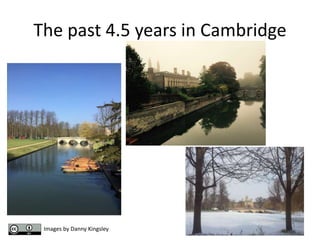
The past 4.5 years in Cambridge
Images by Danny Kingsley
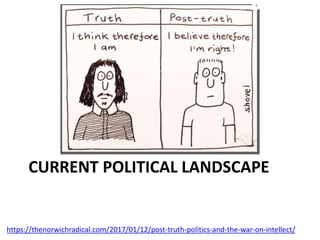
CURRENT POLITICAL LANDSCAPE
https://thenorwichradical.com/2017/01/12/post-truth-politics-and-the-war-on-intellect/
Normative Structure of Science
Robert K Merton, “The Normative Structure of Science”, 1942 essay in
The Sociology of Science edited by Norman W Storer, published 1973
http://www.collier.sts.vt.edu/5424/pdfs/merton_1973.pdf
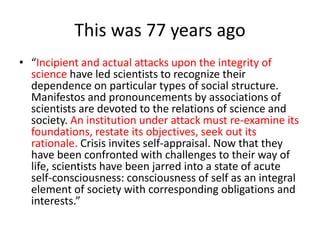
This was 77 years ago
• “Incipient and actual attacks upon the integrity of
science have led scientists to recognize their
dependence on particular types of social structure.
Manifestos and pronouncements by associations of
scientists are devoted to the relations of science and
society. An institution under attack must re-examine its
foundations, restate its objectives, seek out its
rationale. Crisis invites self-appraisal. Now that they
have been confronted with challenges to their way of
life, scientists have been jarred into a state of acute
self-consciousness: consciousness of self as an integral
element of society with corresponding obligations and
interests.”
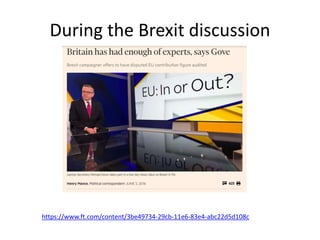
During the Brexit discussion
https://www.ft.com/content/3be49734-29cb-11e6-83e4-abc22d5d108c
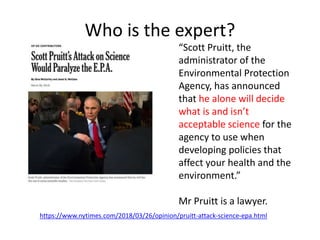
Who is the expert?
https://www.nytimes.com/2018/03/26/opinion/pruitt-attack-science-epa.html
“Scott Pruitt, the
administrator of the
Environmental Protection
Agency, has announced
that he alone will decide
what is and isn’t
acceptable science for the
agency to use when
developing policies that
affect your health and the
environment.”
Mr Pruitt is a lawyer.
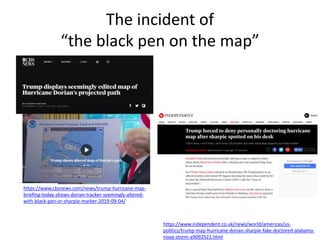
The incident of
“the black pen on the map”
https://www.cbsnews.com/news/trump-hurricane-map-
briefing-today-shows-dorian-tracker-seemingly-altered-
with-black-pen-or-sharpie-marker-2019-09-04/
https://www.independent.co.uk/news/world/americas/us-
politics/trump-map-hurricane-dorian-sharpie-fake-doctored-alabama-
noaa-storm-a9092521.html
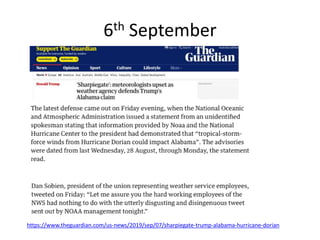
6th September
https://www.cbsnews.com/news/trump-campaign-starts-selling-black-
pens-after-trumps-map-misstatements/
Janice Dean, a meteorologist at Fox News,
later tweeted: “Just so everyone is clear.
This forecast cone was from 5 days ago.
Alabama was NEVER in the official cone
from the [National Hurricane Center].
https://www.washingtonexaminer.com/n
ews/inaccurate-misleading-and-fake-fox-
meteorologist-rips-trump-over-doctored-
hurricane-map
6th September
https://www.theguardian.com/us-news/2019/sep/07/sharpiegate-trump-alabama-hurricane-dorian
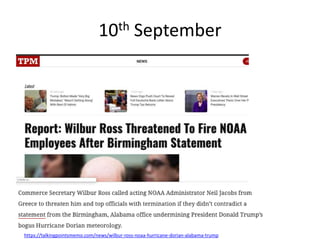
10th September
https://talkingpointsmemo.com/news/wilbur-ross-noaa-hurricane-dorian-alabama-trump
The credibility of science is under
threat
• “Speaking as a scientist, cherrypicking
evidence is unacceptable,” Hawking said [in
March 2018]. “When public figures abuse
scientific argument, citing some studies but
suppressing others, to justify policies that they
want to implement for other reasons, it
debases scientific culture.”
• https://www.theguardian.com/science/2018/mar/14/i-would-not-have-survived-
nhs-enabled-stephen-hawking-to-live-long-life
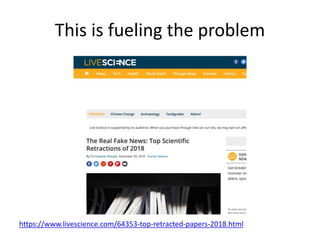
This is fueling the problem
https://www.livescience.com/64353-top-retracted-papers-2018.html
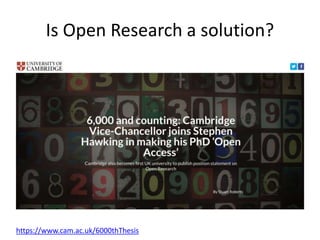
Is Open Research a solution?
https://www.cam.ac.uk/6000thThesis
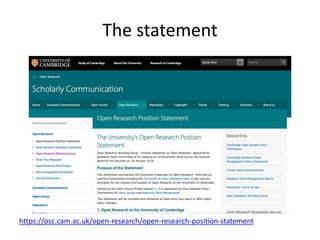
The statement
https://osc.cam.ac.uk/open-research/open-research-position-statement
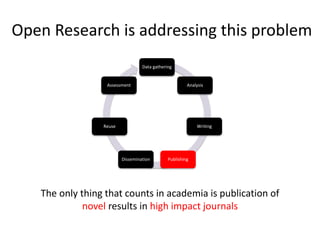
Open Research is addressing this problem
The only thing that counts in academia is publication of
novel results in high impact journals
Data gathering
Analysis
Writing
PublishingDissemination
Reuse
Assessment
Mechanisms for achieving OR
• Making research outputs openly accessible
• Robust research data management
• Registering trials
• Using systems like the CRediT taxonomy for
author contributions
https://www.cell.com/pb/assets/raw/shared/guidelines/CRediT-taxonomy.pdf
• Open peer review
• Publishing null results
• Research integrity training – integrity of the
researcher and of the research
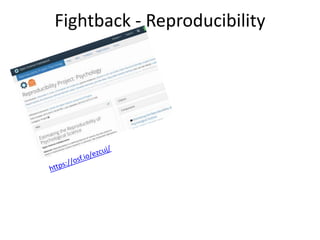
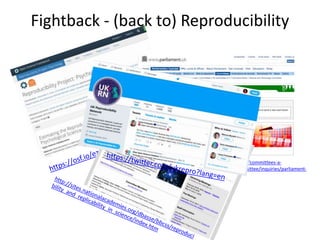
Fightback - Reproducibility
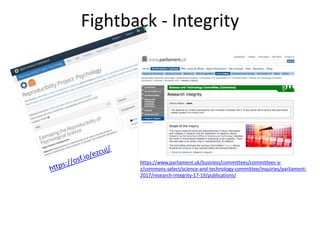
Fightback - Integrity
https://www.parliament.uk/business/committees/committees-a-
z/commons-select/science-and-technology-committee/inquiries/parliament-
2017/research-integrity-17-19/publications/
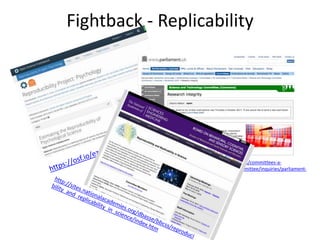
Fightback - Replicability
https://www.parliament.uk/business/committees/committees-a-
z/commons-select/science-and-technology-committee/inquiries/parliament-
2017/research-integrity-17-19/publications/
Fightback - (back to) Reproducibility
https://www.parliament.uk/business/committees/committees-a-
z/commons-select/science-and-technology-committee/inquiries/parliament-
2017/research-integrity-17-19/publications/
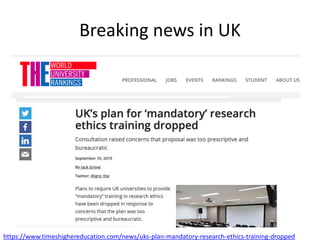
Breaking news in UK
https://www.timeshighereducation.com/news/uks-plan-mandatory-research-ethics-training-dropped
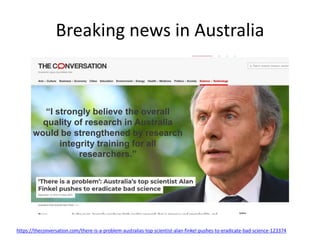
Breaking news in Australia
https://theconversation.com/there-is-a-problem-australias-top-scientist-alan-finkel-pushes-to-eradicate-bad-science-123374
“I strongly believe the overall
quality of research in Australia
would be strengthened by research
integrity training for all
researchers.”
FUTURE PUBLISHING
They have seen the writing on the wall and are diversifying
Image: Pixabay
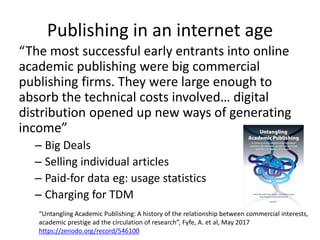
Publishing in an internet age
“The most successful early entrants into online
academic publishing were big commercial
publishing firms. They were large enough to
absorb the technical costs involved… digital
distribution opened up new ways of generating
income”
– Big Deals
– Selling individual articles
– Paid-for data eg: usage statistics
– Charging for TDM
“Untangling Academic Publishing: A history of the relationship between commercial interests,
academic prestige ad the circulation of research”, Fyfe, A. et al, May 2017
https://zenodo.org/record/546100
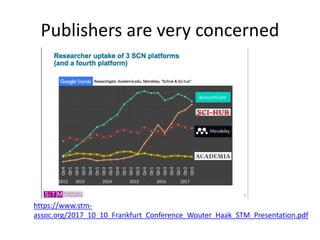
Publishers are very concerned
https://www.stm-
assoc.org/2017_10_10_Frankfurt_Conference_Wouter_Haak_STM_Presentation.pdf
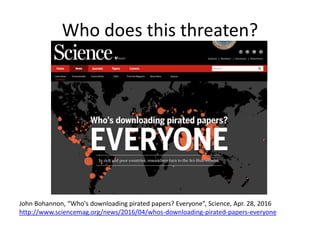
Who does this threaten?
John Bohannon, “Who's downloading pirated papers? Everyone”, Science, Apr. 28, 2016
http://www.sciencemag.org/news/2016/04/whos-downloading-pirated-papers-everyone
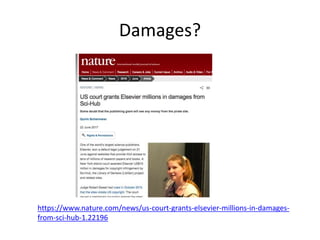
Damages?
https://www.nature.com/news/us-court-grants-elsevier-millions-in-damages-
from-sci-hub-1.22196
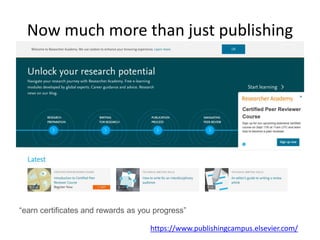
Now much more than just publishing
https://www.publishingcampus.elsevier.com/
“earn certificates and rewards as you progress”
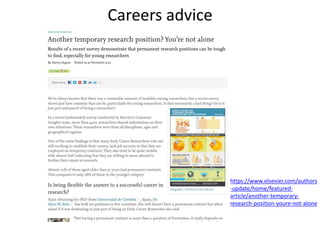
https://www.elsevier.com/authors
-update/home/featured-
article/another-temporary-
research-position-youre-not-alone
Careers advice
https://edservices.wiley.com/
Transformative
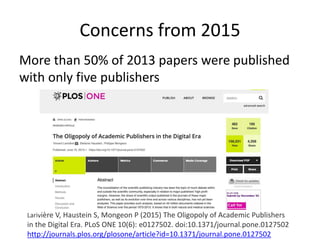
Concerns from 2015
More than 50% of 2013 papers were published
with only five publishers
Larivière V, Haustein S, Mongeon P (2015) The Oligopoly of Academic Publishers
in the Digital Era. PLoS ONE 10(6): e0127502. doi:10.1371/journal.pone.0127502
http://journals.plos.org/plosone/article?id=10.1371/journal.pone.0127502
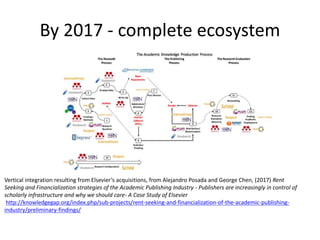
By 2017 - complete ecosystem
Vertical integration resulting from Elsevier’s acquisitions, from Alejandro Posada and George Chen, (2017) Rent
Seeking and Financialization strategies of the Academic Publishing Industry - Publishers are increasingly in control of
scholarly infrastructure and why we should care- A Case Study of Elsevier
http://knowledgegap.org/index.php/sub-projects/rent-seeking-and-financialization-of-the-academic-publishing-
industry/preliminary-findings/
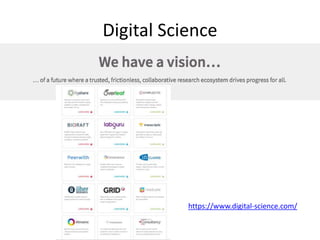
Digital Science
https://www.digital-science.com/
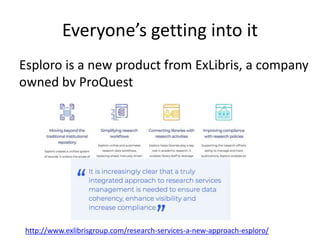
Everyone’s getting into it
Esploro is a new product from ExLibris, a company
owned by ProQuest
http://www.exlibrisgroup.com/research-services-a-new-approach-esploro/
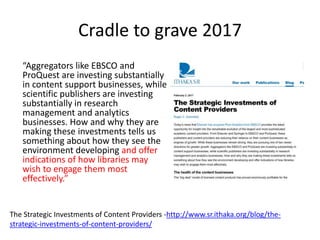
Cradle to grave 2017
“Aggregators like EBSCO and
ProQuest are investing substantially
in content support businesses, while
scientific publishers are investing
substantially in research
management and analytics
businesses. How and why they are
making these investments tells us
something about how they see the
environment developing and offer
indications of how libraries may
wish to engage them most
effectively.”
The Strategic Investments of Content Providers -http://www.sr.ithaka.org/blog/the-
strategic-investments-of-content-providers/
SPARC analysis 2019
“The goal of this
document is to describe
the current landscape
of publishers moving
into core activities of
universities.”
https://sparcopen.org/our-work/landscape-analysis/
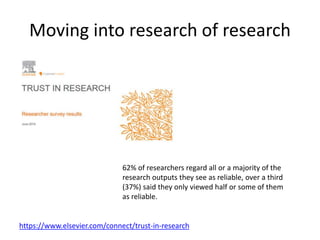
Moving into research of research
https://www.elsevier.com/connect/trust-in-research
62% of researchers regard all or a majority of the
research outputs they see as reliable, over a third
(37%) said they only viewed half or some of them
as reliable.
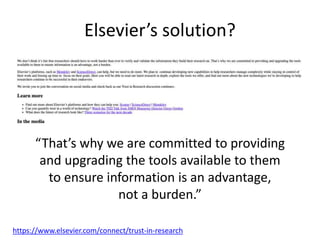
Elsevier’s solution?
https://www.elsevier.com/connect/trust-in-research
“That’s why we are committed to providing
and upgrading the tools available to them
to ensure information is an advantage,
not a burden.”
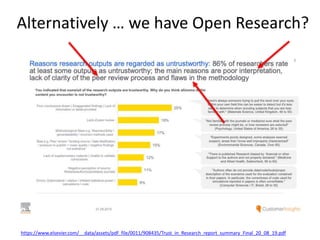
Alternatively … we have Open Research?
https://www.elsevier.com/__data/assets/pdf_file/0011/908435/Trust_in_Research_report_summary_Final_20_08_19.pdf
We are sleepwalking into redundancy
If we do not move fast, the entire higher
education sector will be run by huge
commercial publishing organisations.
CHANGING RELATIONSHIPS WITH
PUBLISHERS
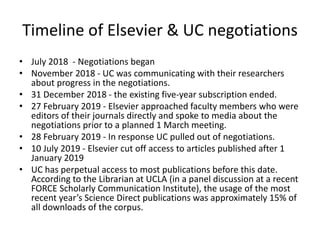
Timeline of Elsevier & UC negotiations
• July 2018 - Negotiations began
• November 2018 - UC was communicating with their researchers
about progress in the negotiations.
• 31 December 2018 - the existing five-year subscription ended.
• 27 February 2019 - Elsevier approached faculty members who were
editors of their journals directly and spoke to media about the
negotiations prior to a planned 1 March meeting.
• 28 February 2019 - In response UC pulled out of negotiations.
• 10 July 2019 - Elsevier cut off access to articles published after 1
January 2019
• UC has perpetual access to most publications before this date.
According to the Librarian at UCLA (in a panel discussion at a recent
FORCE Scholarly Communication Institute), the usage of the most
recent year’s Science Direct publications was approximately 15% of
all downloads of the corpus.
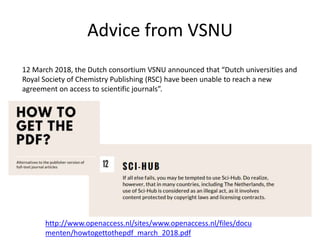
Advice from VSNU
http://www.openaccess.nl/sites/www.openaccess.nl/files/docu
menten/howtogettothepdf_march_2018.pdf
12 March 2018, the Dutch consortium VSNU announced that “Dutch universities and
Royal Society of Chemistry Publishing (RSC) have been unable to reach a new
agreement on access to scientific journals”.
Subscribe to Open
• Berghahn Books, the social sciences publisher based
in Brooklyn, NY and Oxford, U.K., has announced a pilot
to move 13 of the anthropology journals it publishes to
Open Access (OA) from 2020 onwards. In partnership
with Libraria, a group of anthropologists and other
social scientists committed to open access, and the support
of Knowledge Unlatched, Berghahn will be asking
libraries current subscribing to these journals to renew for
2020 on a Subscribe-to-Open basis, which will make these
journals free to readers and authors everywhere.
• http://www.stm-publishing.com/berghahn-to-pilot-the-
move-of-13-anthropology-journals-to-subscribe-to-open/
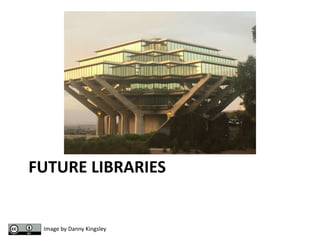
FUTURE LIBRARIES
Image by Danny Kingsley
Food for thought
Within the environment where the users of your
material come from all over the world and your
own cohort looks globally for information, the idea
of a library as a collector and gatekeeper of
information for your closed/defined community
makes less and less sense.
MIT Future of Libraries Task Force
https://future-of-
libraries.mit.edu/sites/default/files/FutureLibr
aries-PrelimReport-Final.pdf
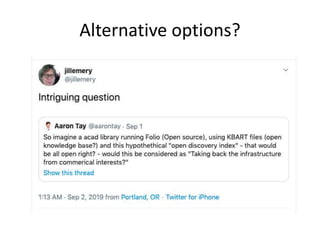
Alternative options?
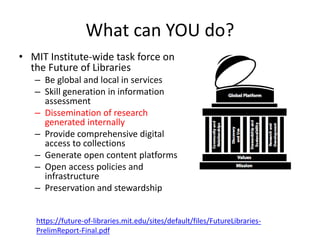
What can YOU do?
• MIT Institute-wide task force on
the Future of Libraries
– Be global and local in services
– Skill generation in information
assessment
– Dissemination of research
generated internally
– Provide comprehensive digital
access to collections
– Generate open content platforms
– Open access policies and
infrastructure
– Preservation and stewardship
https://future-of-libraries.mit.edu/sites/default/files/FutureLibraries-
PrelimReport-Final.pdf
What is the role of the library?
• Discussion at RLUK2017 conference.
– Are librarians support staff or research partners?
– Should we be collaborating and partnering with
the research community?
– Should we be leading the University over these
issues?
• See: “Become part of the research process –
observations from RLUK2017”
– https://unlockingresearch.blog.lib.cam.ac.uk/
What is Scholarly Communication?
• Association of College and Research Libraries
(ACRL) 2003 definition:
– "the system through which research and other
scholarly writings are created, evaluated for quality,
disseminated to the scholarly community, and
preserved for future use. The system includes both
formal means of communication, such as publication
in peer-reviewed journals, and informal channels, such
as electronic listservs.”
• http://acrl.libguides.com/scholcomm/toolkit/
• Often Scholarly Communication services are run
out of libraries
The story so far….
• Changing political landscape
• Reduced trust in science
• Publishers changing their business models
• Movement by some libraries to address the
monopoly
• What does this mean for people who are
working in libraries?
FUTURE WORKFORCE
https://www.macquarie.nsw.edu.au/courses/hospitality-
programs/skill-sets-and-part-qualifications
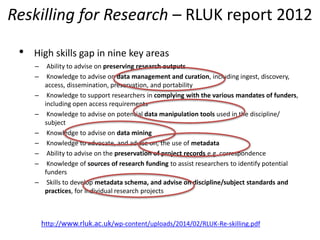
• High skills gap in nine key areas
– Ability to advise on preserving research outputs
– Knowledge to advise on data management and curation, including ingest, discovery,
access, dissemination, preservation, and portability
– Knowledge to support researchers in complying with the various mandates of funders,
including open access requirements
– Knowledge to advise on potential data manipulation tools used in the discipline/
subject
– Knowledge to advise on data mining
– Knowledge to advocate, and advise on, the use of metadata
– Ability to advise on the preservation of project records e.g. correspondence
– Knowledge of sources of research funding to assist researchers to identify potential
funders
– Skills to develop metadata schema, and advise on discipline/subject standards and
practices, for individual research projects
Reskilling for Research – RLUK report 2012
http://www.rluk.ac.uk/wp-content/uploads/2014/02/RLUK-Re-skilling.pdf
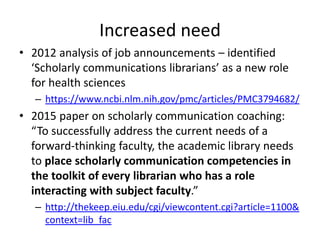
• 2012 analysis of job announcements – identified
‘Scholarly communications librarians’ as a new role
for health sciences
– https://www.ncbi.nlm.nih.gov/pmc/articles/PMC3794682/
• 2015 paper on scholarly communication coaching:
“To successfully address the current needs of a
forward-thinking faculty, the academic library needs
to place scholarly communication competencies in
the toolkit of every librarian who has a role
interacting with subject faculty.”
– http://thekeep.eiu.edu/cgi/viewcontent.cgi?article=1100&
context=lib_fac
Increased need
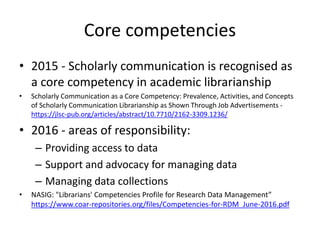
Core competencies
• 2015 - Scholarly communication is recognised as
a core competency in academic librarianship
• Scholarly Communication as a Core Competency: Prevalence, Activities, and Concepts
of Scholarly Communication Librarianship as Shown Through Job Advertisements -
https://jlsc-pub.org/articles/abstract/10.7710/2162-3309.1236/
• 2016 - areas of responsibility:
– Providing access to data
– Support and advocacy for managing data
– Managing data collections
• NASIG: "Librarians' Competencies Profile for Research Data Management”
https://www.coar-repositories.org/files/Competencies-for-RDM_June-2016.pdf
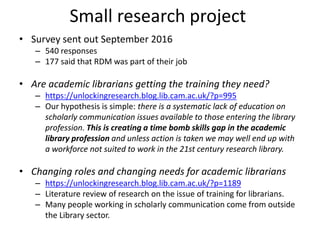
Small research project
• Survey sent out September 2016
– 540 responses
– 177 said that RDM was part of their job
• Are academic librarians getting the training they need?
– https://unlockingresearch.blog.lib.cam.ac.uk/?p=995
– Our hypothesis is simple: there is a systematic lack of education on
scholarly communication issues available to those entering the library
profession. This is creating a time bomb skills gap in the academic
library profession and unless action is taken we may well end up with
a workforce not suited to work in the 21st century research library.
• Changing roles and changing needs for academic librarians
– https://unlockingresearch.blog.lib.cam.ac.uk/?p=1189
– Literature review of research on the issue of training for librarians.
– Many people working in scholarly communication come from outside
the Library sector.
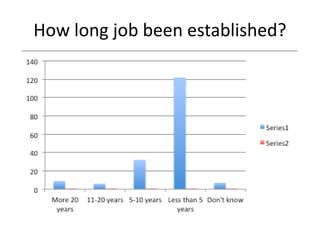
How long job been established?
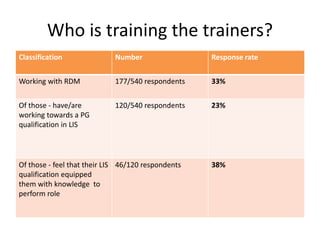
Who is training the trainers?
Classification Number Response rate
Working with RDM 177/540 respondents 33%
Of those - have/are
working towards a PG
qualification in LIS
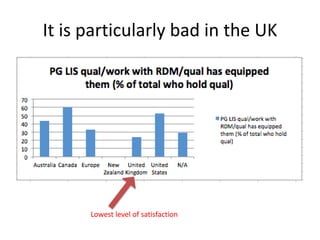
120/540 respondents 23%
Of those - feel that their LIS
qualification equipped
them with knowledge to
perform role
46/120 respondents 38%
It is particularly bad in the UK
Lowest level of satisfaction
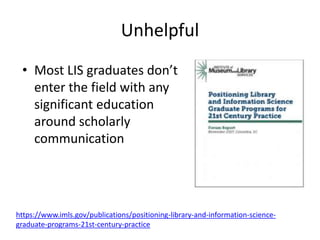
Unhelpful
• Most LIS graduates don’t
enter the field with any
significant education
around scholarly
communication
https://www.imls.gov/publications/positioning-library-and-information-science-
graduate-programs-21st-century-practice
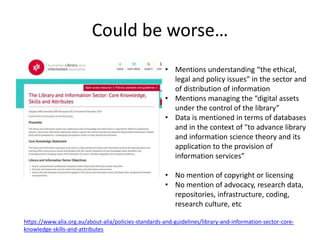
Could be worse…
https://www.alia.org.au/about-alia/policies-standards-and-guidelines/library-and-information-sector-core-
knowledge-skills-and-attributes
• Mentions understanding “the ethical,
legal and policy issues” in the sector and
of distribution of information
• Mentions managing the “digital assets
under the control of the library”
• Data is mentioned in terms of databases
and in the context of "to advance library
and information science theory and its
application to the provision of
information services”
• No mention of copyright or licensing
• No mention of advocacy, research data,
repositories, infrastructure, coding,
research culture, etc
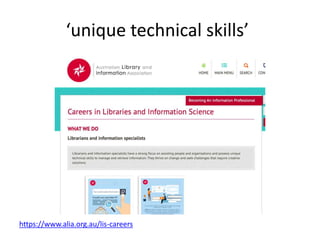
‘unique technical skills’
https://www.alia.org.au/lis-careers
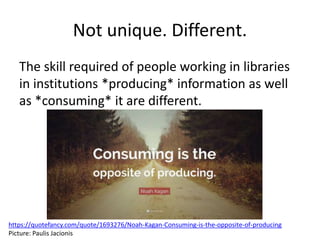
Not unique. Different.
The skill required of people working in libraries
in institutions *producing* information as well
as *consuming* it are different.
https://quotefancy.com/quote/1693276/Noah-Kagan-Consuming-is-the-opposite-of-producing
Picture: Paulis Jacionis
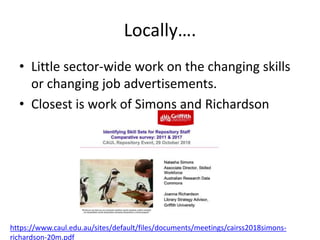
Locally….
• Little sector-wide work on the changing skills
or changing job advertisements.
• Closest is work of Simons and Richardson
https://www.caul.edu.au/sites/default/files/documents/meetings/cairss2018simons-
richardson-20m.pdf
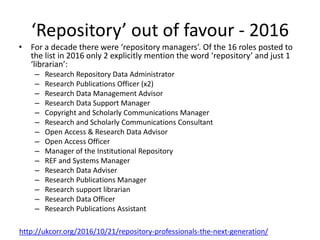
‘Repository’ out of favour - 2016
• For a decade there were ‘repository managers’. Of the 16 roles posted to
the list in 2016 only 2 explicitly mention the word ‘repository’ and just 1
‘librarian’:
– Research Repository Data Administrator
– Research Publications Officer (x2)
– Research Data Management Advisor
– Research Data Support Manager
– Copyright and Scholarly Communications Manager
– Research and Scholarly Communications Consultant
– Open Access & Research Data Advisor
– Open Access Officer
– Manager of the Institutional Repository
– REF and Systems Manager
– Research Data Adviser
– Research Publications Manager
– Research support librarian
– Research Data Officer
– Research Publications Assistant
http://ukcorr.org/2016/10/21/repository-professionals-the-next-generation/
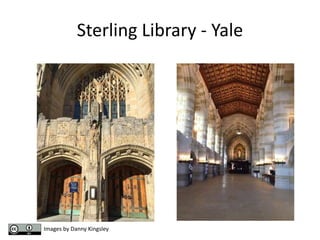
Sterling Library - Yale
Images by Danny Kingsley
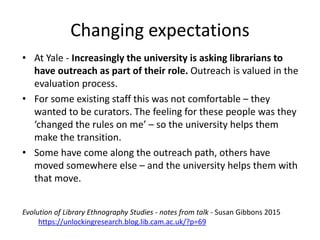
• At Yale - Increasingly the university is asking librarians to
have outreach as part of their role. Outreach is valued in the
evaluation process.
• For some existing staff this was not comfortable – they
wanted to be curators. The feeling for these people was they
‘changed the rules on me’ – so the university helps them
make the transition.
• Some have come along the outreach path, others have
moved somewhere else – and the university helps them with
that move.
Changing expectations
Evolution of Library Ethnography Studies - notes from talk - Susan Gibbons 2015
https://unlockingresearch.blog.lib.cam.ac.uk/?p=69
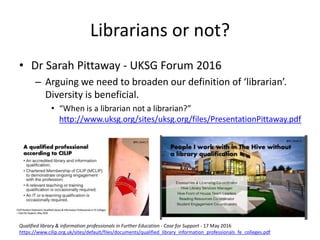
• Dr Sarah Pittaway - UKSG Forum 2016
– Arguing we need to broaden our definition of ‘librarian’.
Diversity is beneficial.
• “When is a librarian not a librarian?”
http://www.uksg.org/sites/uksg.org/files/PresentationPittaway.pdf
Librarians or not?
Qualified library & information professionals in Further Education - Case for Support - 17 May 2016
https://www.cilip.org.uk/sites/default/files/documents/qualified_library_information_professionals_fe_colleges.pdf
Serious question
• Discussion at RLUK 2017
– We need to develop digital
leaders for libraries. Are these
people already in libraries who
we train up, or are they people
with these skill sets we bring in
and introduce to library culture?
• “Become part of the research
process” – observations from
RLUK2017
https://unlockingresearch.blog.lib.c
am.ac.uk/?p=1384
Image: Pixabay
FUTURE OPPORTUNITIES
The only thing that is certain is “business as was” is no more. A fully open or a
fully closed future each offer opportunities and challenges for libraries
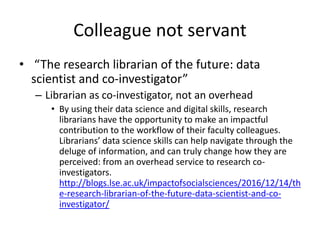
• “The research librarian of the future: data
scientist and co-investigator”
– Librarian as co-investigator, not an overhead
• By using their data science and digital skills, research
librarians have the opportunity to make an impactful
contribution to the workflow of their faculty colleagues.
Librarians’ data science skills can help navigate through the
deluge of information, and can truly change how they are
perceived: from an overhead service to research co-
investigators.
http://blogs.lse.ac.uk/impactofsocialsciences/2016/12/14/th
e-research-librarian-of-the-future-data-scientist-and-co-
investigator/
Colleague not servant
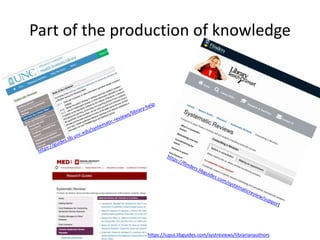
Part of the production of knowledge
https://iupui.libguides.com/systreviews/librarianauthors
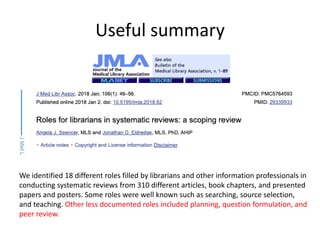
Useful summary
We identified 18 different roles filled by librarians and other information professionals in
conducting systematic reviews from 310 different articles, book chapters, and presented
papers and posters. Some roles were well known such as searching, source selection,
and teaching. Other less documented roles included planning, question formulation, and
peer review.
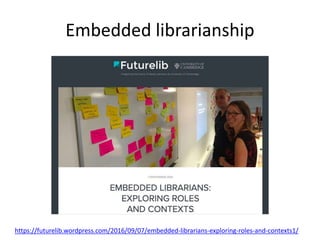
Embedded librarianship
https://futurelib.wordpress.com/2016/09/07/embedded-librarians-exploring-roles-and-contexts1/
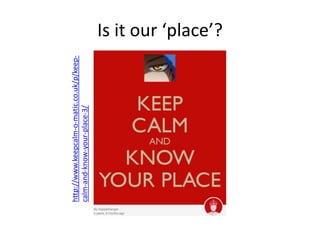
Is it our ‘place’?
http://www.keepcalm-o-matic.co.uk/p/keep-
calm-and-know-your-place-3/
Yes we should be driving this agenda
• Scholarly Communication takes a ‘meta’ view of the
research ecosystem
• Disciplinary differences mean individual researchers
come to the table with very specific perspectives
• They all think they are right
• Very few understand that things are different in other
disciplines – and that these are as valid as their own
• Scholarly Communication is a research discipline of its
own. This is not recognised by most academics!
Future roles
• Research partner
• Advocacy, negotiation, landscape mapping
• Owning the scholarly communication agenda
Image: Pixabay
Summary
• Current political landscape
– Reduced trust in science
– Need for open research
• Future publishing​
– Diversification​ of publishers
– Concentration of the market
• Future libraries​
– Global endeavour
– Scholarly communication
• Changing relationship with publishers
– Elsevier & University of California ​
• Future workforce​
– Changing skills required
• Future Opportunities
– Becoming part of the production of knowledge
– We should be driving the agenda
Thanks!
Dr Danny Kingsley, @dannykay68
Scholarly Communication Consultant
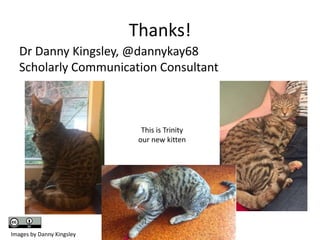
This is Trinity
our new kitten
Images by Danny Kingsley

What *is* a library in an 'open' future

  • 1.
    What is anacademic library in an open access world?​ Health Libraries Conference William Angliss Conference Centre Melbourne Friday 13 September 2019 Tweets on #hliconf2019 Dr Danny Kingsley, Scholarly Communication Consultant, @dannykay68 Slides available CC-BY: Attribution Danny Kingsley
  • 2.
    Hold onto yourhats! • Current political landscape • Future publishing​ • Future libraries​ • Changing relationship with publishers​ • Future workforce​ • Future Opportunities
  • 3.
    The past 4.5years in Cambridge Images by Danny Kingsley
  • 4.
  • 5.
    Normative Structure ofScience Robert K Merton, “The Normative Structure of Science”, 1942 essay in The Sociology of Science edited by Norman W Storer, published 1973 http://www.collier.sts.vt.edu/5424/pdfs/merton_1973.pdf
  • 6.
    This was 77years ago • “Incipient and actual attacks upon the integrity of science have led scientists to recognize their dependence on particular types of social structure. Manifestos and pronouncements by associations of scientists are devoted to the relations of science and society. An institution under attack must re-examine its foundations, restate its objectives, seek out its rationale. Crisis invites self-appraisal. Now that they have been confronted with challenges to their way of life, scientists have been jarred into a state of acute self-consciousness: consciousness of self as an integral element of society with corresponding obligations and interests.”
  • 7.
    During the Brexitdiscussion https://www.ft.com/content/3be49734-29cb-11e6-83e4-abc22d5d108c
  • 8.
    Who is theexpert? https://www.nytimes.com/2018/03/26/opinion/pruitt-attack-science-epa.html “Scott Pruitt, the administrator of the Environmental Protection Agency, has announced that he alone will decide what is and isn’t acceptable science for the agency to use when developing policies that affect your health and the environment.” Mr Pruitt is a lawyer.
  • 9.
    The incident of “theblack pen on the map” https://www.cbsnews.com/news/trump-hurricane-map- briefing-today-shows-dorian-tracker-seemingly-altered- with-black-pen-or-sharpie-marker-2019-09-04/ https://www.independent.co.uk/news/world/americas/us- politics/trump-map-hurricane-dorian-sharpie-fake-doctored-alabama- noaa-storm-a9092521.html
  • 10.
    6th September https://www.cbsnews.com/news/trump-campaign-starts-selling-black- pens-after-trumps-map-misstatements/ Janice Dean,a meteorologist at Fox News, later tweeted: “Just so everyone is clear. This forecast cone was from 5 days ago. Alabama was NEVER in the official cone from the [National Hurricane Center]. https://www.washingtonexaminer.com/n ews/inaccurate-misleading-and-fake-fox- meteorologist-rips-trump-over-doctored- hurricane-map
  • 11.
  • 12.
  • 13.
    The credibility ofscience is under threat • “Speaking as a scientist, cherrypicking evidence is unacceptable,” Hawking said [in March 2018]. “When public figures abuse scientific argument, citing some studies but suppressing others, to justify policies that they want to implement for other reasons, it debases scientific culture.” • https://www.theguardian.com/science/2018/mar/14/i-would-not-have-survived- nhs-enabled-stephen-hawking-to-live-long-life
  • 14.
    This is fuelingthe problem https://www.livescience.com/64353-top-retracted-papers-2018.html
  • 15.
    Is Open Researcha solution? https://www.cam.ac.uk/6000thThesis
  • 16.
  • 17.
    Open Research isaddressing this problem The only thing that counts in academia is publication of novel results in high impact journals Data gathering Analysis Writing PublishingDissemination Reuse Assessment
  • 18.
    Mechanisms for achievingOR • Making research outputs openly accessible • Robust research data management • Registering trials • Using systems like the CRediT taxonomy for author contributions https://www.cell.com/pb/assets/raw/shared/guidelines/CRediT-taxonomy.pdf • Open peer review • Publishing null results • Research integrity training – integrity of the researcher and of the research
  • 19.
  • 20.
  • 21.
  • 22.
    Fightback - (backto) Reproducibility https://www.parliament.uk/business/committees/committees-a- z/commons-select/science-and-technology-committee/inquiries/parliament- 2017/research-integrity-17-19/publications/
  • 23.
    Breaking news inUK https://www.timeshighereducation.com/news/uks-plan-mandatory-research-ethics-training-dropped
  • 24.
    Breaking news inAustralia https://theconversation.com/there-is-a-problem-australias-top-scientist-alan-finkel-pushes-to-eradicate-bad-science-123374 “I strongly believe the overall quality of research in Australia would be strengthened by research integrity training for all researchers.”
  • 25.
    FUTURE PUBLISHING They haveseen the writing on the wall and are diversifying Image: Pixabay
  • 26.
    Publishing in aninternet age “The most successful early entrants into online academic publishing were big commercial publishing firms. They were large enough to absorb the technical costs involved… digital distribution opened up new ways of generating income” – Big Deals – Selling individual articles – Paid-for data eg: usage statistics – Charging for TDM “Untangling Academic Publishing: A history of the relationship between commercial interests, academic prestige ad the circulation of research”, Fyfe, A. et al, May 2017 https://zenodo.org/record/546100
  • 27.
    Publishers are veryconcerned https://www.stm- assoc.org/2017_10_10_Frankfurt_Conference_Wouter_Haak_STM_Presentation.pdf
  • 28.
    Who does thisthreaten? John Bohannon, “Who's downloading pirated papers? Everyone”, Science, Apr. 28, 2016 http://www.sciencemag.org/news/2016/04/whos-downloading-pirated-papers-everyone
  • 29.
  • 30.
    Now much morethan just publishing https://www.publishingcampus.elsevier.com/ “earn certificates and rewards as you progress”
  • 31.
  • 32.
  • 33.
    Concerns from 2015 Morethan 50% of 2013 papers were published with only five publishers Larivière V, Haustein S, Mongeon P (2015) The Oligopoly of Academic Publishers in the Digital Era. PLoS ONE 10(6): e0127502. doi:10.1371/journal.pone.0127502 http://journals.plos.org/plosone/article?id=10.1371/journal.pone.0127502
  • 34.
    By 2017 -complete ecosystem Vertical integration resulting from Elsevier’s acquisitions, from Alejandro Posada and George Chen, (2017) Rent Seeking and Financialization strategies of the Academic Publishing Industry - Publishers are increasingly in control of scholarly infrastructure and why we should care- A Case Study of Elsevier http://knowledgegap.org/index.php/sub-projects/rent-seeking-and-financialization-of-the-academic-publishing- industry/preliminary-findings/
  • 35.
  • 36.
    Everyone’s getting intoit Esploro is a new product from ExLibris, a company owned by ProQuest http://www.exlibrisgroup.com/research-services-a-new-approach-esploro/
  • 37.
    Cradle to grave2017 “Aggregators like EBSCO and ProQuest are investing substantially in content support businesses, while scientific publishers are investing substantially in research management and analytics businesses. How and why they are making these investments tells us something about how they see the environment developing and offer indications of how libraries may wish to engage them most effectively.” The Strategic Investments of Content Providers -http://www.sr.ithaka.org/blog/the- strategic-investments-of-content-providers/
  • 38.
    SPARC analysis 2019 “Thegoal of this document is to describe the current landscape of publishers moving into core activities of universities.” https://sparcopen.org/our-work/landscape-analysis/
  • 39.
    Moving into researchof research https://www.elsevier.com/connect/trust-in-research 62% of researchers regard all or a majority of the research outputs they see as reliable, over a third (37%) said they only viewed half or some of them as reliable.
  • 40.
    Elsevier’s solution? https://www.elsevier.com/connect/trust-in-research “That’s whywe are committed to providing and upgrading the tools available to them to ensure information is an advantage, not a burden.”
  • 41.
    Alternatively … wehave Open Research? https://www.elsevier.com/__data/assets/pdf_file/0011/908435/Trust_in_Research_report_summary_Final_20_08_19.pdf
  • 42.
    We are sleepwalkinginto redundancy If we do not move fast, the entire higher education sector will be run by huge commercial publishing organisations.
  • 43.
  • 44.
    Timeline of Elsevier& UC negotiations • July 2018 - Negotiations began • November 2018 - UC was communicating with their researchers about progress in the negotiations. • 31 December 2018 - the existing five-year subscription ended. • 27 February 2019 - Elsevier approached faculty members who were editors of their journals directly and spoke to media about the negotiations prior to a planned 1 March meeting. • 28 February 2019 - In response UC pulled out of negotiations. • 10 July 2019 - Elsevier cut off access to articles published after 1 January 2019 • UC has perpetual access to most publications before this date. According to the Librarian at UCLA (in a panel discussion at a recent FORCE Scholarly Communication Institute), the usage of the most recent year’s Science Direct publications was approximately 15% of all downloads of the corpus.
  • 45.
    Advice from VSNU http://www.openaccess.nl/sites/www.openaccess.nl/files/docu menten/howtogettothepdf_march_2018.pdf 12March 2018, the Dutch consortium VSNU announced that “Dutch universities and Royal Society of Chemistry Publishing (RSC) have been unable to reach a new agreement on access to scientific journals”.
  • 46.
    Subscribe to Open •Berghahn Books, the social sciences publisher based in Brooklyn, NY and Oxford, U.K., has announced a pilot to move 13 of the anthropology journals it publishes to Open Access (OA) from 2020 onwards. In partnership with Libraria, a group of anthropologists and other social scientists committed to open access, and the support of Knowledge Unlatched, Berghahn will be asking libraries current subscribing to these journals to renew for 2020 on a Subscribe-to-Open basis, which will make these journals free to readers and authors everywhere. • http://www.stm-publishing.com/berghahn-to-pilot-the- move-of-13-anthropology-journals-to-subscribe-to-open/
  • 47.
  • 48.
    Food for thought Withinthe environment where the users of your material come from all over the world and your own cohort looks globally for information, the idea of a library as a collector and gatekeeper of information for your closed/defined community makes less and less sense. MIT Future of Libraries Task Force https://future-of- libraries.mit.edu/sites/default/files/FutureLibr aries-PrelimReport-Final.pdf
  • 49.
  • 50.
    What can YOUdo? • MIT Institute-wide task force on the Future of Libraries – Be global and local in services – Skill generation in information assessment – Dissemination of research generated internally – Provide comprehensive digital access to collections – Generate open content platforms – Open access policies and infrastructure – Preservation and stewardship https://future-of-libraries.mit.edu/sites/default/files/FutureLibraries- PrelimReport-Final.pdf
  • 51.
    What is therole of the library? • Discussion at RLUK2017 conference. – Are librarians support staff or research partners? – Should we be collaborating and partnering with the research community? – Should we be leading the University over these issues? • See: “Become part of the research process – observations from RLUK2017” – https://unlockingresearch.blog.lib.cam.ac.uk/
  • 52.
    What is ScholarlyCommunication? • Association of College and Research Libraries (ACRL) 2003 definition: – "the system through which research and other scholarly writings are created, evaluated for quality, disseminated to the scholarly community, and preserved for future use. The system includes both formal means of communication, such as publication in peer-reviewed journals, and informal channels, such as electronic listservs.” • http://acrl.libguides.com/scholcomm/toolkit/ • Often Scholarly Communication services are run out of libraries
  • 53.
    The story sofar…. • Changing political landscape • Reduced trust in science • Publishers changing their business models • Movement by some libraries to address the monopoly • What does this mean for people who are working in libraries?
  • 54.
  • 55.
    • High skillsgap in nine key areas – Ability to advise on preserving research outputs – Knowledge to advise on data management and curation, including ingest, discovery, access, dissemination, preservation, and portability – Knowledge to support researchers in complying with the various mandates of funders, including open access requirements – Knowledge to advise on potential data manipulation tools used in the discipline/ subject – Knowledge to advise on data mining – Knowledge to advocate, and advise on, the use of metadata – Ability to advise on the preservation of project records e.g. correspondence – Knowledge of sources of research funding to assist researchers to identify potential funders – Skills to develop metadata schema, and advise on discipline/subject standards and practices, for individual research projects Reskilling for Research – RLUK report 2012 http://www.rluk.ac.uk/wp-content/uploads/2014/02/RLUK-Re-skilling.pdf
  • 56.
    • 2012 analysisof job announcements – identified ‘Scholarly communications librarians’ as a new role for health sciences – https://www.ncbi.nlm.nih.gov/pmc/articles/PMC3794682/ • 2015 paper on scholarly communication coaching: “To successfully address the current needs of a forward-thinking faculty, the academic library needs to place scholarly communication competencies in the toolkit of every librarian who has a role interacting with subject faculty.” – http://thekeep.eiu.edu/cgi/viewcontent.cgi?article=1100& context=lib_fac Increased need
  • 57.
    Core competencies • 2015- Scholarly communication is recognised as a core competency in academic librarianship • Scholarly Communication as a Core Competency: Prevalence, Activities, and Concepts of Scholarly Communication Librarianship as Shown Through Job Advertisements - https://jlsc-pub.org/articles/abstract/10.7710/2162-3309.1236/ • 2016 - areas of responsibility: – Providing access to data – Support and advocacy for managing data – Managing data collections • NASIG: "Librarians' Competencies Profile for Research Data Management” https://www.coar-repositories.org/files/Competencies-for-RDM_June-2016.pdf
  • 58.
    Small research project •Survey sent out September 2016 – 540 responses – 177 said that RDM was part of their job • Are academic librarians getting the training they need? – https://unlockingresearch.blog.lib.cam.ac.uk/?p=995 – Our hypothesis is simple: there is a systematic lack of education on scholarly communication issues available to those entering the library profession. This is creating a time bomb skills gap in the academic library profession and unless action is taken we may well end up with a workforce not suited to work in the 21st century research library. • Changing roles and changing needs for academic librarians – https://unlockingresearch.blog.lib.cam.ac.uk/?p=1189 – Literature review of research on the issue of training for librarians. – Many people working in scholarly communication come from outside the Library sector.
  • 59.
    How long jobbeen established?
  • 60.
    Who is trainingthe trainers? Classification Number Response rate Working with RDM 177/540 respondents 33% Of those - have/are working towards a PG qualification in LIS 120/540 respondents 23% Of those - feel that their LIS qualification equipped them with knowledge to perform role 46/120 respondents 38%
  • 61.
    It is particularlybad in the UK Lowest level of satisfaction
  • 62.
    Unhelpful • Most LISgraduates don’t enter the field with any significant education around scholarly communication https://www.imls.gov/publications/positioning-library-and-information-science- graduate-programs-21st-century-practice
  • 63.
    Could be worse… https://www.alia.org.au/about-alia/policies-standards-and-guidelines/library-and-information-sector-core- knowledge-skills-and-attributes •Mentions understanding “the ethical, legal and policy issues” in the sector and of distribution of information • Mentions managing the “digital assets under the control of the library” • Data is mentioned in terms of databases and in the context of "to advance library and information science theory and its application to the provision of information services” • No mention of copyright or licensing • No mention of advocacy, research data, repositories, infrastructure, coding, research culture, etc
  • 64.
  • 65.
    Not unique. Different. Theskill required of people working in libraries in institutions *producing* information as well as *consuming* it are different. https://quotefancy.com/quote/1693276/Noah-Kagan-Consuming-is-the-opposite-of-producing Picture: Paulis Jacionis
  • 66.
    Locally…. • Little sector-widework on the changing skills or changing job advertisements. • Closest is work of Simons and Richardson https://www.caul.edu.au/sites/default/files/documents/meetings/cairss2018simons- richardson-20m.pdf
  • 67.
    ‘Repository’ out offavour - 2016 • For a decade there were ‘repository managers’. Of the 16 roles posted to the list in 2016 only 2 explicitly mention the word ‘repository’ and just 1 ‘librarian’: – Research Repository Data Administrator – Research Publications Officer (x2) – Research Data Management Advisor – Research Data Support Manager – Copyright and Scholarly Communications Manager – Research and Scholarly Communications Consultant – Open Access & Research Data Advisor – Open Access Officer – Manager of the Institutional Repository – REF and Systems Manager – Research Data Adviser – Research Publications Manager – Research support librarian – Research Data Officer – Research Publications Assistant http://ukcorr.org/2016/10/21/repository-professionals-the-next-generation/
  • 68.
    Sterling Library -Yale Images by Danny Kingsley
  • 69.
    • At Yale- Increasingly the university is asking librarians to have outreach as part of their role. Outreach is valued in the evaluation process. • For some existing staff this was not comfortable – they wanted to be curators. The feeling for these people was they ‘changed the rules on me’ – so the university helps them make the transition. • Some have come along the outreach path, others have moved somewhere else – and the university helps them with that move. Changing expectations Evolution of Library Ethnography Studies - notes from talk - Susan Gibbons 2015 https://unlockingresearch.blog.lib.cam.ac.uk/?p=69
  • 70.
    • Dr SarahPittaway - UKSG Forum 2016 – Arguing we need to broaden our definition of ‘librarian’. Diversity is beneficial. • “When is a librarian not a librarian?” http://www.uksg.org/sites/uksg.org/files/PresentationPittaway.pdf Librarians or not? Qualified library & information professionals in Further Education - Case for Support - 17 May 2016 https://www.cilip.org.uk/sites/default/files/documents/qualified_library_information_professionals_fe_colleges.pdf
  • 71.
    Serious question • Discussionat RLUK 2017 – We need to develop digital leaders for libraries. Are these people already in libraries who we train up, or are they people with these skill sets we bring in and introduce to library culture? • “Become part of the research process” – observations from RLUK2017 https://unlockingresearch.blog.lib.c am.ac.uk/?p=1384 Image: Pixabay
  • 72.
    FUTURE OPPORTUNITIES The onlything that is certain is “business as was” is no more. A fully open or a fully closed future each offer opportunities and challenges for libraries
  • 73.
    • “The researchlibrarian of the future: data scientist and co-investigator” – Librarian as co-investigator, not an overhead • By using their data science and digital skills, research librarians have the opportunity to make an impactful contribution to the workflow of their faculty colleagues. Librarians’ data science skills can help navigate through the deluge of information, and can truly change how they are perceived: from an overhead service to research co- investigators. http://blogs.lse.ac.uk/impactofsocialsciences/2016/12/14/th e-research-librarian-of-the-future-data-scientist-and-co- investigator/ Colleague not servant
  • 74.
    Part of theproduction of knowledge https://iupui.libguides.com/systreviews/librarianauthors
  • 75.
    Useful summary We identified18 different roles filled by librarians and other information professionals in conducting systematic reviews from 310 different articles, book chapters, and presented papers and posters. Some roles were well known such as searching, source selection, and teaching. Other less documented roles included planning, question formulation, and peer review.
  • 76.
  • 77.
    Is it our‘place’? http://www.keepcalm-o-matic.co.uk/p/keep- calm-and-know-your-place-3/
  • 78.
    Yes we shouldbe driving this agenda • Scholarly Communication takes a ‘meta’ view of the research ecosystem • Disciplinary differences mean individual researchers come to the table with very specific perspectives • They all think they are right • Very few understand that things are different in other disciplines – and that these are as valid as their own • Scholarly Communication is a research discipline of its own. This is not recognised by most academics!
  • 79.
    Future roles • Researchpartner • Advocacy, negotiation, landscape mapping • Owning the scholarly communication agenda Image: Pixabay
  • 80.
    Summary • Current politicallandscape – Reduced trust in science – Need for open research • Future publishing​ – Diversification​ of publishers – Concentration of the market • Future libraries​ – Global endeavour – Scholarly communication • Changing relationship with publishers – Elsevier & University of California ​ • Future workforce​ – Changing skills required • Future Opportunities – Becoming part of the production of knowledge – We should be driving the agenda
  • 81.
    Thanks! Dr Danny Kingsley,@dannykay68 Scholarly Communication Consultant This is Trinity our new kitten Images by Danny Kingsley