 Research Data Management: 
a gentle introduction for admin staff 
Martin Donnelly, Digital Curation Centre, University of Edinburgh 
Royal Holloway University of London, 22 August 2014
OVERVIEW (45 mins) 
1. Introductions and definitions 
2. Drivers for RDM 
3. What does it mean for researchers? 
4. What does it mean for support staff?
1. INTRODUCTIONS AND DEFINITIONS
The Digital Curation Centre 
 The (est. 2004) is… 
 A UK centre of expertise in digital 
preservation, with a particular focus on 
research data management (RDM) 
 Based across three sites: Universities of 
Edinburgh, Glasgow and Bath 
 Working with a number of UK universities to 
identify gaps in RDM provision and raise 
capabilities across the sector 
 Also involved in a variety of international 
collaborations, but I won’t say much about 
these
Working with UK universities
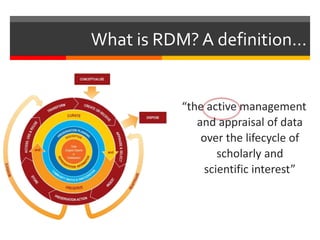
What is RDM? A definition… 
“the active management 
and appraisal of data 
over the lifecycle of 
scholarly and 
scientific interest”
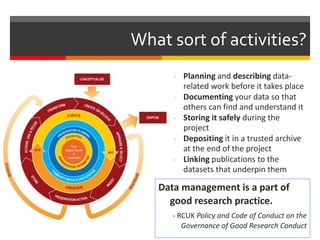
What sort of activities? 
- Planning and describing data-related 
work before it takes place 
- Documenting your data so that 
others can find and understand it 
- Storing it safely during the 
project 
- Depositing it in a trusted archive 
at the end of the project 
- Linking publications to the 
datasets that underpin them 
Data management is a part of 
good research practice. 
- RCUK Policy and Code of Conduct on the 
Governance of Good Research Conduct
Okay, but what is ‘data’ exactly? 
 Definitions vary from discipline to discipline, and from funder to funder… 
 Here’s a science-centric definition: 
 “The recorded factual material commonly accepted in the scientific community as 
necessary to validate research findings.” (US Office of Management and Budget, 
Circular 110) 
 [Addendum: This policy applies to scientific collections, known in some disciplines 
as institutional collections, permanent collections, archival collections, museum 
collections, or voucher collections, which are assets with long-term scientific value. 
(US Office of Science and Technology Policy, Memorandum, 20 March 2014)] 
 And another from the visual arts: 
 “Evidence which is used or created to generate new knowledge and 
interpretations. ‘Evidence’ may be intersubjective or subjective; physical or 
emotional; persistent or ephemeral; personal or public; explicit or tacit; and is 
consciously or unconsciously referenced by the researcher at some point during 
the course of their research.” 
(Leigh Garrett, KAPTUR project: see http://kaptur.wordpress.com/ 
2013/01/23/what-is-visual-arts-research-data-revisited/)
From data to research objects? 
 “Research object” is a term that is gaining in popularity, 
not least in the humanities where the relevance of the 
term ‘data’ is not always recognised… 
 Research objects can comprise any supporting material 
which underpins or otherwise enriches the (written) 
outputs of research 
 Data (numeric, written, audiovisual….) 
 Software code 
 Workflows and methodologies 
 Slides, logs, lab books, sketchbooks, notebooks, you name it! 
 See http://www.researchobject.org/ for more info
Helicopter view: What are the benefits of active RDM? 
 TRANSPARENCY: The evidence that underpins 
research can be made open for anyone to scrutinise, 
and attempt to replicate findings. 
 EFFICIENCY: Data collection can be funded once, and 
used many times for a variety of purposes. 
 RISK MANAGEMENT: A pro-active approach to data 
management reduces the risk of inappropriate 
disclosure of sensitive data, whether commercial or 
personal. 
 PRESERVATION: Lots of data is unique, and can only 
be captured once. If lost, it can’t be replaced.
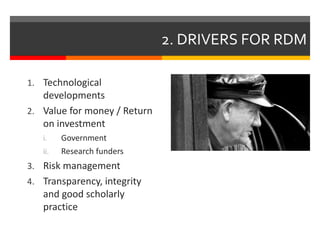
2. DRIVERS FOR RDM 
1. Technological 
developments 
2. Value for money / Return 
on investment 
i. Government 
ii. Research funders 
3. Risk management 
4. Transparency, integrity 
and good scholarly 
practice
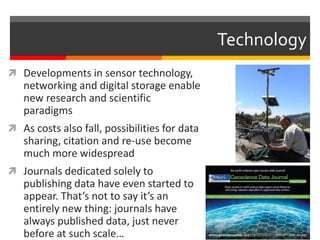
 Developments in sensor technology, 
networking and digital storage enable 
new research and scientific 
paradigms 
 As costs also fall, possibilities for data 
sharing, citation and re-use become 
much more widespread 
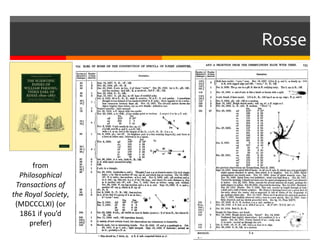
 Journals dedicated solely to 
publishing data have even started to 
appear. That’s not to say it’s an 
entirely new thing: journals have 
always published data, just never 
before at such scale… 
Technology
Rosse 
from 
Philosophical 
Transactions of 
the Royal Society, 
(MDCCCLXI) (or 
1861 if you’d 
prefer)
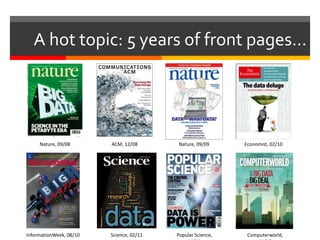
A hot topic: 5 years of front pages… 
Nature, 09/08 ACM, 12/08 Nature, 09/09 
Economist, 02/10 
InformationWeek, 08/10 Popular Science, 
Computerworld, 
11/11 
Science, 02/11 
11/12
Repurposing / VfM via data re-use 
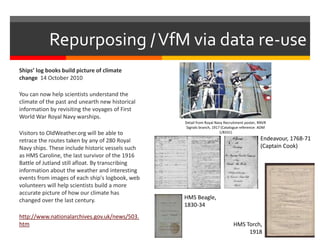
Ships’ log books build picture of climate 
change 14 October 2010 
You can now help scientists understand the 
climate of the past and unearth new historical 
information by revisiting the voyages of First 
World War Royal Navy warships. 
Visitors to OldWeather.org will be able to 
retrace the routes taken by any of 280 Royal 
Navy ships. These include historic vessels such 
as HMS Caroline, the last survivor of the 1916 
Battle of Jutland still afloat. By transcribing 
information about the weather and interesting 
events from images of each ship's logbook, web 
volunteers will help scientists build a more 
accurate picture of how our climate has 
changed over the last century. 
http://www.nationalarchives.gov.uk/news/503. 
htm 
Detail from Royal Navy Recruitment poster, RNVR 
Signals branch, 1917 (Catalogue reference: ADM 
1/8331) 
Endeavour, 1768-71 
(Captain Cook) 
HMS Beagle, 
1830-34 
HMS Torch, 
1918
Government pressure/support 
6.9 The Research Councils expect the researchers they fund 
to deposit published articles or conference proceedings in 
an open access repository at or around the time of 
publication. But this practice is unevenly enforced. 
Therefore, as an immediate step, we have asked the 
Research Councils to ensure the researchers they fund 
fulfil the current requirements. Additionally, the Research 
Councils have now agreed to invest £2 million in the 
development, by 2013, of a UK ‘Gateway to Research’. In 
the first instance this will allow ready access to Research 
Council funded research information and related data but 
it will be designed so that it can also include research 
funded by others in due course. The Research Councils will 
work with their partners and users to ensure information is 
presented in a readily reusable form, using common 
formats and open standards. 
http://www.bis.gov.uk/assets/biscor 
e/innovation/docs/i/11-1387- 
innovation-and-research-strategy-for- 
growth.pdf
(Aside: Open Data) 
 Open Data is a philosophy, underpinned by 
pragmatism… transparency + utility. 
 “Open data is the idea that certain data should be 
freely available to everyone to use and republish as 
they wish, without restrictions from copyright, patents 
or other mechanisms of control.” – Wikipedia 
 Governments, cities etc are all getting onboard 
 Open Knowledge Foundation is basically the political / 
activist wing: http://okfn.org/ 
 From the government / industry side, we have the 
Open Data Institute: http://theodi.org/
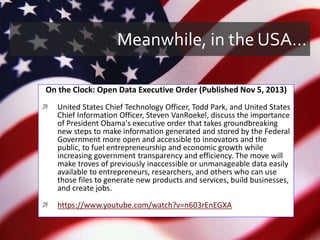
Meanwhile, in the USA… 
On the Clock: Open Data Executive Order (Published Nov 5, 2013) 
 United States Chief Technology Officer, Todd Park, and United States 
Chief Information Officer, Steven VanRoekel, discuss the importance 
of President Obama's executive order that takes groundbreaking 
new steps to make information generated and stored by the Federal 
Government more open and accessible to innovators and the 
public, to fuel entrepreneurship and economic growth while 
increasing government transparency and efficiency. The move will 
make troves of previously inaccessible or unmanageable data easily 
available to entrepreneurs, researchers, and others who can use 
those files to generate new products and services, build businesses, 
and create jobs. 
 https://www.youtube.com/watch?v=n603rEnEGXA
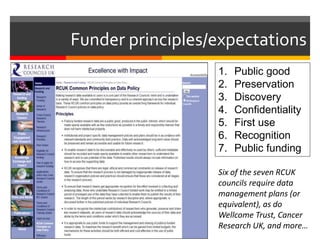
Funder principles/expectations 
1. Public good 
2. Preservation 
3. Discovery 
4. Confidentiality 
5. First use 
6. Recognition 
7. Public funding 
Six of the seven RCUK 
councils require data 
management plans (or 
equivalent), as do 
Wellcome Trust, Cancer 
Research UK, and more…
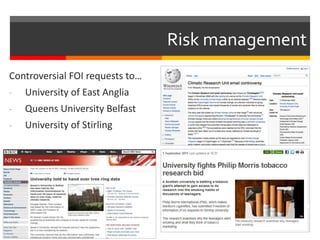
Controversial FOI requests to… 
- University of East Anglia 
- Queens University Belfast 
- University of Stirling 
Risk management
Research quality and integrity 
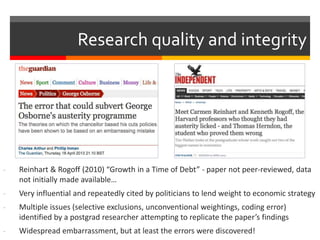
- Reinhart & Rogoff (2010) “Growth in a Time of Debt” - paper not peer-reviewed, data 
not initially made available… 
- Very influential and repeatedly cited by politicians to lend weight to economic strategy 
- Multiple issues (selective exclusions, unconventional weightings, coding error) 
identified by a postgrad researcher attempting to replicate the paper’s findings 
- Widespread embarrassment, but at least the errors were discovered!
3. WHAT DOES IT MEAN FOR RESEARCHERS? 
 A disruption to their working processes 
 Additional expectations / requirements from the 
funders 
 But! It provides opportunities for new types of 
investigation 
 And leads to a more robust scholarly record
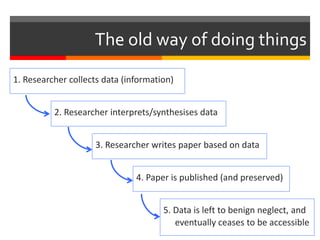
The old way of doing things 
1. Researcher collects data (information) 
2. Researcher interprets/synthesises data 
3. Researcher writes paper based on data 
4. Paper is published (and preserved) 
5. Data is left to benign neglect, and 
eventually ceases to be accessible
Without intervention, data + time = no data 
Vines et al. “examined the availability of data from 516 studies between 2 and 22 years old” 
- The odds of a data set being reported as extant fell by 17% per year 
- Broken e-mails and obsolete storage devices were the main obstacles to data sharing 
- Policies mandating data archiving at publication are clearly needed 
“The current system of leaving data with authors means that almost all of it is lost over time, 
unavailable for validation of the original results or to use for entirely new purposes” according to 
Timothy Vines, one of the researchers. This underscores the need for intentional management of data 
from all disciplines and opened our conversation on potential roles for librarians in this arena. (“80 
Percent of Scientific Data Gone in 20 Years,” HNGN, Dec. 20, 2013, 
http://www.hngn.com/articles/20083/20131220/80-percent-of-scientific-data-gone-in-20-years.htm.) 
Vines et al., The Availability of Research Data Declines Rapidly with Article Age, 
Current Biology (2014), http://dx.doi.org/10.1016/j.cub.2013.11.014
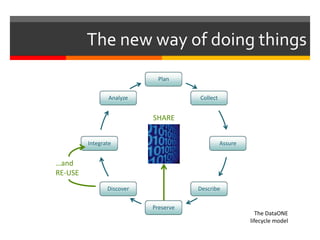
The new way of doing things 
Plan 
Collect 
Assure 
Describe 
Preserve 
Analyze 
Integrate 
Discover 
SHARE 
…and 
RE-USE 
The DataONE 
lifecycle model
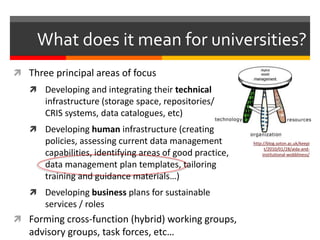
What does it mean for universities? 
 Three principal areas of focus 
 Developing and integrating their technical 
infrastructure (storage space, repositories/ 
CRIS systems, data catalogues, etc) 
 Developing human infrastructure (creating 
policies, assessing current data management 
capabilities, identifying areas of good practice, 
data management plan templates, tailoring 
training and guidance materials…) 
 Developing business plans for sustainable 
services / roles 
 Forming cross-function (hybrid) working groups, 
advisory groups, task forces, etc… 
http://blog.soton.ac.uk/keepi 
t/2010/01/28/aida-and-institutional- 
wobbliness/
4. WHAT DOES IT MEAN FOR ADMINISTRATORS? 
 Need to understand the key element in the process, 
as well as roles and responsibilities 
 Understand the key points of the funders’ 
requirements 
 Expect questions from researchers…
Understand the different roles 
 Three main roles for research-support staff… 
 Compliance: checking adherence with funder policies, at both ends of 
the funding process (pre-award and end-of-project) 
 Guidance: helping researchers meet expectations and requirements 
 Selection etc: some staff may also have an appraisal and retention role, 
making decisions re. what the institution will want to keep / share, 
under what conditions, and for how long. There are various reasons for 
universities to want to keep some datasets, and to get rid of others. 
 Different universities organise their provision in different ways; 
there’s no one-size-fits-all approach 
 We’ll explore this in more detail in the data management planning 
exercise later…
Understand funder requirements 
 The DCC maintains an overview of the major UK funders’ data-related 
expectations / requirements 
 http://www.dcc.ac.uk/resources/policy-and-legal/overview-funders-data-policies 
 Key points 
 6 of the 7 RCUK funders require data management plans as part of the (Je-S) 
funding application process 
 NERC also require a second iteration during the project, which is developed in 
collaboration with one of their data centres 
 NERC and ESRC operate their own data centres. The other RCUK funders do not, 
so researchers have to decide where to deposit their data. Sometimes there is an 
obvious home for it, sometimes they may need help from the university… 
 EPSRC do not require data management plans; instead they require a whole 
infrastructure (by May 2015) 
 Beyond the UK, the European Commission is running a data management pilot 
in Horizon 2020 
 http://ec.europa.eu/research/participants/data/ref/h2020/grants_manual/hi/oa_ 
pilot/h2020-hi-oa-data-mgt_en.pdf
Expect questions from researchers 
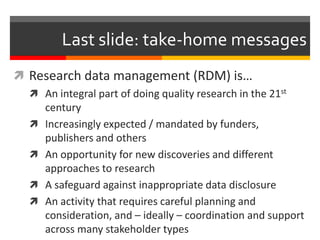
 …and know where to direct 
enquiries 
 Also, expect resistance! 
 It can pay to focus on the 
benefits rather than 
hammering home the 
requirements, but be clear 
that DMPs (and good RDM 
practice, more broadly) are no 
longer optional for many 
funders (and publishers)
Last slide: take-home messages 
 Research data management (RDM) is… 
 An integral part of doing quality research in the 21st 
century 
 Increasingly expected / mandated by funders, 
publishers and others 
 An opportunity for new discoveries and different 
approaches to research 
 A safeguard against inappropriate data disclosure 
 An activity that requires careful planning and 
consideration, and – ideally – coordination and support 
across many stakeholder types
Thank you 
Questions? 
Martin Donnelly 
Digital Curation Centre 
University of Edinburgh 
martin.donnelly@ed.ac.uk 
@mkdDCC 
For more about DCC services see www.dcc.ac.uk or follow us on twitter @digitalcuration / #ukdcc 
Image credits 
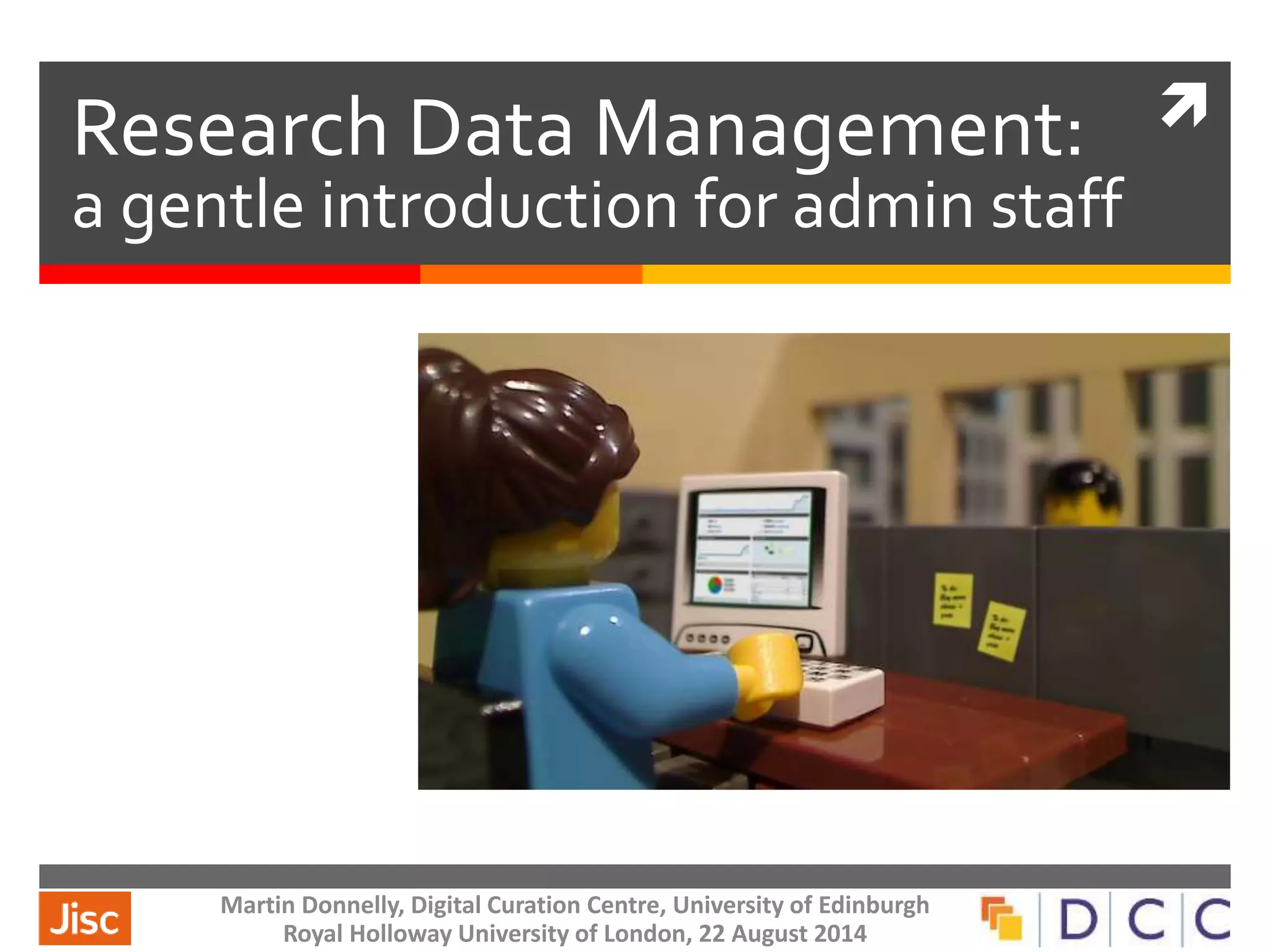
Slide 1 (lego office) - https://www.flickr.com/photos/oblongpictures/ 
Slide 2 (forest) – http://assets.worldwildlife.org/photos/934/images/hero_small/forest-overview-HI_115486.jpg?1345533675 
Slide 3 (dictionary) – http://www.flickr.com/photos/dougbelshaw/ 
Slide 11 (driver) - http://www.flickr.com/photos/rpmarks/ 
Slide 30 (carrot and stick) – https://www.flickr.com/photos/kaptainkobold 
Thanks to Sarah Callaghan, PREPARDE, for the Rosse example. All images are Creative Commons licensed. 
This work is licensed under the 
Creative Commons Attribution 
2.5 UK: Scotland License.

Research Data Management: a gentle introduction for admin staff

  • 1.
     Research DataManagement: a gentle introduction for admin staff Martin Donnelly, Digital Curation Centre, University of Edinburgh Royal Holloway University of London, 22 August 2014
  • 2.
    OVERVIEW (45 mins) 1. Introductions and definitions 2. Drivers for RDM 3. What does it mean for researchers? 4. What does it mean for support staff?
  • 3.
  • 4.
    The Digital CurationCentre  The (est. 2004) is…  A UK centre of expertise in digital preservation, with a particular focus on research data management (RDM)  Based across three sites: Universities of Edinburgh, Glasgow and Bath  Working with a number of UK universities to identify gaps in RDM provision and raise capabilities across the sector  Also involved in a variety of international collaborations, but I won’t say much about these
  • 5.
    Working with UKuniversities
  • 6.
    What is RDM?A definition… “the active management and appraisal of data over the lifecycle of scholarly and scientific interest”
  • 7.
    What sort ofactivities? - Planning and describing data-related work before it takes place - Documenting your data so that others can find and understand it - Storing it safely during the project - Depositing it in a trusted archive at the end of the project - Linking publications to the datasets that underpin them Data management is a part of good research practice. - RCUK Policy and Code of Conduct on the Governance of Good Research Conduct
  • 8.
    Okay, but whatis ‘data’ exactly?  Definitions vary from discipline to discipline, and from funder to funder…  Here’s a science-centric definition:  “The recorded factual material commonly accepted in the scientific community as necessary to validate research findings.” (US Office of Management and Budget, Circular 110)  [Addendum: This policy applies to scientific collections, known in some disciplines as institutional collections, permanent collections, archival collections, museum collections, or voucher collections, which are assets with long-term scientific value. (US Office of Science and Technology Policy, Memorandum, 20 March 2014)]  And another from the visual arts:  “Evidence which is used or created to generate new knowledge and interpretations. ‘Evidence’ may be intersubjective or subjective; physical or emotional; persistent or ephemeral; personal or public; explicit or tacit; and is consciously or unconsciously referenced by the researcher at some point during the course of their research.” (Leigh Garrett, KAPTUR project: see http://kaptur.wordpress.com/ 2013/01/23/what-is-visual-arts-research-data-revisited/)
  • 9.
    From data toresearch objects?  “Research object” is a term that is gaining in popularity, not least in the humanities where the relevance of the term ‘data’ is not always recognised…  Research objects can comprise any supporting material which underpins or otherwise enriches the (written) outputs of research  Data (numeric, written, audiovisual….)  Software code  Workflows and methodologies  Slides, logs, lab books, sketchbooks, notebooks, you name it!  See http://www.researchobject.org/ for more info
  • 10.
    Helicopter view: Whatare the benefits of active RDM?  TRANSPARENCY: The evidence that underpins research can be made open for anyone to scrutinise, and attempt to replicate findings.  EFFICIENCY: Data collection can be funded once, and used many times for a variety of purposes.  RISK MANAGEMENT: A pro-active approach to data management reduces the risk of inappropriate disclosure of sensitive data, whether commercial or personal.  PRESERVATION: Lots of data is unique, and can only be captured once. If lost, it can’t be replaced.
  • 11.
    2. DRIVERS FORRDM 1. Technological developments 2. Value for money / Return on investment i. Government ii. Research funders 3. Risk management 4. Transparency, integrity and good scholarly practice
  • 12.
     Developments insensor technology, networking and digital storage enable new research and scientific paradigms  As costs also fall, possibilities for data sharing, citation and re-use become much more widespread  Journals dedicated solely to publishing data have even started to appear. That’s not to say it’s an entirely new thing: journals have always published data, just never before at such scale… Technology
  • 13.
    Rosse from Philosophical Transactions of the Royal Society, (MDCCCLXI) (or 1861 if you’d prefer)
  • 14.
    A hot topic:5 years of front pages… Nature, 09/08 ACM, 12/08 Nature, 09/09 Economist, 02/10 InformationWeek, 08/10 Popular Science, Computerworld, 11/11 Science, 02/11 11/12
  • 15.
    Repurposing / VfMvia data re-use Ships’ log books build picture of climate change 14 October 2010 You can now help scientists understand the climate of the past and unearth new historical information by revisiting the voyages of First World War Royal Navy warships. Visitors to OldWeather.org will be able to retrace the routes taken by any of 280 Royal Navy ships. These include historic vessels such as HMS Caroline, the last survivor of the 1916 Battle of Jutland still afloat. By transcribing information about the weather and interesting events from images of each ship's logbook, web volunteers will help scientists build a more accurate picture of how our climate has changed over the last century. http://www.nationalarchives.gov.uk/news/503. htm Detail from Royal Navy Recruitment poster, RNVR Signals branch, 1917 (Catalogue reference: ADM 1/8331) Endeavour, 1768-71 (Captain Cook) HMS Beagle, 1830-34 HMS Torch, 1918
  • 16.
    Government pressure/support 6.9The Research Councils expect the researchers they fund to deposit published articles or conference proceedings in an open access repository at or around the time of publication. But this practice is unevenly enforced. Therefore, as an immediate step, we have asked the Research Councils to ensure the researchers they fund fulfil the current requirements. Additionally, the Research Councils have now agreed to invest £2 million in the development, by 2013, of a UK ‘Gateway to Research’. In the first instance this will allow ready access to Research Council funded research information and related data but it will be designed so that it can also include research funded by others in due course. The Research Councils will work with their partners and users to ensure information is presented in a readily reusable form, using common formats and open standards. http://www.bis.gov.uk/assets/biscor e/innovation/docs/i/11-1387- innovation-and-research-strategy-for- growth.pdf
  • 17.
    (Aside: Open Data)  Open Data is a philosophy, underpinned by pragmatism… transparency + utility.  “Open data is the idea that certain data should be freely available to everyone to use and republish as they wish, without restrictions from copyright, patents or other mechanisms of control.” – Wikipedia  Governments, cities etc are all getting onboard  Open Knowledge Foundation is basically the political / activist wing: http://okfn.org/  From the government / industry side, we have the Open Data Institute: http://theodi.org/
  • 18.
    Meanwhile, in theUSA… On the Clock: Open Data Executive Order (Published Nov 5, 2013)  United States Chief Technology Officer, Todd Park, and United States Chief Information Officer, Steven VanRoekel, discuss the importance of President Obama's executive order that takes groundbreaking new steps to make information generated and stored by the Federal Government more open and accessible to innovators and the public, to fuel entrepreneurship and economic growth while increasing government transparency and efficiency. The move will make troves of previously inaccessible or unmanageable data easily available to entrepreneurs, researchers, and others who can use those files to generate new products and services, build businesses, and create jobs.  https://www.youtube.com/watch?v=n603rEnEGXA
  • 19.
    Funder principles/expectations 1.Public good 2. Preservation 3. Discovery 4. Confidentiality 5. First use 6. Recognition 7. Public funding Six of the seven RCUK councils require data management plans (or equivalent), as do Wellcome Trust, Cancer Research UK, and more…
  • 20.
    Controversial FOI requeststo… - University of East Anglia - Queens University Belfast - University of Stirling Risk management
  • 21.
    Research quality andintegrity - Reinhart & Rogoff (2010) “Growth in a Time of Debt” - paper not peer-reviewed, data not initially made available… - Very influential and repeatedly cited by politicians to lend weight to economic strategy - Multiple issues (selective exclusions, unconventional weightings, coding error) identified by a postgrad researcher attempting to replicate the paper’s findings - Widespread embarrassment, but at least the errors were discovered!
  • 22.
    3. WHAT DOESIT MEAN FOR RESEARCHERS?  A disruption to their working processes  Additional expectations / requirements from the funders  But! It provides opportunities for new types of investigation  And leads to a more robust scholarly record
  • 23.
    The old wayof doing things 1. Researcher collects data (information) 2. Researcher interprets/synthesises data 3. Researcher writes paper based on data 4. Paper is published (and preserved) 5. Data is left to benign neglect, and eventually ceases to be accessible
  • 24.
    Without intervention, data+ time = no data Vines et al. “examined the availability of data from 516 studies between 2 and 22 years old” - The odds of a data set being reported as extant fell by 17% per year - Broken e-mails and obsolete storage devices were the main obstacles to data sharing - Policies mandating data archiving at publication are clearly needed “The current system of leaving data with authors means that almost all of it is lost over time, unavailable for validation of the original results or to use for entirely new purposes” according to Timothy Vines, one of the researchers. This underscores the need for intentional management of data from all disciplines and opened our conversation on potential roles for librarians in this arena. (“80 Percent of Scientific Data Gone in 20 Years,” HNGN, Dec. 20, 2013, http://www.hngn.com/articles/20083/20131220/80-percent-of-scientific-data-gone-in-20-years.htm.) Vines et al., The Availability of Research Data Declines Rapidly with Article Age, Current Biology (2014), http://dx.doi.org/10.1016/j.cub.2013.11.014
  • 25.
    The new wayof doing things Plan Collect Assure Describe Preserve Analyze Integrate Discover SHARE …and RE-USE The DataONE lifecycle model
  • 26.
    What does itmean for universities?  Three principal areas of focus  Developing and integrating their technical infrastructure (storage space, repositories/ CRIS systems, data catalogues, etc)  Developing human infrastructure (creating policies, assessing current data management capabilities, identifying areas of good practice, data management plan templates, tailoring training and guidance materials…)  Developing business plans for sustainable services / roles  Forming cross-function (hybrid) working groups, advisory groups, task forces, etc… http://blog.soton.ac.uk/keepi t/2010/01/28/aida-and-institutional- wobbliness/
  • 27.
    4. WHAT DOESIT MEAN FOR ADMINISTRATORS?  Need to understand the key element in the process, as well as roles and responsibilities  Understand the key points of the funders’ requirements  Expect questions from researchers…
  • 28.
    Understand the differentroles  Three main roles for research-support staff…  Compliance: checking adherence with funder policies, at both ends of the funding process (pre-award and end-of-project)  Guidance: helping researchers meet expectations and requirements  Selection etc: some staff may also have an appraisal and retention role, making decisions re. what the institution will want to keep / share, under what conditions, and for how long. There are various reasons for universities to want to keep some datasets, and to get rid of others.  Different universities organise their provision in different ways; there’s no one-size-fits-all approach  We’ll explore this in more detail in the data management planning exercise later…
  • 29.
    Understand funder requirements  The DCC maintains an overview of the major UK funders’ data-related expectations / requirements  http://www.dcc.ac.uk/resources/policy-and-legal/overview-funders-data-policies  Key points  6 of the 7 RCUK funders require data management plans as part of the (Je-S) funding application process  NERC also require a second iteration during the project, which is developed in collaboration with one of their data centres  NERC and ESRC operate their own data centres. The other RCUK funders do not, so researchers have to decide where to deposit their data. Sometimes there is an obvious home for it, sometimes they may need help from the university…  EPSRC do not require data management plans; instead they require a whole infrastructure (by May 2015)  Beyond the UK, the European Commission is running a data management pilot in Horizon 2020  http://ec.europa.eu/research/participants/data/ref/h2020/grants_manual/hi/oa_ pilot/h2020-hi-oa-data-mgt_en.pdf
  • 30.
    Expect questions fromresearchers  …and know where to direct enquiries  Also, expect resistance!  It can pay to focus on the benefits rather than hammering home the requirements, but be clear that DMPs (and good RDM practice, more broadly) are no longer optional for many funders (and publishers)
  • 31.
    Last slide: take-homemessages  Research data management (RDM) is…  An integral part of doing quality research in the 21st century  Increasingly expected / mandated by funders, publishers and others  An opportunity for new discoveries and different approaches to research  A safeguard against inappropriate data disclosure  An activity that requires careful planning and consideration, and – ideally – coordination and support across many stakeholder types
  • 32.
    Thank you Questions? Martin Donnelly Digital Curation Centre University of Edinburgh martin.donnelly@ed.ac.uk @mkdDCC For more about DCC services see www.dcc.ac.uk or follow us on twitter @digitalcuration / #ukdcc Image credits Slide 1 (lego office) - https://www.flickr.com/photos/oblongpictures/ Slide 2 (forest) – http://assets.worldwildlife.org/photos/934/images/hero_small/forest-overview-HI_115486.jpg?1345533675 Slide 3 (dictionary) – http://www.flickr.com/photos/dougbelshaw/ Slide 11 (driver) - http://www.flickr.com/photos/rpmarks/ Slide 30 (carrot and stick) – https://www.flickr.com/photos/kaptainkobold Thanks to Sarah Callaghan, PREPARDE, for the Rosse example. All images are Creative Commons licensed. This work is licensed under the Creative Commons Attribution 2.5 UK: Scotland License.

Editor's Notes

  • #4 Slide 3 (Definitions) – http://www.flickr.com/photos/dougbelshaw/
  • #6 First cohort of institutional engagements, 2011-2013. Mention my own past as an administrator.
  • #7 Will talk about active management now, and appraisal a little later…
  • #9 Think about what you do in your own research
  • #10 But for the time being we’ll stick with ‘data’…
  • #11 Will unpack these over the course of the presentation, but first
  • #12 Slide 9 (Drivers) – http://www.flickr.com/photos/rpmarks/
  • #13 Earliest academic scientific journal is Journal des sçavans, published on 5 Jan 1665
  • #14 We can now publish and re-use data in a much more structured way, automating the process and crunching more data via computers than we could when it was only available on paper.
  • #15 …and as the worlds of business and academia continue to merge… Interest in data is not limited to academia: the business world sees data as a valuable and potentially lucrative resource, a real game-changer…
  • #21 Philip Morris International vs University of Stirling (2011) - another example of unanticipated data re-use! There’s a delicate balance between the rights of researchers, of human research subjects, of funders, and other interested stakeholders to enable or prevent access to research data…
  • #23 Change is seldom welcomed
  • #24 Painting in broad strokes here, of course…
  • #25 Tragedy + time = comedy
  • #26 Share = deposit, link, publish, etc
  • #27 Forming cross-function (hybrid) working groups, advisory groups, task forces, etc
  • #31 https://www.flickr.com/photos/kaptainkobold