March 2015
WHAT EVERY RETAILER MUST KNOW
A B O U T T R A F F I C
2.0
T A B L E O F C O N T E N T S
Table of Contents
Introduction
1 Who are your shoppers?
2 What do your shoppers do, and how?
3 Where do your shoppers go in-store, when, and for how long?
4 What’s the “Why behind the buy?” (or the “No buy?”)
5 Employee Exclusion
More Information
Does your competition know more about your
shoppers than you do? What would that cost your
business?
In years past, store traffic was a simple measure - the
number of shoppers who entered the store - and traffic
counts were critical in determining core retail metrics like con-
version (i.e.; the percentage of shoppers who actually purchased,
calculated as the number of transactions divided by traffic).
Traffic told the story of “how many.”
That was it. Nothing more.
Retailers wanted to know more about their shoppers, but additional data collection
included methods like surveying, and was very manual and very expensive.
That was then. This is now.
Traffic 2.0 is the latest generation of traffic counting, and it doesn’t stop at “how many.” Today,
it includes “who,” “what,” “where,” and “when,” and when brought all together, goes a long way
to determining “why” and “why not” as well.
Here are five things a retailer needs to know about retail traffic today.
I N T R O D U C T I O N
Introduction
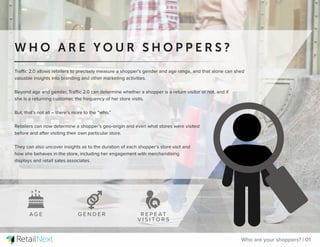
Traffic 2.0 allows retailers to precisely measure a shopper’s gender and age range, and that alone can shed
valuable insights into branding and other marketing activities.
Beyond age and gender, Traffic 2.0 can determine whether a shopper is a return visitor or not, and if
she is a returning customer, the frequency of her store visits.
But, that’s not all – there’s more to the “who.”
Retailers can now determine a shopper’s geo-origin and even what stores were visited
before and after visiting their own particular store.
They can also uncover insights as to the duration of each shopper’s store visit and
how she behaves in the store, including her engagement with merchandising
displays and retail sales associates.
W H O A R E Y O U R S H O P P E R S ?
Who are your shoppers? | 01
A G E G E N D E R R E P E AT
V I S I T O R S
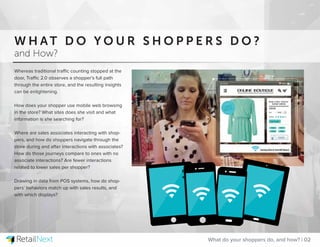
Whereas traditional traffic counting stopped at the
door, Traffic 2.0 observes a shopper’s full path
through the entire store, and the resulting insights
can be enlightening.
How does your shopper use mobile web browsing
in the store? What sites does she visit and what
information is she searching for?
Where are sales associates interacting with shop-
pers, and how do shoppers navigate through the
store during and after interactions with associates?
How do those journeys compare to ones with no
associate interactions? Are fewer interactions
related to lower sales per shopper?
Drawing in data from POS systems, how do shop-
pers’ behaviors match up with sales results, and
with which displays?
What do your shoppers do, and how? | 02
W H A T D O Y O U R S H O P P E R S D O ?
and How?
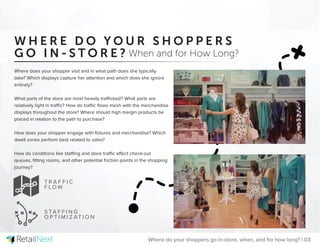
Where does your shopper visit and in what path does she typically
take? Which displays capture her attention and which does she ignore
entirely?
What parts of the store are most heavily trafficked? What parts are
relatively light in traffic? How do traffic flows mesh with the merchandise
displays throughout the store? Where should high margin products be
placed in relation to the path to purchase?
How does your shopper engage with fixtures and merchandise? Which
dwell zones perform best related to sales?
How do conditions like staffing and store traffic affect check-out
queues, fitting rooms, and other potential friction points in the shopping
journey?
Where do your shoppers go in-store, when, and for how long? | 03
W H E R E D O Y O U R S H O P P E R S
G O I N - S T O R E ?
T R A F F I C
F L O W
S TA F F I N G
O P T I M I Z AT I O N
When and for How Long?
Retail analytics platforms and their traffic counting systems integrate with other data sources, like workforce management, POS, CRM,
loyalty and other data streams, delivering powerful insights:
• How does store staffing correlate to store traffic, sales and conversion, and where do opportunities exist to better allocate staffing
to improve store service and sales?
• How do shoppers who convert navigate through the store, and how does that compare with those shoppers who do not convert?
• Is there a certain point in the shopping journey, be it an associate interaction or a particular component of the store design, that
leads to purchase?
• Can various store designs and layouts create higher shopper engagement and purchasing?
• And so much more!
More accurate, more comprehensive store traffic measurement and observation leads to better data – for both asking and answering
better questions.
Better data, better questions and better answers lead to better decision-making, and it’s those better decisions that empower a retailer to
better understand its shoppers, deliver a better shopping experience and differentiated value proposition, and improve shopper satisfac-
tion, retention and loyalty.
It empowers a retailer to ascend to the level of “retailer of choice,” driving sales, profit and shopper loyalty.
What’s the why behind the buy? And the Why behind the NO buy? | 04
W H A T ’ S T H E W H Y B E H I N D T H E B U Y ?
As well as it’s closely related cousin, the, “Why behind the NO buy.”
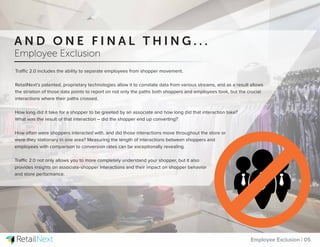
Traffic 2.0 includes the ability to separate employees from shopper movement.
RetailNext’s patented, proprietary technologies allow it to correlate data from various streams, and as a result allows
the striation of those data points to report on not only the paths both shoppers and employees took, but the crucial
interactions where their paths crossed.
How long did it take for a shopper to be greeted by an associate and how long did that interaction take?
What was the result of that interaction – did the shopper end up converting?
How often were shoppers interacted with, and did those interactions move throughout the store or
were they stationary in one area? Measuring the length of interactions between shoppers and
employees with comparison to conversion rates can be exceptionally revealing.
Traffic 2.0 not only allows you to more completely understand your shopper, but it also
provides insights on associate-shopper interactions and their impact on shopper behavior
and store performance.
Employee Exclusion | 05
A N D O N E F I N A L T H I N G . . .
Employee Exclusion
Does your competition know more about your shoppers than you do? What would that cost your business?
At RetailNext, we’re passionate about retailing and how to empower retailers to become better retailers,
growing comp store sales and improving bottom-line profits.
Do you have a point of view to share? Questions about retail analytics and how it’s used to better shopper
experience and, in turn, better store results?
Please join the #retail conversation on Twitter @RetailNext and at www.facebook.com/retailnext.
M O R E I N F O R M A T I O N
More Information
For more information, visit: www.retailnext.net
@RetailNext
linkedin.com/company/retailnext
/RetailNext
www.retailnext.net

What Every Retailer Must Know About Traffic 2.0

  • 1.
    March 2015 WHAT EVERYRETAILER MUST KNOW A B O U T T R A F F I C 2.0
  • 2.
    T A BL E O F C O N T E N T S Table of Contents Introduction 1 Who are your shoppers? 2 What do your shoppers do, and how? 3 Where do your shoppers go in-store, when, and for how long? 4 What’s the “Why behind the buy?” (or the “No buy?”) 5 Employee Exclusion More Information
  • 3.
    Does your competitionknow more about your shoppers than you do? What would that cost your business? In years past, store traffic was a simple measure - the number of shoppers who entered the store - and traffic counts were critical in determining core retail metrics like con- version (i.e.; the percentage of shoppers who actually purchased, calculated as the number of transactions divided by traffic). Traffic told the story of “how many.” That was it. Nothing more. Retailers wanted to know more about their shoppers, but additional data collection included methods like surveying, and was very manual and very expensive. That was then. This is now. Traffic 2.0 is the latest generation of traffic counting, and it doesn’t stop at “how many.” Today, it includes “who,” “what,” “where,” and “when,” and when brought all together, goes a long way to determining “why” and “why not” as well. Here are five things a retailer needs to know about retail traffic today. I N T R O D U C T I O N Introduction
  • 4.
    Traffic 2.0 allowsretailers to precisely measure a shopper’s gender and age range, and that alone can shed valuable insights into branding and other marketing activities. Beyond age and gender, Traffic 2.0 can determine whether a shopper is a return visitor or not, and if she is a returning customer, the frequency of her store visits. But, that’s not all – there’s more to the “who.” Retailers can now determine a shopper’s geo-origin and even what stores were visited before and after visiting their own particular store. They can also uncover insights as to the duration of each shopper’s store visit and how she behaves in the store, including her engagement with merchandising displays and retail sales associates. W H O A R E Y O U R S H O P P E R S ? Who are your shoppers? | 01 A G E G E N D E R R E P E AT V I S I T O R S
  • 5.
    Whereas traditional trafficcounting stopped at the door, Traffic 2.0 observes a shopper’s full path through the entire store, and the resulting insights can be enlightening. How does your shopper use mobile web browsing in the store? What sites does she visit and what information is she searching for? Where are sales associates interacting with shop- pers, and how do shoppers navigate through the store during and after interactions with associates? How do those journeys compare to ones with no associate interactions? Are fewer interactions related to lower sales per shopper? Drawing in data from POS systems, how do shop- pers’ behaviors match up with sales results, and with which displays? What do your shoppers do, and how? | 02 W H A T D O Y O U R S H O P P E R S D O ? and How?
  • 6.
    Where does yourshopper visit and in what path does she typically take? Which displays capture her attention and which does she ignore entirely? What parts of the store are most heavily trafficked? What parts are relatively light in traffic? How do traffic flows mesh with the merchandise displays throughout the store? Where should high margin products be placed in relation to the path to purchase? How does your shopper engage with fixtures and merchandise? Which dwell zones perform best related to sales? How do conditions like staffing and store traffic affect check-out queues, fitting rooms, and other potential friction points in the shopping journey? Where do your shoppers go in-store, when, and for how long? | 03 W H E R E D O Y O U R S H O P P E R S G O I N - S T O R E ? T R A F F I C F L O W S TA F F I N G O P T I M I Z AT I O N When and for How Long?
  • 7.
    Retail analytics platformsand their traffic counting systems integrate with other data sources, like workforce management, POS, CRM, loyalty and other data streams, delivering powerful insights: • How does store staffing correlate to store traffic, sales and conversion, and where do opportunities exist to better allocate staffing to improve store service and sales? • How do shoppers who convert navigate through the store, and how does that compare with those shoppers who do not convert? • Is there a certain point in the shopping journey, be it an associate interaction or a particular component of the store design, that leads to purchase? • Can various store designs and layouts create higher shopper engagement and purchasing? • And so much more! More accurate, more comprehensive store traffic measurement and observation leads to better data – for both asking and answering better questions. Better data, better questions and better answers lead to better decision-making, and it’s those better decisions that empower a retailer to better understand its shoppers, deliver a better shopping experience and differentiated value proposition, and improve shopper satisfac- tion, retention and loyalty. It empowers a retailer to ascend to the level of “retailer of choice,” driving sales, profit and shopper loyalty. What’s the why behind the buy? And the Why behind the NO buy? | 04 W H A T ’ S T H E W H Y B E H I N D T H E B U Y ? As well as it’s closely related cousin, the, “Why behind the NO buy.”
  • 8.
    Traffic 2.0 includesthe ability to separate employees from shopper movement. RetailNext’s patented, proprietary technologies allow it to correlate data from various streams, and as a result allows the striation of those data points to report on not only the paths both shoppers and employees took, but the crucial interactions where their paths crossed. How long did it take for a shopper to be greeted by an associate and how long did that interaction take? What was the result of that interaction – did the shopper end up converting? How often were shoppers interacted with, and did those interactions move throughout the store or were they stationary in one area? Measuring the length of interactions between shoppers and employees with comparison to conversion rates can be exceptionally revealing. Traffic 2.0 not only allows you to more completely understand your shopper, but it also provides insights on associate-shopper interactions and their impact on shopper behavior and store performance. Employee Exclusion | 05 A N D O N E F I N A L T H I N G . . . Employee Exclusion
  • 9.
    Does your competitionknow more about your shoppers than you do? What would that cost your business? At RetailNext, we’re passionate about retailing and how to empower retailers to become better retailers, growing comp store sales and improving bottom-line profits. Do you have a point of view to share? Questions about retail analytics and how it’s used to better shopper experience and, in turn, better store results? Please join the #retail conversation on Twitter @RetailNext and at www.facebook.com/retailnext. M O R E I N F O R M A T I O N More Information For more information, visit: www.retailnext.net @RetailNext linkedin.com/company/retailnext /RetailNext www.retailnext.net