Human rights services
Respect brings
its own rewards
Climate Change & Sustainability Services
EY Germany
MAKE
RESPECT
FOR
RIGHTS
A WIN-WIN
MAKE
RESPECT
FOR
RIGHTS
A WIN-WIN
Protecting human rights
in global supply and
value chains
Businesses are part of a comprehensive political, economic
and social system. They operate within a rapidly evolving
landscape of global regulatory, investor and social
expectations in the field of human rights.
In order to improve the global human rights situation and
comply with the 2030 Agenda for Sustainable Development,
many countries have taken measures to increase corporate
responsibility. Due to their influence on local structures and
the lives of individuals, companies are expected to meet
international human rights standards wherever they operate.
In the National Action Plan for Business and Human Rights
(2016–2020, “NAP”), the German Federal Government lays
down the responsibility of German businesses to exercise
human rights due diligence within their own operations as well
as their supply and value chains.
EY Germany has been mandated by the German Federal
Office to lead the NAP monitoring, which is set up to evaluate
the implementation status of human rights due diligence
of companies based in Germany. Our research will help the
government decide on whether legal action is necessary for
businesses to increase their actions for effective “human
rights due diligence” from 2020 onwards.
Can you afford to ignore
potential human rights impacts?
Task list for globally competitive companies
Inhibiting sustainable
business growth
•	 Loss of customer loyalty
•	 Damage to brand value
•	 Missed business opportunities
•	 Loss of government procurement
opportunities
Compliance
risks
•	 New laws, e.g., in the UK and France.
Possible legal action in Germany
following the NAP process
•	 The Modern Slavery Act and the
California Supply Chains
Transparency Act require increased
visibility of supply chain conditions
•	 Increased scrutiny by
regulatory bodies
Financial
risks
•	 Reduced access to finance and
responsible investment
•	 Regulatory fines
•	 Desertion by customers and
employees
•	 Negative NGO/media campaigns
Reporting
and disclosure
•	 Meet increasing demands for transparency from customers,
potential investors and ranking initiatives on the company’s
human rights challenges and initiatives currently underway
Training and
education
•	 Offer dynamic human rights education that inspires
and empowers employees
•	 Build capacity to identify and manage potential human
rights impacts
Stakeholder dialogue •	 Communicate with stakeholders to receive valuable
feedback on policies, potential impacts and reports,
and to build positive relationships
Risk assessment/due diligence •	 Identify and assess actual and potential human rights
impacts in domestic and overseas operations along your
entire value chain
•	 Integrate and act on these findings, tracking responses
and communicating how impacts are addressed
Policy formulation •	 Prepare a publically available human rights policy in line
with the UN Guiding principles
* The world’s first comprehensive reporting guidance for companies released in 2015
Can you afford to ignore
potential human rights impacts?
Task list for globally competitive companies
Inhibiting sustainable
business growth
• Loss of customer loyalty
• Damage to brand value
• Missed business opportunities
• Loss of government procurement
opportunities
Compliance
risks
• New laws, e.g., in the UK and France.
Possible legal action in Germany
following the NAP process
• The Modern Slavery Act and the
California Supply Chains
Transparency Act require increased
visibility of supply chain conditions
• Increased scrutiny by
regulatory bodies
Financial
risks
• Reduced access to finance and
responsible investment
• Regulatory fines
• Desertion by customers and
employees
• Negative NGO/media campaigns
Reporting
and disclosure
• Meet increasing demands for transparency from customers,
potential investors and ranking initiatives on the company’s
human rights challenges and initiatives currently underway
Training and
education
• Offer dynamic human rights education that inspires
and empowers employees
• Build capacity to identify and manage potential human
rights impacts
Stakeholder dialogue • Communicate with stakeholders to receive valuable
feedback on policies, potential impacts and reports,
and to build positive relationships
Risk assessment/due diligence • Identify and assess actual and potential human rights
impacts in domestic and overseas operations along your
entire value chain
• Integrate and act on these findings, tracking responses
and communicating how impacts are addressed
Policy formulation • Prepare a publically available human rights policy in line
with the UN Guiding principles
* The world’s first comprehensive reporting guidance for companies released in 2015
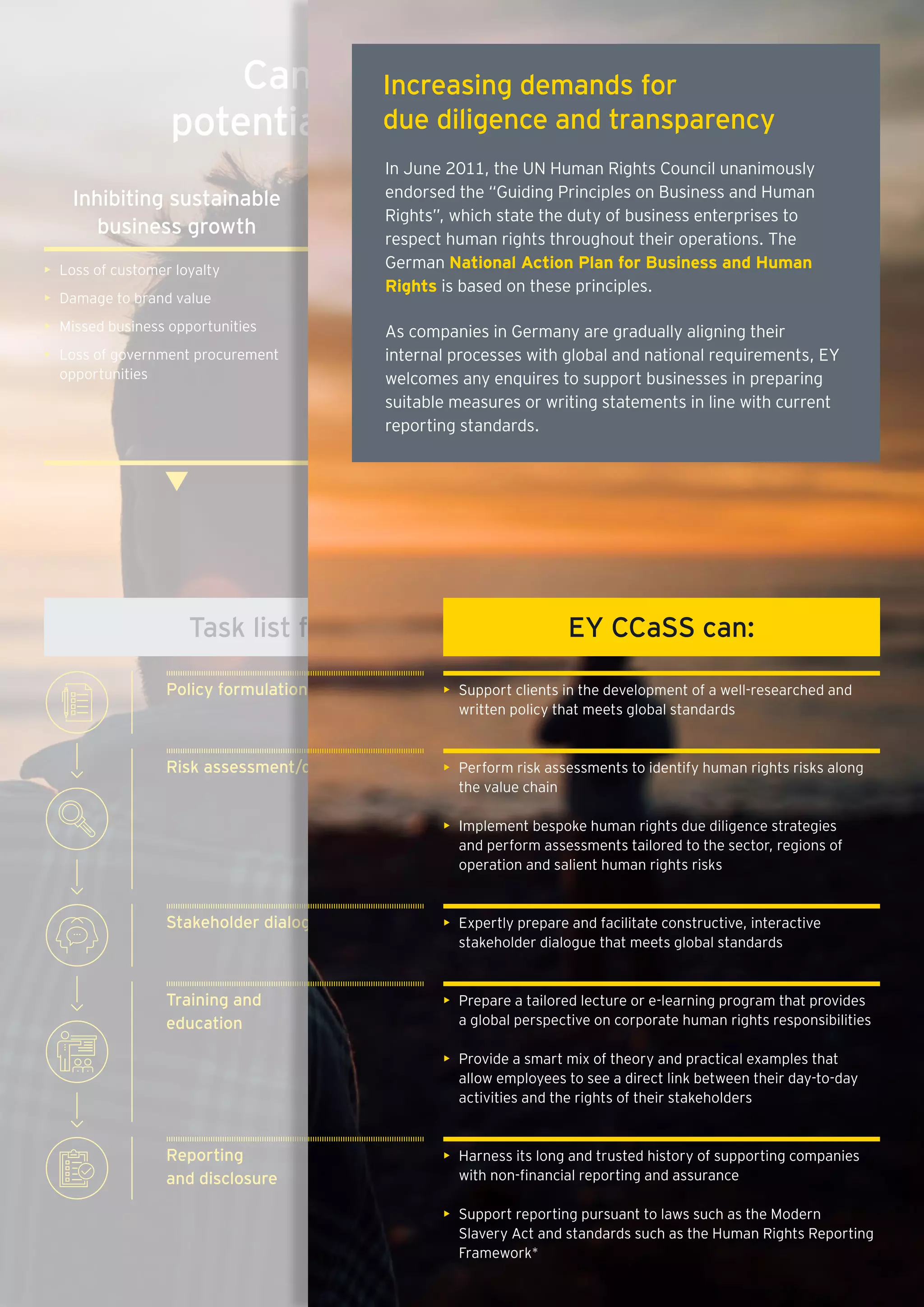
EY CCaSS can:
Increasing demands for
due diligence and transparency
In June 2011, the UN Human Rights Council unanimously
endorsed the “Guiding Principles on Business and Human
Rights”, which state the duty of business enterprises to
respect human rights throughout their operations. The
German National Action Plan for Business and Human
Rights is based on these principles.
As companies in Germany are gradually aligning their
internal processes with global and national requirements, EY
welcomes any enquires to support businesses in preparing
suitable measures or writing statements in line with current
reporting standards.
• Support clients in the development of a well-researched and
written policy that meets global standards
• Perform risk assessments to identify human rights risks along
the value chain
• Implement bespoke human rights due diligence strategies
and perform assessments tailored to the sector, regions of
operation and salient human rights risks
• Expertly prepare and facilitate constructive, interactive
stakeholder dialogue that meets global standards
• Prepare a tailored lecture or e-learning program that provides
a global perspective on corporate human rights responsibilities
• Provide a smart mix of theory and practical examples that
allow employees to see a direct link between their day-to-day
activities and the rights of their stakeholders
• Harness its long and trusted history of supporting companies
with non-financial reporting and assurance
• Support reporting pursuant to laws such as the Modern
Slavery Act and standards such as the Human Rights Reporting
Framework*
Can you afford to ignore
potential human rights impacts?
Task list for globally competitive companies
Inhibiting sustainable
business growth
• Loss of customer loyalty
• Damage to brand value
• Missed business opportunities
• Loss of government procurement
opportunities
Compliance
risks
• New laws, e.g., in the UK and France.
Possible legal action in Germany
following the NAP process
• The Modern Slavery Act and the
California Supply Chains
Transparency Act require increased
visibility of supply chain conditions
• Increased scrutiny by
regulatory bodies
Financial
risks
• Reduced access to finance and
responsible investment
• Regulatory fines
• Desertion by customers and
employees
• Negative NGO/media campaigns
Reporting
and disclosure
• Meet increasing demands for transparency from customers,
potential investors and ranking initiatives on the company’s
human rights challenges and initiatives currently underway
Training and
education
• Offer dynamic human rights education that inspires
and empowers employees
• Build capacity to identify and manage potential human
rights impacts
Stakeholder dialogue • Communicate with stakeholders to receive valuable
feedback on policies, potential impacts and reports,
and to build positive relationships
Risk assessment/due diligence • Identify and assess actual and potential human rights
impacts in domestic and overseas operations along your
entire value chain
• Integrate and act on these findings, tracking responses
and communicating how impacts are addressed
Policy formulation • Prepare a publically available human rights policy in line
with the UN Guiding principles
* The world’s first comprehensive reporting guidance for companies released in 2015
Added benefits of respect for
your stakeholders’ rights:
Contact EY Germany
Nicole Richter
Partner, Head of GSA
Climate Change and Sustainability Services
Telefon +49 89 14331 19332
nicole.richter@de.ey.com
Hans-Bernd Brokamp
Partner
Climate Change and Sustainability Services
Telefon +49 211 9352 13923
hans-bernd.brokamp@de.ey.com
Enhanced risk management
with less likelihood of business disruption, negative media/
NGO campaigns, reputational damage and litigation.
Greater access to opportunities
with partners who expect to see that potential human rights impacts
are being identified and addressed.
Positive recognition
from customers and key stakeholders for efforts taken to improve
performance and address negative impacts.
Improved relationships
with employees and local communities, resulting in greater trust
and the maintenance of a social licence to operate.
Improved ability to attract
the next generation of young leaders, who are increasingly focused
on companies’ wider contributions to society.
Inclusion in stock exchanges
and financial institutions scrutinizing companies’ non-financial
performance (DJSI, Norwegian Pension Fund, FTSE4Good, etc.)
EY | Assurance | Tax | Transactions | Advisory
About the global EY organization
The global EY organization is a leader in assurance, tax, transaction and
­advisory services. We leverage our experience, knowledge and services
to help build trust and confidence in the capital markets and in economies
the world over. We are ideally equipped for this task — with well trained
­employees, strong teams, excellent services and outstanding client
relations. Our global purpose is to drive progress and make a difference
by building a better working world — for our people, for our clients and
for our communities.
The global EY organization refers to all member firms of Ernst & Young
Global Limited (EYG). Each EYG member firm is a separate legal
entity and has no liability for another such entity’s acts or omissions.
Ernst & Young Global Limited, a UK company limited by guarantee,
does not provide services to clients. Information about how EY collects
and uses personal data and a description of the rights individuals have
­under data protection legislation are available via ey.com/privacy. For
more information about our organization, please visit ey.com.
In Germany, EY has 20 locations. In this publication, “EY” and “we”
refer to all German member firms of Ernst & Young Global Limited.
© 2019 Ernst & Young GmbH
Wirtschaftsprüfungsgesellschaft
All Rights Reserved.
GSA Agency
BKL 1906-043
ED None
In line with EY’s commitment to minimize its environmental impact this document has been printed
CO2 neutral and on FSC®-certified paper that consists of 60% recycled fibers.
This publication contains information in summary form and is therefore intended for general guidance
only. Although prepared with utmost care this publication is not intended to be a substitute for
detailed research or the exercise of professional judgment. Therefore no liability for correctness,
completeness and/or currentness will be assumed. It is solely the responsibility of the readers
to decide whether and in what form the information made available is relevant for their purposes.
Neither Ernst & Young GmbH Wirtschaftsprüfungsgesellschaft nor any other member of the global
EY organization can accept any responsibility. On any specific matter, reference should be made
to the appropriate advisor.
ey.com/de

Respect brings its own rewards

  • 1.
    Human rights services Respectbrings its own rewards Climate Change & Sustainability Services EY Germany
  • 2.
    MAKE RESPECT FOR RIGHTS A WIN-WIN MAKE RESPECT FOR RIGHTS A WIN-WIN Protectinghuman rights in global supply and value chains Businesses are part of a comprehensive political, economic and social system. They operate within a rapidly evolving landscape of global regulatory, investor and social expectations in the field of human rights. In order to improve the global human rights situation and comply with the 2030 Agenda for Sustainable Development, many countries have taken measures to increase corporate responsibility. Due to their influence on local structures and the lives of individuals, companies are expected to meet international human rights standards wherever they operate. In the National Action Plan for Business and Human Rights (2016–2020, “NAP”), the German Federal Government lays down the responsibility of German businesses to exercise human rights due diligence within their own operations as well as their supply and value chains. EY Germany has been mandated by the German Federal Office to lead the NAP monitoring, which is set up to evaluate the implementation status of human rights due diligence of companies based in Germany. Our research will help the government decide on whether legal action is necessary for businesses to increase their actions for effective “human rights due diligence” from 2020 onwards.
  • 3.
    Can you affordto ignore potential human rights impacts? Task list for globally competitive companies Inhibiting sustainable business growth • Loss of customer loyalty • Damage to brand value • Missed business opportunities • Loss of government procurement opportunities Compliance risks • New laws, e.g., in the UK and France. Possible legal action in Germany following the NAP process • The Modern Slavery Act and the California Supply Chains Transparency Act require increased visibility of supply chain conditions • Increased scrutiny by regulatory bodies Financial risks • Reduced access to finance and responsible investment • Regulatory fines • Desertion by customers and employees • Negative NGO/media campaigns Reporting and disclosure • Meet increasing demands for transparency from customers, potential investors and ranking initiatives on the company’s human rights challenges and initiatives currently underway Training and education • Offer dynamic human rights education that inspires and empowers employees • Build capacity to identify and manage potential human rights impacts Stakeholder dialogue • Communicate with stakeholders to receive valuable feedback on policies, potential impacts and reports, and to build positive relationships Risk assessment/due diligence • Identify and assess actual and potential human rights impacts in domestic and overseas operations along your entire value chain • Integrate and act on these findings, tracking responses and communicating how impacts are addressed Policy formulation • Prepare a publically available human rights policy in line with the UN Guiding principles * The world’s first comprehensive reporting guidance for companies released in 2015
  • 4.
    Can you affordto ignore potential human rights impacts? Task list for globally competitive companies Inhibiting sustainable business growth • Loss of customer loyalty • Damage to brand value • Missed business opportunities • Loss of government procurement opportunities Compliance risks • New laws, e.g., in the UK and France. Possible legal action in Germany following the NAP process • The Modern Slavery Act and the California Supply Chains Transparency Act require increased visibility of supply chain conditions • Increased scrutiny by regulatory bodies Financial risks • Reduced access to finance and responsible investment • Regulatory fines • Desertion by customers and employees • Negative NGO/media campaigns Reporting and disclosure • Meet increasing demands for transparency from customers, potential investors and ranking initiatives on the company’s human rights challenges and initiatives currently underway Training and education • Offer dynamic human rights education that inspires and empowers employees • Build capacity to identify and manage potential human rights impacts Stakeholder dialogue • Communicate with stakeholders to receive valuable feedback on policies, potential impacts and reports, and to build positive relationships Risk assessment/due diligence • Identify and assess actual and potential human rights impacts in domestic and overseas operations along your entire value chain • Integrate and act on these findings, tracking responses and communicating how impacts are addressed Policy formulation • Prepare a publically available human rights policy in line with the UN Guiding principles * The world’s first comprehensive reporting guidance for companies released in 2015 EY CCaSS can: Increasing demands for due diligence and transparency In June 2011, the UN Human Rights Council unanimously endorsed the “Guiding Principles on Business and Human Rights”, which state the duty of business enterprises to respect human rights throughout their operations. The German National Action Plan for Business and Human Rights is based on these principles. As companies in Germany are gradually aligning their internal processes with global and national requirements, EY welcomes any enquires to support businesses in preparing suitable measures or writing statements in line with current reporting standards. • Support clients in the development of a well-researched and written policy that meets global standards • Perform risk assessments to identify human rights risks along the value chain • Implement bespoke human rights due diligence strategies and perform assessments tailored to the sector, regions of operation and salient human rights risks • Expertly prepare and facilitate constructive, interactive stakeholder dialogue that meets global standards • Prepare a tailored lecture or e-learning program that provides a global perspective on corporate human rights responsibilities • Provide a smart mix of theory and practical examples that allow employees to see a direct link between their day-to-day activities and the rights of their stakeholders • Harness its long and trusted history of supporting companies with non-financial reporting and assurance • Support reporting pursuant to laws such as the Modern Slavery Act and standards such as the Human Rights Reporting Framework*
  • 5.
    Can you affordto ignore potential human rights impacts? Task list for globally competitive companies Inhibiting sustainable business growth • Loss of customer loyalty • Damage to brand value • Missed business opportunities • Loss of government procurement opportunities Compliance risks • New laws, e.g., in the UK and France. Possible legal action in Germany following the NAP process • The Modern Slavery Act and the California Supply Chains Transparency Act require increased visibility of supply chain conditions • Increased scrutiny by regulatory bodies Financial risks • Reduced access to finance and responsible investment • Regulatory fines • Desertion by customers and employees • Negative NGO/media campaigns Reporting and disclosure • Meet increasing demands for transparency from customers, potential investors and ranking initiatives on the company’s human rights challenges and initiatives currently underway Training and education • Offer dynamic human rights education that inspires and empowers employees • Build capacity to identify and manage potential human rights impacts Stakeholder dialogue • Communicate with stakeholders to receive valuable feedback on policies, potential impacts and reports, and to build positive relationships Risk assessment/due diligence • Identify and assess actual and potential human rights impacts in domestic and overseas operations along your entire value chain • Integrate and act on these findings, tracking responses and communicating how impacts are addressed Policy formulation • Prepare a publically available human rights policy in line with the UN Guiding principles * The world’s first comprehensive reporting guidance for companies released in 2015 Added benefits of respect for your stakeholders’ rights: Contact EY Germany Nicole Richter Partner, Head of GSA Climate Change and Sustainability Services Telefon +49 89 14331 19332 nicole.richter@de.ey.com Hans-Bernd Brokamp Partner Climate Change and Sustainability Services Telefon +49 211 9352 13923 hans-bernd.brokamp@de.ey.com Enhanced risk management with less likelihood of business disruption, negative media/ NGO campaigns, reputational damage and litigation. Greater access to opportunities with partners who expect to see that potential human rights impacts are being identified and addressed. Positive recognition from customers and key stakeholders for efforts taken to improve performance and address negative impacts. Improved relationships with employees and local communities, resulting in greater trust and the maintenance of a social licence to operate. Improved ability to attract the next generation of young leaders, who are increasingly focused on companies’ wider contributions to society. Inclusion in stock exchanges and financial institutions scrutinizing companies’ non-financial performance (DJSI, Norwegian Pension Fund, FTSE4Good, etc.)
  • 6.
    EY | Assurance| Tax | Transactions | Advisory About the global EY organization The global EY organization is a leader in assurance, tax, transaction and ­advisory services. We leverage our experience, knowledge and services to help build trust and confidence in the capital markets and in economies the world over. We are ideally equipped for this task — with well trained ­employees, strong teams, excellent services and outstanding client relations. Our global purpose is to drive progress and make a difference by building a better working world — for our people, for our clients and for our communities. The global EY organization refers to all member firms of Ernst & Young Global Limited (EYG). Each EYG member firm is a separate legal entity and has no liability for another such entity’s acts or omissions. Ernst & Young Global Limited, a UK company limited by guarantee, does not provide services to clients. Information about how EY collects and uses personal data and a description of the rights individuals have ­under data protection legislation are available via ey.com/privacy. For more information about our organization, please visit ey.com. In Germany, EY has 20 locations. In this publication, “EY” and “we” refer to all German member firms of Ernst & Young Global Limited. © 2019 Ernst & Young GmbH Wirtschaftsprüfungsgesellschaft All Rights Reserved. GSA Agency BKL 1906-043 ED None In line with EY’s commitment to minimize its environmental impact this document has been printed CO2 neutral and on FSC®-certified paper that consists of 60% recycled fibers. This publication contains information in summary form and is therefore intended for general guidance only. Although prepared with utmost care this publication is not intended to be a substitute for detailed research or the exercise of professional judgment. Therefore no liability for correctness, completeness and/or currentness will be assumed. It is solely the responsibility of the readers to decide whether and in what form the information made available is relevant for their purposes. Neither Ernst & Young GmbH Wirtschaftsprüfungsgesellschaft nor any other member of the global EY organization can accept any responsibility. On any specific matter, reference should be made to the appropriate advisor. ey.com/de