The Networked Bank: Utility Concepts to 
Transform the Operating Model 
By taking a utility approach to service delivery, banks can increase 
their cost-control initiatives across geographies and business 
divisions, advance new growth opportunities, standardize operations 
and improve the client experience. 
Executive Summary 
Industrialization1 helps banks cut operational 
costs, protect eroding margins and build a leaner, 
more standardized operating model for lower-ing 
risk and supporting revenue growth. While 
industrialization in the banking industry is not 
a new concept, it remains in the early stages. 
Yet the complexities arising from multiple, frag-mented 
and redundant processes – often manu-ally 
controlled – underscore the need for banks to 
focus on transforming their operating framework. 
Industrialization impacts all areas of banking, 
including business development, regulatory 
compliance and operations. By nature, business 
operations are the most amenable to industri-alization, 
followed by regulatory controls (when 
based on a robust operational foundation) and 
select client services activities. Back-office 
processes – including post-trade securities pro-cessing, 
cards processing, mortgages and trade 
finance – are also affected by industrialization. 
One way to industrialize a bank is through the 
creation of a utility – or shared services – model 
that can be employed internally, or externally to 
support multiple banks. The utility approach helps 
ensure the most efficient use of resources, and 
helps keep costs under control. However, setting 
up this type of environment requires executive 
commitment at the highest level, combined with 
a strategy backed by a strong operating model 
and effective program governance. In this white 
paper, we will examine key considerations that a 
bank needs to address when setting up internal 
and external utilities. 
Banking on Industrialization 
Before we can understand the fundamentals 
of industrialization, it is important to know the 
forces that have led to its emergence in the bank-ing 
industry. Although the industry has survived 
the financial meltdown, growth has been stymied 
by structural change, driven by risk management-related 
regulations. 
Historically, the banking industry evolved primar-ily 
by piggybacking on rapid growth – an approach 
that often led to fragmented operating models. To 
address customer needs, banks regularly offered 
cognizant 20-20 insights | september 2014 
• Cognizant 20-20 Insights
cognizant 20-20 insights 2 
Banks realize that 
profound changes 
are required if they 
are to sustain long-term growth – compelling them 
to explore how 
to architect new 
operating and 
business models to 
leverage their cost 
structure. 
innovative financial products and, in the process, 
deployed tactical operating models and systems 
to be ready to take on new business. In the initial 
stages of this trend, due to high revenue growth, 
the return on equity (ROE) of these models 
justified the investments made, but also lessened 
the focus on efficiency and integration. With com-petition growing steadily over the last decade, 
the profitability associated with particular 
products or business lines eroded. Operating 
models stymied by poorly integrated systems and 
under-utilized resources were duplicated across 
business and/or product lines – resulting in even 
more margin pressure. 
Overall, this situation led to the erosion of 
top-line growth, as well as the erosion/stagnation 
of bottom-line growth for 
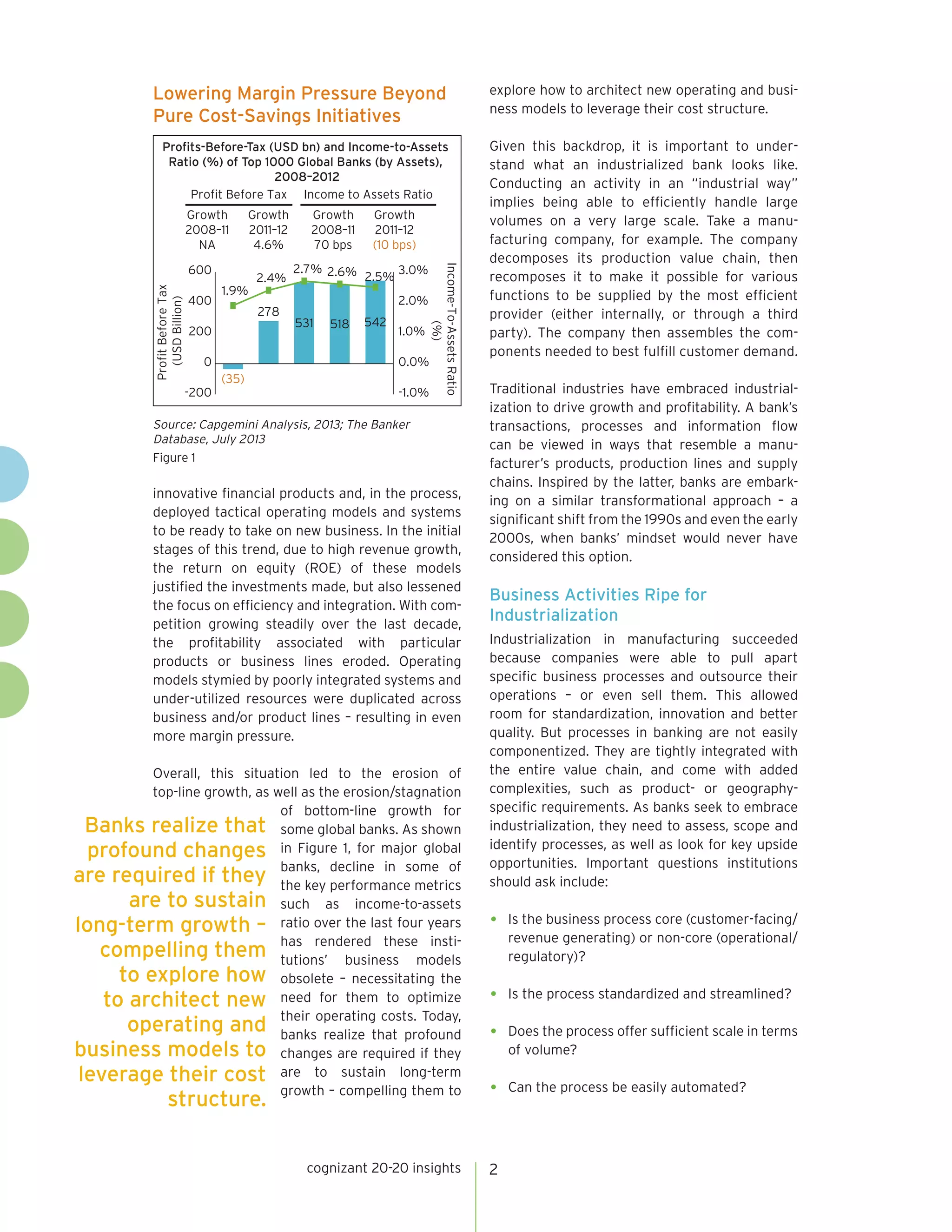
some global banks. As shown 
in Figure 1, for major global 
banks, decline in some of 
the key performance metrics 
such as income-to-assets 
ratio over the last four years 
has rendered these insti-tutions’ business models 
obsolete – necessitating the 
need for them to optimize 
their operating costs. Today, 
banks realize that profound 
changes are required if they 
are to sustain long-term 
growth – compelling them to 
explore how to architect new operating and busi-ness models to leverage their cost structure. 
Given this backdrop, it is important to under-stand what an industrialized bank looks like. Conducting an activity in an “industrial way” implies being able to efficiently handle large volumes on a very large scale. Take a manu-facturing company, for example. The company decomposes its production value chain, then recomposes it to make it possible for various functions to be supplied by the most efficient provider (either internally, or through a third party). The company then assembles the com-ponents needed to best fulfill customer demand. Traditional industries have embraced industrial-ization to drive growth and profitability. A bank’s 
transactions, processes and information flow 
can be viewed in ways that resemble a manu-facturer’s products, production lines and supply 
chains. Inspired by the latter, banks are embark-ing 
on a similar transformational approach – a 
significant shift from the 1990s and even the early 
2000s, when banks’ mindset would never have 
considered this option. 
Business Activities Ripe for 
Industrialization 
Industrialization in manufacturing succeeded 
because companies were able to pull apart 
specific business processes and outsource their 
operations – or even sell them. This allowed 
room for standardization, innovation and better 
quality. But processes in banking are not easily 
componentized. They are tightly integrated with 
the entire value chain, and come with added 
complexities, such as product- or geography- 
specific requirements. As banks seek to embrace 
industrialization, they need to assess, scope and 
identify processes, as well as look for key upside 
opportunities. Important questions institutions 
should ask include: 
• Is the business process core (customer-facing/ 
revenue generating) or non-core (operational/ 
regulatory)? 
• Is the process standardized and streamlined? 
• Does the process offer sufficient scale in terms 
of volume? 
• Can the process be easily automated? 
Lowering Margin Pressure Beyond 
Pure Cost-Savings Initiatives 
Profits-Before-Tax (USD bn) and Income-to-Assets 
Ratio (%) of Top 1000 Global Banks (by Assets), 
2008–2012 
Figure 1 
Source: Capgemini Analysis, 2013; The Banker 
Database, July 2013 
(35) 
278 
531 518 542 
1.9% 
2.4% 
2.7% 2.6% 2.5% 
-1.0% 
0.0% 
1.0% 
2.0% 
3.0% 
-200 
0 
200 
400 
600 
Profit Before Tax Income to Assets Ratio 
Growth 
2008–11 
NA 
Growth 
2011–12 
4.6% 
Growth 
2008–11 
70 bps 
Growth 
2011–12 
(10 bps) 
Profit Before Tax 
(USD Billion) 
Income-To-Assets Ratio 
(%)
cognizant 20-20 insights 3 
• Can the process be independently operated or 
outsourced with minimal control, and without 
increasing operational risk? 
• Does the process offer enough scope for cost 
reduction and/or revenue enhancement? 
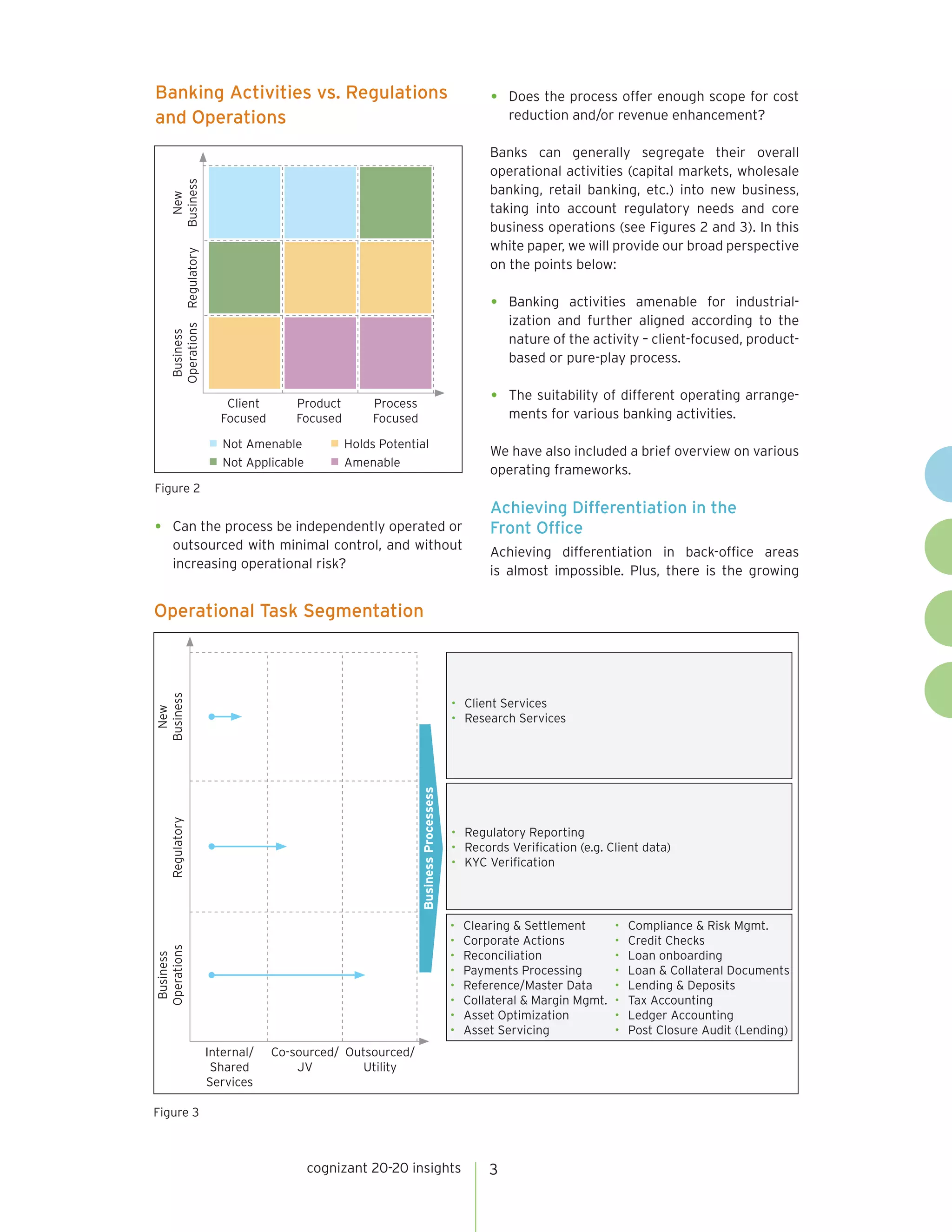
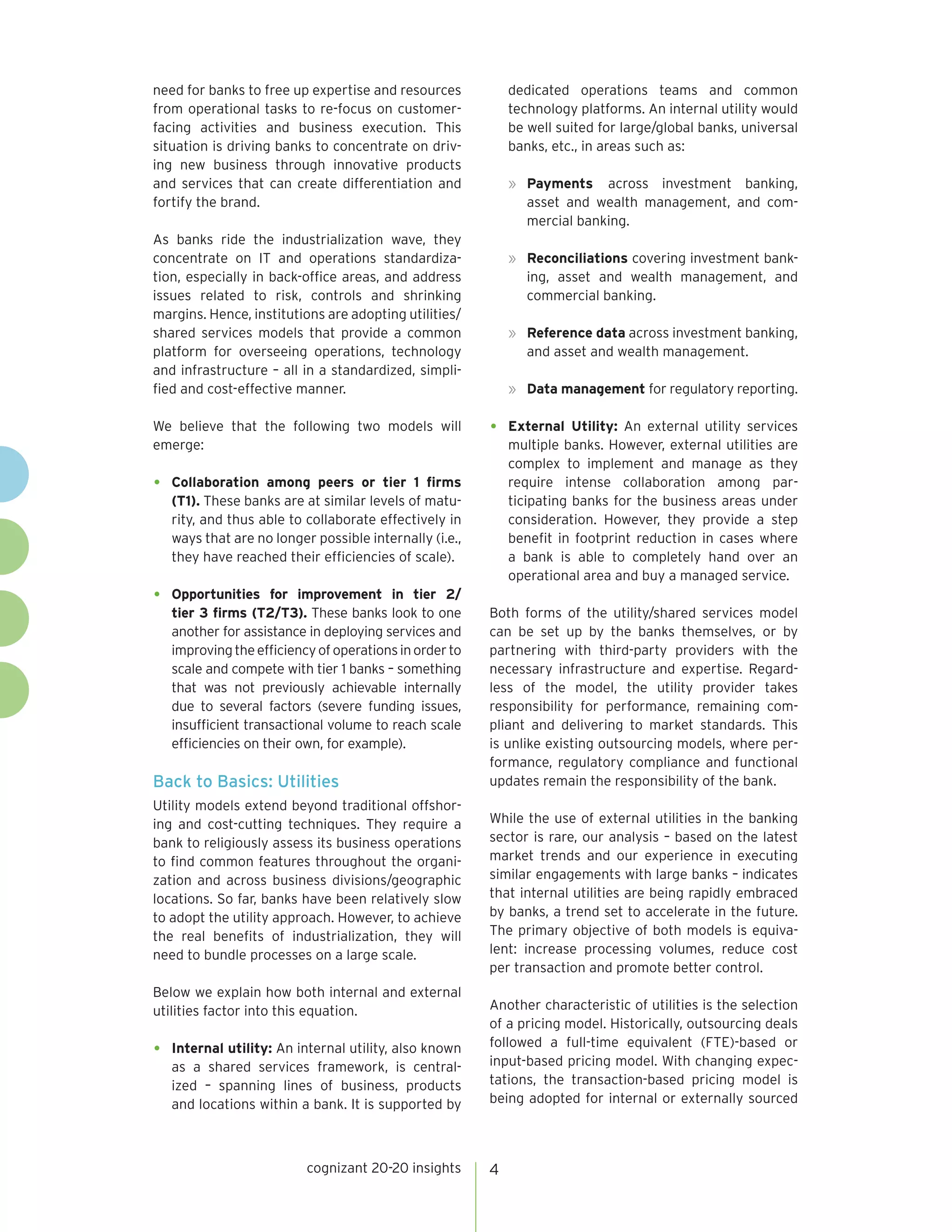
Banks can generally segregate their overall 
operational activities (capital markets, wholesale 
banking, retail banking, etc.) into new business, 
taking into account regulatory needs and core 
business operations (see Figures 2 and 3). In this 
white paper, we will provide our broad perspective 
on the points below: 
• Banking activities amenable for industrial-ization 
and further aligned according to the 
nature of the activity – client-focused, product-based 
or pure-play process. 
• The suitability of different operating arrange-ments 
for various banking activities. 
We have also included a brief overview on various 
operating frameworks. 
Achieving Differentiation in the 
Front Office 
Achieving differentiation in back-office areas 
is almost impossible. Plus, there is the growing 
Banking Activities vs. Regulations 
and Operations 
Not Amenable 
Not Applicable 
Holds Potential 
Amenable 
Client 
Focused 
Product 
Focused 
Process 
Focused 
Regulatory 
Business 
Operations 
New 
Business 
Figure 2 
Figure 3 
• Client Services 
• Research Services 
• Regulatory Reporting 
• Records Verification (e.g. Client data) 
• KYC Verification 
• Clearing & Settlement 
• Corporate Actions 
• Reconciliation 
• Payments Processing 
• Reference/Master Data 
• Collateral & Margin Mgmt. 
• Asset Optimization 
• Asset Servicing 
• Compliance & Risk Mgmt. 
• Credit Checks 
• Loan onboarding 
• Loan & Collateral Documents 
• Lending & Deposits 
• Tax Accounting 
• Ledger Accounting 
• Post Closure Audit (Lending) 
Regulatory 
Business 
Operations Internal/ 
Shared 
Services 
Co-sourced/ 
JV 
Outsourced/ 
Utility New 
Business 
BBuussiinneessss PPrroocceesssseessss 
Operational Task Segmentation
cognizant 20-20 insights 4 
need for banks to free up expertise and resources 
from operational tasks to re-focus on customer-facing 
activities and business execution. This 
situation is driving banks to concentrate on driv-ing 
new business through innovative products 
and services that can create differentiation and 
fortify the brand. 
As banks ride the industrialization wave, they 
concentrate on IT and operations standardiza-tion, 
especially in back-office areas, and address 
issues related to risk, controls and shrinking 
margins. Hence, institutions are adopting utilities/ 
shared services models that provide a common 
platform for overseeing operations, technology 
and infrastructure – all in a standardized, simpli-fied 
and cost-effective manner. 
We believe that the following two models will 
emerge: 
• Collaboration among peers or tier 1 firms 
(T1). These banks are at similar levels of matu-rity, 
and thus able to collaborate effectively in 
ways that are no longer possible internally (i.e., 
they have reached their efficiencies of scale). 
• Opportunities for improvement in tier 2/ 
tier 3 firms (T2/T3). These banks look to one 
another for assistance in deploying services and 
improving the efficiency of operations in order to 
scale and compete with tier 1 banks – something 
that was not previously achievable internally 
due to several factors (severe funding issues, 
insufficient transactional volume to reach scale 
efficiencies on their own, for example). 
Back to Basics: Utilities 
Utility models extend beyond traditional offshor-ing 
and cost-cutting techniques. They require a 
bank to religiously assess its business operations 
to find common features throughout the organi-zation 
and across business divisions/geographic 
locations. So far, banks have been relatively slow 
to adopt the utility approach. However, to achieve 
the real benefits of industrialization, they will 
need to bundle processes on a large scale. 
Below we explain how both internal and external 
utilities factor into this equation. 
• Internal utility: An internal utility, also known 
as a shared services framework, is central-ized 
– spanning lines of business, products 
and locations within a bank. It is supported by 
dedicated operations teams and common 
technology platforms. An internal utility would 
be well suited for large/global banks, universal 
banks, etc., in areas such as: 
» Payments across investment banking, 
asset and wealth management, and com-mercial 
banking. 
» Reconciliations covering investment bank-ing, 
asset and wealth management, and 
commercial banking. 
» Reference data across investment banking, 
and asset and wealth management. 
» Data management for regulatory reporting. 
• External Utility: An external utility services 
multiple banks. However, external utilities are 
complex to implement and manage as they 
require intense collaboration among par-ticipating 
banks for the business areas under 
consideration. However, they provide a step 
benefit in footprint reduction in cases where 
a bank is able to completely hand over an 
operational area and buy a managed service. 
Both forms of the utility/shared services model 
can be set up by the banks themselves, or by 
partnering with third-party providers with the 
necessary infrastructure and expertise. Regard-less 
of the model, the utility provider takes 
responsibility for performance, remaining com-pliant 
and delivering to market standards. This 
is unlike existing outsourcing models, where per-formance, 
regulatory compliance and functional 
updates remain the responsibility of the bank. 
While the use of external utilities in the banking 
sector is rare, our analysis – based on the latest 
market trends and our experience in executing 
similar engagements with large banks – indicates 
that internal utilities are being rapidly embraced 
by banks, a trend set to accelerate in the future. 
The primary objective of both models is equiva-lent: 
increase processing volumes, reduce cost 
per transaction and promote better control. 
Another characteristic of utilities is the selection 
of a pricing model. Historically, outsourcing deals 
followed a full-time equivalent (FTE)-based or 
input-based pricing model. With changing expec-tations, 
the transaction-based pricing model is 
being adopted for internal or externally sourced
cognizant 20-20 insights 5 
services. (Transaction-based pricing refers to 
a model where payment to a vendor partner or 
vendor is based on the number of transactions 
they process). Here, the payment is directly 
linked to output as opposed to the FTE-based 
pricing model, where payment is linked to inputs 
(resource time and materials). 
Benefits to Banks 
The benefits of a utility-based model are more 
tangible than traditional outsourcing approaches. 
A utility-based model: 
• Follows best practices in areas such as stan-dardization, 
process excellence, productiv-ity 
improvements and staffing consolidation, 
for example. These have an overall impact 
on economies and cost reduction. Our pre-liminary 
assessment indicates that banks can 
look forward to cost reductions in the range of 
30%-40% by implementing utilities. 
• Segregates core and non-core activities – 
allowing banks to spend more time on 
customer activities and improving client 
satisfaction. 
• Allows the bank to quickly respond to market 
and customer needs through process and plat-form 
standardization, process excellence and 
productivity improvements, for example. 
• Facilitates rationalization of the technology 
infrastructure by improving customization 
and enhancement possibilities – a benefit that 
would apply across all business divisions and 
locations. Having a single platform affords 
simplicity by reducing the number of interfac-ing 
applications, and lowering costs associated 
with managing the architecture, data feeds, etc. 
Challenges of Setting Up Utilities/ 
Shared Services 
Setting up a utility is not a small task; the asso-ciated 
complexities, if not addressed adequately, 
can lead to a convoluted system landscape, a 
fragmented infrastructure, process inefficien-cies 
and internal resistance – each of which can 
hamper implementation. 
Although external utilities can potentially achieve 
the lowest cost per transaction, it is worth con-sidering 
the following in terms of business risks: 
• Data confidentiality. 
• Ownership and recovery of sensitive/business– 
critical data if the utility provider is acquired or 
goes bankrupt. 
• Reliability and availability of the utility if the 
provider closes its doors or stops investing in 
a backup service in-house, such as disaster 
recovery, which has a direct impact on the utility. 
• Absence of a dedicated team for special 
processes. 
• Resistance to change from teams across lines 
of business and geographies. 
• Specific market practices, regulations or 
special processes that are handled differently 
from a utility perspective. 
• Integrating with external trade utilities, such 
as DTCC, SWIFT, etc., which vary from bank to 
bank. 
Early Adopters 
Global investment banks and custodians have 
been among the first to adopt utility-based 
operating models. 
• Euroclear and Smartstream have jointly 
created Central Data Utility (CDU). The CDU 
collects information from multiple original 
market sources and further processes the 
data so that the downstream firms accessing 
the data derive greater efficiencies and avoid 
reworking the data independently. 
• “Post Trade Plus,” a platform launched by 
Citibank and UBS, provides a comprehen-sive 
post-trade solution to broker-dealers in 
the Asia Pacific region. The platform enables 
broker-dealers to focus on their core busi-ness, 
with UBS performing all middle-office 
functions and Citibank providing clearing and 
settlement, as well as custody services. 
• In mortgage and consumer lending, 
utility models are known to exist in areas 
that facilitate decisions regarding granting 
consumer credit, and are provided as an 
industrialized service to lenders. Without 
this model, these lenders would have to rely 
on their own individual and sometimes sub-optimal 
efforts to cover all possible bases.
cognizant 20-20 insights 6 
• To facilitate payments tracking, quite a few 
banks are implementing shared database 
utilities that link the customer’s bank accounts 
to mobile numbers or e-mail addresses. 
• Some leading global banks have set up a 
shared services model for electronic invoice 
presentment and payment to facilitate 
end-to-end invoice processing and provide 
fully integrated accounts payable/receivable 
functionality. 
Key decision criteria that can be used to deter-mine 
the suitability of either utility operating 
model include regulatory requirements, dif-ferentiating 
operations vs. commodity, specific 
knowledge, control and risk. 
Implementing a Target Operating 
Model 
The operating model at the core of the utility, 
as well as its implementation, represent major 
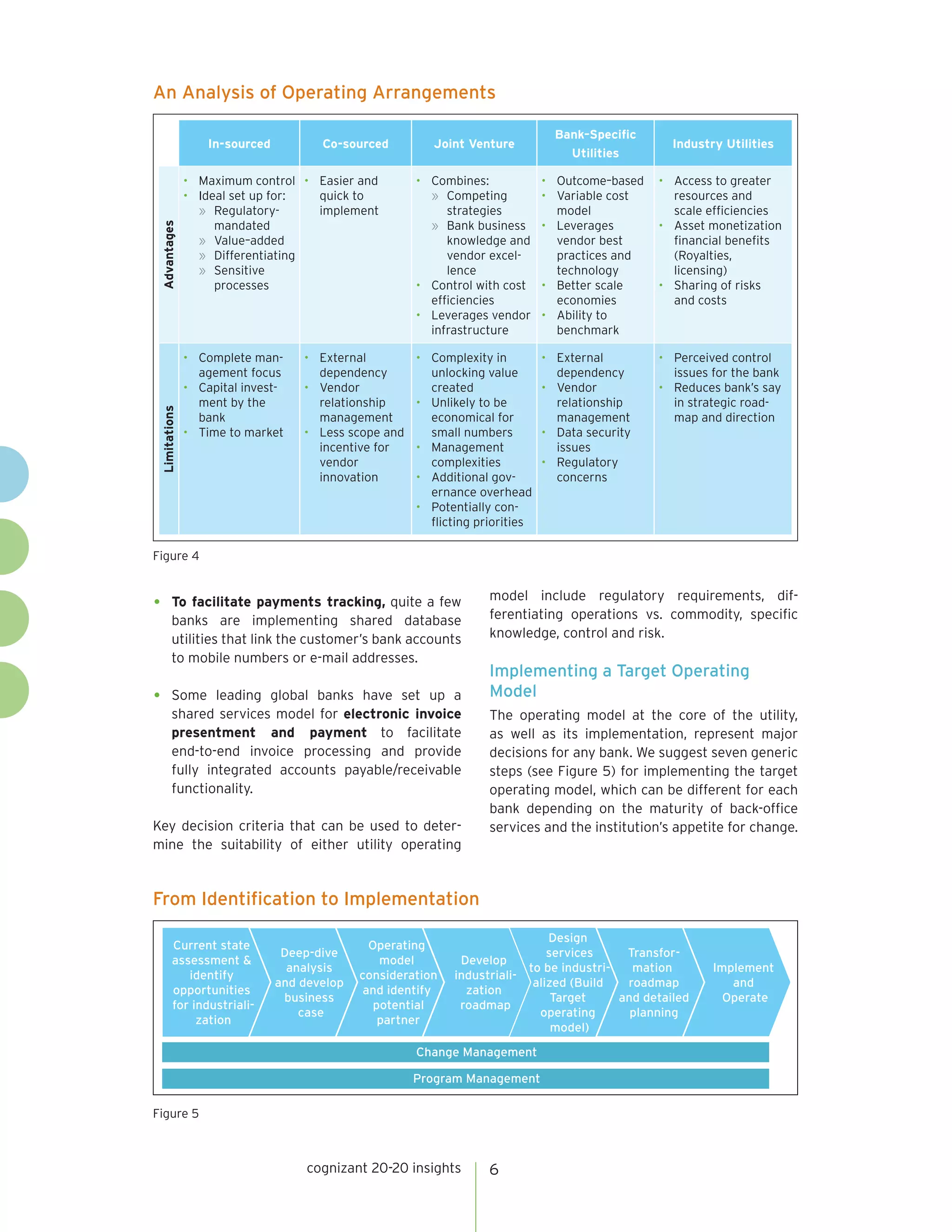
decisions for any bank. We suggest seven generic 
steps (see Figure 5) for implementing the target 
operating model, which can be different for each 
bank depending on the maturity of back-office 
services and the institution’s appetite for change. 
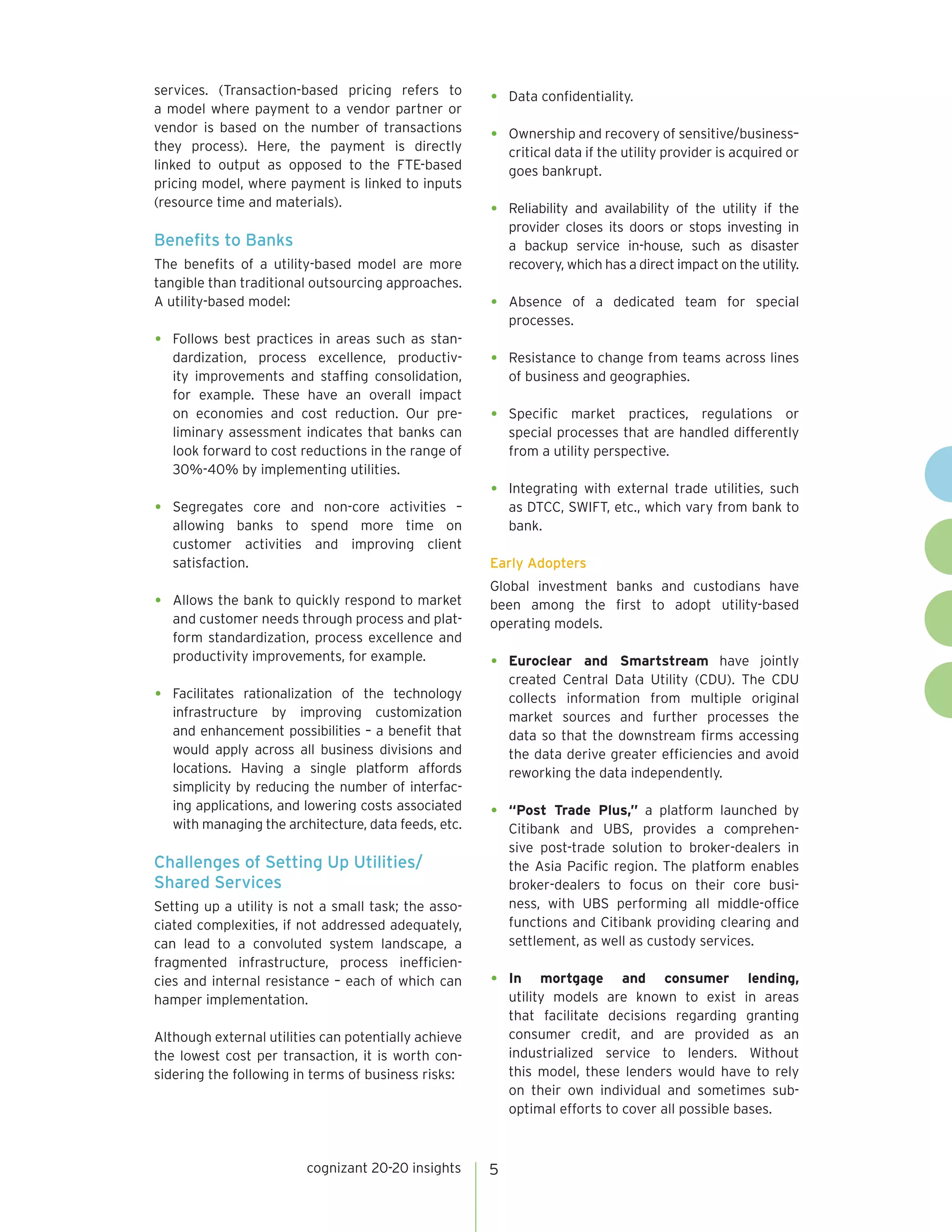
An Analysis of Operating Arrangements 
In-sourced Co-sourced Joint Venture 
Bank–Specific 
Utilities 
Industry Utilities 
Advantages 
• Maximum control 
• Ideal set up for: 
» Regulatory-mandated 
» Value–added 
» Differentiating 
» Sensitive 
processes 
• Easier and 
quick to 
implement 
• Combines: 
» Competing 
strategies 
» Bank business 
knowledge and 
vendor excel-lence 
• Control with cost 
efficiencies 
• Leverages vendor 
infrastructure 
• Outcome–based 
• Variable cost 
model 
• Leverages 
vendor best 
practices and 
technology 
• Better scale 
economies 
• Ability to 
benchmark 
• Access to greater 
resources and 
scale efficiencies 
• Asset monetization 
financial benefits 
(Royalties, 
licensing) 
• Sharing of risks 
and costs 
Limitations 
• Complete man-agement 
focus 
• Capital invest-ment 
by the 
bank 
• Time to market 
• External 
dependency 
• Vendor 
relationship 
management 
• Less scope and 
incentive for 
vendor 
innovation 
• Complexity in 
unlocking value 
created 
• Unlikely to be 
economical for 
small numbers 
• Management 
complexities 
• Additional gov-ernance 
overhead 
• Potentially con-flicting 
priorities 
• External 
dependency 
• Vendor 
relationship 
management 
• Data security 
issues 
• Regulatory 
concerns 
• Perceived control 
issues for the bank 
• Reduces bank’s say 
in strategic road-map 
and direction 
Figure 4 
From Identification to Implementation 
Figure 5 
Current state 
assessment & 
identify 
opportunities 
for industriali-zation 
Deep-dive 
analysis 
and develop 
business 
case 
Operating 
model 
consideration 
and identify 
potential 
partner 
Develop 
industriali-zation 
roadmap 
Design 
services 
to be industri-alized 
(Build 
Target 
operating 
model) 
Transfor-mation 
roadmap 
and detailed 
planning 
Implement 
and 
Operate 
Change Management 
Program Management
cognizant 20-20 insights 7 
Overview of the Transformation Steps 
Transforming to a utility model involves 
several steps: 
• Assess the current state and identify 
opportunities for industrialization: At this 
stage, banks should conduct a scope analysis 
and identify affected entities, services and 
employees. This provides a framework for 
change, and aligns the utility model with the 
wider organizational strategy. 
• Perform a deep-dive analysis of identi-fied 
areas and develop the business case: 
A sound business case can help ensure that 
all key stakeholders understand the rationale 
for transformation. Banks must justify the 
business case in terms of the cost implica-tions, 
anticipated business impact and associ-ated 
risks, and mitigation. At this stage, it is 
important to agree on the preferred operating 
model option. 
• Consider the operating model and identify 
a potential partner: For a large-scale trans-formation 
(since we do not recommend an 
in-house option), banks must choose their 
partners. Key partner selection criteria are 
rigorous due diligence, executive management 
commitment, future funding options, and 
consensus on Service Level Agreements 
(SLAs) and commercials. 
• Develop an industrialization roadmap: Banks 
should develop a chronological roadmap for 
moving given functions to shared services. At 
the end of this stage, institutions should be 
in a position to validate the outcome of the 
business case. 
• Design services to be industrialized (build 
target operating model): Banks should 
work with their partners to design the target 
business architecture and operating model. 
Levers for the detailed design include guiding 
principles, process decomposition, ascertain-ing 
the right granularity for the current state, 
data-gathering and preparing a “to-be” state 
reference model. The “to be” state model 
should also provide a view of geographical/ 
regional variations, map current business pro-cesses 
to the target state model, apply imple-mentation 
constraints, and identify process 
and IT improvement initiatives. 
• Develop a transformation roadmap and 
detailed planning: The bank should put in 
place a sound plan summarizing key steps 
for mobilizing and driving the utility model. 
Planning should be backed by rigorous 
progress monitoring. 
• Implement and operate: At the final stage, 
when the utility model is up and running, the 
focus will shift from design and construction 
to support and transformation. The utility in 
its target state should support multiple areas 
across lines of business. 
The underpinnings of this approach should 
encompass program management and change 
management: 
• Program management: This is critical to 
ensuring that the implementation program 
runs smoothly, that the correct resources 
are in place, and that risks are managed and 
sustainability is built in. Banks must focus 
on the vision, with supporting milestones 
and responsibilities specified throughout the 
change. Otherwise, benefits can erode rapidly 
and, eventually, dissolve completely. 
• Change management: Banks often face 
employee resistance, since setting up a util-ity 
model usually involves transforming the 
operations model, which 
has a significant impact 
on organizational struc-ture, 
roles and responsi-bilities. 
The change man-agement 
process should 
begin at the inception of 
the program and continue 
throughout the trans-formation 
process. The 
success of the trans-formation 
will be deter-mined 
by how effectively 
employees are engaged, 
since they will be the ones 
ultimately responsible for 
delivering more value. 
Realizing Tangible Benefits 
Banks should adopt the following principles in 
order to realize the transformational benefits of 
services delivered by utilities: 
Success of the 
transformation 
will be determined 
by how effectively 
employees are 
engaged, since 
they will be the 
ones ultimately 
responsible for 
delivering more 
value.
cognizant 20-20 insights 8 
• Ensure that the right people are in place to 
manage the utility design and implementation. 
• Build consistent and strong leadership – 
crucial to assuring that the utility is accepted 
and managers do not fall back on less efficient 
ways of functioning. 
• Aim for the highest degree of standardization 
and automation to help maximize savings. 
(This warrants robust planning well before the 
model is created). 
• Aim to re-engineer internal processes that 
have the greatest impact on business, and 
address the pain points of the current set-up. 
• Work to develop strong and trusting relation-ships 
among collaborating groups, supported 
by proper governance arrangements. 
• Devise risk-sharing agreements to manage the 
balance of risk and rewards. 
The above factors can enable banks to over-come 
some of the challenges, especially the ones 
that are internal, and better position them 
to manage the stumbling blocks arising from 
external environments and service providers. 
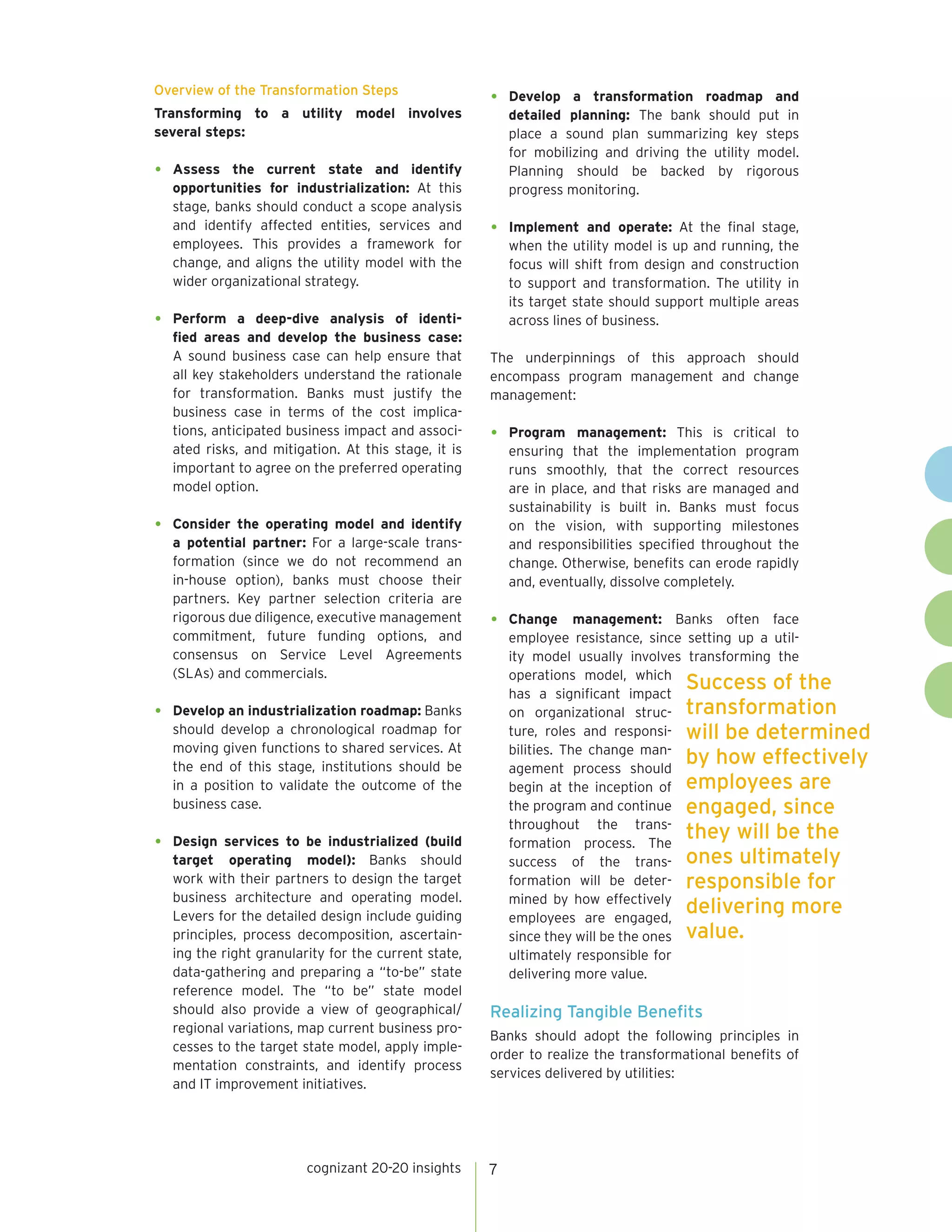
Ultimately, the success of the operating model 
will be determined by the benefits achieved, not 
just in one, but in all of the key metrics described 
in Figure 6, below: 
Metrics for Success 
Metric 
Minimum 
Benefit 
Preferred 
Benefit 
Qualifying Criteria 
Cost of Operations Reduces. Target cost benefits 
are achieved. 
• Reduce costs by eliminating variable 
overheads. 
• Create capacity and scale. 
Quality of Service At par with the old 
model. 
Increases. • Enhance client experience and 
eliminate client pain points. 
• Increase client servicing (increased 
responsiveness, etc.). 
Operational Risk At par with the old 
model. 
Reduces. • Provide for adequate audit controls. 
• Align with the evolving regulatory 
environment. 
Figure 6 
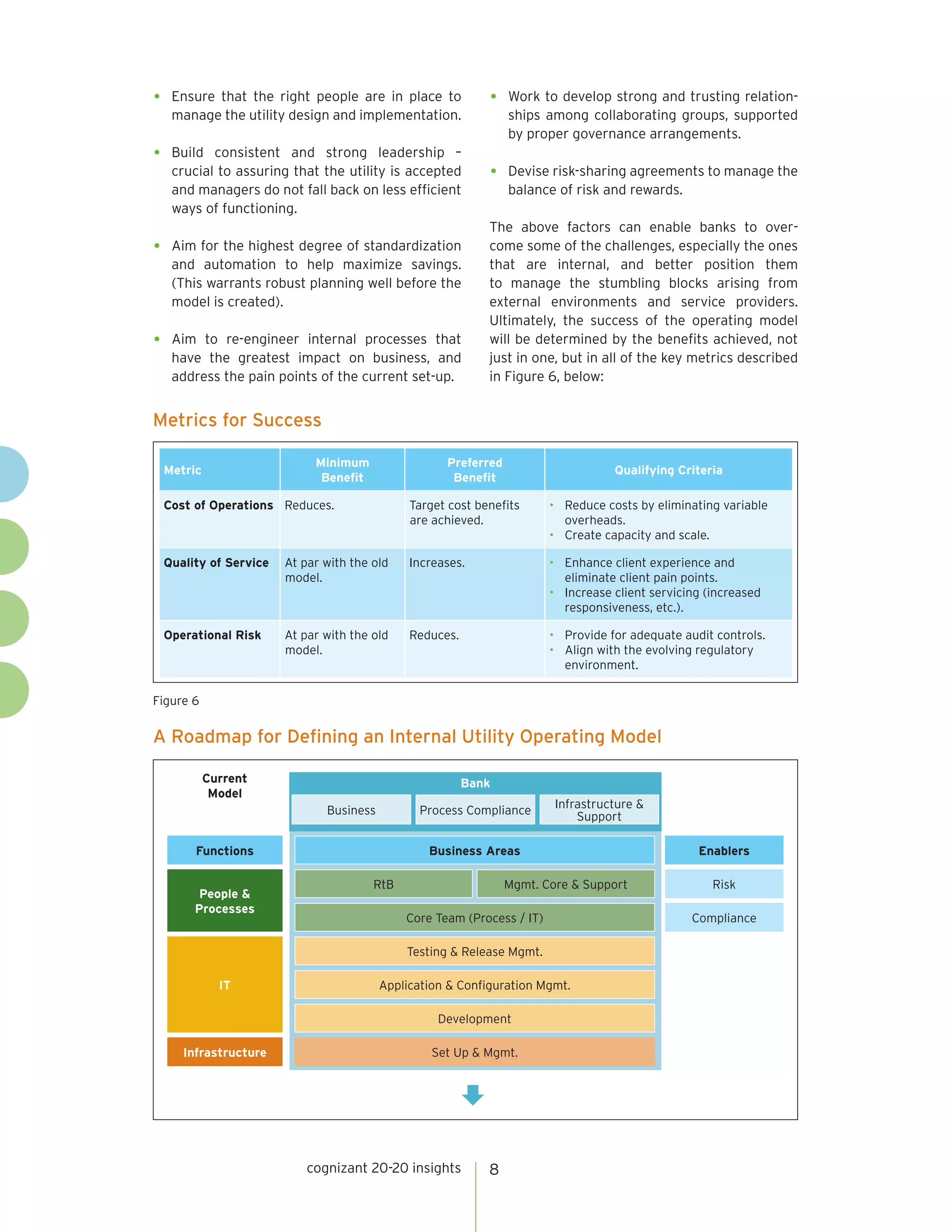
A Roadmap for Defining an Internal Utility Operating Model 
Functions 
People & 
Processes 
IT 
Infrastructure 
Enablers 
Risk 
Compliance 
Bank 
Business Areas 
Application & Configuration Mgmt. 
Testing & Release Mgmt. 
Development 
Set Up & Mgmt. 
Core Team (Process / IT) 
RtB Mgmt. Core & Support 
Business Process Compliance Infrastructure & 
Support 
Current 
Model
cognizant 20-20 insights 9 
Defining the Utility Operating Model: 
An Illustrative Approach 
We recommend that banks create utilities 
with a transformation partner. In either an 
internal or external utility, a common approach 
applies in transforming to the operating model: 
• Identify tasks that are common across the 
bank or other banks, and which can be 
standardized and simplified. 
• Identify a common platform and migrate the 
common tasks to this platform. 
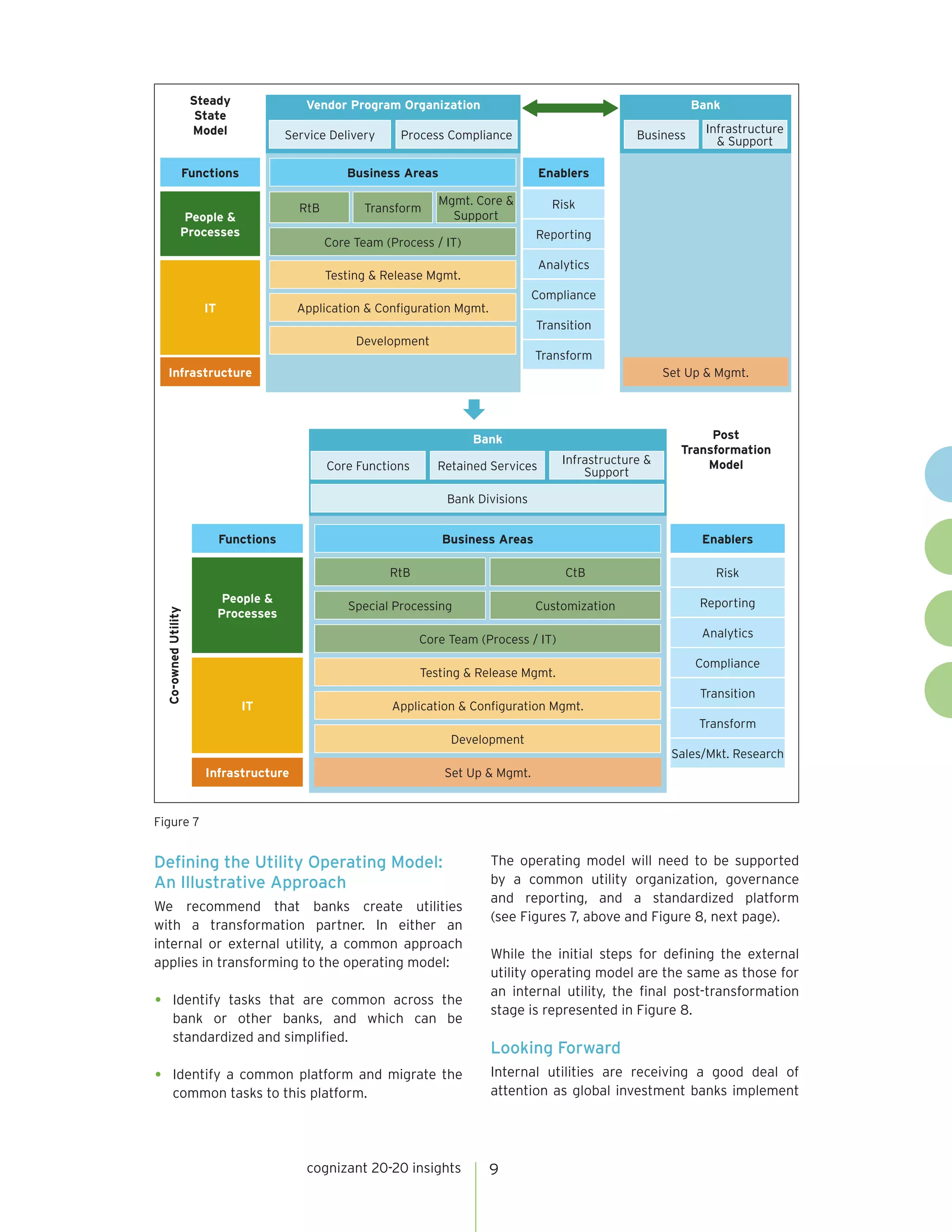
The operating model will need to be supported 
by a common utility organization, governance 
and reporting, and a standardized platform 
(see Figures 7, above and Figure 8, next page). 
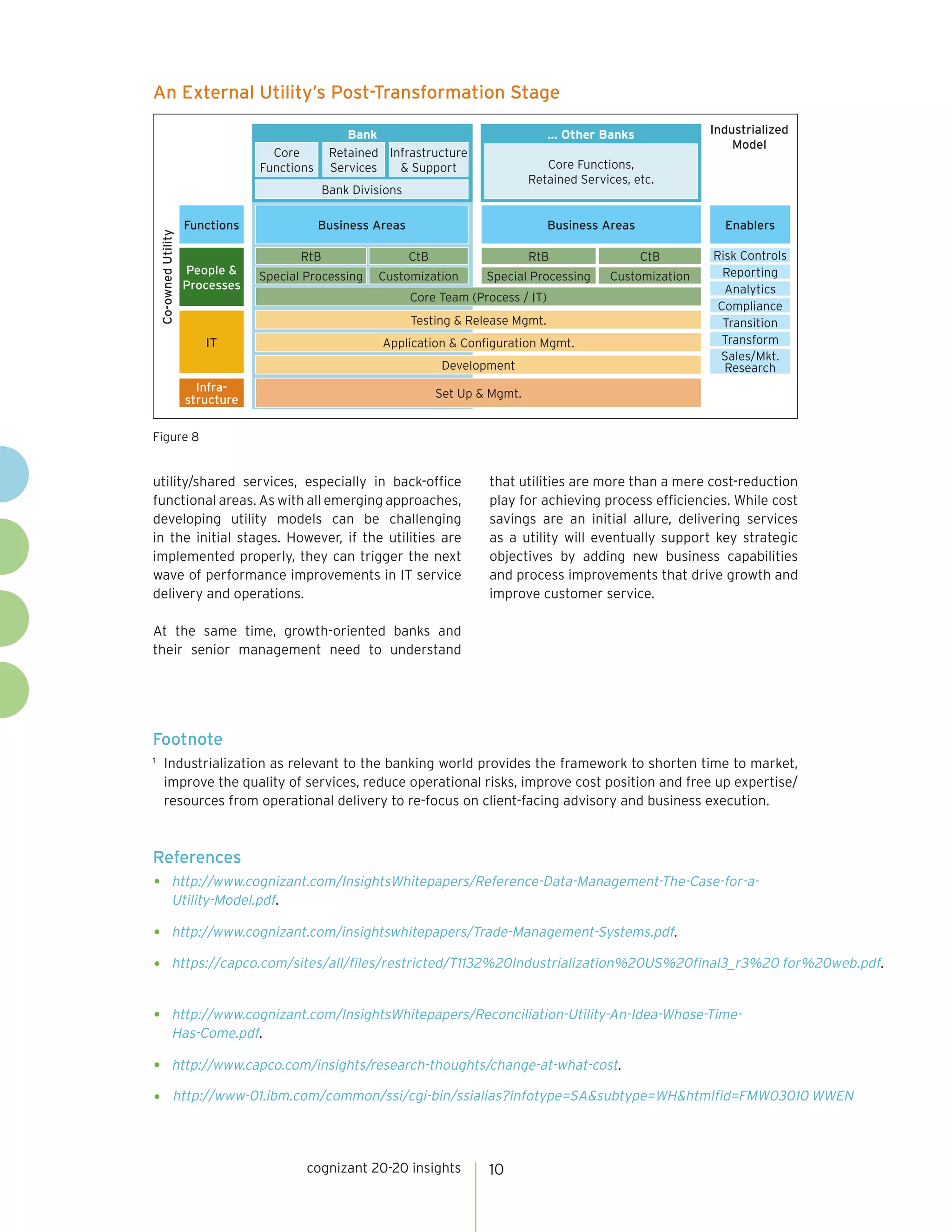
While the initial steps for defining the external 
utility operating model are the same as those for 
an internal utility, the final post-transformation 
stage is represented in Figure 8. 
Looking Forward 
Internal utilities are receiving a good deal of 
attention as global investment banks implement 
Figure 7 
People & 
Processes 
IT 
Functions 
Infrastructure 
Enablers 
Bank 
Business Areas 
Application & Configuration Mgmt. 
Testing & Release Mgmt. 
Development 
Set Up & Mgmt. 
Core Team (Process / IT) 
RtB 
Special Processing 
CtB 
Customization 
Bank Divisions 
Core Functions Retained Services Infrastructure & 
Support 
Post 
Transformation 
Model 
Co-owned Utility 
Risk 
Reporting 
Analytics 
Compliance 
Transition 
Transform 
Sales/Mkt. Research 
Infrastructure 
Functions 
People & 
Processes 
IT 
Enablers 
Risk 
Reporting 
Analytics 
Compliance 
Transition 
Transform 
Vendor Program Organization 
Business Areas 
Application & Configuration Mgmt. 
Testing & Release Mgmt. 
Development 
Transform 
Core Team (Process / IT) 
RtB 
Mgmt. Core & 
Support 
Service Delivery Process Compliance 
Bank 
Infrastructure 
Business & Support 
Steady 
State 
Model 
Set Up & Mgmt.
cognizant 20-20 insights 10 
utility/shared services, especially in back-office 
functional areas. As with all emerging approaches, 
developing utility models can be challenging 
in the initial stages. However, if the utilities are 
implemented properly, they can trigger the next 
wave of performance improvements in IT service 
delivery and operations. 
At the same time, growth-oriented banks and 
their senior management need to understand 
that utilities are more than a mere cost-reduction 
play for achieving process efficiencies. While cost 
savings are an initial allure, delivering services 
as a utility will eventually support key strategic 
objectives by adding new business capabilities 
and process improvements that drive growth and 
improve customer service. 
Footnote 
1 Industrialization as relevant to the banking world provides the framework to shorten time to market, 
improve the quality of services, reduce operational risks, improve cost position and free up expertise/ 
resources from operational delivery to re-focus on client-facing advisory and business execution. 
References 
• http://www.cognizant.com/InsightsWhitepapers/Reference-Data-Management-The-Case-for-a- 
Utility-Model.pdf. 
• http://www.cognizant.com/insightswhitepapers/Trade-Management-Systems.pdf. 
• https://capco.com/sites/all/files/restricted/T1132%20Industrialization%20US%20final3_r3%20 for%20web.pdf. 
• http://www.cognizant.com/InsightsWhitepapers/Reconciliation-Utility-An-Idea-Whose-Time- 
Has-Come.pdf. 
• http://www.capco.com/insights/research-thoughts/change-at-what-cost. 
• http://www-01.ibm.com/common/ssi/cgi-bin/ssialias?infotype=SA&subtype=WH&htmlfid=FMW03010 WWEN 
An External Utility’s Post-Transformation Stage 
Figure 8 
Business Areas Enablers 
Risk Controls 
Reporting 
Analytics 
Compliance 
Transition 
Transform 
Sales/Mkt. 
Research 
Business Areas 
Core 
Functions 
Bank Divisions 
Retained 
Services 
Infrastructure 
& Support 
Special Processing Customization Special Processing Customization 
RtB 
Core Team (Process / IT) 
Testing & Release Mgmt. 
Application & Configuration Mgmt. 
Development 
Set Up & Mgmt. 
Functions 
People & 
Processes 
IT 
Infra-structure 
CtB RtB CtB 
Bank 
Co-owned Utility 
Industrialized 
Model 
… Other Banks 
Core Functions, 
Retained Services, etc.
World Headquarters 
500 Frank W. Burr Blvd. 
Teaneck, NJ 07666 USA 
Phone: +1 201 801 0233 
Fax: +1 201 801 0243 
Toll Free: +1 888 937 3277 
Email: inquiry@cognizant.com 
European Headquarters 
1 Kingdom Street 
Paddington Central 
London W2 6BD 
Phone: +44 (0) 207 297 7600 
Fax: +44 (0) 207 121 0102 
Email: infouk@cognizant.com 
India Operations Headquarters 
#5/535, Old Mahabalipuram Road 
Okkiyam Pettai, Thoraipakkam 
Chennai, 600 096 India 
Phone: +91 (0) 44 4209 6000 
Fax: +91 (0) 44 4209 6060 
Email: inquiryindia@cognizant.com 
 
© Copyright 2014, Cognizant. All rights reserved. No part of this document may be reproduced, stored in a retrieval system, transmitted in any form or by any 
means, electronic, mechanical, photocopying, recording, or otherwise, without the express written permission from Cognizant. The information contained herein is 
subject to change without notice. All other trademarks mentioned herein are the property of their respective owners. 
About Cognizant 
Cognizant (NASDAQ: CTSH) is a leading provider of information technology, consulting, and business process 
outsourcing services, dedicated to helping the world's leading companies build stronger businesses. Headquartered 
in Teaneck, New Jersey (U.S.), Cognizant combines a passion for client satisfaction, technology innovation, deep 
industry and business process expertise, and a global, collaborative workforce that embodies the future of work. With 
over 75 development and delivery centers worldwide and approximately 187,400 employees as of June 30, 2014, 
Cognizant is a member of the NASDAQ-100, the S&P 500, the Forbes Global 2000, and the Fortune 500 and is ranked 
among the top performing and fastest growing companies in the world. 
Visit us online at www.cognizant.com or follow us on Twitter: Cognizant. 
About the Authors 
Sanjay Bhanot is Vice President and leads Cognizant Business Consulting’s Banking and Financial 
Services practice in continental Europe, and has 25 years of industry experience in defining and 
delivering business solutions. He has worked in a variety of engagements, including delivering turnkey 
projects, product development, implementations and product management. Sanjay is an alumnus of 
the Indian Institute of Technology Delhi. He can be reached at Sanjay.Bhanot@cognizant.com. 
Arun Iyer is Director, Consulting, with Cognizant Business Consulting’s Banking and Financial 
Services Practice. He has over 18 years of experience in IT and consulting – focused on capital markets 
in areas such as client-facing technologies, trading, post-trade processing and risk management. His 
experience includes business and IT consulting, process analysis and improvements, business analysis, 
application conceptualization/architecting, system design and data modeling with global clients. 
Arun is a post-graduate in Management from Mumbai University and BE, Computer Engineering. 
He can be contacted at Arun.Iyer@cognizant.com. 
Harshad Khachane is Senior Manager with Domain Solutions Group's Banking and Financial 
Services Practice. He has over 12 years of experience in business and IT, focused on capital markets 
engagements, and is involved in multiple consulting assignments in areas such as trade, post-trade 
processing and private banking. His areas of expertise include business analysis, business process 
management and GAP analysis. Harshad is a post-graduate in management and BE from Mumbai 
University. He can be contacted at Harshad.Khachane@cognizant.com.

The Networked Bank: Utility Concepts to Transform the Operating Model

  • 1.
    The Networked Bank:Utility Concepts to Transform the Operating Model By taking a utility approach to service delivery, banks can increase their cost-control initiatives across geographies and business divisions, advance new growth opportunities, standardize operations and improve the client experience. Executive Summary Industrialization1 helps banks cut operational costs, protect eroding margins and build a leaner, more standardized operating model for lower-ing risk and supporting revenue growth. While industrialization in the banking industry is not a new concept, it remains in the early stages. Yet the complexities arising from multiple, frag-mented and redundant processes – often manu-ally controlled – underscore the need for banks to focus on transforming their operating framework. Industrialization impacts all areas of banking, including business development, regulatory compliance and operations. By nature, business operations are the most amenable to industri-alization, followed by regulatory controls (when based on a robust operational foundation) and select client services activities. Back-office processes – including post-trade securities pro-cessing, cards processing, mortgages and trade finance – are also affected by industrialization. One way to industrialize a bank is through the creation of a utility – or shared services – model that can be employed internally, or externally to support multiple banks. The utility approach helps ensure the most efficient use of resources, and helps keep costs under control. However, setting up this type of environment requires executive commitment at the highest level, combined with a strategy backed by a strong operating model and effective program governance. In this white paper, we will examine key considerations that a bank needs to address when setting up internal and external utilities. Banking on Industrialization Before we can understand the fundamentals of industrialization, it is important to know the forces that have led to its emergence in the bank-ing industry. Although the industry has survived the financial meltdown, growth has been stymied by structural change, driven by risk management-related regulations. Historically, the banking industry evolved primar-ily by piggybacking on rapid growth – an approach that often led to fragmented operating models. To address customer needs, banks regularly offered cognizant 20-20 insights | september 2014 • Cognizant 20-20 Insights
  • 2.
    cognizant 20-20 insights2 Banks realize that profound changes are required if they are to sustain long-term growth – compelling them to explore how to architect new operating and business models to leverage their cost structure. innovative financial products and, in the process, deployed tactical operating models and systems to be ready to take on new business. In the initial stages of this trend, due to high revenue growth, the return on equity (ROE) of these models justified the investments made, but also lessened the focus on efficiency and integration. With com-petition growing steadily over the last decade, the profitability associated with particular products or business lines eroded. Operating models stymied by poorly integrated systems and under-utilized resources were duplicated across business and/or product lines – resulting in even more margin pressure. Overall, this situation led to the erosion of top-line growth, as well as the erosion/stagnation of bottom-line growth for some global banks. As shown in Figure 1, for major global banks, decline in some of the key performance metrics such as income-to-assets ratio over the last four years has rendered these insti-tutions’ business models obsolete – necessitating the need for them to optimize their operating costs. Today, banks realize that profound changes are required if they are to sustain long-term growth – compelling them to explore how to architect new operating and busi-ness models to leverage their cost structure. Given this backdrop, it is important to under-stand what an industrialized bank looks like. Conducting an activity in an “industrial way” implies being able to efficiently handle large volumes on a very large scale. Take a manu-facturing company, for example. The company decomposes its production value chain, then recomposes it to make it possible for various functions to be supplied by the most efficient provider (either internally, or through a third party). The company then assembles the com-ponents needed to best fulfill customer demand. Traditional industries have embraced industrial-ization to drive growth and profitability. A bank’s transactions, processes and information flow can be viewed in ways that resemble a manu-facturer’s products, production lines and supply chains. Inspired by the latter, banks are embark-ing on a similar transformational approach – a significant shift from the 1990s and even the early 2000s, when banks’ mindset would never have considered this option. Business Activities Ripe for Industrialization Industrialization in manufacturing succeeded because companies were able to pull apart specific business processes and outsource their operations – or even sell them. This allowed room for standardization, innovation and better quality. But processes in banking are not easily componentized. They are tightly integrated with the entire value chain, and come with added complexities, such as product- or geography- specific requirements. As banks seek to embrace industrialization, they need to assess, scope and identify processes, as well as look for key upside opportunities. Important questions institutions should ask include: • Is the business process core (customer-facing/ revenue generating) or non-core (operational/ regulatory)? • Is the process standardized and streamlined? • Does the process offer sufficient scale in terms of volume? • Can the process be easily automated? Lowering Margin Pressure Beyond Pure Cost-Savings Initiatives Profits-Before-Tax (USD bn) and Income-to-Assets Ratio (%) of Top 1000 Global Banks (by Assets), 2008–2012 Figure 1 Source: Capgemini Analysis, 2013; The Banker Database, July 2013 (35) 278 531 518 542 1.9% 2.4% 2.7% 2.6% 2.5% -1.0% 0.0% 1.0% 2.0% 3.0% -200 0 200 400 600 Profit Before Tax Income to Assets Ratio Growth 2008–11 NA Growth 2011–12 4.6% Growth 2008–11 70 bps Growth 2011–12 (10 bps) Profit Before Tax (USD Billion) Income-To-Assets Ratio (%)
  • 3.
    cognizant 20-20 insights3 • Can the process be independently operated or outsourced with minimal control, and without increasing operational risk? • Does the process offer enough scope for cost reduction and/or revenue enhancement? Banks can generally segregate their overall operational activities (capital markets, wholesale banking, retail banking, etc.) into new business, taking into account regulatory needs and core business operations (see Figures 2 and 3). In this white paper, we will provide our broad perspective on the points below: • Banking activities amenable for industrial-ization and further aligned according to the nature of the activity – client-focused, product-based or pure-play process. • The suitability of different operating arrange-ments for various banking activities. We have also included a brief overview on various operating frameworks. Achieving Differentiation in the Front Office Achieving differentiation in back-office areas is almost impossible. Plus, there is the growing Banking Activities vs. Regulations and Operations Not Amenable Not Applicable Holds Potential Amenable Client Focused Product Focused Process Focused Regulatory Business Operations New Business Figure 2 Figure 3 • Client Services • Research Services • Regulatory Reporting • Records Verification (e.g. Client data) • KYC Verification • Clearing & Settlement • Corporate Actions • Reconciliation • Payments Processing • Reference/Master Data • Collateral & Margin Mgmt. • Asset Optimization • Asset Servicing • Compliance & Risk Mgmt. • Credit Checks • Loan onboarding • Loan & Collateral Documents • Lending & Deposits • Tax Accounting • Ledger Accounting • Post Closure Audit (Lending) Regulatory Business Operations Internal/ Shared Services Co-sourced/ JV Outsourced/ Utility New Business BBuussiinneessss PPrroocceesssseessss Operational Task Segmentation
  • 4.
    cognizant 20-20 insights4 need for banks to free up expertise and resources from operational tasks to re-focus on customer-facing activities and business execution. This situation is driving banks to concentrate on driv-ing new business through innovative products and services that can create differentiation and fortify the brand. As banks ride the industrialization wave, they concentrate on IT and operations standardiza-tion, especially in back-office areas, and address issues related to risk, controls and shrinking margins. Hence, institutions are adopting utilities/ shared services models that provide a common platform for overseeing operations, technology and infrastructure – all in a standardized, simpli-fied and cost-effective manner. We believe that the following two models will emerge: • Collaboration among peers or tier 1 firms (T1). These banks are at similar levels of matu-rity, and thus able to collaborate effectively in ways that are no longer possible internally (i.e., they have reached their efficiencies of scale). • Opportunities for improvement in tier 2/ tier 3 firms (T2/T3). These banks look to one another for assistance in deploying services and improving the efficiency of operations in order to scale and compete with tier 1 banks – something that was not previously achievable internally due to several factors (severe funding issues, insufficient transactional volume to reach scale efficiencies on their own, for example). Back to Basics: Utilities Utility models extend beyond traditional offshor-ing and cost-cutting techniques. They require a bank to religiously assess its business operations to find common features throughout the organi-zation and across business divisions/geographic locations. So far, banks have been relatively slow to adopt the utility approach. However, to achieve the real benefits of industrialization, they will need to bundle processes on a large scale. Below we explain how both internal and external utilities factor into this equation. • Internal utility: An internal utility, also known as a shared services framework, is central-ized – spanning lines of business, products and locations within a bank. It is supported by dedicated operations teams and common technology platforms. An internal utility would be well suited for large/global banks, universal banks, etc., in areas such as: » Payments across investment banking, asset and wealth management, and com-mercial banking. » Reconciliations covering investment bank-ing, asset and wealth management, and commercial banking. » Reference data across investment banking, and asset and wealth management. » Data management for regulatory reporting. • External Utility: An external utility services multiple banks. However, external utilities are complex to implement and manage as they require intense collaboration among par-ticipating banks for the business areas under consideration. However, they provide a step benefit in footprint reduction in cases where a bank is able to completely hand over an operational area and buy a managed service. Both forms of the utility/shared services model can be set up by the banks themselves, or by partnering with third-party providers with the necessary infrastructure and expertise. Regard-less of the model, the utility provider takes responsibility for performance, remaining com-pliant and delivering to market standards. This is unlike existing outsourcing models, where per-formance, regulatory compliance and functional updates remain the responsibility of the bank. While the use of external utilities in the banking sector is rare, our analysis – based on the latest market trends and our experience in executing similar engagements with large banks – indicates that internal utilities are being rapidly embraced by banks, a trend set to accelerate in the future. The primary objective of both models is equiva-lent: increase processing volumes, reduce cost per transaction and promote better control. Another characteristic of utilities is the selection of a pricing model. Historically, outsourcing deals followed a full-time equivalent (FTE)-based or input-based pricing model. With changing expec-tations, the transaction-based pricing model is being adopted for internal or externally sourced
  • 5.
    cognizant 20-20 insights5 services. (Transaction-based pricing refers to a model where payment to a vendor partner or vendor is based on the number of transactions they process). Here, the payment is directly linked to output as opposed to the FTE-based pricing model, where payment is linked to inputs (resource time and materials). Benefits to Banks The benefits of a utility-based model are more tangible than traditional outsourcing approaches. A utility-based model: • Follows best practices in areas such as stan-dardization, process excellence, productiv-ity improvements and staffing consolidation, for example. These have an overall impact on economies and cost reduction. Our pre-liminary assessment indicates that banks can look forward to cost reductions in the range of 30%-40% by implementing utilities. • Segregates core and non-core activities – allowing banks to spend more time on customer activities and improving client satisfaction. • Allows the bank to quickly respond to market and customer needs through process and plat-form standardization, process excellence and productivity improvements, for example. • Facilitates rationalization of the technology infrastructure by improving customization and enhancement possibilities – a benefit that would apply across all business divisions and locations. Having a single platform affords simplicity by reducing the number of interfac-ing applications, and lowering costs associated with managing the architecture, data feeds, etc. Challenges of Setting Up Utilities/ Shared Services Setting up a utility is not a small task; the asso-ciated complexities, if not addressed adequately, can lead to a convoluted system landscape, a fragmented infrastructure, process inefficien-cies and internal resistance – each of which can hamper implementation. Although external utilities can potentially achieve the lowest cost per transaction, it is worth con-sidering the following in terms of business risks: • Data confidentiality. • Ownership and recovery of sensitive/business– critical data if the utility provider is acquired or goes bankrupt. • Reliability and availability of the utility if the provider closes its doors or stops investing in a backup service in-house, such as disaster recovery, which has a direct impact on the utility. • Absence of a dedicated team for special processes. • Resistance to change from teams across lines of business and geographies. • Specific market practices, regulations or special processes that are handled differently from a utility perspective. • Integrating with external trade utilities, such as DTCC, SWIFT, etc., which vary from bank to bank. Early Adopters Global investment banks and custodians have been among the first to adopt utility-based operating models. • Euroclear and Smartstream have jointly created Central Data Utility (CDU). The CDU collects information from multiple original market sources and further processes the data so that the downstream firms accessing the data derive greater efficiencies and avoid reworking the data independently. • “Post Trade Plus,” a platform launched by Citibank and UBS, provides a comprehen-sive post-trade solution to broker-dealers in the Asia Pacific region. The platform enables broker-dealers to focus on their core busi-ness, with UBS performing all middle-office functions and Citibank providing clearing and settlement, as well as custody services. • In mortgage and consumer lending, utility models are known to exist in areas that facilitate decisions regarding granting consumer credit, and are provided as an industrialized service to lenders. Without this model, these lenders would have to rely on their own individual and sometimes sub-optimal efforts to cover all possible bases.
  • 6.
    cognizant 20-20 insights6 • To facilitate payments tracking, quite a few banks are implementing shared database utilities that link the customer’s bank accounts to mobile numbers or e-mail addresses. • Some leading global banks have set up a shared services model for electronic invoice presentment and payment to facilitate end-to-end invoice processing and provide fully integrated accounts payable/receivable functionality. Key decision criteria that can be used to deter-mine the suitability of either utility operating model include regulatory requirements, dif-ferentiating operations vs. commodity, specific knowledge, control and risk. Implementing a Target Operating Model The operating model at the core of the utility, as well as its implementation, represent major decisions for any bank. We suggest seven generic steps (see Figure 5) for implementing the target operating model, which can be different for each bank depending on the maturity of back-office services and the institution’s appetite for change. An Analysis of Operating Arrangements In-sourced Co-sourced Joint Venture Bank–Specific Utilities Industry Utilities Advantages • Maximum control • Ideal set up for: » Regulatory-mandated » Value–added » Differentiating » Sensitive processes • Easier and quick to implement • Combines: » Competing strategies » Bank business knowledge and vendor excel-lence • Control with cost efficiencies • Leverages vendor infrastructure • Outcome–based • Variable cost model • Leverages vendor best practices and technology • Better scale economies • Ability to benchmark • Access to greater resources and scale efficiencies • Asset monetization financial benefits (Royalties, licensing) • Sharing of risks and costs Limitations • Complete man-agement focus • Capital invest-ment by the bank • Time to market • External dependency • Vendor relationship management • Less scope and incentive for vendor innovation • Complexity in unlocking value created • Unlikely to be economical for small numbers • Management complexities • Additional gov-ernance overhead • Potentially con-flicting priorities • External dependency • Vendor relationship management • Data security issues • Regulatory concerns • Perceived control issues for the bank • Reduces bank’s say in strategic road-map and direction Figure 4 From Identification to Implementation Figure 5 Current state assessment & identify opportunities for industriali-zation Deep-dive analysis and develop business case Operating model consideration and identify potential partner Develop industriali-zation roadmap Design services to be industri-alized (Build Target operating model) Transfor-mation roadmap and detailed planning Implement and Operate Change Management Program Management
  • 7.
    cognizant 20-20 insights7 Overview of the Transformation Steps Transforming to a utility model involves several steps: • Assess the current state and identify opportunities for industrialization: At this stage, banks should conduct a scope analysis and identify affected entities, services and employees. This provides a framework for change, and aligns the utility model with the wider organizational strategy. • Perform a deep-dive analysis of identi-fied areas and develop the business case: A sound business case can help ensure that all key stakeholders understand the rationale for transformation. Banks must justify the business case in terms of the cost implica-tions, anticipated business impact and associ-ated risks, and mitigation. At this stage, it is important to agree on the preferred operating model option. • Consider the operating model and identify a potential partner: For a large-scale trans-formation (since we do not recommend an in-house option), banks must choose their partners. Key partner selection criteria are rigorous due diligence, executive management commitment, future funding options, and consensus on Service Level Agreements (SLAs) and commercials. • Develop an industrialization roadmap: Banks should develop a chronological roadmap for moving given functions to shared services. At the end of this stage, institutions should be in a position to validate the outcome of the business case. • Design services to be industrialized (build target operating model): Banks should work with their partners to design the target business architecture and operating model. Levers for the detailed design include guiding principles, process decomposition, ascertain-ing the right granularity for the current state, data-gathering and preparing a “to-be” state reference model. The “to be” state model should also provide a view of geographical/ regional variations, map current business pro-cesses to the target state model, apply imple-mentation constraints, and identify process and IT improvement initiatives. • Develop a transformation roadmap and detailed planning: The bank should put in place a sound plan summarizing key steps for mobilizing and driving the utility model. Planning should be backed by rigorous progress monitoring. • Implement and operate: At the final stage, when the utility model is up and running, the focus will shift from design and construction to support and transformation. The utility in its target state should support multiple areas across lines of business. The underpinnings of this approach should encompass program management and change management: • Program management: This is critical to ensuring that the implementation program runs smoothly, that the correct resources are in place, and that risks are managed and sustainability is built in. Banks must focus on the vision, with supporting milestones and responsibilities specified throughout the change. Otherwise, benefits can erode rapidly and, eventually, dissolve completely. • Change management: Banks often face employee resistance, since setting up a util-ity model usually involves transforming the operations model, which has a significant impact on organizational struc-ture, roles and responsi-bilities. The change man-agement process should begin at the inception of the program and continue throughout the trans-formation process. The success of the trans-formation will be deter-mined by how effectively employees are engaged, since they will be the ones ultimately responsible for delivering more value. Realizing Tangible Benefits Banks should adopt the following principles in order to realize the transformational benefits of services delivered by utilities: Success of the transformation will be determined by how effectively employees are engaged, since they will be the ones ultimately responsible for delivering more value.
  • 8.
    cognizant 20-20 insights8 • Ensure that the right people are in place to manage the utility design and implementation. • Build consistent and strong leadership – crucial to assuring that the utility is accepted and managers do not fall back on less efficient ways of functioning. • Aim for the highest degree of standardization and automation to help maximize savings. (This warrants robust planning well before the model is created). • Aim to re-engineer internal processes that have the greatest impact on business, and address the pain points of the current set-up. • Work to develop strong and trusting relation-ships among collaborating groups, supported by proper governance arrangements. • Devise risk-sharing agreements to manage the balance of risk and rewards. The above factors can enable banks to over-come some of the challenges, especially the ones that are internal, and better position them to manage the stumbling blocks arising from external environments and service providers. Ultimately, the success of the operating model will be determined by the benefits achieved, not just in one, but in all of the key metrics described in Figure 6, below: Metrics for Success Metric Minimum Benefit Preferred Benefit Qualifying Criteria Cost of Operations Reduces. Target cost benefits are achieved. • Reduce costs by eliminating variable overheads. • Create capacity and scale. Quality of Service At par with the old model. Increases. • Enhance client experience and eliminate client pain points. • Increase client servicing (increased responsiveness, etc.). Operational Risk At par with the old model. Reduces. • Provide for adequate audit controls. • Align with the evolving regulatory environment. Figure 6 A Roadmap for Defining an Internal Utility Operating Model Functions People & Processes IT Infrastructure Enablers Risk Compliance Bank Business Areas Application & Configuration Mgmt. Testing & Release Mgmt. Development Set Up & Mgmt. Core Team (Process / IT) RtB Mgmt. Core & Support Business Process Compliance Infrastructure & Support Current Model
  • 9.
    cognizant 20-20 insights9 Defining the Utility Operating Model: An Illustrative Approach We recommend that banks create utilities with a transformation partner. In either an internal or external utility, a common approach applies in transforming to the operating model: • Identify tasks that are common across the bank or other banks, and which can be standardized and simplified. • Identify a common platform and migrate the common tasks to this platform. The operating model will need to be supported by a common utility organization, governance and reporting, and a standardized platform (see Figures 7, above and Figure 8, next page). While the initial steps for defining the external utility operating model are the same as those for an internal utility, the final post-transformation stage is represented in Figure 8. Looking Forward Internal utilities are receiving a good deal of attention as global investment banks implement Figure 7 People & Processes IT Functions Infrastructure Enablers Bank Business Areas Application & Configuration Mgmt. Testing & Release Mgmt. Development Set Up & Mgmt. Core Team (Process / IT) RtB Special Processing CtB Customization Bank Divisions Core Functions Retained Services Infrastructure & Support Post Transformation Model Co-owned Utility Risk Reporting Analytics Compliance Transition Transform Sales/Mkt. Research Infrastructure Functions People & Processes IT Enablers Risk Reporting Analytics Compliance Transition Transform Vendor Program Organization Business Areas Application & Configuration Mgmt. Testing & Release Mgmt. Development Transform Core Team (Process / IT) RtB Mgmt. Core & Support Service Delivery Process Compliance Bank Infrastructure Business & Support Steady State Model Set Up & Mgmt.
  • 10.
    cognizant 20-20 insights10 utility/shared services, especially in back-office functional areas. As with all emerging approaches, developing utility models can be challenging in the initial stages. However, if the utilities are implemented properly, they can trigger the next wave of performance improvements in IT service delivery and operations. At the same time, growth-oriented banks and their senior management need to understand that utilities are more than a mere cost-reduction play for achieving process efficiencies. While cost savings are an initial allure, delivering services as a utility will eventually support key strategic objectives by adding new business capabilities and process improvements that drive growth and improve customer service. Footnote 1 Industrialization as relevant to the banking world provides the framework to shorten time to market, improve the quality of services, reduce operational risks, improve cost position and free up expertise/ resources from operational delivery to re-focus on client-facing advisory and business execution. References • http://www.cognizant.com/InsightsWhitepapers/Reference-Data-Management-The-Case-for-a- Utility-Model.pdf. • http://www.cognizant.com/insightswhitepapers/Trade-Management-Systems.pdf. • https://capco.com/sites/all/files/restricted/T1132%20Industrialization%20US%20final3_r3%20 for%20web.pdf. • http://www.cognizant.com/InsightsWhitepapers/Reconciliation-Utility-An-Idea-Whose-Time- Has-Come.pdf. • http://www.capco.com/insights/research-thoughts/change-at-what-cost. • http://www-01.ibm.com/common/ssi/cgi-bin/ssialias?infotype=SA&subtype=WH&htmlfid=FMW03010 WWEN An External Utility’s Post-Transformation Stage Figure 8 Business Areas Enablers Risk Controls Reporting Analytics Compliance Transition Transform Sales/Mkt. Research Business Areas Core Functions Bank Divisions Retained Services Infrastructure & Support Special Processing Customization Special Processing Customization RtB Core Team (Process / IT) Testing & Release Mgmt. Application & Configuration Mgmt. Development Set Up & Mgmt. Functions People & Processes IT Infra-structure CtB RtB CtB Bank Co-owned Utility Industrialized Model … Other Banks Core Functions, Retained Services, etc.
  • 11.
    World Headquarters 500Frank W. Burr Blvd. Teaneck, NJ 07666 USA Phone: +1 201 801 0233 Fax: +1 201 801 0243 Toll Free: +1 888 937 3277 Email: inquiry@cognizant.com European Headquarters 1 Kingdom Street Paddington Central London W2 6BD Phone: +44 (0) 207 297 7600 Fax: +44 (0) 207 121 0102 Email: infouk@cognizant.com India Operations Headquarters #5/535, Old Mahabalipuram Road Okkiyam Pettai, Thoraipakkam Chennai, 600 096 India Phone: +91 (0) 44 4209 6000 Fax: +91 (0) 44 4209 6060 Email: inquiryindia@cognizant.com © Copyright 2014, Cognizant. All rights reserved. No part of this document may be reproduced, stored in a retrieval system, transmitted in any form or by any means, electronic, mechanical, photocopying, recording, or otherwise, without the express written permission from Cognizant. The information contained herein is subject to change without notice. All other trademarks mentioned herein are the property of their respective owners. About Cognizant Cognizant (NASDAQ: CTSH) is a leading provider of information technology, consulting, and business process outsourcing services, dedicated to helping the world's leading companies build stronger businesses. Headquartered in Teaneck, New Jersey (U.S.), Cognizant combines a passion for client satisfaction, technology innovation, deep industry and business process expertise, and a global, collaborative workforce that embodies the future of work. With over 75 development and delivery centers worldwide and approximately 187,400 employees as of June 30, 2014, Cognizant is a member of the NASDAQ-100, the S&P 500, the Forbes Global 2000, and the Fortune 500 and is ranked among the top performing and fastest growing companies in the world. Visit us online at www.cognizant.com or follow us on Twitter: Cognizant. About the Authors Sanjay Bhanot is Vice President and leads Cognizant Business Consulting’s Banking and Financial Services practice in continental Europe, and has 25 years of industry experience in defining and delivering business solutions. He has worked in a variety of engagements, including delivering turnkey projects, product development, implementations and product management. Sanjay is an alumnus of the Indian Institute of Technology Delhi. He can be reached at Sanjay.Bhanot@cognizant.com. Arun Iyer is Director, Consulting, with Cognizant Business Consulting’s Banking and Financial Services Practice. He has over 18 years of experience in IT and consulting – focused on capital markets in areas such as client-facing technologies, trading, post-trade processing and risk management. His experience includes business and IT consulting, process analysis and improvements, business analysis, application conceptualization/architecting, system design and data modeling with global clients. Arun is a post-graduate in Management from Mumbai University and BE, Computer Engineering. He can be contacted at Arun.Iyer@cognizant.com. Harshad Khachane is Senior Manager with Domain Solutions Group's Banking and Financial Services Practice. He has over 12 years of experience in business and IT, focused on capital markets engagements, and is involved in multiple consulting assignments in areas such as trade, post-trade processing and private banking. His areas of expertise include business analysis, business process management and GAP analysis. Harshad is a post-graduate in management and BE from Mumbai University. He can be contacted at Harshad.Khachane@cognizant.com.