LIB 601 Libraries and Learning   Fall 2011what are libraries and what are they good for?
2What is a Library?OK, What is a Library?“A truly great library contains something in it to offend everyone.” Jo Godwin“If you want to get laid, go to college. If you want an education, go to the library.”  Frank ZappaOnline Dictionary of Quotations
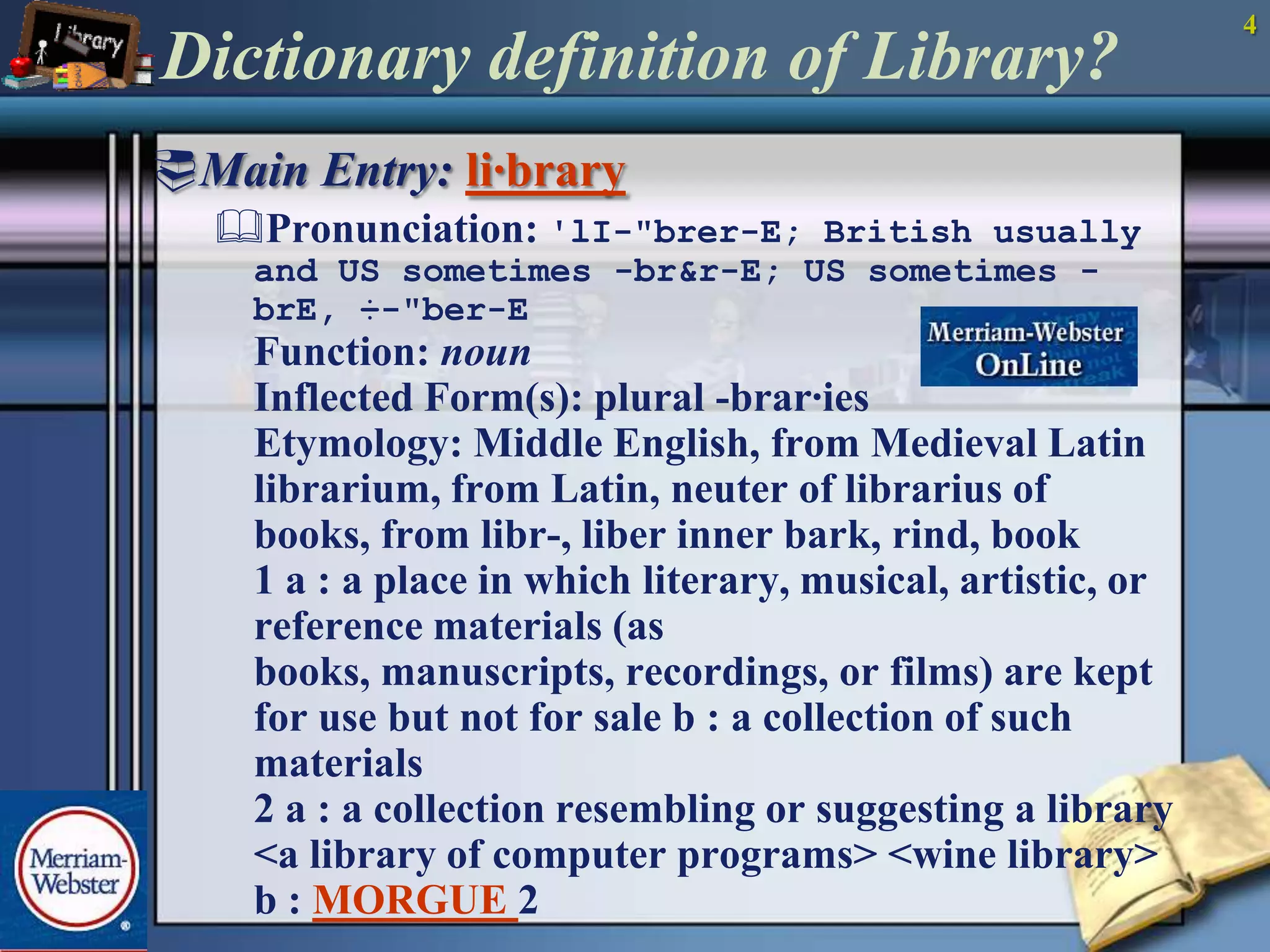
3Library?“You see, I don’t believe that libraries should be drab places where people sit in silence, and that’s been the main reason for our policy of employing wild animals as librarians.” Monty Python skit Gorilla Librarian
4Dictionary definition of Library?Main Entry: li·braryPronunciation:'lI-"brer-E; British usually and US sometimes -br&r-E; US sometimes -brE, ÷-"ber-EFunction: nounInflected Form(s): plural -brar·iesEtymology: Middle English, from Medieval Latin librarium, from Latin, neuter of librarius of books, from libr-, liber inner bark, rind, book1 a : a place in which literary, musical, artistic, or reference materials (as books, manuscripts, recordings, or films) are kept for use but not for sale b : a collection of such materials2 a : a collection resembling or suggesting a library <a library of computer programs> <wine library> b : MORGUE2
How do librarians define it?libraryA collection or group of collections of books and/or other print or nonprintmaterials organized and maintained for use (reading, consultation, study, research, etc.). Institutional libraries, organized to facilitate access by a specific clientele, are staffed by librarians and other personnel trained to provide services to meet user needs. By extension, the room, building, or facility that houses such a collection, usually but not necessarily built for that purpose.
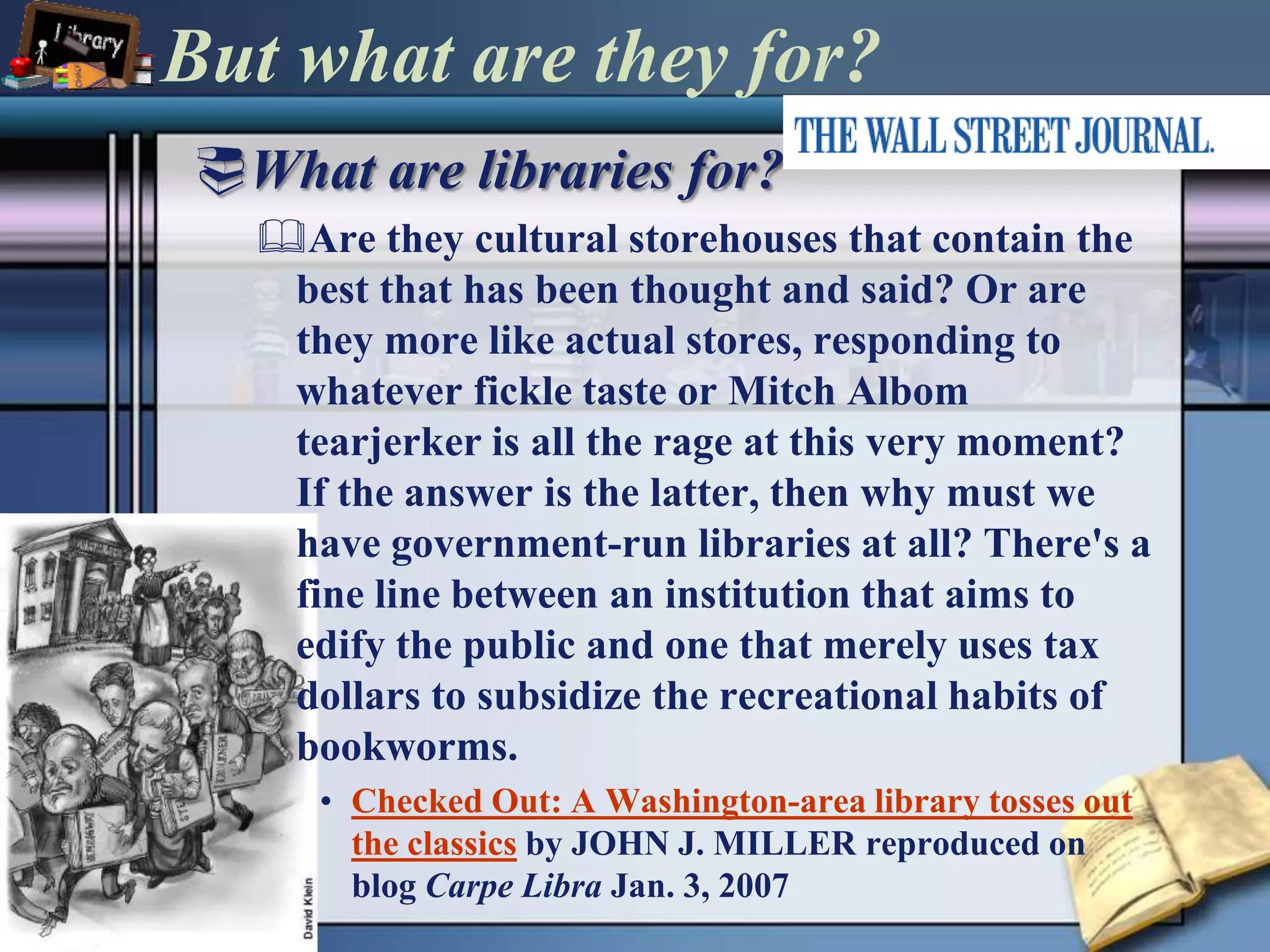
But what are they for?What are libraries for?Are they cultural storehouses that contain the best that has been thought and said? Or are they more like actual stores, responding to whatever fickle taste or Mitch Albom tearjerker is all the rage at this very moment? If the answer is the latter, then why must we have government-run libraries at all? There's a fine line between an institution that aims to edify the public and one that merely uses tax dollars to subsidize the recreational habits of bookworms.Checked Out: A Washington-area library tosses out the classicsby JOHN J. MILLER reproduced on blog Carpe Libra Jan. 3, 2007
One possible model	The Library as a DictionaryInstead of embracing this doomed model, libraries might seek to differentiate themselves among the many options readers now have, using a good dictionary as the model. Such a dictionary doesn’t merely describe the words of a language--it provides proper spelling, pronunciation and usage. New words come in and old ones go out, but a reliable lexicon becomes a foundation of linguistic stability and coherence. Likewise, libraries should seek to shore up the culture against the eroding force of trends.Checked Out: A Washington-area library tosses out the classics
Why bother, though?What about the internet?Libraries will have a crucial role for years to come no matter how much of recorded human knowledge makes its way onto the Internet. No one has yet come up with a proven method of preserving digital information for a century or more, and the explosion of knowledge and information abetted by the digital revolution makes the organizing and cataloging skills of librarians ever more valuable.“Do Libraries Still Matter?”
What about School Libraries?School LibraryA library in an elementary or secondary public school, charter school or non-profit private school serving some combination of grades K-12. Some also serve pre-kindergarten (PK), or may be combined with a public library or branch.Colorado Librarian's Survival Guide Glossary
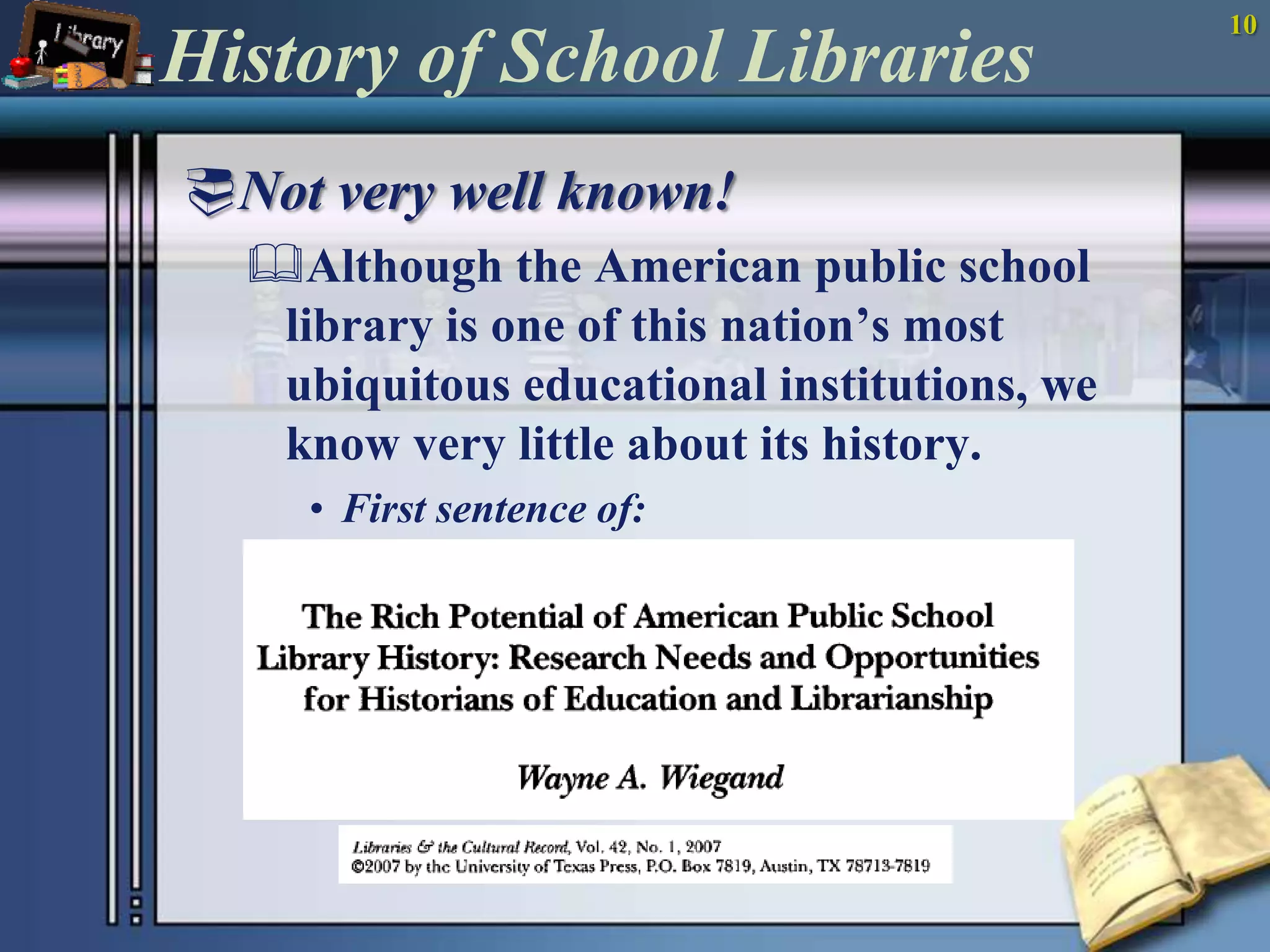
10History of School LibrariesNot very well known!Although the American public school library is one of this nation’s most ubiquitous educational institutions, we know very little about its history.First sentence of:
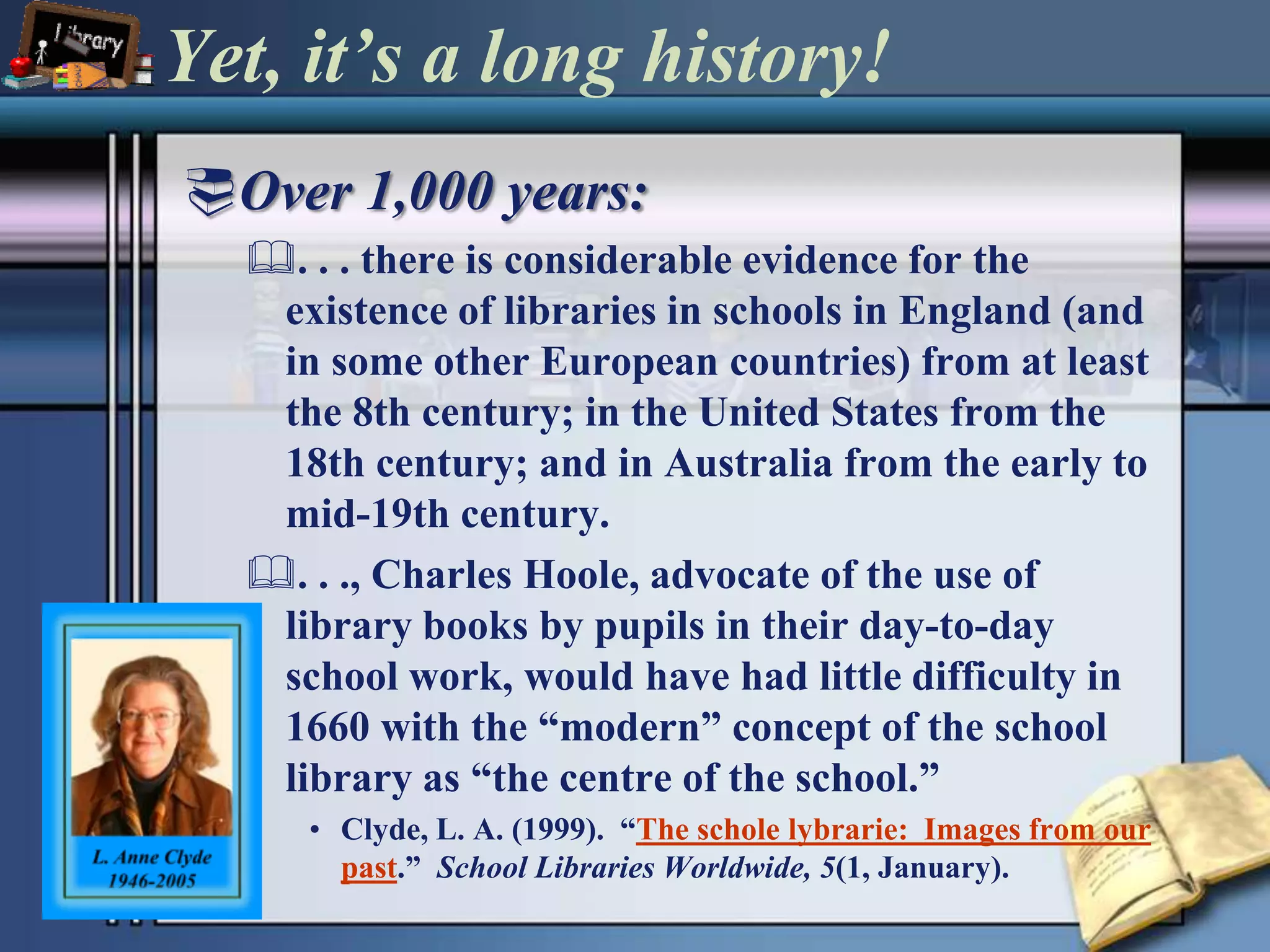
Yet, it’s a long history!Over 1,000 years:. . . there is considerable evidence for the existence of libraries in schools in England (and in some other European countries) from at least the 8th century; in the United States from the 18th century; and in Australia from the early to mid-19th century.. . ., Charles Hoole, advocate of the use of library books by pupils in their day-to-day school work, would have had little difficulty in 1660 with the “modern” concept of the school library as “the centre of the school.”Clyde, L. A. (1999).  “The scholelybrarie:  Images from our past.”  School Libraries Worldwide, 5(1, January).
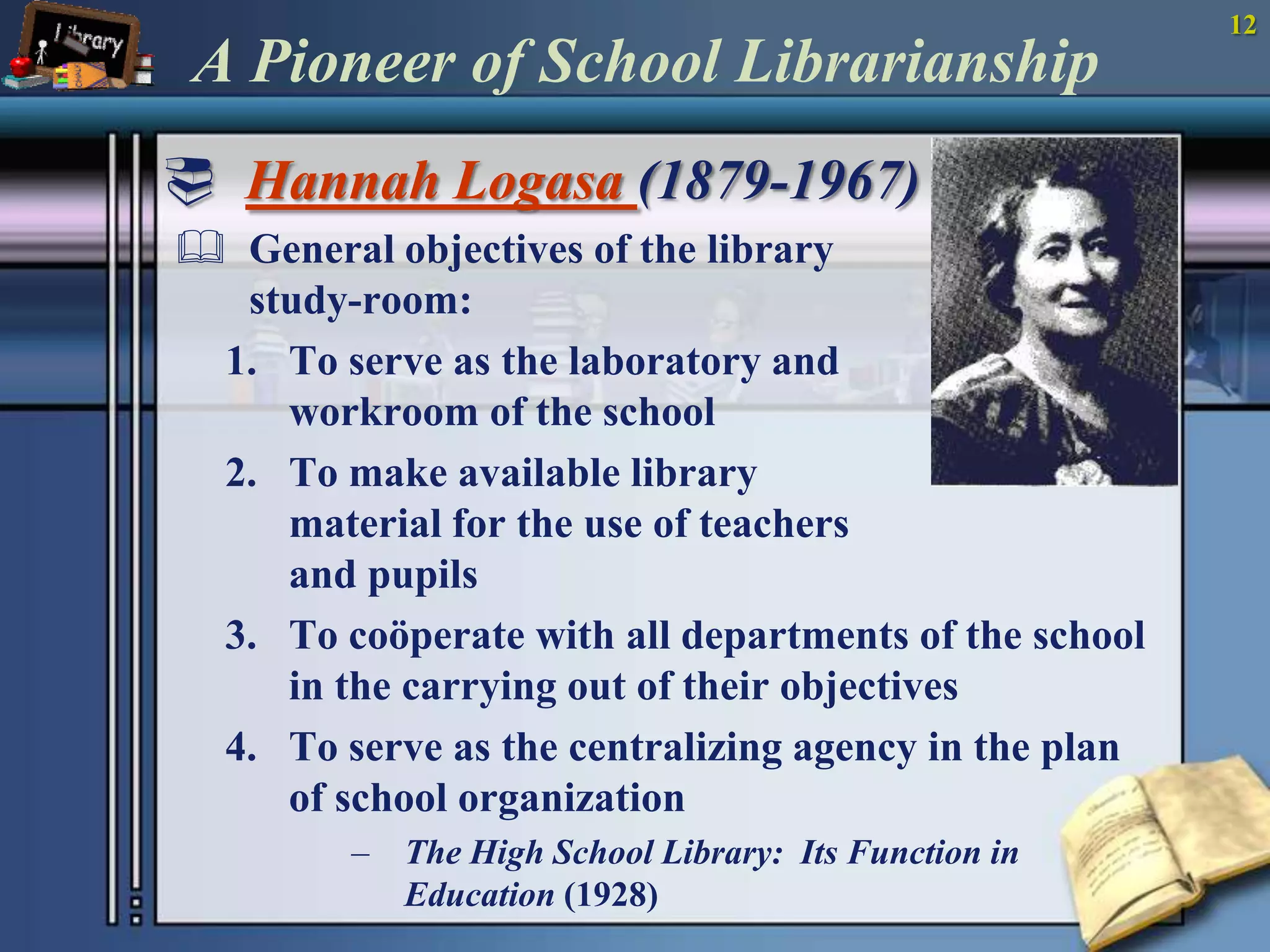
12A Pioneer of School LibrarianshipHannah Logasa(1879-1967) General objectives of the library study-room:To serve as the laboratory and workroom of the schoolTo make available library material for the use of teachers and pupilsTo coöperate with all departments of the school in the carrying out of their objectivesTo serve as the centralizing agency in the plan of school organizationThe High School Library:  Its Function in Education (1928)
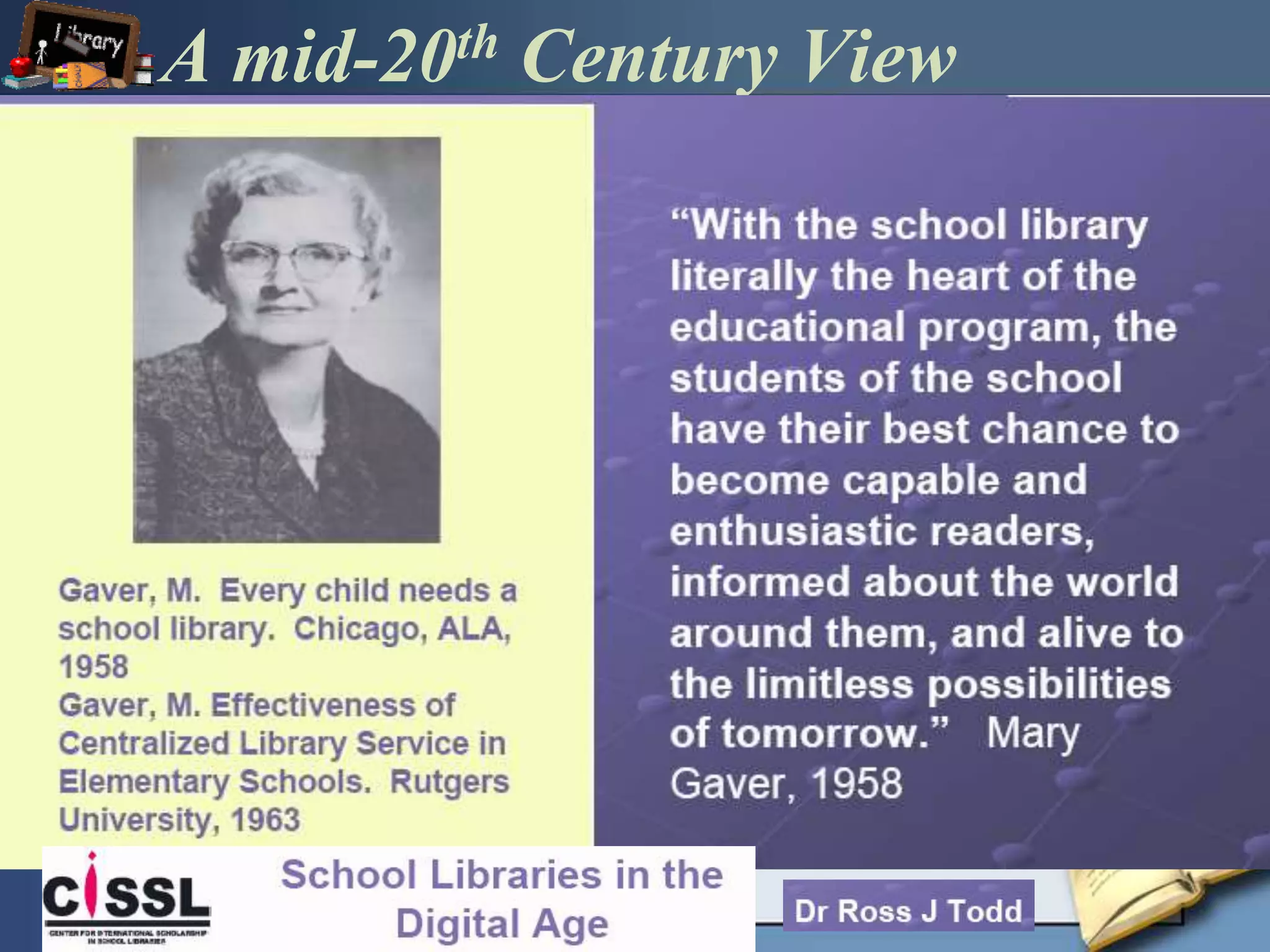
A mid-20th Century View
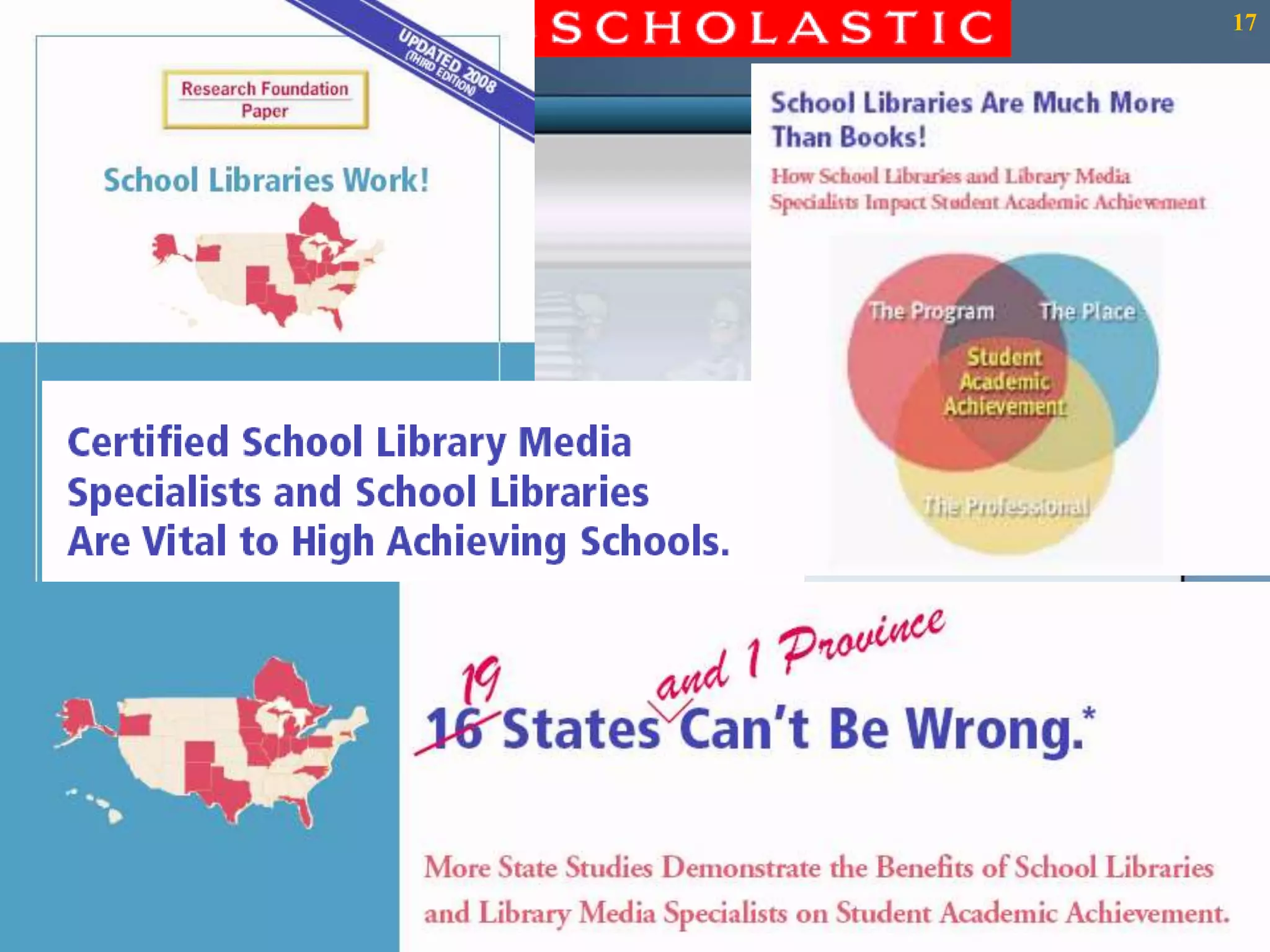
17
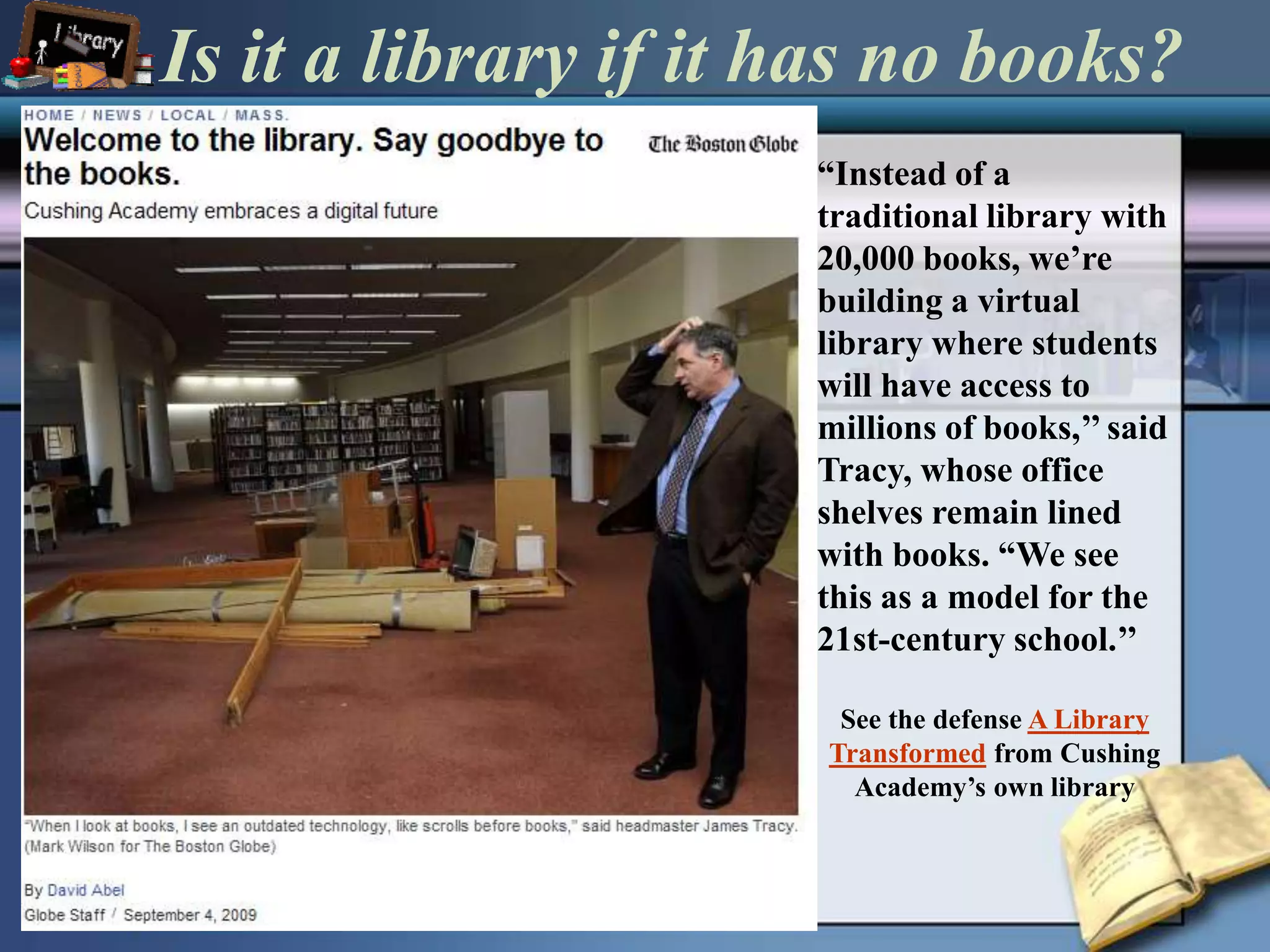
Is it a library if it has no books?“Instead of a traditional library with 20,000 books, we’re building a virtual library where students will have access to millions of books,’’ said Tracy, whose office shelves remain lined with books. “We see this as a model for the 21st-century school.’’See the defense A Library Transformed from Cushing Academy’s own library
What does ALA say?Keith Michael Fiels, executive director of the American Library Association:“Unless every student has a Kindle and an unlimited budget, I don’t see how that need is going to be met,’’ Fiels said. “Books are not a waste of space, and they won’t be until a digital book can tolerate as much sand, survive a coffee spill, and have unlimited power. When that happens, there will be next to no difference between that and a book.”Welcome to the library. Say goodbye to the books.The full article is in pdfhere
Another reactionWilliam Powers, author of “Hamlet’s Blackberry: Why Paper is Eternal”:“There are modes of learning and thinking that at the moment are only available from actual books,’’ he said. “There is a kind of deep-dive, meditative reading that’s almost impossible to do on a screen. Without books, students are more likely to do the grazing or quick reading that screens enable, rather than be by themselves with the author’s ideas.”Welcome to the library. Say goodbye to the books.
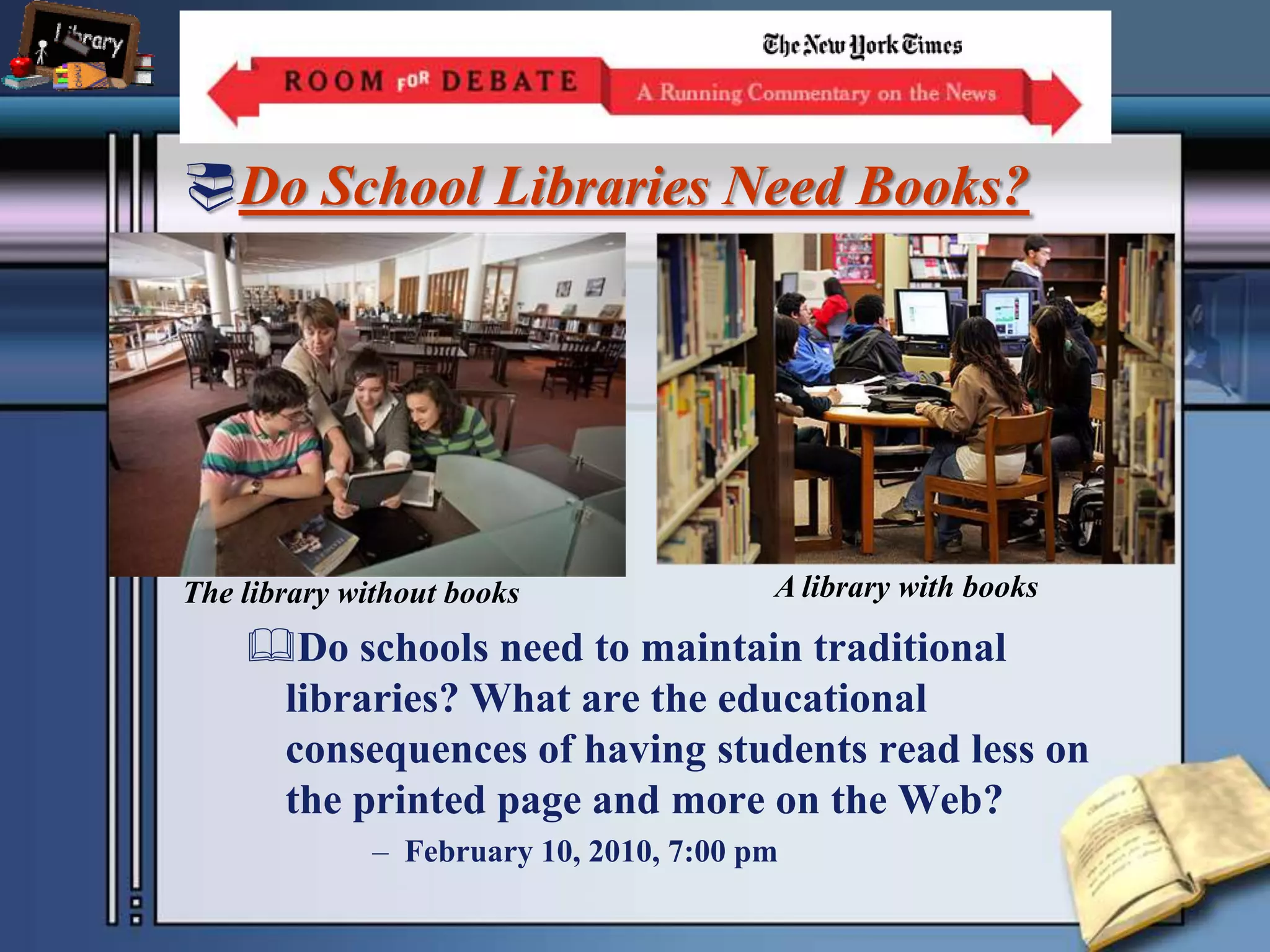
Do School Libraries Need Books?Do schools need to maintain traditional libraries? What are the educational consequences of having students read less on the printed page and more on the Web?February 10, 2010, 7:00 pm A library with booksThe library without books
www.animationfactory.com

What are Libraries Good For?

  • 1.
    LIB 601 Librariesand Learning Fall 2011what are libraries and what are they good for?
  • 2.
    2What is aLibrary?OK, What is a Library?“A truly great library contains something in it to offend everyone.” Jo Godwin“If you want to get laid, go to college. If you want an education, go to the library.”  Frank ZappaOnline Dictionary of Quotations
  • 3.
    3Library?“You see, Idon’t believe that libraries should be drab places where people sit in silence, and that’s been the main reason for our policy of employing wild animals as librarians.” Monty Python skit Gorilla Librarian
  • 4.
    4Dictionary definition ofLibrary?Main Entry: li·braryPronunciation:'lI-"brer-E; British usually and US sometimes -br&r-E; US sometimes -brE, ÷-"ber-EFunction: nounInflected Form(s): plural -brar·iesEtymology: Middle English, from Medieval Latin librarium, from Latin, neuter of librarius of books, from libr-, liber inner bark, rind, book1 a : a place in which literary, musical, artistic, or reference materials (as books, manuscripts, recordings, or films) are kept for use but not for sale b : a collection of such materials2 a : a collection resembling or suggesting a library <a library of computer programs> <wine library> b : MORGUE2
  • 5.
    How do librariansdefine it?libraryA collection or group of collections of books and/or other print or nonprintmaterials organized and maintained for use (reading, consultation, study, research, etc.). Institutional libraries, organized to facilitate access by a specific clientele, are staffed by librarians and other personnel trained to provide services to meet user needs. By extension, the room, building, or facility that houses such a collection, usually but not necessarily built for that purpose.
  • 6.
    But what arethey for?What are libraries for?Are they cultural storehouses that contain the best that has been thought and said? Or are they more like actual stores, responding to whatever fickle taste or Mitch Albom tearjerker is all the rage at this very moment? If the answer is the latter, then why must we have government-run libraries at all? There's a fine line between an institution that aims to edify the public and one that merely uses tax dollars to subsidize the recreational habits of bookworms.Checked Out: A Washington-area library tosses out the classicsby JOHN J. MILLER reproduced on blog Carpe Libra Jan. 3, 2007
  • 7.
    One possible model TheLibrary as a DictionaryInstead of embracing this doomed model, libraries might seek to differentiate themselves among the many options readers now have, using a good dictionary as the model. Such a dictionary doesn’t merely describe the words of a language--it provides proper spelling, pronunciation and usage. New words come in and old ones go out, but a reliable lexicon becomes a foundation of linguistic stability and coherence. Likewise, libraries should seek to shore up the culture against the eroding force of trends.Checked Out: A Washington-area library tosses out the classics
  • 8.
    Why bother, though?Whatabout the internet?Libraries will have a crucial role for years to come no matter how much of recorded human knowledge makes its way onto the Internet. No one has yet come up with a proven method of preserving digital information for a century or more, and the explosion of knowledge and information abetted by the digital revolution makes the organizing and cataloging skills of librarians ever more valuable.“Do Libraries Still Matter?”
  • 9.
    What about SchoolLibraries?School LibraryA library in an elementary or secondary public school, charter school or non-profit private school serving some combination of grades K-12. Some also serve pre-kindergarten (PK), or may be combined with a public library or branch.Colorado Librarian's Survival Guide Glossary
  • 10.
    10History of SchoolLibrariesNot very well known!Although the American public school library is one of this nation’s most ubiquitous educational institutions, we know very little about its history.First sentence of:
  • 11.
    Yet, it’s along history!Over 1,000 years:. . . there is considerable evidence for the existence of libraries in schools in England (and in some other European countries) from at least the 8th century; in the United States from the 18th century; and in Australia from the early to mid-19th century.. . ., Charles Hoole, advocate of the use of library books by pupils in their day-to-day school work, would have had little difficulty in 1660 with the “modern” concept of the school library as “the centre of the school.”Clyde, L. A. (1999). “The scholelybrarie: Images from our past.” School Libraries Worldwide, 5(1, January).
  • 12.
    12A Pioneer ofSchool LibrarianshipHannah Logasa(1879-1967) General objectives of the library study-room:To serve as the laboratory and workroom of the schoolTo make available library material for the use of teachers and pupilsTo coöperate with all departments of the school in the carrying out of their objectivesTo serve as the centralizing agency in the plan of school organizationThe High School Library: Its Function in Education (1928)
  • 13.
  • 17.
  • 18.
    Is it alibrary if it has no books?“Instead of a traditional library with 20,000 books, we’re building a virtual library where students will have access to millions of books,’’ said Tracy, whose office shelves remain lined with books. “We see this as a model for the 21st-century school.’’See the defense A Library Transformed from Cushing Academy’s own library
  • 19.
    What does ALAsay?Keith Michael Fiels, executive director of the American Library Association:“Unless every student has a Kindle and an unlimited budget, I don’t see how that need is going to be met,’’ Fiels said. “Books are not a waste of space, and they won’t be until a digital book can tolerate as much sand, survive a coffee spill, and have unlimited power. When that happens, there will be next to no difference between that and a book.”Welcome to the library. Say goodbye to the books.The full article is in pdfhere
  • 20.
    Another reactionWilliam Powers,author of “Hamlet’s Blackberry: Why Paper is Eternal”:“There are modes of learning and thinking that at the moment are only available from actual books,’’ he said. “There is a kind of deep-dive, meditative reading that’s almost impossible to do on a screen. Without books, students are more likely to do the grazing or quick reading that screens enable, rather than be by themselves with the author’s ideas.”Welcome to the library. Say goodbye to the books.
  • 21.
    Do School LibrariesNeed Books?Do schools need to maintain traditional libraries? What are the educational consequences of having students read less on the printed page and more on the Web?February 10, 2010, 7:00 pm A library with booksThe library without books
  • 22.