ALMANAC
CONTENTS
1. Introduction
2. Definition
3. Etymology
4. Types of Almanac
5. List of some Almanacs by country of publications
6. Criteria for Evaluation of Almanac
7. Uses of Almanacs
8. Conclusion
9. References
INTRODUCTION
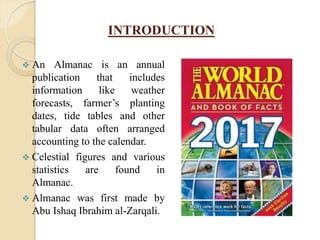
 An Almanac is an annual
publication that includes
information like weather
forecasts, farmer‟s planting
dates, tide tables and other
tabular data often arranged
accounting to the calendar.
 Celestial figures and various
statistics are found in
Almanac.
 Almanac was first made by
Abu Ishaq Ibrahim al-Zarqali.
DEFINITION
 An Almanac, originally a calendar with notations of
astronomical or meteorology and other data.
 ALA Glossary defines Almanac as, “1. An annual publication
containing a calendar, frequently accompanied by astrological
data and other information. 2. An annual yearbook of statistics
and other information sometimes in a particular field.”
ETYMOLOGY
 The etymology of the word „Almanac‟ is unclear, but there are
several theories. One of them is :
The earliest documented use of the word in any language
is in Latin in 1267 by Roger Bacon, where it meant a set of tables
detailing movements of heavenly bodies including the moon.
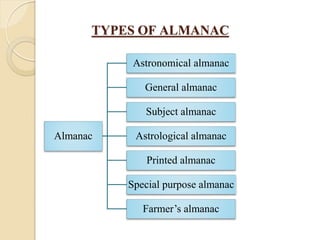
TYPES OF ALMANAC
Almanac
Astronomical almanac
General almanac
Subject almanac
Astrological almanac
Printed almanac
Special purpose almanac
Farmer‟s almanac
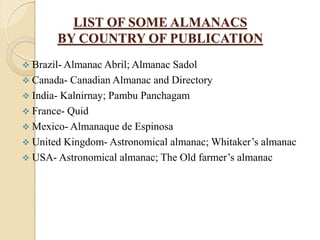
LIST OF SOME ALMANACS
BY COUNTRY OF PUBLICATION
 Brazil- Almanac Abril; Almanac Sadol
 Canada- Canadian Almanac and Directory
 India- Kalnirnay; Pambu Panchagam
 France- Quid
 Mexico- Almanaque de Espinosa
 United Kingdom- Astronomical almanac; Whitaker‟s almanac
 USA- Astronomical almanac; The Old farmer‟s almanac
CRITERIA FOR EVALUATION OF ALMANAC
 Authority
 Scope
 Up datedness
 Treatment
 Arrangement
 Format
 Special features
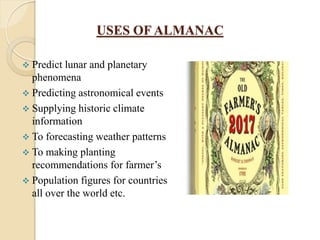
USES OF ALMANAC
 Predict lunar and planetary
phenomena
 Predicting astronomical events
 Supplying historic climate
information
 To forecasting weather patterns
 To making planting
recommendations for farmer‟s
 Population figures for countries
all over the world etc.
CONCLUSION
 The almanac, which initially was treated as calendars of the
months and days with special dates and anniversaries, forecast
of weather and astronomical calculation, is now a collection of
miscellaneous facts and statistics.
 At last, we can say that, an almanac is a very important
reference tool which provides information about current
events, development, statistics, astronomical data and
miscellaneous information.
REFERENCES
 En.m.wikipedia.org
 http://encyclopedia2.thedictionary.com
 www.answers.com
 Information sources, services and systems by Gurdev Singh
THANK YOU

Almanac

  • 1.
    ALMANAC CONTENTS 1. Introduction 2. Definition 3.Etymology 4. Types of Almanac 5. List of some Almanacs by country of publications 6. Criteria for Evaluation of Almanac 7. Uses of Almanacs 8. Conclusion 9. References
  • 2.
    INTRODUCTION  An Almanacis an annual publication that includes information like weather forecasts, farmer‟s planting dates, tide tables and other tabular data often arranged accounting to the calendar.  Celestial figures and various statistics are found in Almanac.  Almanac was first made by Abu Ishaq Ibrahim al-Zarqali.
  • 3.
    DEFINITION  An Almanac,originally a calendar with notations of astronomical or meteorology and other data.  ALA Glossary defines Almanac as, “1. An annual publication containing a calendar, frequently accompanied by astrological data and other information. 2. An annual yearbook of statistics and other information sometimes in a particular field.”
  • 4.
    ETYMOLOGY  The etymologyof the word „Almanac‟ is unclear, but there are several theories. One of them is : The earliest documented use of the word in any language is in Latin in 1267 by Roger Bacon, where it meant a set of tables detailing movements of heavenly bodies including the moon.
  • 5.
    TYPES OF ALMANAC Almanac Astronomicalalmanac General almanac Subject almanac Astrological almanac Printed almanac Special purpose almanac Farmer‟s almanac
  • 6.
    LIST OF SOMEALMANACS BY COUNTRY OF PUBLICATION  Brazil- Almanac Abril; Almanac Sadol  Canada- Canadian Almanac and Directory  India- Kalnirnay; Pambu Panchagam  France- Quid  Mexico- Almanaque de Espinosa  United Kingdom- Astronomical almanac; Whitaker‟s almanac  USA- Astronomical almanac; The Old farmer‟s almanac
  • 7.
    CRITERIA FOR EVALUATIONOF ALMANAC  Authority  Scope  Up datedness  Treatment  Arrangement  Format  Special features
  • 8.
    USES OF ALMANAC Predict lunar and planetary phenomena  Predicting astronomical events  Supplying historic climate information  To forecasting weather patterns  To making planting recommendations for farmer‟s  Population figures for countries all over the world etc.
  • 9.
    CONCLUSION  The almanac,which initially was treated as calendars of the months and days with special dates and anniversaries, forecast of weather and astronomical calculation, is now a collection of miscellaneous facts and statistics.  At last, we can say that, an almanac is a very important reference tool which provides information about current events, development, statistics, astronomical data and miscellaneous information.
  • 10.
    REFERENCES  En.m.wikipedia.org  http://encyclopedia2.thedictionary.com www.answers.com  Information sources, services and systems by Gurdev Singh
  • 11.