Enhancing teaching through constructive alignment’, John
Biggs (1996), Higher Education, 32: 342-364
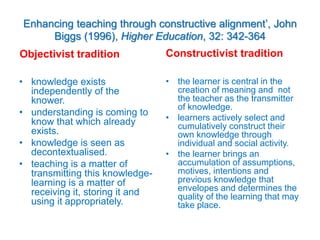
Objectivist tradition
• knowledge exists
independently of the
knower.
• understanding is coming to
know that which already
exists.
• knowledge is seen as
decontextualised.
• teaching is a matter of
transmitting this knowledge-
learning is a matter of
receiving it, storing it and
using it appropriately.
Constructivist tradition
• the learner is central in the
creation of meaning and not
the teacher as the transmitter
of knowledge.
• learners actively select and
cumulatively construct their
own knowledge through
individual and social activity.
• the learner brings an
accumulation of assumptions,
motives, intentions and
previous knowledge that
envelopes and determines the
quality of the learning that may
take place.
Enhancing teaching through constructive alignment’, John
Biggs (1996), Higher Education, 32: 342-364
• If students are to learn
desired outcomes in a
reasonably effective
manner then the
teacher’s fundamental
task is to get students
to engage in learning
activities that are likely
to result in their
achieving these
outcomes...’’
• ‘It is helpful to
remember that what the
student does is actually
more important in
determining what is
learned than what the
teacher does.’ (Shuell
1986: 429 cited in
Biggs 1996)
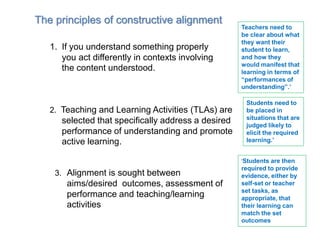
The principles of constructive alignment
1. If you understand something properly
you act differently in contexts involving
the content understood.
2. Teaching and Learning Activities (TLAs) are
selected that specifically address a desired
performance of understanding and promote
active learning.
3. Alignment is sought between
aims/desired outcomes, assessment of
performance and teaching/learning
activities
Teachers need to
be clear about what
they want their
student to learn,
and how they
would manifest that
learning in terms of
“performances of
understanding”.’
Students need to
be placed in
situations that are
judged likely to
elicit the required
learning.’
‘Students are then
required to provide
evidence, either by
self-set or teacher
set tasks, as
appropriate, that
their learning can
match the set
outcomes
Constructive
alignment Aims
Outcomes/
intentions
Assessment
Method/
Criteria
Teaching and
Learning
Activities
Feedback
Activities
The greatest
enemy of
understanding is
coverage – I can’t
repeat that often
enough...’
(Gardner 1993:24
cited in Biggs
1996)
Video link
The difference between learning outcomes and aims is that aims are
written in terms of broad teaching intentions and learning outcomes are
descriptions of what the student is expected to learn.
• Verbs which require evidence of knowing.
– define, describe, identify, label
• Verbs which require evidence of comprehension.
– Interpret, translate, estimate, defend, distinguish, explain
• Verbs which require evidence of understanding.
– Apply, solve, construct, demonstrate, change, compute
• Verbs which require evidence of analysis.
– Recognise, distinguish between, evaluate, differentiate
• Verbs which require evidence of synthesis.
– Compose, assemble, organise, plan, prepare
• Verbs which require evidence of evaluation.
– Judge, appraise, revise, select, evaluate, conclude
References
• Biggs and Tang (2007) 2007. Teaching for Quality Learning at University
Society for Research into Higher Education and Open University Press.
• Gosling D., and Moon, J. (2001) How to use learning outcomes and assessment
criteria. SEEC (www.ssec-office.org.uk )
• Hussey, T. and Smith, P. (2002) ‘The trouble with learning outcomes.’ Active
Learning in Higher Education. Vol 3, No 3, pp 220-233.
• Hussey, T. and Smith, P. (2008) Learning outcomes: a conceptual analysis, Teaching
in Higher Education, Vol 13, No, 1, pp 107-115.
• Stefani, L. (2003) ‘Planning teaching and learning: Curriculum design and
development.’ In Fry,H., Ketteridge,S. and Marshall,S. (eds) A Handbook for
Teaching and Learning in Higher Education, London: Routledge.
• Tusting K. and Barton D. (2006) Models of adult learning: a literature review NIACE.
• Indicative websites
• Learning theories.com Available at http://www.learning-theories.com/
An index of learning theories and models with a brief overview of each.
ATHERTON J S (2003) Learning and Teaching:
Available: http://www.learningandteaching.info/
An introduction to theories of learning and other resources.

WEXE 702

  • 1.
    Enhancing teaching throughconstructive alignment’, John Biggs (1996), Higher Education, 32: 342-364 Objectivist tradition • knowledge exists independently of the knower. • understanding is coming to know that which already exists. • knowledge is seen as decontextualised. • teaching is a matter of transmitting this knowledge- learning is a matter of receiving it, storing it and using it appropriately. Constructivist tradition • the learner is central in the creation of meaning and not the teacher as the transmitter of knowledge. • learners actively select and cumulatively construct their own knowledge through individual and social activity. • the learner brings an accumulation of assumptions, motives, intentions and previous knowledge that envelopes and determines the quality of the learning that may take place.
  • 2.
    Enhancing teaching throughconstructive alignment’, John Biggs (1996), Higher Education, 32: 342-364 • If students are to learn desired outcomes in a reasonably effective manner then the teacher’s fundamental task is to get students to engage in learning activities that are likely to result in their achieving these outcomes...’’ • ‘It is helpful to remember that what the student does is actually more important in determining what is learned than what the teacher does.’ (Shuell 1986: 429 cited in Biggs 1996)
  • 3.
    The principles ofconstructive alignment 1. If you understand something properly you act differently in contexts involving the content understood. 2. Teaching and Learning Activities (TLAs) are selected that specifically address a desired performance of understanding and promote active learning. 3. Alignment is sought between aims/desired outcomes, assessment of performance and teaching/learning activities Teachers need to be clear about what they want their student to learn, and how they would manifest that learning in terms of “performances of understanding”.’ Students need to be placed in situations that are judged likely to elicit the required learning.’ ‘Students are then required to provide evidence, either by self-set or teacher set tasks, as appropriate, that their learning can match the set outcomes
  • 4.
    Constructive alignment Aims Outcomes/ intentions Assessment Method/ Criteria Teaching and Learning Activities Feedback Activities Thegreatest enemy of understanding is coverage – I can’t repeat that often enough...’ (Gardner 1993:24 cited in Biggs 1996) Video link
  • 5.
    The difference betweenlearning outcomes and aims is that aims are written in terms of broad teaching intentions and learning outcomes are descriptions of what the student is expected to learn. • Verbs which require evidence of knowing. – define, describe, identify, label • Verbs which require evidence of comprehension. – Interpret, translate, estimate, defend, distinguish, explain • Verbs which require evidence of understanding. – Apply, solve, construct, demonstrate, change, compute • Verbs which require evidence of analysis. – Recognise, distinguish between, evaluate, differentiate • Verbs which require evidence of synthesis. – Compose, assemble, organise, plan, prepare • Verbs which require evidence of evaluation. – Judge, appraise, revise, select, evaluate, conclude
  • 6.
    References • Biggs andTang (2007) 2007. Teaching for Quality Learning at University Society for Research into Higher Education and Open University Press. • Gosling D., and Moon, J. (2001) How to use learning outcomes and assessment criteria. SEEC (www.ssec-office.org.uk ) • Hussey, T. and Smith, P. (2002) ‘The trouble with learning outcomes.’ Active Learning in Higher Education. Vol 3, No 3, pp 220-233. • Hussey, T. and Smith, P. (2008) Learning outcomes: a conceptual analysis, Teaching in Higher Education, Vol 13, No, 1, pp 107-115. • Stefani, L. (2003) ‘Planning teaching and learning: Curriculum design and development.’ In Fry,H., Ketteridge,S. and Marshall,S. (eds) A Handbook for Teaching and Learning in Higher Education, London: Routledge. • Tusting K. and Barton D. (2006) Models of adult learning: a literature review NIACE. • Indicative websites • Learning theories.com Available at http://www.learning-theories.com/ An index of learning theories and models with a brief overview of each. ATHERTON J S (2003) Learning and Teaching: Available: http://www.learningandteaching.info/ An introduction to theories of learning and other resources.