SEMINAR PRESENTATION
on
“Processes of runoff generation operating during
the spring and autumn seasons in a permafrost
catchment on semi-arid plateaus”
Wang Genxu, Mao Tianxu, Chang Juan, Song Chunlin, Huang Kewei (2017)
SHYAM MOHAN CHAUDHARY
17AG62R13
Land and Water Resources Engineering
Agricultural and Food Engineering Department
IIT KHARAGPUR
CONTENTS
• INTRODUCTION
• REVIEW OF LITERATURE
• PROBLEM STATEMENT
• OBJECTIVES
• METHODOLOGY
• RESULTS AND DISCUSSION
• CONCLUSION
INTRODUCTION
• What is Permafrost ?
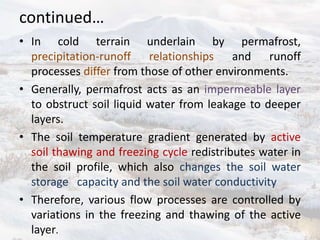
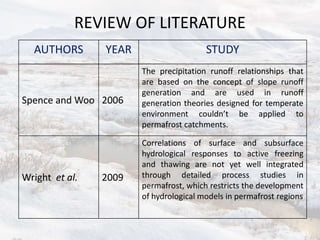
In geology, permafrost is ground, including rock or
soil, at or below the freezing point of water 0 °C
(32 °F) for two or more years.
Permafrost accounts for 0.022% of total water on
Earth and exists in 24% of exposed land in the
Northern Hemisphere.
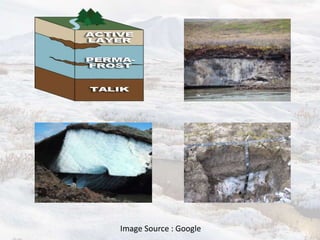
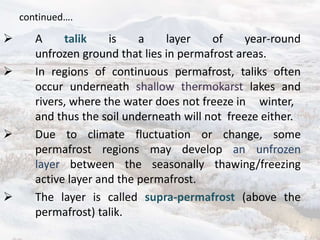
In environments containing permafrost, the active
layer is the top layer of soil that thaws during the
summer and freezes again during the autumn.
Image Source : Google
continued….
 A talik is a layer of year-round
unfrozen ground that lies in permafrost areas.
 In regions of continuous permafrost, taliks often
occur underneath shallow thermokarst lakes and
rivers, where the water does not freeze in winter,
and thus the soil underneath will not freeze either.
 Due to climate fluctuation or change, some
permafrost regions may develop an unfrozen
layer between the seasonally thawing/freezing
active layer and the permafrost.
 The layer is called supra-permafrost (above the
permafrost) talik.
continued…
• In cold terrain underlain by permafrost,
precipitation-runoff relationships and runoff
processes differ from those of other environments.
• Generally, permafrost acts as an impermeable layer
to obstruct soil liquid water from leakage to deeper
layers.
• The soil temperature gradient generated by active
soil thawing and freezing cycle redistributes water in
the soil profile, which also changes the soil water
storage capacity and the soil water conductivity
• Therefore, various flow processes are controlled by
variations in the freezing and thawing of the active
layer.
REVIEW OF LITERATURE
AUTHORS YEAR STUDY
Spence and Woo 2006
The precipitation runoff relationships that
are based on the concept of slope runoff
generation and are used in runoff
generation theories designed for temperate
environment couldn’t be applied to
permafrost catchments.
Wright et al. 2009
Correlations of surface and subsurface
hydrological responses to active freezing
and thawing are not yet well integrated
through detailed process studies in
permafrost, which restricts the development
of hydrological models in permafrost regions
PROBLEM STATEMENT
In cold environments such where forcing data and
parameter information is typically lacking or poorly
approximated, it is inappropriate and physically
unrealistic to run detailed distributed models for
simulating and predicting streamflow processes.
Runoff is the most crucial part of hydrological
process. There is a lack of knowledge about how to
determine the mechanisms responsible for and to
quantify runoff generation in permafrost areas.
OBJECTIVES
• To develop an approach based on the variable
contributing area concept that integrates soil water
storage (soil saturation) and the associated active-
layer (soil temperature) dynamics with surface and
subsurface runoff processes to precisely simulate
runoff generation and variability.
• To estimate the effects of freezing and thawing of the
active layer on the runoff generation process.
METHODOLOGY
Study area
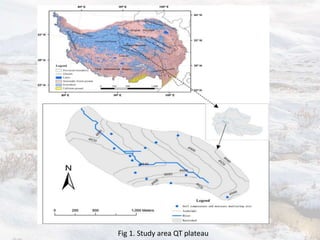
This study was conducted in the Fenghuoshan
watershed in the central regions of the Qinghai-Tibet
Plateau (93 3–92 50E and 34 40–34 48 N) with
continuous permafrost having catchment area as
1.62 square kilometres.
Precipitation observed in the region ranges from
248.5 to 467.4 mm, with more than 85% falling
during the warmer season (June to September).
The mean annual air temperature from the years
2005 to 2015 was of -5.2 C.
Fig 1. Study area QT plateau
Data collection
• The thickness of the active layer ranged from 2.1 m
in the valley to 0.8 m on the mountain ridge.
• The soil temperatures at depths of 0.05, 0.20, 0.40,
0.80, 1.0, 1.20, and 1.60 m were measured by a
thermal resistance sensor.
• The soil moistures at the same depths were
measured by a Frequency Domain Reflectometer
with Data logger.
• One micro-meteorological station was established in
the experimental catchment to monitor air
temperature and precipitation.
• Daily stream flows were monitored by a V-notch weir
at the outlet of the catchment from July 2012 to July
2015.
Analysis approach….
The water storage capacity-based contribution to
saturation excess runoff in non-permafrost catchment can
be estimated from the water balance equation as follows
where, Rs is runoff production in the catchment (mm),
P is daily precipitation(mm)
E is the actual daily evapotranspiration (mm).
W’sm is the soil water content at field water capacity, and
β( W’sm ) is the water storage capacity function, which refers
to the ratio of areas with soil water content < W’sm
to total catchment area
continued….
The infiltration excess runoff production Ri can also
be estimated with the infiltration capacity fp and the
rainfall intensity pi using following simple equation
In both the equations the previous soil water content W0 is
the main force driving β(W’sm) and the infiltration capacity fp.
In general, both latter functions depend on degree of
saturation of surface soil because permeability decreases with
decreasing liquid water saturation.
Hypothesis and numerical implementation
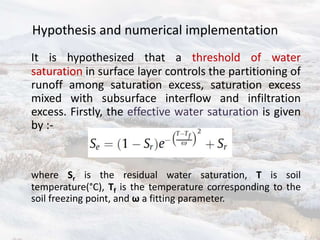
It is hypothesized that a threshold of water
saturation in surface layer controls the partitioning of
runoff among saturation excess, saturation excess
mixed with subsurface interflow and infiltration
excess. Firstly, the effective water saturation is given
by :-
where Sr is the residual water saturation, T is soil
temperature(°C), Tf is the temperature corresponding to the
soil freezing point, and ω a fitting parameter.
continued…
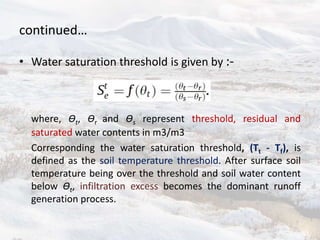
• Water saturation threshold is given by :-
where, ϴt, ϴr and ϴs represent threshold, residual and
saturated water contents in m3/m3
Corresponding the water saturation threshold, (Tt - Tf), is
defined as the soil temperature threshold. After surface soil
temperature being over the threshold and soil water content
below ϴt, infiltration excess becomes the dominant runoff
generation process.
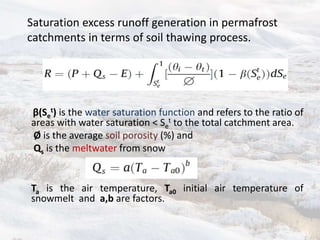
Saturation excess runoff generation in permafrost
catchments in terms of soil thawing process.
β(Se
t) is the water saturation function and refers to the ratio of
areas with water saturation < Se
t to the total catchment area.
Ø is the average soil porosity (%) and
Qs is the meltwater from snow
Ta is the air temperature, Ta0 initial air temperature of
snowmelt and a,b are factors.
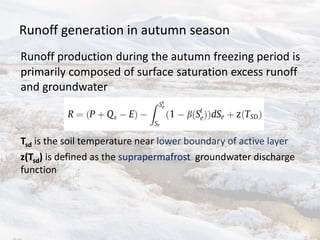
Runoff generation in autumn season
Runoff production during the autumn freezing period is
primarily composed of surface saturation excess runoff
and groundwater
Tsd is the soil temperature near lower boundary of active layer
z(Tsd) is defined as the suprapermafrost groundwater discharge
function
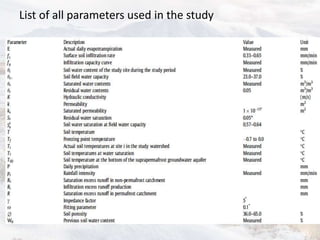
List of all parameters used in the study
RESULTS AND DISCUSSION
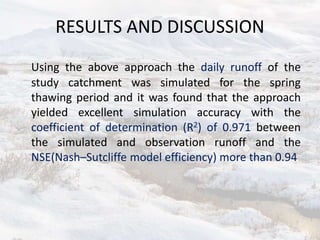
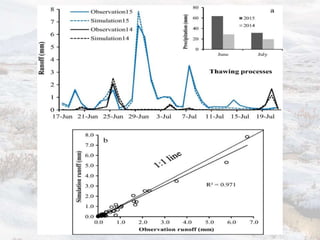
Using the above approach the daily runoff of the
study catchment was simulated for the spring
thawing period and it was found that the approach
yielded excellent simulation accuracy with the
coefficient of determination (R2) of 0.971 between
the simulated and observation runoff and the
NSE(Nash–Sutcliffe model efficiency) more than 0.94
In autumn season
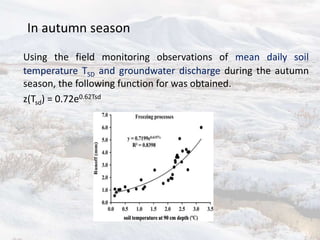
Using the field monitoring observations of mean daily soil
temperature TSD and groundwater discharge during the autumn
season, the following function for was obtained.
z(Tsd) = 0.72e0.62Tsd
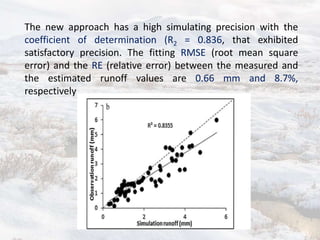
The new approach has a high simulating precision with the
coefficient of determination (R2 = 0.836, that exhibited
satisfactory precision. The fitting RMSE (root mean square
error) and the RE (relative error) between the measured and
the estimated runoff values are 0.66 mm and 8.7%,
respectively
CONCLUSIONS
• The new approach successfully fills the gap in quantitative
approaches in modeling of runoff generation processes in
permafrost catchments of the semi-arid plateaus.
• During the initial spring thawing period, saturation excess
runoff and subsurface interflow within the thawed active
layer are the dominant runoff components .
• During the autumn freezing period, the groundwater
discharge is the dominant source of runoff generation,
contributing more than 75% of the total river runoff in the
permafrost catchment of the semi-arid TP.
THANK YOU

PERMAFROST RUNOFF

  • 1.
    SEMINAR PRESENTATION on “Processes ofrunoff generation operating during the spring and autumn seasons in a permafrost catchment on semi-arid plateaus” Wang Genxu, Mao Tianxu, Chang Juan, Song Chunlin, Huang Kewei (2017) SHYAM MOHAN CHAUDHARY 17AG62R13 Land and Water Resources Engineering Agricultural and Food Engineering Department IIT KHARAGPUR
  • 2.
    CONTENTS • INTRODUCTION • REVIEWOF LITERATURE • PROBLEM STATEMENT • OBJECTIVES • METHODOLOGY • RESULTS AND DISCUSSION • CONCLUSION
  • 3.
    INTRODUCTION • What isPermafrost ? In geology, permafrost is ground, including rock or soil, at or below the freezing point of water 0 °C (32 °F) for two or more years. Permafrost accounts for 0.022% of total water on Earth and exists in 24% of exposed land in the Northern Hemisphere. In environments containing permafrost, the active layer is the top layer of soil that thaws during the summer and freezes again during the autumn.
  • 4.
  • 5.
    continued….  A talikis a layer of year-round unfrozen ground that lies in permafrost areas.  In regions of continuous permafrost, taliks often occur underneath shallow thermokarst lakes and rivers, where the water does not freeze in winter, and thus the soil underneath will not freeze either.  Due to climate fluctuation or change, some permafrost regions may develop an unfrozen layer between the seasonally thawing/freezing active layer and the permafrost.  The layer is called supra-permafrost (above the permafrost) talik.
  • 6.
    continued… • In coldterrain underlain by permafrost, precipitation-runoff relationships and runoff processes differ from those of other environments. • Generally, permafrost acts as an impermeable layer to obstruct soil liquid water from leakage to deeper layers. • The soil temperature gradient generated by active soil thawing and freezing cycle redistributes water in the soil profile, which also changes the soil water storage capacity and the soil water conductivity • Therefore, various flow processes are controlled by variations in the freezing and thawing of the active layer.
  • 7.
    REVIEW OF LITERATURE AUTHORSYEAR STUDY Spence and Woo 2006 The precipitation runoff relationships that are based on the concept of slope runoff generation and are used in runoff generation theories designed for temperate environment couldn’t be applied to permafrost catchments. Wright et al. 2009 Correlations of surface and subsurface hydrological responses to active freezing and thawing are not yet well integrated through detailed process studies in permafrost, which restricts the development of hydrological models in permafrost regions
  • 8.
    PROBLEM STATEMENT In coldenvironments such where forcing data and parameter information is typically lacking or poorly approximated, it is inappropriate and physically unrealistic to run detailed distributed models for simulating and predicting streamflow processes. Runoff is the most crucial part of hydrological process. There is a lack of knowledge about how to determine the mechanisms responsible for and to quantify runoff generation in permafrost areas.
  • 9.
    OBJECTIVES • To developan approach based on the variable contributing area concept that integrates soil water storage (soil saturation) and the associated active- layer (soil temperature) dynamics with surface and subsurface runoff processes to precisely simulate runoff generation and variability. • To estimate the effects of freezing and thawing of the active layer on the runoff generation process.
  • 10.
    METHODOLOGY Study area This studywas conducted in the Fenghuoshan watershed in the central regions of the Qinghai-Tibet Plateau (93 3–92 50E and 34 40–34 48 N) with continuous permafrost having catchment area as 1.62 square kilometres. Precipitation observed in the region ranges from 248.5 to 467.4 mm, with more than 85% falling during the warmer season (June to September). The mean annual air temperature from the years 2005 to 2015 was of -5.2 C.
  • 11.
    Fig 1. Studyarea QT plateau
  • 12.
    Data collection • Thethickness of the active layer ranged from 2.1 m in the valley to 0.8 m on the mountain ridge. • The soil temperatures at depths of 0.05, 0.20, 0.40, 0.80, 1.0, 1.20, and 1.60 m were measured by a thermal resistance sensor. • The soil moistures at the same depths were measured by a Frequency Domain Reflectometer with Data logger. • One micro-meteorological station was established in the experimental catchment to monitor air temperature and precipitation. • Daily stream flows were monitored by a V-notch weir at the outlet of the catchment from July 2012 to July 2015.
  • 14.
    Analysis approach…. The waterstorage capacity-based contribution to saturation excess runoff in non-permafrost catchment can be estimated from the water balance equation as follows where, Rs is runoff production in the catchment (mm), P is daily precipitation(mm) E is the actual daily evapotranspiration (mm). W’sm is the soil water content at field water capacity, and β( W’sm ) is the water storage capacity function, which refers to the ratio of areas with soil water content < W’sm to total catchment area
  • 15.
    continued…. The infiltration excessrunoff production Ri can also be estimated with the infiltration capacity fp and the rainfall intensity pi using following simple equation In both the equations the previous soil water content W0 is the main force driving β(W’sm) and the infiltration capacity fp. In general, both latter functions depend on degree of saturation of surface soil because permeability decreases with decreasing liquid water saturation.
  • 16.
    Hypothesis and numericalimplementation It is hypothesized that a threshold of water saturation in surface layer controls the partitioning of runoff among saturation excess, saturation excess mixed with subsurface interflow and infiltration excess. Firstly, the effective water saturation is given by :- where Sr is the residual water saturation, T is soil temperature(°C), Tf is the temperature corresponding to the soil freezing point, and ω a fitting parameter.
  • 17.
    continued… • Water saturationthreshold is given by :- where, ϴt, ϴr and ϴs represent threshold, residual and saturated water contents in m3/m3 Corresponding the water saturation threshold, (Tt - Tf), is defined as the soil temperature threshold. After surface soil temperature being over the threshold and soil water content below ϴt, infiltration excess becomes the dominant runoff generation process.
  • 18.
    Saturation excess runoffgeneration in permafrost catchments in terms of soil thawing process. β(Se t) is the water saturation function and refers to the ratio of areas with water saturation < Se t to the total catchment area. Ø is the average soil porosity (%) and Qs is the meltwater from snow Ta is the air temperature, Ta0 initial air temperature of snowmelt and a,b are factors.
  • 19.
    Runoff generation inautumn season Runoff production during the autumn freezing period is primarily composed of surface saturation excess runoff and groundwater Tsd is the soil temperature near lower boundary of active layer z(Tsd) is defined as the suprapermafrost groundwater discharge function
  • 20.
    List of allparameters used in the study
  • 21.
    RESULTS AND DISCUSSION Usingthe above approach the daily runoff of the study catchment was simulated for the spring thawing period and it was found that the approach yielded excellent simulation accuracy with the coefficient of determination (R2) of 0.971 between the simulated and observation runoff and the NSE(Nash–Sutcliffe model efficiency) more than 0.94
  • 23.
    In autumn season Usingthe field monitoring observations of mean daily soil temperature TSD and groundwater discharge during the autumn season, the following function for was obtained. z(Tsd) = 0.72e0.62Tsd
  • 24.
    The new approachhas a high simulating precision with the coefficient of determination (R2 = 0.836, that exhibited satisfactory precision. The fitting RMSE (root mean square error) and the RE (relative error) between the measured and the estimated runoff values are 0.66 mm and 8.7%, respectively
  • 25.
    CONCLUSIONS • The newapproach successfully fills the gap in quantitative approaches in modeling of runoff generation processes in permafrost catchments of the semi-arid plateaus. • During the initial spring thawing period, saturation excess runoff and subsurface interflow within the thawed active layer are the dominant runoff components . • During the autumn freezing period, the groundwater discharge is the dominant source of runoff generation, contributing more than 75% of the total river runoff in the permafrost catchment of the semi-arid TP.
  • 26.