Clinical Dietitians, Food & Nutrition Services, UC Davis Medical Center (3/06)
© 2006 The Regents of the University of California. All Rights Reserved.
Helpful Guidelines for Successful
Weight Loss
Weight loss should occur when you eat fewer calories than you burn. Increasing physical activity while
limiting your calories will increase your rate of weight loss. Increasing physical activity will also help
you to maintain your weight after weight loss. Discuss appropriate calorie levels and serving sizes with
your dietitian.
1. Keep a written food and physical activity journal.
2. Weigh yourself once per week at the same time of day, with the same amount
of clothing, and on the same scale.
3. Eat breakfast everyday and do not skip meals. Skipping meals can lead to
extreme hunger, overeating and poor food choices.
4. Plan your meals and eat around the same time every day.
5. Pick an eating area at home and/or work.
6. Turn off the TV and/or computer during meals and snacks.
7. Eat slowly. Take 30 minutes for a meal. It takes 20 minutes before you feel full, so wait 20
minutes after your first serving before taking a second serving.
8. Eat protein foods first to help you feel full sooner.
9. Read food labels to help control portions of food.
10. Eat less fat and sugar. Eat more fiber, including fresh fruits/vegetables and whole grains.
11. Limit restaurant and fast food meals.
12. Don’t keep problem foods around the house and/or at work. A problem food is a food that you are
likely to eat too much of or too often if readily available.
13. Drink at least 8 cups (64 ounces) of liquids per day. Focus on calorie-free, caffeine-free
beverages.
14. Get adequate sleep each night (7-9 hours).
Food Preparation
Use lowfat cooking methods such as baking, grilling, boiling, poaching, broiling, roasting, steaming
or microwaving without additional fat.
Avoid or limit frying.
Place meat on a rack so the fat will drain off during cooking.
Remove skin from poultry before cooking.
Trim all visible fat from food (i.e. poultry and meat) before cooking.
Use non-stick cookware or cooking sprays.
Use egg whites or egg substitute in place of whole eggs.
Season food with spices, butter flavoring (such as Butter Buds®
), lemon or low-fat dressings.
Limit high-fat sauces or gravies such as sour cream, regular salad dressings, full-fat gravy, and cream
or cheese sauces (such as Hollandaise or Alfredo sauce).
Use a sugar substitute in place of sugar. Replace sugar in recipes with a sugar substitute that can be
used in baking or cooking.
Restaurant Eating/Take-Out
Limit appetizers, bread with butter, and chips.
Select a salad with light dressing on the side or broth-based soup as your first course.
Choose foods prepared using lowfat cooking methods.
Request sauces, dressings, and gravies on the side.
Clinical Dietitians, Food & Nutrition Services, UC Davis Medical Center (3/06)
© 2006 The Regents of the University of California. All Rights Reserved.
2
Place a portion of your meal in a take-home container before you start eating.
Share an entrée with a friend.
Consider purchasing a pocket-sized calorie counter book to help make healthy
choices.
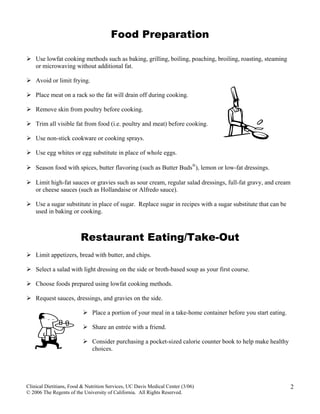
Food Groups and Recommended Portion Sizes
Meat/Protein
(2-3 servings per day)
1 serving = 3 ounces meat/poultry/fish;
1½ cups cooked dry beans/lentils/split
peas; ½ cup tofu; 2 eggs
Bread/starch
(4-8 servings per day)
1 serving = ½ cup rice/pasta/cereal;
1 slice bread; ½ small bagel
Fruit
(2-4 servings per day)
1 serving = 1 small piece fruit;
½ cup cut-up fruit; ½ cup fruit
juice
Choose more often Choose more often Choose more often
Poultry without skin
Chili without meat
Egg whites or egg substitute
Baked fish
Lean red meat (round, loin)
Lowfat lunchmeat (<10% fat)
Canned tuna in water
Cooked dry beans/legumes
Lentils
Split peas/black eyed pea
Tofu
Tempeh
Meat substitutes (soy based)
Barley
Whole-grain bread
Bulgur
Unsweetened cereal
Whole grain crackers
English muffins
Hominy
Whole-grain pasta
Brown rice
Rice cakes
Corn tortillas
Plain popcorn
Oatmeal
Baked chips
Fresh fruits
Fruit canned in water or juice
Frozen fruit without added
sugar
Unsweetened applesauce
Choose less often or avoid Choose less often or avoid Choose less often or avoid
Bacon
Sausage
Hot dogs
Fried chicken
Poultry with skin
Chili with meat
Fried eggs
Fried fish
Fish sticks
Marbled red meat
Peanut butter
Lunch meat, bologna, salami
Nuts and seeds
Canned tuna in oil
Oil-packed sardines
Biscuits
Chips
Sweetened cereal
Corn bread
High fat crackers
French toast
Granola
Pasta with cream sauce
Macaroni and cheese
Macaroni salad
Muffins
Pancakes
Pizza
Buttered popcorn
Stuffing
Crisp taco shells
Waffles
Sweetened applesauce
Fruit juice
Fruit canned in syrup
Fruit roll ups
Fruit sorbet
Avocado
Coconut
Clinical Dietitians, Food & Nutrition Services, UC Davis Medical Center (3/06)
© 2006 The Regents of the University of California. All Rights Reserved.
3
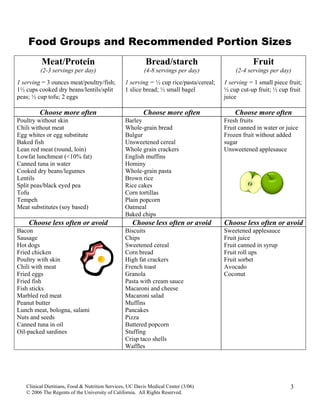
Food Groups and Recommended Portion Sizes
Vegetable
(3 or more servings per day)
1 serving = ½ cup
Dairy/Milk
(2-3 servings per day)
1 serving = 8 ounces milk or yogurt; 1 ounce
cheese; ¼ cup cottage cheese
Choose more often Choose more often
Fresh, frozen or canned vegetables
(Prepared without added fat)
Broth-based vegetable soups
Nonfat or lowfat (1%) milk
Nonfat or lowfat cheese
Nonfat or lowfat cottage cheese
Light nonfat fruit yogurt
Nonfat or lowfat plain yogurt
Choose less often or avoid Choose less often or avoid
Creamed vegetable soups
French fries
Fried or tempura vegetables
Vegetables in cream sauce
Hash brown potatoes
Mashed potatoes made with butter
Potato salad
Cheese
Chocolate milk
Ice cream / ice milk
Whole or reduced fat 2% milk
Pudding
Regular fruit yogurt
Frozen yogurt
Fats
(Use sparingly)
1 serving = 1 teaspoon butter or oil; 1 Tablespoon
reduced-fat margarine/mayonnaise
Bacon Grease
Butter
Cream
Lard
Margarine
Mayonnaise
Oil
Salad Dressing
Shortening
Sour Cream
Clinical Dietitians, Food & Nutrition Services, UC Davis Medical Center (3/06)
© 2006 The Regents of the University of California. All Rights Reserved.
4
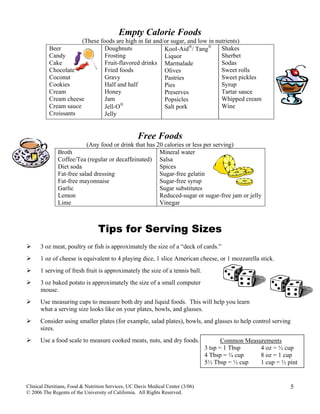
Empty Calorie Foods
(These foods are high in fat and/or sugar, and low in nutrients)
Beer
Candy
Cake
Chocolate
Coconut
Cookies
Cream
Cream cheese
Cream sauce
Croissants
Doughnuts
Frosting
Fruit-flavored drinks
Fried foods
Gravy
Half and half
Honey
Jam
Jell-O®
Jelly
Kool-Aid®
/ Tang®
Liquor
Marmalade
Olives
Pastries
Pies
Preserves
Popsicles
Salt pork
Shakes
Sherbet
Sodas
Sweet rolls
Sweet pickles
Syrup
Tartar sauce
Whipped cream
Wine
Free Foods
(Any food or drink that has 20 calories or less per serving)
Clinical Dietitians, Food & Nutrition Services, UC Davis Medical Center (3/06)
© 2006 The Regents of the University of California. All Rights Reserved.
5
Tips for Serving Sizes
3 oz meat, poultry or fish is approximately the size of a “deck of cards.”
1 oz of cheese is equivalent to 4 playing dice, 1 slice American cheese, or 1 mozzarella stick.
1 serving of fresh fruit is approximately the size of a tennis ball.
3 oz baked potato is approximately the size of a small computer
mouse.
Use measuring cups to measure both dry and liquid foods. This will help you learn
what a serving size looks like on your plates, bowls, and glasses.
Consider using smaller plates (for example, salad plates), bowls, and glasses to help control serving
sizes.
Use a food scale to measure cooked meats, nuts, and dry foods.
Broth
Coffee/Tea (regular or decaffeinated)
Diet soda
Fat-free salad dressing
Fat-free mayonnaise
Garlic
Lemon
Lime
Mineral water
Salsa
Spices
Sugar-free gelatin
Sugar-free syrup
Sugar substitutes
Reduced-sugar or sugar-free jam or jelly
Vinegar
Common Measurements
3 tsp = 1 Tbsp 4 oz = ½ cup
4 Tbsp = ¼ cup 8 oz = 1 cup
5⅓ Tbsp = ⅓ cup 1 cup = ½ pint
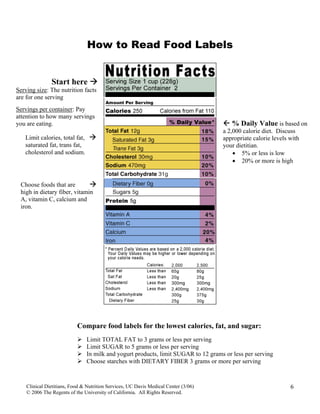
How to Read Food Labels
Limit calories, total fat,
saturated fat, trans fat,
cholesterol and sodium.
Start here
Serving size: The nutrition facts
are for one serving
Servings per container: Pay
attention to how many servings
you are eating. % Daily Value is based on
a 2,000 calorie diet. Discuss
appropriate calorie levels with
your dietitian.
• 5% or less is low
• 20% or more is high
Choose foods that are
high in dietary fiber, vitamin
A, vitamin C, calcium and
iron.
Compare food labels for the lowest calories, fat, and sugar:
Limit TOTAL FAT to 3 grams or less per serving
Limit SUGAR to 5 grams or less per serving
In milk and yogurt products, limit SUGAR to 12 grams or less per serving
Choose starches with DIETARY FIBER 3 grams or more per serving
Clinical Dietitians, Food & Nutrition Services, UC Davis Medical Center (3/06)
© 2006 The Regents of the University of California. All Rights Reserved.
6
Tips to Become More Physically Active
Consult your doctor before beginning any exercise routine.
Begin slowly and work toward a goal of 30-90 minutes of moderate intensity activity most days of
the week.
Find activities you enjoy and spread physical activity throughout the day.
Reward yourself for reaching your goals. Some examples are:
• Buy yourself new sports equipment
• Ask your spouse to take the kids for an hour
• Visit a friend
• Spend more time on your favorite hobby
• Buy yourself some flowers or a plant
• Enjoy a long hot bath
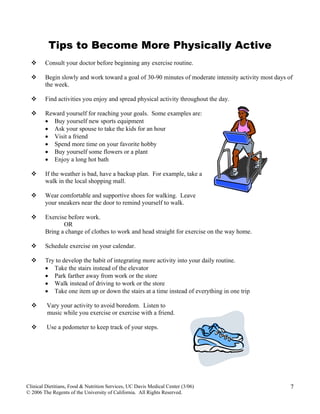
If the weather is bad, have a backup plan. For example, take a
walk in the local shopping mall.
Wear comfortable and supportive shoes for walking. Leave
your sneakers near the door to remind yourself to walk.
Exercise before work.
OR
Bring a change of clothes to work and head straight for exercise on the way home.
Schedule exercise on your calendar.
Try to develop the habit of integrating more activity into your daily routine.
• Take the stairs instead of the elevator
• Park farther away from work or the store
• Walk instead of driving to work or the store
• Take one item up or down the stairs at a time instead of everything in one trip
Clinical Dietitians, Food & Nutrition Services, UC Davis Medical Center (3/06)
© 2006 The Regents of the University of California. All Rights Reserved.
7
Vary your activity to avoid boredom. Listen to
music while you exercise or exercise with a friend.
Use a pedometer to keep track of your steps.
Clinical Dietitians, Food & Nutrition Services, UC Davis Medical Center (3/06)
© 2006 The Regents of the University of California. All Rights Reserved.
8
Weight Management Resources
Books
• Thin for Life: 10 Keys to Success from People Who Have Lost Weight and Kept It Off
Anne Fletcher. Houghton Mifflin, revised and updated edition. 2003. ISBN 0618340556
• Eating Thin for Life: Food Secrets and Recipes from People Who Have Lost Weight and Kept It Off
Anne Fletcher. Houghton Mifflin. 1998. ISBN 1576300625
• Habits Not Diets: The Secret to Lifetime Weight Control
James Ferguson and Cassandra Ferguson. Bull Publishing. 4th
edition. 2003.
ISBN 0923521704
• Breaking Free from Compulsive Eating
Geneen Roth. Plume Books. 1993. ISBN 0452270847
• The Healthy Weigh: A Practical Food Guide
Maureen Callahan. American Dietetic Association. 1991. ISBN 0880910852
• The American Dietetic Association’s Complete Food and Nutrition Guide
Roberta Larson Duyff. Wiley, 2nd
edition. 2002. ISBN 0471441449
• The Calorie King’s Calorie, Fat and Carbohydrate Counter
Alan Borushek. Family Health Publications. 2006. ISBN 1930448112
• The Complete Cooking Light Cookbook
Cathy Wesler, Editor. Oxmoor House. 2000. ISBN 084871945X
• The Essential Eating Well Cookbook: Good Carbs, Good Fats, Great Flavors
Patsy Jamieson, Editor. Countryman, re-printed. 2006. ISBN 0881507016
• The Eating Well Healthy in a Hurry Cookbook
Jim Romanoff. Countryman. 2006. ISBN 088150877
• The Step Diet: Count Steps, Not Calories to Lose Weight and Keep it off Forever
James Hill, John Peters, Bonnie Jortberg, and Pamela Peeke.
Workman Publishing Company, Bk & Acces edition. 2004. ISBN 0761133240
Internet Sites
Take off Pounds Sensibly (TOPS): www.tops.org
Overeaters Anonymous: www.overeatersanonymous.org
Weight Watchers: www.weightwatchers.com
Better Homes and Gardens Kitchen: www.bhg.com
Betty Crocker: www.bettycrocker.com
Vegetarian: www.vrg.org, www.fatfree.com
Low fat recipes/Health: www.foodfit.com , www.lowfatlifestyle.com, www.recipesource.com
American Dietetic Association: www.eatright.org
American Heart Association: www.americanheart.org/
Nutritional Analysis from University of Illinois: www.ag.uiuc.edu/~food-lab/nat/
Nutrition Analysis Tools and System: http://nat.crgq.com
Weight Loss: www.cyberdiet.com , www.shapeup.org, www.ediets.com
Low Calorie: www.calorieking.com, www.cookinglight.com, www.eatingwell.com
USDA Food Composition Data: www.ars.usda.gov/ba/bhnrc/ndl
USDA Food Pyramid: www.mypyramid.gov
National Weight Control Registry: www.lifespan.org/services/bmed/wt_loss/nwcr

Weight Loss Secret Formula !

  • 1.
    Clinical Dietitians, Food& Nutrition Services, UC Davis Medical Center (3/06) © 2006 The Regents of the University of California. All Rights Reserved. Helpful Guidelines for Successful Weight Loss Weight loss should occur when you eat fewer calories than you burn. Increasing physical activity while limiting your calories will increase your rate of weight loss. Increasing physical activity will also help you to maintain your weight after weight loss. Discuss appropriate calorie levels and serving sizes with your dietitian. 1. Keep a written food and physical activity journal. 2. Weigh yourself once per week at the same time of day, with the same amount of clothing, and on the same scale. 3. Eat breakfast everyday and do not skip meals. Skipping meals can lead to extreme hunger, overeating and poor food choices. 4. Plan your meals and eat around the same time every day. 5. Pick an eating area at home and/or work. 6. Turn off the TV and/or computer during meals and snacks. 7. Eat slowly. Take 30 minutes for a meal. It takes 20 minutes before you feel full, so wait 20 minutes after your first serving before taking a second serving. 8. Eat protein foods first to help you feel full sooner. 9. Read food labels to help control portions of food. 10. Eat less fat and sugar. Eat more fiber, including fresh fruits/vegetables and whole grains. 11. Limit restaurant and fast food meals. 12. Don’t keep problem foods around the house and/or at work. A problem food is a food that you are likely to eat too much of or too often if readily available. 13. Drink at least 8 cups (64 ounces) of liquids per day. Focus on calorie-free, caffeine-free beverages. 14. Get adequate sleep each night (7-9 hours).
  • 2.
    Food Preparation Use lowfatcooking methods such as baking, grilling, boiling, poaching, broiling, roasting, steaming or microwaving without additional fat. Avoid or limit frying. Place meat on a rack so the fat will drain off during cooking. Remove skin from poultry before cooking. Trim all visible fat from food (i.e. poultry and meat) before cooking. Use non-stick cookware or cooking sprays. Use egg whites or egg substitute in place of whole eggs. Season food with spices, butter flavoring (such as Butter Buds® ), lemon or low-fat dressings. Limit high-fat sauces or gravies such as sour cream, regular salad dressings, full-fat gravy, and cream or cheese sauces (such as Hollandaise or Alfredo sauce). Use a sugar substitute in place of sugar. Replace sugar in recipes with a sugar substitute that can be used in baking or cooking. Restaurant Eating/Take-Out Limit appetizers, bread with butter, and chips. Select a salad with light dressing on the side or broth-based soup as your first course. Choose foods prepared using lowfat cooking methods. Request sauces, dressings, and gravies on the side. Clinical Dietitians, Food & Nutrition Services, UC Davis Medical Center (3/06) © 2006 The Regents of the University of California. All Rights Reserved. 2 Place a portion of your meal in a take-home container before you start eating. Share an entrée with a friend. Consider purchasing a pocket-sized calorie counter book to help make healthy choices.
  • 3.
    Food Groups andRecommended Portion Sizes Meat/Protein (2-3 servings per day) 1 serving = 3 ounces meat/poultry/fish; 1½ cups cooked dry beans/lentils/split peas; ½ cup tofu; 2 eggs Bread/starch (4-8 servings per day) 1 serving = ½ cup rice/pasta/cereal; 1 slice bread; ½ small bagel Fruit (2-4 servings per day) 1 serving = 1 small piece fruit; ½ cup cut-up fruit; ½ cup fruit juice Choose more often Choose more often Choose more often Poultry without skin Chili without meat Egg whites or egg substitute Baked fish Lean red meat (round, loin) Lowfat lunchmeat (<10% fat) Canned tuna in water Cooked dry beans/legumes Lentils Split peas/black eyed pea Tofu Tempeh Meat substitutes (soy based) Barley Whole-grain bread Bulgur Unsweetened cereal Whole grain crackers English muffins Hominy Whole-grain pasta Brown rice Rice cakes Corn tortillas Plain popcorn Oatmeal Baked chips Fresh fruits Fruit canned in water or juice Frozen fruit without added sugar Unsweetened applesauce Choose less often or avoid Choose less often or avoid Choose less often or avoid Bacon Sausage Hot dogs Fried chicken Poultry with skin Chili with meat Fried eggs Fried fish Fish sticks Marbled red meat Peanut butter Lunch meat, bologna, salami Nuts and seeds Canned tuna in oil Oil-packed sardines Biscuits Chips Sweetened cereal Corn bread High fat crackers French toast Granola Pasta with cream sauce Macaroni and cheese Macaroni salad Muffins Pancakes Pizza Buttered popcorn Stuffing Crisp taco shells Waffles Sweetened applesauce Fruit juice Fruit canned in syrup Fruit roll ups Fruit sorbet Avocado Coconut Clinical Dietitians, Food & Nutrition Services, UC Davis Medical Center (3/06) © 2006 The Regents of the University of California. All Rights Reserved. 3
  • 4.
    Food Groups andRecommended Portion Sizes Vegetable (3 or more servings per day) 1 serving = ½ cup Dairy/Milk (2-3 servings per day) 1 serving = 8 ounces milk or yogurt; 1 ounce cheese; ¼ cup cottage cheese Choose more often Choose more often Fresh, frozen or canned vegetables (Prepared without added fat) Broth-based vegetable soups Nonfat or lowfat (1%) milk Nonfat or lowfat cheese Nonfat or lowfat cottage cheese Light nonfat fruit yogurt Nonfat or lowfat plain yogurt Choose less often or avoid Choose less often or avoid Creamed vegetable soups French fries Fried or tempura vegetables Vegetables in cream sauce Hash brown potatoes Mashed potatoes made with butter Potato salad Cheese Chocolate milk Ice cream / ice milk Whole or reduced fat 2% milk Pudding Regular fruit yogurt Frozen yogurt Fats (Use sparingly) 1 serving = 1 teaspoon butter or oil; 1 Tablespoon reduced-fat margarine/mayonnaise Bacon Grease Butter Cream Lard Margarine Mayonnaise Oil Salad Dressing Shortening Sour Cream Clinical Dietitians, Food & Nutrition Services, UC Davis Medical Center (3/06) © 2006 The Regents of the University of California. All Rights Reserved. 4
  • 5.
    Empty Calorie Foods (Thesefoods are high in fat and/or sugar, and low in nutrients) Beer Candy Cake Chocolate Coconut Cookies Cream Cream cheese Cream sauce Croissants Doughnuts Frosting Fruit-flavored drinks Fried foods Gravy Half and half Honey Jam Jell-O® Jelly Kool-Aid® / Tang® Liquor Marmalade Olives Pastries Pies Preserves Popsicles Salt pork Shakes Sherbet Sodas Sweet rolls Sweet pickles Syrup Tartar sauce Whipped cream Wine Free Foods (Any food or drink that has 20 calories or less per serving) Clinical Dietitians, Food & Nutrition Services, UC Davis Medical Center (3/06) © 2006 The Regents of the University of California. All Rights Reserved. 5 Tips for Serving Sizes 3 oz meat, poultry or fish is approximately the size of a “deck of cards.” 1 oz of cheese is equivalent to 4 playing dice, 1 slice American cheese, or 1 mozzarella stick. 1 serving of fresh fruit is approximately the size of a tennis ball. 3 oz baked potato is approximately the size of a small computer mouse. Use measuring cups to measure both dry and liquid foods. This will help you learn what a serving size looks like on your plates, bowls, and glasses. Consider using smaller plates (for example, salad plates), bowls, and glasses to help control serving sizes. Use a food scale to measure cooked meats, nuts, and dry foods. Broth Coffee/Tea (regular or decaffeinated) Diet soda Fat-free salad dressing Fat-free mayonnaise Garlic Lemon Lime Mineral water Salsa Spices Sugar-free gelatin Sugar-free syrup Sugar substitutes Reduced-sugar or sugar-free jam or jelly Vinegar Common Measurements 3 tsp = 1 Tbsp 4 oz = ½ cup 4 Tbsp = ¼ cup 8 oz = 1 cup 5⅓ Tbsp = ⅓ cup 1 cup = ½ pint
  • 6.
    How to ReadFood Labels Limit calories, total fat, saturated fat, trans fat, cholesterol and sodium. Start here Serving size: The nutrition facts are for one serving Servings per container: Pay attention to how many servings you are eating. % Daily Value is based on a 2,000 calorie diet. Discuss appropriate calorie levels with your dietitian. • 5% or less is low • 20% or more is high Choose foods that are high in dietary fiber, vitamin A, vitamin C, calcium and iron. Compare food labels for the lowest calories, fat, and sugar: Limit TOTAL FAT to 3 grams or less per serving Limit SUGAR to 5 grams or less per serving In milk and yogurt products, limit SUGAR to 12 grams or less per serving Choose starches with DIETARY FIBER 3 grams or more per serving Clinical Dietitians, Food & Nutrition Services, UC Davis Medical Center (3/06) © 2006 The Regents of the University of California. All Rights Reserved. 6
  • 7.
    Tips to BecomeMore Physically Active Consult your doctor before beginning any exercise routine. Begin slowly and work toward a goal of 30-90 minutes of moderate intensity activity most days of the week. Find activities you enjoy and spread physical activity throughout the day. Reward yourself for reaching your goals. Some examples are: • Buy yourself new sports equipment • Ask your spouse to take the kids for an hour • Visit a friend • Spend more time on your favorite hobby • Buy yourself some flowers or a plant • Enjoy a long hot bath If the weather is bad, have a backup plan. For example, take a walk in the local shopping mall. Wear comfortable and supportive shoes for walking. Leave your sneakers near the door to remind yourself to walk. Exercise before work. OR Bring a change of clothes to work and head straight for exercise on the way home. Schedule exercise on your calendar. Try to develop the habit of integrating more activity into your daily routine. • Take the stairs instead of the elevator • Park farther away from work or the store • Walk instead of driving to work or the store • Take one item up or down the stairs at a time instead of everything in one trip Clinical Dietitians, Food & Nutrition Services, UC Davis Medical Center (3/06) © 2006 The Regents of the University of California. All Rights Reserved. 7 Vary your activity to avoid boredom. Listen to music while you exercise or exercise with a friend. Use a pedometer to keep track of your steps.
  • 8.
    Clinical Dietitians, Food& Nutrition Services, UC Davis Medical Center (3/06) © 2006 The Regents of the University of California. All Rights Reserved. 8 Weight Management Resources Books • Thin for Life: 10 Keys to Success from People Who Have Lost Weight and Kept It Off Anne Fletcher. Houghton Mifflin, revised and updated edition. 2003. ISBN 0618340556 • Eating Thin for Life: Food Secrets and Recipes from People Who Have Lost Weight and Kept It Off Anne Fletcher. Houghton Mifflin. 1998. ISBN 1576300625 • Habits Not Diets: The Secret to Lifetime Weight Control James Ferguson and Cassandra Ferguson. Bull Publishing. 4th edition. 2003. ISBN 0923521704 • Breaking Free from Compulsive Eating Geneen Roth. Plume Books. 1993. ISBN 0452270847 • The Healthy Weigh: A Practical Food Guide Maureen Callahan. American Dietetic Association. 1991. ISBN 0880910852 • The American Dietetic Association’s Complete Food and Nutrition Guide Roberta Larson Duyff. Wiley, 2nd edition. 2002. ISBN 0471441449 • The Calorie King’s Calorie, Fat and Carbohydrate Counter Alan Borushek. Family Health Publications. 2006. ISBN 1930448112 • The Complete Cooking Light Cookbook Cathy Wesler, Editor. Oxmoor House. 2000. ISBN 084871945X • The Essential Eating Well Cookbook: Good Carbs, Good Fats, Great Flavors Patsy Jamieson, Editor. Countryman, re-printed. 2006. ISBN 0881507016 • The Eating Well Healthy in a Hurry Cookbook Jim Romanoff. Countryman. 2006. ISBN 088150877 • The Step Diet: Count Steps, Not Calories to Lose Weight and Keep it off Forever James Hill, John Peters, Bonnie Jortberg, and Pamela Peeke. Workman Publishing Company, Bk & Acces edition. 2004. ISBN 0761133240 Internet Sites Take off Pounds Sensibly (TOPS): www.tops.org Overeaters Anonymous: www.overeatersanonymous.org Weight Watchers: www.weightwatchers.com Better Homes and Gardens Kitchen: www.bhg.com Betty Crocker: www.bettycrocker.com Vegetarian: www.vrg.org, www.fatfree.com Low fat recipes/Health: www.foodfit.com , www.lowfatlifestyle.com, www.recipesource.com American Dietetic Association: www.eatright.org American Heart Association: www.americanheart.org/ Nutritional Analysis from University of Illinois: www.ag.uiuc.edu/~food-lab/nat/ Nutrition Analysis Tools and System: http://nat.crgq.com Weight Loss: www.cyberdiet.com , www.shapeup.org, www.ediets.com Low Calorie: www.calorieking.com, www.cookinglight.com, www.eatingwell.com USDA Food Composition Data: www.ars.usda.gov/ba/bhnrc/ndl USDA Food Pyramid: www.mypyramid.gov National Weight Control Registry: www.lifespan.org/services/bmed/wt_loss/nwcr