Physical Layer
Ch 5: AnalogTransmission
Outline
Ì Chapter 5: Analog Transmission
 5.1 Digital-to-Analog Conversion
   o Amplitude shift keying
   o Frequency shift keying
   o Phase shift keying
   o Quadrature amplitude modulation
 5.2 Analog-to-Analog Conversion
   o Amplitude modulation
   o Frequency modulation
   o Phase modulation


                                       2
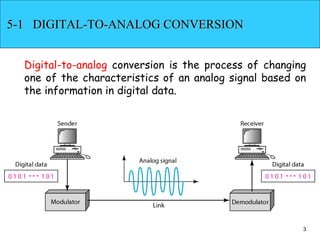
5-1 DIGITAL-TO-ANALOG CONVERSION


  Digital-to-analog conversion is the process of changing
  one of the characteristics of an analog signal based on
  the information in digital data.


                                                        3
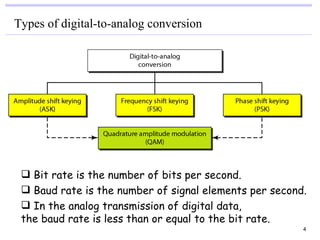
Types of digital-to-analog conversion


  Bit rate is the number of bits per second.
  Baud rate is the number of signal elements per second.
  In the analog transmission of digital data,
 the baud rate is less than or equal to the bit rate.
                                                        4
Example

An analog signal carries 4 bits per signal element.
If 1000 signal elements are sent per second, find the
bit rate.


Solution
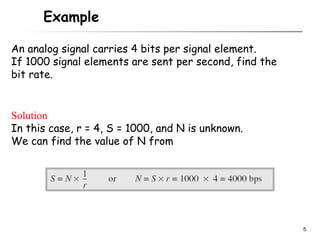
In this case, r = 4, S = 1000, and N is unknown.
We can find the value of N from


                                                        5
Example

An analog signal has a bit rate of 8000 bps and a baud
rate of 1000 baud.
 How many data elements are carried by each signal
element?
 How many signal elements do we need?

Solution
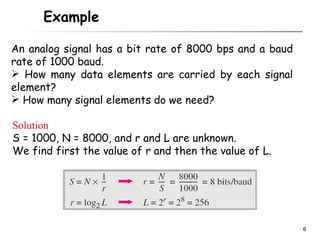
S = 1000, N = 8000, and r and L are unknown.
We find first the value of r and then the value of L.


                                                         6
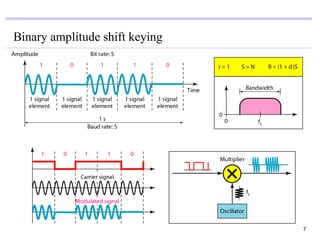
Binary amplitude shift keying


                                7
Example

We have an available bandwidth of 100 kHz which spans
from 200 to 300 kHz.
What are the carrier frequency and the bit rate if we
modulated our data by using ASK with d = 1?

Solution
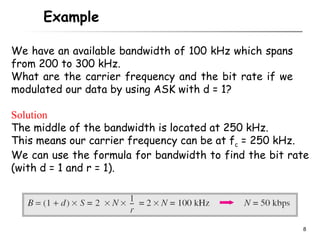
The middle of the bandwidth is located at 250 kHz.
This means our carrier frequency can be at fc = 250 kHz.
We can use the formula for bandwidth to find the bit rate
(with d = 1 and r = 1).


                                                        8
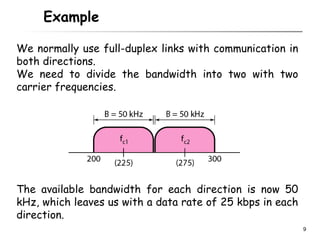
Example

We normally use full-duplex links with communication in
both directions.
We need to divide the bandwidth into two with two
carrier frequencies.


The available bandwidth for each direction is now 50
kHz, which leaves us with a data rate of 25 kbps in each
direction.
                                                           9
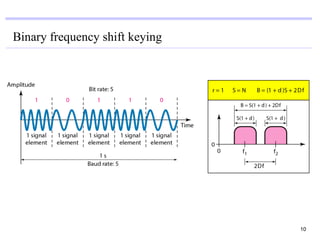
Binary frequency shift keying


                                10
Example

We have an available bandwidth of 100 kHz which spans
from 200 to 300 kHz. What should be the carrier
frequency and the bit rate if we modulated our data by
using FSK with d = 1?

Solution
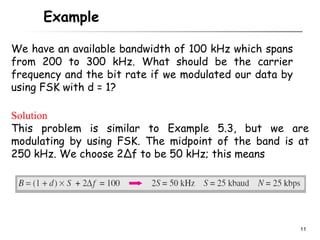
This problem is similar to Example 5.3, but we are
modulating by using FSK. The midpoint of the band is at
250 kHz. We choose 2Δf to be 50 kHz; this means


                                                         11
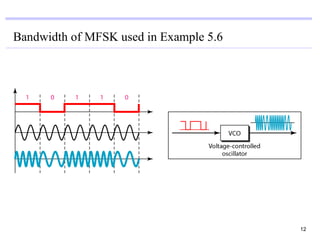
Bandwidth of MFSK used in Example 5.6


                                        12
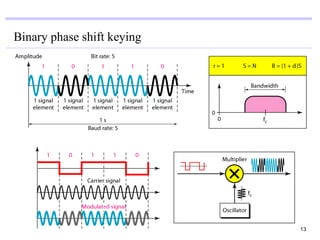
Binary phase shift keying


                            13
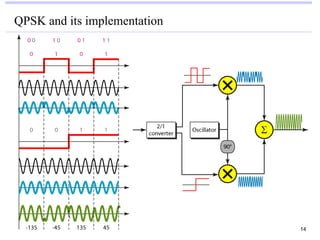
QPSK and its implementation


                              14
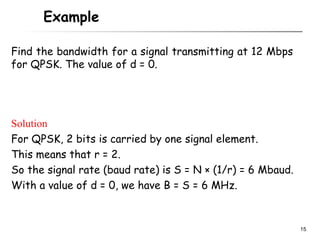
Example

Find the bandwidth for a signal transmitting at 12 Mbps
for QPSK. The value of d = 0.


Solution
For QPSK, 2 bits is carried by one signal element.
This means that r = 2.
So the signal rate (baud rate) is S = N × (1/r) = 6 Mbaud.
With a value of d = 0, we have B = S = 6 MHz.


                                                             15
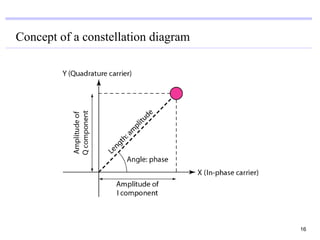
Concept of a constellation diagram


                                     16
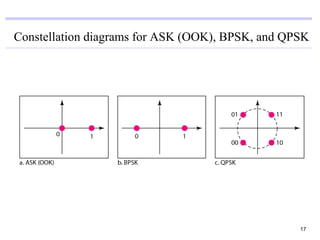
Constellation diagrams for ASK (OOK), BPSK, and QPSK


                                                  17
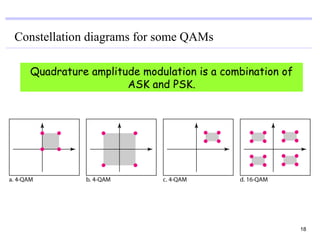
Constellation diagrams for some QAMs

  Quadrature amplitude modulation is a combination of
                    ASK and PSK.


                                                        18
Outline
Ì Chapter 5: Analog Transmission
 5.1 Digital-to-Analog Conversion
   o Amplitude shift keying
   o Frequency shift keying
   o Phase shift keying
   o Quadrature amplitude modulation
 5.2 Analog-to-Analog Conversion
   o Amplitude modulation
   o Frequency modulation
   o Phase modulation


                                       19
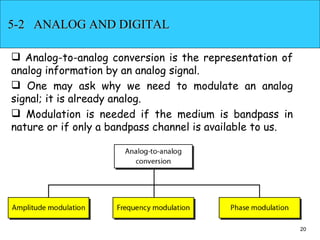
5-2 ANALOG AND DIGITAL

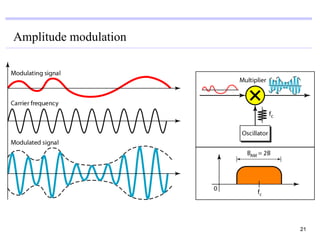
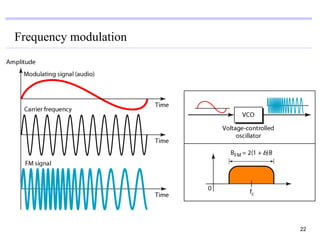
 Analog-to-analog conversion is the representation of
analog information by an analog signal.
 One may ask why we need to modulate an analog
signal; it is already analog.
 Modulation is needed if the medium is bandpass in
nature or if only a bandpass channel is available to us.


                                                           20
Amplitude modulation


                       21
Frequency modulation


                       22

Week5 (chap 5)

  • 1.
    Physical Layer Ch 5:AnalogTransmission
  • 2.
    Outline Ì Chapter 5:Analog Transmission  5.1 Digital-to-Analog Conversion o Amplitude shift keying o Frequency shift keying o Phase shift keying o Quadrature amplitude modulation  5.2 Analog-to-Analog Conversion o Amplitude modulation o Frequency modulation o Phase modulation 2
  • 3.
    5-1 DIGITAL-TO-ANALOG CONVERSION Digital-to-analog conversion is the process of changing one of the characteristics of an analog signal based on the information in digital data. 3
  • 4.
    Types of digital-to-analogconversion  Bit rate is the number of bits per second.  Baud rate is the number of signal elements per second.  In the analog transmission of digital data, the baud rate is less than or equal to the bit rate. 4
  • 5.
    Example An analog signalcarries 4 bits per signal element. If 1000 signal elements are sent per second, find the bit rate. Solution In this case, r = 4, S = 1000, and N is unknown. We can find the value of N from 5
  • 6.
    Example An analog signalhas a bit rate of 8000 bps and a baud rate of 1000 baud.  How many data elements are carried by each signal element?  How many signal elements do we need? Solution S = 1000, N = 8000, and r and L are unknown. We find first the value of r and then the value of L. 6
  • 7.
  • 8.
    Example We have anavailable bandwidth of 100 kHz which spans from 200 to 300 kHz. What are the carrier frequency and the bit rate if we modulated our data by using ASK with d = 1? Solution The middle of the bandwidth is located at 250 kHz. This means our carrier frequency can be at fc = 250 kHz. We can use the formula for bandwidth to find the bit rate (with d = 1 and r = 1). 8
  • 9.
    Example We normally usefull-duplex links with communication in both directions. We need to divide the bandwidth into two with two carrier frequencies. The available bandwidth for each direction is now 50 kHz, which leaves us with a data rate of 25 kbps in each direction. 9
  • 10.
  • 11.
    Example We have anavailable bandwidth of 100 kHz which spans from 200 to 300 kHz. What should be the carrier frequency and the bit rate if we modulated our data by using FSK with d = 1? Solution This problem is similar to Example 5.3, but we are modulating by using FSK. The midpoint of the band is at 250 kHz. We choose 2Δf to be 50 kHz; this means 11
  • 12.
    Bandwidth of MFSKused in Example 5.6 12
  • 13.
  • 14.
    QPSK and itsimplementation 14
  • 15.
    Example Find the bandwidthfor a signal transmitting at 12 Mbps for QPSK. The value of d = 0. Solution For QPSK, 2 bits is carried by one signal element. This means that r = 2. So the signal rate (baud rate) is S = N × (1/r) = 6 Mbaud. With a value of d = 0, we have B = S = 6 MHz. 15
  • 16.
    Concept of aconstellation diagram 16
  • 17.
    Constellation diagrams forASK (OOK), BPSK, and QPSK 17
  • 18.
    Constellation diagrams forsome QAMs Quadrature amplitude modulation is a combination of ASK and PSK. 18
  • 19.
    Outline Ì Chapter 5:Analog Transmission  5.1 Digital-to-Analog Conversion o Amplitude shift keying o Frequency shift keying o Phase shift keying o Quadrature amplitude modulation  5.2 Analog-to-Analog Conversion o Amplitude modulation o Frequency modulation o Phase modulation 19
  • 20.
    5-2 ANALOG ANDDIGITAL  Analog-to-analog conversion is the representation of analog information by an analog signal.  One may ask why we need to modulate an analog signal; it is already analog.  Modulation is needed if the medium is bandpass in nature or if only a bandpass channel is available to us. 20
  • 21.
  • 22.