Personal blogs and social
shaping: a qualitative approach

          ELISABETTA LOCATELLI
  UNIVERSITÀ CATTOLICA DEL SACRO CUORE
                DI MILANO


  @WARM: Workshop on Advanced Research Methods –
          Università “Carlo BO” - Urbino
              30th September 2010
Blogs as User Generated Contents

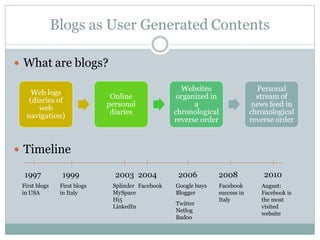
 What are blogs?

                                                     Websites                   Personal
    Web logs
                               Online               organized in                stream of
   (diaries of
                              personal                   a                     news feed in
      web
                               diaries             chronological              chronological
  navigation)
                                                   reverse order              reverse order


 Timeline

  1997           1999           2003 2004           2006         2008             2010
 First blogs    First blogs    Splinder Facebook   Google buys   Facebook        August:
 in USA         in Italy       MySpace             Blogger       success in      Facebook is
                               Hi5                               Italy           the most
                                                   Twitter
                               LinkedIn                                          visited
                                                   Netlog
                                                                                 website
                                                   Badoo
Methodology

   Objectives
       Investigate the microsocial processes of blog appropriation  focus on bloggers (blog owners).
       Understand blogs developement in Italy.


 Qualitative approach, focused on the context of use (Mason, 1996).
 Importance of following users in their practices to understand their “personal economies
  of meaning” (Silverstone - Hirsch 1992).


 Mix of different methodologies, integrated and not “balkanized” (Lievrouw – Livingstone,
  2006)
 Focus onpersonal blogs.
       No triangulation of methodologies (Cardano, 2003) but multi-sited approach (Marcus, 1995).
       Field of research as a “field of relations” (Hine, 2000).
       Researched as a bricoleur (Denzin – Lincoln, 2000).
       Continuous comparison between hypothesis and data  hermeneutic approach and Grounded Theory
        (Glaser, Strauss, 1967).
Methodology


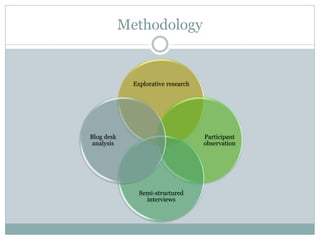
              Explorative research


Blog desk                            Participant
 analysis                            observation


                Semi-structured
                  interviews
Methodology

 (1) Explorative research  follow the “biography of the object”
  (Kopytoff 1992) in USA and Italy
     Culural product as a key for a firts interpretation (Griswold, 1994; Colombo, 2001, 2003
     Articles, essays, books, blogs with blogs history in USA and Italy
     Archive.org
   Identification of three phases in Italian blogsphere (now updating):
         2000: Early blogger
         2003: Creation of Splinder
         2006: Google buys Blogger
         …?
   Need to meet blogger and their practices


 (2) Participant observation at three blogger events:
     VlogEurope, Milan, 18th-19th November 2006
     PiùBlog, Rome, 8th-10th December
     RomeCamp, Rome, 21° January 2007
Methodology

 Enter the field (Hine 2000; Roversi 2001)

 (3) 26 Semi-structured interviews (12
  females e 14 males)
                                                                 Snowball and theoretical
     Privileged instrument for exploring microsocial field of
      blog incorporation into daily practices (Silverstone       sampling;
      1992) and its “subjective meaning” (Roversi 2001) both     Three cities (Milan, Rome;
      at a material and symbolic level.
                                                                 Turin);
     Exploration of feelings, perceptions, and images of blog
      use (also done with the request of drawing their own’s     Divided into the three
      blog image)                                                phases;

 (4) 50 Blog analysis (26 males and 24
  females)
     Textual analysis with a semiotic grid (Cosenza 20062)
Results

 A double structure (Cfr. Hine 2000):
     Artifact
     Context of communication
 Strong interaction between
     Individuals
     Technology
     Social discourse
 Blog as a “boundary object” (Star - Griesemer 1989)
 Blogger as a “processor” able to convert a technological infrastructure in
  social and cultural values (Silverstone - Hirsch 1994)
 Social Shaping of Technology as a theoretical framework for
  comprehending the results.
     MacKenzie e Wajcman 1988
     Bijker et al. 1989
     Bijker 1995
     Fulk 1993; Schneider 2000
Results

 Blog as a “configurational
  technology” (Fleck 1988):
         Its elements are shaped in the context of use
     Interpretive flexibility (Williams – Edge 1996)
         Material (script);
         Symbolical (meaning)
 User as prosumer (Toffler 1987):
   Consume and active production of contents

 Knowledge distribution:
   Horizontal (peer to peer)
   Vertical (groups; “opinion leaders”; experts)

 Closure
   Early blogger and relevant social groups
   Relevant institutional subjects

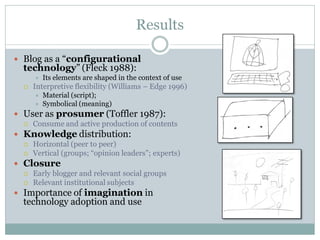
 Importance of imagination in
  technology adoption and use
Going further: social networks

 Two qualitative research on social networks:
      Qualitative analysis (ethnography) of 6 profiles (3 male; 3 females) of
       social networks profiles of social media heavy users (Facebook, Twitter,
       FriendFeed + blog)
      50 telephonic interviews to young adults (19-15 years old) about new
       media appropriation (mobile phone, IM, SN, blog) + social network
       profiles analysis (cfr. www.testimonidigitali.it and Giaccardi 2010
       forthcoming).

 Social networks are similar to blogs:
      Open (although less flexible in some case) structure;
      Need of user to close it;
      Performing elements;
      Role of the institutional subjects in the space definition;
      Relevance of the year of adoption on the meaning attributed to the
       social network.
Methodological issues

 Blog and social networks as both objects and
 instruments of research
    Becoming “friend” of the panel (?)
    Privacy (?)
    Accountability (?)
 Contextualization of profiles and contents
 Focus on subjects
    Mix different methods of research  “Multimodal methodology”
     (Dicks 2006)
 Sample
 What about the relationship between blogs and social
 networks and blogs and mainstream media?
    4° stage of development?
Thanks for your attention
    elisabetta.locatelli@unicatt.it
       theblogup.blogspot.com
  www.facebook.com/elisabettalocatelli
       twitter.com/donnabetta
Bibliography

   Beer D., Burrows R. (2007), “Sociology and, of and in Web 2.0: Some Initial Considerations”, in Sociological
    Research Online, vol. 12, Issue 5, disponibile al sito www.socresonline.org.uk/cgi-
    bin/perlfect/search/search.pl?q=sure&showurl=%2F12%2F5%2F17.html
   Bijker W. E., Pinch T., Hughes T.P. (1989), The Social Construction of Technological Systems, MIT Press,
    Cambridge Mass. - London.
   Blood R. (2002), The Weblog Handbook: Practical Advice on Creating and Maintaining your Blog, Perseus
    Books Group, (trad. it.: Weblog…il tuo diario online, Mondadori, Milano 2003).
   Blood R. (ed.) (2002), We’ve Got Blog: how weblogs are changing our culture, Perseus Books Group.
   Cosenza G. (20082), Semiotica dei nuovi media, Laterza, Roma-Bari.
   Cardano M. (2003), Tecniche di ricerca qualitativa. Percorsi di ricerca nelle scienze sociali, Carocci, Milano.
   Colombo F. (2001), in Colombo F., Farinotti L., Pasquali F., I margini della cultura, Franco Angeli, Milano,
    2001.
   Colombo F. (2003), Introduzione allo studio dei media, Carocci, Roma, 2003.
   Di Fraia G. (a cura di) (2007), Blog-grafie. Identità narrative in rete, Guerini e Associati, Milano.
   Dicks B., Soyinka B., Coffey A. (2006), “Multimodal Ethnography”, in Qualitative Research, vol. 6 (1), 77-96.
   Glaser B. G., Strauss A. L. (1967), The Discovery of Grounded Theory: Strategies for Qualitative Research,
    Aldine Publishing Company, New York,.
   Griswold W. (1994), Cultures and Societies in a Changing World, Pine Forge Press, Thousand Oaks, Cal.,
    (trad. it.: Sociologia della cultura, Il Mulino, Bologna 2005).
   Hine C. (ed.) (2005), Virtual Methods. Issues in Social Research on the Internet, Berg, Oxford,New York.
   Hine C. (2000), Virtual Etnography, Sage, London.
   Jones, S. (ed.) (1999), Doing Internet Research. Critical Issues and Methods for Examining the Net, Sage
    Publications, London et al.
Bibliography

   Kopytoff I. (1992), “The Cultural Life of Things: Commoditization as a Process”, in Appadurai A. (ed.), The
    Social Life of Things. Commodities in a Cultural Perspective, Cambridge University Press, Cambridge.
   Lievrouw L. A., Livingstone S. (2006), Handbook of New Media: Social Shaping and Social Consequences of
    ICTs. Updated Student Edition, Sage, London et al., (trad. it.: Capire i nuovi media, Hopli, Milano 2007).
   MacKenzie D., Wajcman J. (1988), The Social Shaping of Technology: How the Refrigetor got its Hum,
    Milton Keynes, Philadelphia.
   Marcus G. E. (1995), “Ethnography in/of the World System: the Emergence of Multisided Ethnography”, in
    Annual Review of Anthropology, vol. 24, 95-117.
   Mason J. (1996), Qualitative Researching, Sage, London.
   Murthy D. (2008), “Digital Ethnography: An Examination of the Use of New Technologies for Social
    Research”, in Sociology, vol. 42.
   Roversi A. (2001), Chat line: luoghi ed esperienze della vita in rete, Il Mulino, Bologna.
   Salzano D. (2008), Etnografie della rete. Pratiche comunicative tra online e offline, Franco Angeli, Milano.
   Schneider V. (2000), “Evolution in Cyberspace: the Adaptation of NationalVideotext Systems to the Internet”,
    in The Information Society, vol. 16, 319-328.
   Silverstone R., Hirsch E. (eds.) (1992), Consuming Technologies: Media and Information in Domestic Space,
    Routledge, London.
   Star S. L., Griesemer J. R. (1989), “Institutional Ecology, “Translation” and Boundary Objects: Amateurs and
    Professional in Berkeley’s Museum of Vertebrate Zoology, 1907-39”, in Social Studies of Science, Sage, London
    et al, vol. 19, 387-420.
   Williams R., “The Social Shaping of Information and Communications Technologies”, disponibile al sito
    http://www.rcss.ed.ac.uk/SLIM/public/phase1/SSICT.html. Zucca G. (2008), “Limiti e problemi della ricerca
    qualitativa ai tempi del web 2.0: il caso dei blog”, paper discusso durante il convegno AIS - Metodologia il 6-7-
    8 novembre 2008 a Milano.

Personal Blogs and Social Shaping: A Qualitative Approach

  • 1.
    Personal blogs andsocial shaping: a qualitative approach ELISABETTA LOCATELLI UNIVERSITÀ CATTOLICA DEL SACRO CUORE DI MILANO @WARM: Workshop on Advanced Research Methods – Università “Carlo BO” - Urbino 30th September 2010
  • 2.
    Blogs as UserGenerated Contents  What are blogs? Websites Personal Web logs Online organized in stream of (diaries of personal a news feed in web diaries chronological chronological navigation) reverse order reverse order  Timeline 1997 1999 2003 2004 2006 2008 2010 First blogs First blogs Splinder Facebook Google buys Facebook August: in USA in Italy MySpace Blogger success in Facebook is Hi5 Italy the most Twitter LinkedIn visited Netlog website Badoo
  • 4.
    Methodology  Objectives  Investigate the microsocial processes of blog appropriation  focus on bloggers (blog owners).  Understand blogs developement in Italy.  Qualitative approach, focused on the context of use (Mason, 1996).  Importance of following users in their practices to understand their “personal economies of meaning” (Silverstone - Hirsch 1992).  Mix of different methodologies, integrated and not “balkanized” (Lievrouw – Livingstone, 2006)  Focus onpersonal blogs.  No triangulation of methodologies (Cardano, 2003) but multi-sited approach (Marcus, 1995).  Field of research as a “field of relations” (Hine, 2000).  Researched as a bricoleur (Denzin – Lincoln, 2000).  Continuous comparison between hypothesis and data  hermeneutic approach and Grounded Theory (Glaser, Strauss, 1967).
  • 5.
    Methodology Explorative research Blog desk Participant analysis observation Semi-structured interviews
  • 6.
    Methodology  (1) Explorativeresearch  follow the “biography of the object” (Kopytoff 1992) in USA and Italy  Culural product as a key for a firts interpretation (Griswold, 1994; Colombo, 2001, 2003  Articles, essays, books, blogs with blogs history in USA and Italy  Archive.org  Identification of three phases in Italian blogsphere (now updating):  2000: Early blogger  2003: Creation of Splinder  2006: Google buys Blogger  …?  Need to meet blogger and their practices  (2) Participant observation at three blogger events:  VlogEurope, Milan, 18th-19th November 2006  PiùBlog, Rome, 8th-10th December  RomeCamp, Rome, 21° January 2007
  • 7.
    Methodology  Enter thefield (Hine 2000; Roversi 2001)  (3) 26 Semi-structured interviews (12 females e 14 males) Snowball and theoretical  Privileged instrument for exploring microsocial field of blog incorporation into daily practices (Silverstone sampling; 1992) and its “subjective meaning” (Roversi 2001) both Three cities (Milan, Rome; at a material and symbolic level. Turin);  Exploration of feelings, perceptions, and images of blog use (also done with the request of drawing their own’s Divided into the three blog image) phases;  (4) 50 Blog analysis (26 males and 24 females)  Textual analysis with a semiotic grid (Cosenza 20062)
  • 8.
    Results  A doublestructure (Cfr. Hine 2000):  Artifact  Context of communication  Strong interaction between  Individuals  Technology  Social discourse  Blog as a “boundary object” (Star - Griesemer 1989)  Blogger as a “processor” able to convert a technological infrastructure in social and cultural values (Silverstone - Hirsch 1994)  Social Shaping of Technology as a theoretical framework for comprehending the results.  MacKenzie e Wajcman 1988  Bijker et al. 1989  Bijker 1995  Fulk 1993; Schneider 2000
  • 9.
    Results  Blog asa “configurational technology” (Fleck 1988):  Its elements are shaped in the context of use  Interpretive flexibility (Williams – Edge 1996)  Material (script);  Symbolical (meaning)  User as prosumer (Toffler 1987):  Consume and active production of contents  Knowledge distribution:  Horizontal (peer to peer)  Vertical (groups; “opinion leaders”; experts)  Closure  Early blogger and relevant social groups  Relevant institutional subjects  Importance of imagination in technology adoption and use
  • 10.
    Going further: socialnetworks  Two qualitative research on social networks:  Qualitative analysis (ethnography) of 6 profiles (3 male; 3 females) of social networks profiles of social media heavy users (Facebook, Twitter, FriendFeed + blog)  50 telephonic interviews to young adults (19-15 years old) about new media appropriation (mobile phone, IM, SN, blog) + social network profiles analysis (cfr. www.testimonidigitali.it and Giaccardi 2010 forthcoming).  Social networks are similar to blogs:  Open (although less flexible in some case) structure;  Need of user to close it;  Performing elements;  Role of the institutional subjects in the space definition;  Relevance of the year of adoption on the meaning attributed to the social network.
  • 11.
    Methodological issues  Blogand social networks as both objects and instruments of research  Becoming “friend” of the panel (?)  Privacy (?)  Accountability (?)  Contextualization of profiles and contents  Focus on subjects  Mix different methods of research  “Multimodal methodology” (Dicks 2006)  Sample  What about the relationship between blogs and social networks and blogs and mainstream media?  4° stage of development?
  • 12.
    Thanks for yourattention elisabetta.locatelli@unicatt.it theblogup.blogspot.com www.facebook.com/elisabettalocatelli twitter.com/donnabetta
  • 13.
    Bibliography  Beer D., Burrows R. (2007), “Sociology and, of and in Web 2.0: Some Initial Considerations”, in Sociological Research Online, vol. 12, Issue 5, disponibile al sito www.socresonline.org.uk/cgi- bin/perlfect/search/search.pl?q=sure&showurl=%2F12%2F5%2F17.html  Bijker W. E., Pinch T., Hughes T.P. (1989), The Social Construction of Technological Systems, MIT Press, Cambridge Mass. - London.  Blood R. (2002), The Weblog Handbook: Practical Advice on Creating and Maintaining your Blog, Perseus Books Group, (trad. it.: Weblog…il tuo diario online, Mondadori, Milano 2003).  Blood R. (ed.) (2002), We’ve Got Blog: how weblogs are changing our culture, Perseus Books Group.  Cosenza G. (20082), Semiotica dei nuovi media, Laterza, Roma-Bari.  Cardano M. (2003), Tecniche di ricerca qualitativa. Percorsi di ricerca nelle scienze sociali, Carocci, Milano.  Colombo F. (2001), in Colombo F., Farinotti L., Pasquali F., I margini della cultura, Franco Angeli, Milano, 2001.  Colombo F. (2003), Introduzione allo studio dei media, Carocci, Roma, 2003.  Di Fraia G. (a cura di) (2007), Blog-grafie. Identità narrative in rete, Guerini e Associati, Milano.  Dicks B., Soyinka B., Coffey A. (2006), “Multimodal Ethnography”, in Qualitative Research, vol. 6 (1), 77-96.  Glaser B. G., Strauss A. L. (1967), The Discovery of Grounded Theory: Strategies for Qualitative Research, Aldine Publishing Company, New York,.  Griswold W. (1994), Cultures and Societies in a Changing World, Pine Forge Press, Thousand Oaks, Cal., (trad. it.: Sociologia della cultura, Il Mulino, Bologna 2005).  Hine C. (ed.) (2005), Virtual Methods. Issues in Social Research on the Internet, Berg, Oxford,New York.  Hine C. (2000), Virtual Etnography, Sage, London.  Jones, S. (ed.) (1999), Doing Internet Research. Critical Issues and Methods for Examining the Net, Sage Publications, London et al.
  • 14.
    Bibliography  Kopytoff I. (1992), “The Cultural Life of Things: Commoditization as a Process”, in Appadurai A. (ed.), The Social Life of Things. Commodities in a Cultural Perspective, Cambridge University Press, Cambridge.  Lievrouw L. A., Livingstone S. (2006), Handbook of New Media: Social Shaping and Social Consequences of ICTs. Updated Student Edition, Sage, London et al., (trad. it.: Capire i nuovi media, Hopli, Milano 2007).  MacKenzie D., Wajcman J. (1988), The Social Shaping of Technology: How the Refrigetor got its Hum, Milton Keynes, Philadelphia.  Marcus G. E. (1995), “Ethnography in/of the World System: the Emergence of Multisided Ethnography”, in Annual Review of Anthropology, vol. 24, 95-117.  Mason J. (1996), Qualitative Researching, Sage, London.  Murthy D. (2008), “Digital Ethnography: An Examination of the Use of New Technologies for Social Research”, in Sociology, vol. 42.  Roversi A. (2001), Chat line: luoghi ed esperienze della vita in rete, Il Mulino, Bologna.  Salzano D. (2008), Etnografie della rete. Pratiche comunicative tra online e offline, Franco Angeli, Milano.  Schneider V. (2000), “Evolution in Cyberspace: the Adaptation of NationalVideotext Systems to the Internet”, in The Information Society, vol. 16, 319-328.  Silverstone R., Hirsch E. (eds.) (1992), Consuming Technologies: Media and Information in Domestic Space, Routledge, London.  Star S. L., Griesemer J. R. (1989), “Institutional Ecology, “Translation” and Boundary Objects: Amateurs and Professional in Berkeley’s Museum of Vertebrate Zoology, 1907-39”, in Social Studies of Science, Sage, London et al, vol. 19, 387-420.  Williams R., “The Social Shaping of Information and Communications Technologies”, disponibile al sito http://www.rcss.ed.ac.uk/SLIM/public/phase1/SSICT.html. Zucca G. (2008), “Limiti e problemi della ricerca qualitativa ai tempi del web 2.0: il caso dei blog”, paper discusso durante il convegno AIS - Metodologia il 6-7- 8 novembre 2008 a Milano.