EE-3111
ELECTRICAL AND ELECTRONIC
SYSTEMS
INSTRUCTOR
ENGR. NEELAM MUGHEES
Lecture Learning Outcomes
Students will be able to:
 Differentiate Analogue and Digital Electronics
 Explain Logic Gates and its applications
 Discuss Electronics in the Textile Industry
Analogue vs Digital Electronics
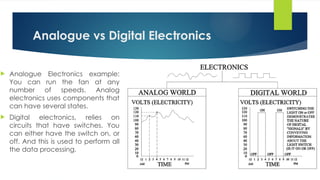
 Analogue Electronics example:
You can run the fan at any
number of speeds. Analog
electronics uses components that
can have several states.
 Digital electronics, relies on
circuits that have switches. You
can either have the switch on, or
off. And this is used to perform all
the data processing.
Analogue vs Digital Electronics
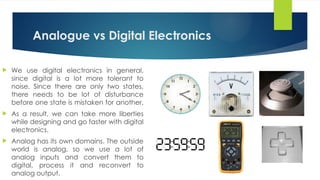
 We use digital electronics in general,
since digital is a lot more tolerant to
noise. Since there are only two states,
there needs to be lot of disturbance
before one state is mistaken for another.
 As a result, we can take more liberties
while designing and go faster with digital
electronics.
 Analog has its own domains. The outside
world is analog, so we use a lot of
analog inputs and convert them to
digital, process it and reconvert to
analog output.
Analogue vs Digital Electronics
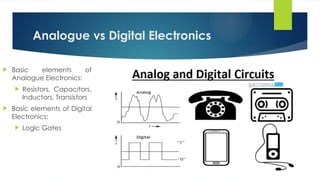
 Basic elements of
Analogue Electronics:
 Resistors, Capacitors,
Inductors, Transistors
 Basic elements of Digital
Electronics:
 Logic Gates
Logic Gates
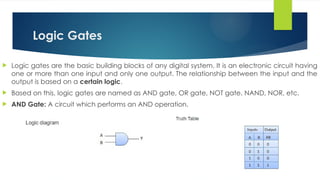
 Logic gates are the basic building blocks of any digital system. It is an electronic circuit having
one or more than one input and only one output. The relationship between the input and the
output is based on a certain logic.
 Based on this, logic gates are named as AND gate, OR gate, NOT gate, NAND, NOR, etc.
 AND Gate: A circuit which performs an AND operation.
Logic Gates
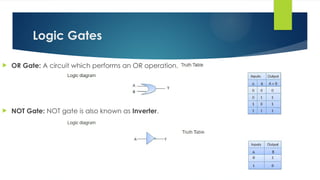
 OR Gate: A circuit which performs an OR operation.
 NOT Gate: NOT gate is also known as Inverter.
Logic Gates
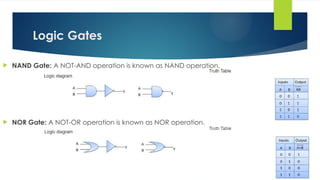
 NAND Gate: A NOT-AND operation is known as NAND operation.
 NOR Gate: A NOT-OR operation is known as NOR operation.
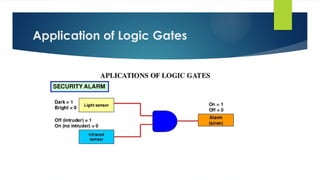
Application of Logic Gates
Introduction to Electronics in Textile
Industry
 In Textile Industry, electronics can be embedded in the fabrics to make them function electrically
and behave physically as textiles. The technology is not visible on the fabric as it is actually
embedded into it. This type of fabrics are known as electronic textiles.
The field of e-textiles can be divided into two main categories:
 1) Laminated e-textiles: The first category involves mounting classical electronic devices such as
conducting wires, ICs, LEDs and conventional batteries into garments.
 2) Embedded e-textiles: The second category involves creating electronic function directly on the
textile fibers. These functions can either be passive such as pure wires, conducting textile fibers, or
more advanced functions such as transistors, diodes and solar cells. The field of embedding
advanced electronic components onto textile fibers is sometimes referred to as fibertronics.
Introduction to Electronics in Textile
Industry
Examples
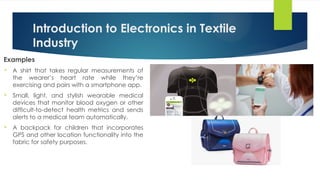
 A shirt that takes regular measurements of
the wearer’s heart rate while they’re
exercising and pairs with a smartphone app.
 Small, light, and stylish wearable medical
devices that monitor blood oxygen or other
difficult-to-detect health metrics and sends
alerts to a medical team automatically.
 A backpack for children that incorporates
GPS and other location functionality into the
fabric for safety purposes.
Introduction to Electronics in Textile
Industry
Examples
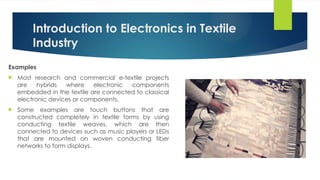
 Most research and commercial e-textile projects
are hybrids where electronic components
embedded in the textile are connected to classical
electronic devices or components.
 Some examples are touch buttons that are
constructed completely in textile forms by using
conducting textile weaves, which are then
connected to devices such as music players or LEDs
that are mounted on woven conducting fiber
networks to form displays.
Introduction to Electronics in Textile
Industry
BENEFITS OF E TEXTILES
 – Flexible
 – No wires to snag
environment
 – Large surface area for
sensing
 – Invisible to others
 – Cheap manufacturing
Electrical properties:
 Conductivity is the most important factor. Electrical
resistance low enough to allow a flow of electric energy,
such as for power or data transmission, is critical. Metal,
carbon, or optical fibers are typically well-known conductors.
 Conductive yarns are either pure metal yarns or composites
of metals and textiles. Metals are superior in strength and
fineness, and textiles are selected for comfort. In order to
produce a successful conductive yarn, the best mix of
conductive and non-conductive materials is critical.
 As a thread takes on a bigger portion of conductive
components, it loses the typical textile properties such as
flexibility or drapability and becomes more conductive. The
achievement in electrical resistance has ranged from 0.2441
ohms per meter (Ω/m) to 5,000 Ω/m
Any Questions?

Week 6 S-25 Electrical and Electronic Systems.pptx

  • 1.
  • 2.
    Lecture Learning Outcomes Studentswill be able to:  Differentiate Analogue and Digital Electronics  Explain Logic Gates and its applications  Discuss Electronics in the Textile Industry
  • 3.
    Analogue vs DigitalElectronics  Analogue Electronics example: You can run the fan at any number of speeds. Analog electronics uses components that can have several states.  Digital electronics, relies on circuits that have switches. You can either have the switch on, or off. And this is used to perform all the data processing.
  • 4.
    Analogue vs DigitalElectronics  We use digital electronics in general, since digital is a lot more tolerant to noise. Since there are only two states, there needs to be lot of disturbance before one state is mistaken for another.  As a result, we can take more liberties while designing and go faster with digital electronics.  Analog has its own domains. The outside world is analog, so we use a lot of analog inputs and convert them to digital, process it and reconvert to analog output.
  • 5.
    Analogue vs DigitalElectronics  Basic elements of Analogue Electronics:  Resistors, Capacitors, Inductors, Transistors  Basic elements of Digital Electronics:  Logic Gates
  • 6.
    Logic Gates  Logicgates are the basic building blocks of any digital system. It is an electronic circuit having one or more than one input and only one output. The relationship between the input and the output is based on a certain logic.  Based on this, logic gates are named as AND gate, OR gate, NOT gate, NAND, NOR, etc.  AND Gate: A circuit which performs an AND operation.
  • 7.
    Logic Gates  ORGate: A circuit which performs an OR operation.  NOT Gate: NOT gate is also known as Inverter.
  • 8.
    Logic Gates  NANDGate: A NOT-AND operation is known as NAND operation.  NOR Gate: A NOT-OR operation is known as NOR operation.
  • 9.
  • 10.
    Introduction to Electronicsin Textile Industry  In Textile Industry, electronics can be embedded in the fabrics to make them function electrically and behave physically as textiles. The technology is not visible on the fabric as it is actually embedded into it. This type of fabrics are known as electronic textiles. The field of e-textiles can be divided into two main categories:  1) Laminated e-textiles: The first category involves mounting classical electronic devices such as conducting wires, ICs, LEDs and conventional batteries into garments.  2) Embedded e-textiles: The second category involves creating electronic function directly on the textile fibers. These functions can either be passive such as pure wires, conducting textile fibers, or more advanced functions such as transistors, diodes and solar cells. The field of embedding advanced electronic components onto textile fibers is sometimes referred to as fibertronics.
  • 11.
    Introduction to Electronicsin Textile Industry Examples  A shirt that takes regular measurements of the wearer’s heart rate while they’re exercising and pairs with a smartphone app.  Small, light, and stylish wearable medical devices that monitor blood oxygen or other difficult-to-detect health metrics and sends alerts to a medical team automatically.  A backpack for children that incorporates GPS and other location functionality into the fabric for safety purposes.
  • 12.
    Introduction to Electronicsin Textile Industry Examples  Most research and commercial e-textile projects are hybrids where electronic components embedded in the textile are connected to classical electronic devices or components.  Some examples are touch buttons that are constructed completely in textile forms by using conducting textile weaves, which are then connected to devices such as music players or LEDs that are mounted on woven conducting fiber networks to form displays.
  • 13.
    Introduction to Electronicsin Textile Industry BENEFITS OF E TEXTILES  – Flexible  – No wires to snag environment  – Large surface area for sensing  – Invisible to others  – Cheap manufacturing Electrical properties:  Conductivity is the most important factor. Electrical resistance low enough to allow a flow of electric energy, such as for power or data transmission, is critical. Metal, carbon, or optical fibers are typically well-known conductors.  Conductive yarns are either pure metal yarns or composites of metals and textiles. Metals are superior in strength and fineness, and textiles are selected for comfort. In order to produce a successful conductive yarn, the best mix of conductive and non-conductive materials is critical.  As a thread takes on a bigger portion of conductive components, it loses the typical textile properties such as flexibility or drapability and becomes more conductive. The achievement in electrical resistance has ranged from 0.2441 ohms per meter (Ω/m) to 5,000 Ω/m
  • 14.

Editor's Notes

  • #2 3.4 Optical Diodes